Introduction: The Growing Need for Energy-Efficient Computing
The quick development of artificial intelligence, cloud computing, data centers, edge computing, and other technologies results in the need for more computing power. Although traditional semiconductor technology allowed achieving significant results in the field of computing power, it faces new challenges associated with high power consumption, heat generation, and low energy efficiency. Data-heavy applications necessitate processors and memory systems capable of processing a huge amount of data, requiring researchers to develop technologies providing enhanced performance without additional energy consumption.
Spintronics, also called spin-based electronics, appears to be one of such solutions. While in traditional electronics, the processing of information uses the motion of electric charges, in spintronics, information processing takes place thanks to the spin and charges of electrons. Therefore, the implementation of spintronics allows for the creation of information processing devices with low energy consumption and possible heat dissipation.
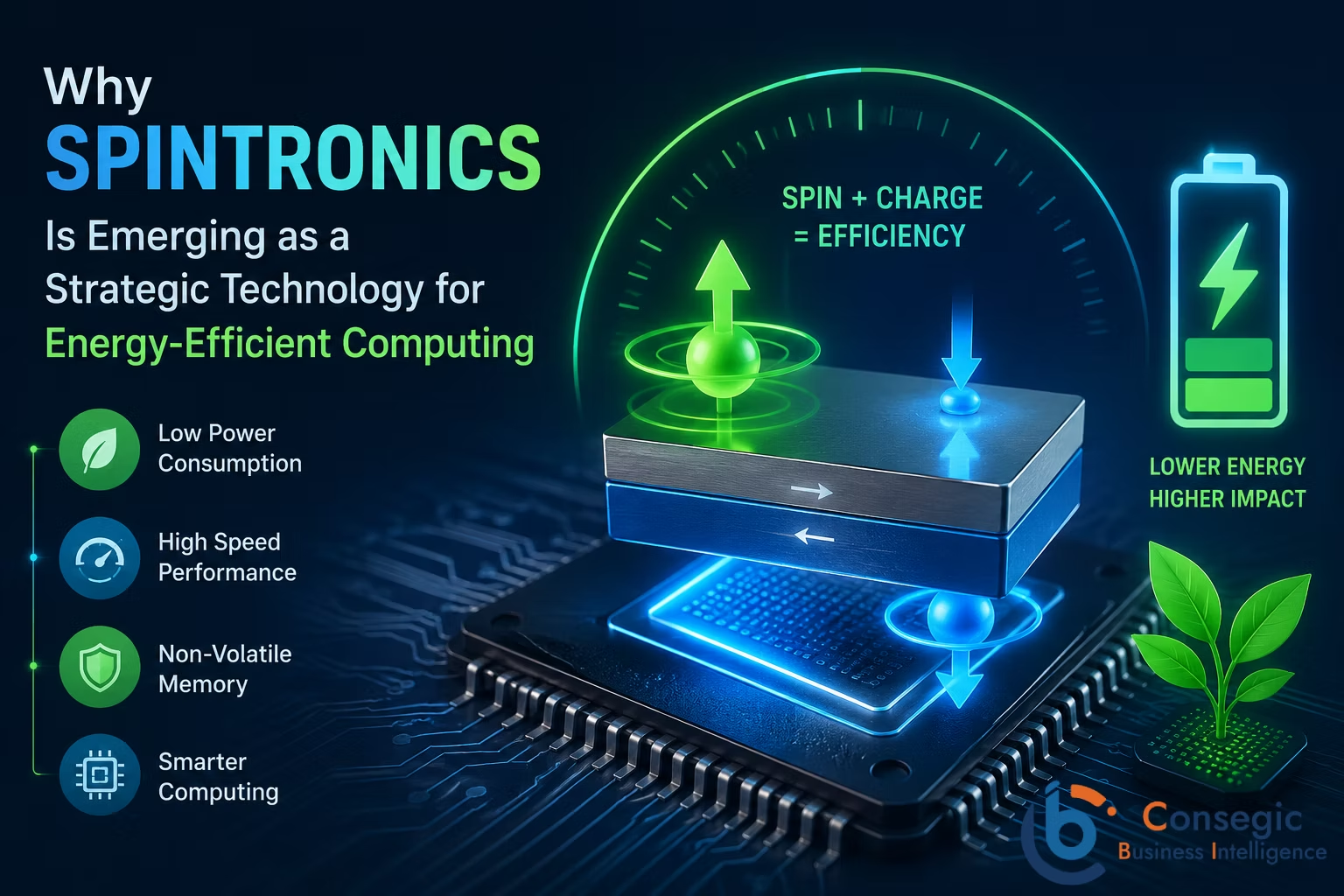
Thus, the significance of spintronics as a strategic technology is growing as companies try to create more sustainable systems of computing. Its applications may include non-volatile memory, data storage, processors, and neuromorphic systems. With further development, spintronics may help in developing computing platforms that will be energy efficient, fast, reliable, and scalable.
Understanding Spintronics and Its Role in Modern Electronics
Spintronics is a technology in the field of electronics in which information storage and transfer are based on the inherent spin of the electron. Unlike the regular electronic devices that store information in terms of electric charge, the spintronics devices can use the electron spin for storing their information. Thus, there are possibilities of developing new electronic devices with unique properties.
The most significant feature of the spintronic approach is the possibility of realizing non-volatile information storage. Magnetic-state-based devices are able to store information without electrical power being applied to them. It can lower the energy needed for information retention and can be helpful for designing efficient computing systems. The magnetic tunnel junctions and spin transfer torque devices show the real possibilities of magnetic state control for memory technologies.
Moreover, spintronic technology can supplement the traditional semiconductor technology and not immediately replace it. Hybrid structures combining traditional transistor-based logic with spin-based memory and processors can become reality in the near future. Such integration of the approaches may help to overcome some problems with high transistor density, energy consumption, and heat dissipation. Thus, spintronics is becoming one of the most important areas of research in future electronics.
How Spin-Based Devices Reduce Energy Consumption
The reason why spintronics technology is gaining prominence is due to its ability to reduce energy consumption during information storage and processing. Traditional computer memory requires energy for information movement, writing, refreshing, and retaining it. The use of spintronic technology helps overcome some of these shortcomings by storing information in magnetic states that do not require continuous energy supply.
In terms of energy-saving computing, non-volatility has many advantages. Information will be retained even when a system is shut down meaning computers will use less energy on data preservation. Increased speed and reduced data movement also play an important role in energy savings of some configurations. This is particularly true for data centers and supercomputing environments in which memory and data transfer consume a large portion of energy.
Another advantage of some spintronic technologies is that they can operate in ways that require low switching energy. The development of spin-transfer torque and spin-orbit torque devices is one example of efforts to achieve this goal. Yet, the energy savings depend on several factors such as device architecture, materials, manufacturing techniques and others. Therefore, current efforts are aimed at improving switching reliability, reducing operating currents and developing appropriate materials.
Spintronics in Memory, Processing, and Data Storage Applications
There is a lot of potential of Spintronics in multiple areas of computing as there is an opportunity to employ spin-based technology for both information storage and processing. One of the best explored domains is the domain of memory. For example, Magnetic Random Access Memory or MRAM stores information in the form of magnetic states and provides non-volatile memory, fast access and high endurance. Such features make spin-based memory attractive for use in different applications including advanced computing systems.
Spintronic technologies might be useful for further developments of processing technologies. There are spin-based logic devices under research which might execute computations independently of conventional charge-based switching. It would be especially beneficial in specialized computing applications when efficiency is more important than the clock frequency.
Data storage is yet another significant application of spintronics. Magnetic-based techniques have been traditionally utilized to store digital data, and innovations in spin-dependent effects may be used to improve data storage methods in terms of increased density and efficiency. Apart from computing applications, spintronics is also applied in neuromorphic computing, which involves the implementation of devices that mimic the properties of biological neurons. These applications could facilitate energy-efficient artificial intelligence by allowing computations near the memory locations, thus eliminating expensive data transfers.
Key Advantages and Challenges of Spintronic Technology
Several advantages of spintronics make it highly strategic technology for future computing needs. The non-volatility is among the strongest features of this technology since the spin memory retains the information without the need for continuous power supply. This can be utilized to minimize the energy spent during stand-by mode operation. The high efficiency of the switching process, high endurance and potentially great scalability capabilities are possible in case of the proper design and materials used.
One of the major advantages can be related to the possibility of tighter integration between memory and computational functions. As the necessity to move the data becomes a major bottleneck in modern computing devices, the spin-based technologies can be complementary to the emerging architectures optimized for artificial intelligence, edge computing, and high performance computing.
Nevertheless, despite these advantages, there are still some barriers to be overcome. The large-scale manufacturing of spintronic devices is associated with the precise control over the advanced magnetic materials and nanodevices. There are issues regarding the efficiency of the switching process, thermal stability of materials, compatibility with other materials and fabrication processes. The process of integration with the CMOS manufacturing is another major challenge for spintronic devices.
The Future of Spintronics in Sustainable and High-Performance Computing
Spintronics' future depends to a great extent on the growing need for computing solutions that combine high performance with lower energy consumption. The growth in artificial intelligence, autonomy, edge computing and big data processing necessitates a reduction in energy consumption. Spintronic innovations could be instrumental by helping create non-volatile memory, improved switches and innovative methods of combining storage and computing.
Advanced materials, improved magnetic architectures and techniques of controlling electron spin are some of the areas in which future innovation would concentrate. The use of spintronics in neuromorphic computing and other architectures is also being considered. This could see spintronic technology applied in processing information more effectively than conventional architectures under certain circumstances. Compatibility with established semiconductor fabrication processes could determine when spintronic technologies find their way into products.
Despite all these efforts in research and innovation, it is doubtful whether spintronic technologies can substitute for conventional electronics in every application in computing. In fact, it is possible that the greatest future impact of spintronics lies in hybrid systems comprising CMOS electronics and spintronics. Nevertheless, investment in R&D and production could increase the impact of the spintronic technology in future computing.
Conclusion
Spintronics is becoming a promising technology for coping with increasing demand for energy-efficient computation. The ability to utilize electron spin in conjunction with electric charge makes it possible to create non-volatile memories, faster access, less energy spent on standby modes, and even decrease energy consumption altogether. The range of its use including MRAM, data storage, computation, and neuromorphic computing only confirm its versatility. Nevertheless, problems concerning the complexity of manufacturing processes, switching, heat dissipation, materials, and integration with CMOS should be solved. Instead of being an alternative to existing semiconductor technologies, spintronics is destined to work alongside with them in hybrid designs. Further research, investments, and advances in material science may lead to spintronic solutions for sustainable, scalable, reliable, and fast computation systems.