Why Supply Chain Security Matters in a Connected World?
The contemporary supply chains are highly interlinked, complicated and rely heavily on the flow of goods, information and money. Starting from raw material suppliers, manufacturers, warehousing organizations and all the way up to retailers and customers - each one is interconnected with another one in the chain. In spite of the benefits from the interconnection that allows saving resources and being more efficient, there are numerous chances for possible security threats. They might be such as theft, cyberattacks, fraud, unauthorized access, tampering of cargo and disruption of supplies.
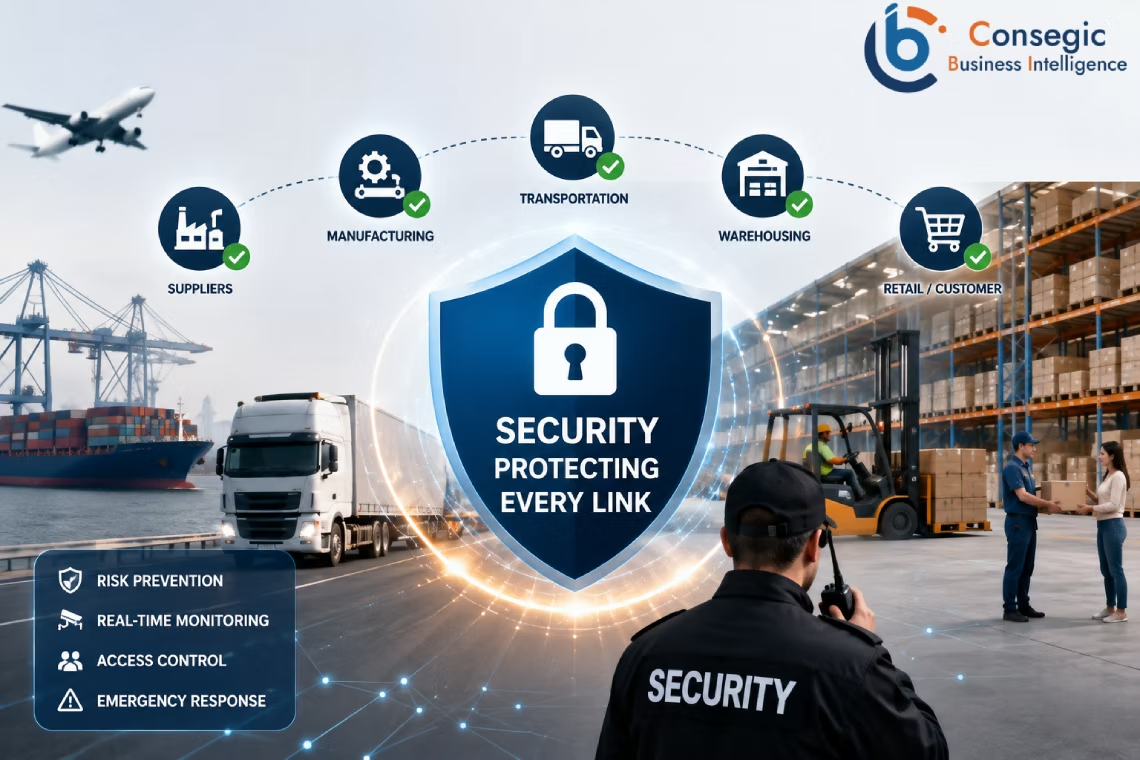
Security services can play their role in ensuring the security of the interconnections. The professionals in physical security, surveillance systems, cybersecurity solutions, access control technologies and risk management services might help the organizations in identifying potential vulnerabilities and threats. Also, efficient security will ensure the safety of the valuable inventory, confidential business information, staff members and critical infrastructure.
With the increasing implementation of digital platforms, automatization and IoT systems into the supply chains, it will be necessary to take into consideration both physical and digital security of the processes. Proper security will help organizations ensure their continuity and protect valuable assets.
The Growing Security Risks Facing Modern Supply Chains
In the modern business environment, supply chains have various types of security threats that can be caused by internal and external factors. Theft of cargo is one of the biggest threats that can occur during the shipment and storage process. In this case, criminals may steal expensive products, break into warehouses using weak controls, and fake ship documents to get access to the products. Moreover, supply chains can suffer from threats such as the actions of employees, fraud, counterfeits, and unauthorized movements of the inventory.
However, nowadays, there are cybersecurity threats associated with the digitalization of businesses. For example, supply chain management software, sensors, IoT technology, cloud-based systems, and networks can become a target for such types of attacks as ransomware, phishing, data theft, and many others. One cyber-attack can harm several firms that use the same network as the supplier.
Natural disasters, geopolitical events, shortage of labor force, and infrastructure failures are additional security threats to supply chains. Therefore, security services should not only monitor the premises but also provide risk assessment, threat monitoring, incident response, identification and verification, and cooperation. It is crucial to know about security threats because it will allow developing preventive measures.
How Security Services Protect Logistics, Warehouses, and Transportation?
Security services ensure the safety of all physical locations associated with supply chain management such as warehouses, distribution centers, transport network, and others. Security staff may observe facilities, check people entering there, control access, and react to suspicious behavior. These actions will help to avoid unauthorized entrance, stealing, damage, and interference with cargo.
Surveillance cameras, alarm system, perimeter observation, and access-control systems can be also used by warehouses in order to increase physical protection. In real time security services are able to detect any strange activity and prevent its further development. At the stage of transport, companies can use various technologies of cargo tracking.
Loading and unloading can be secured by security services as well. Checking of documentation about shipment, inspection of vehicle, and record of authorized personnel can reduce frauds. High-value or special cargoes may require additional measures of protection such as monitoring of delivery route and special security teams.
With the help of trained specialists and new security technologies, organizations can make many layers of protection. This approach will help to protect inventory, physical assets, personnel, and transport while providing shipment of goods from suppliers to customers.
The Role of Technology in Strengthening Supply Chain Security
Technological developments have started to play a significant role in securing supply chains. Modern corporations tend to leverage artificial intelligence, Internet of Things (IoT) devices, video monitoring, GPS tracking, biometric verification, digital access control, and cloud-based systems in order to observe activities in their company and recognize any security risks.
Sensors, which may be part of IoT devices, may monitor location, temperature, movements, and other environmental conditions. Deviations may trigger alerts in order to help the company to check for any incidents of theft or product tampering or damages. The same goes for GPS tracking, which gives information about vehicles and cargo and allows detecting any deviation from the route.
Artificial intelligence and big data analysis could help the company to analyze the information obtained in order to find abnormalities in the operations. Video analytics can assist in monitoring any suspicious activities in the facility.
However, technology must not run in isolation. Corporations require security specialists who will be able to analyze the alarms and make necessary decisions. In this way, the integration of technology and human expertise will help companies enhance their security posture and achieve greater visibility and protection.
Preventing Supply Chain Disruptions Through Risk Management and Monitoring
Effective risk management is a critical step to prevent security issues from becoming the source of a significant disruption of the supply chain. Businesses need to continuously assess their suppliers, transportation, storage, technologies, and processes to identify any possible weakness that can lead to security issues. Security services can help with such assessments using the audits, inspections, monitoring, vulnerability assessment, and incident analysis.
Monitoring on a regular basis can help companies detect abnormal activity. Abnormal shipment delay, unauthorized access attempts, route changes, or abnormal activity of the inventory can be the signs of security issues and should be investigated further. Early detection provides opportunities to react in a timely way before the problem grows bigger.
Security providers can also assist in preparing the emergency and business continuity plans in order to provide a plan of actions to be taken in case of any incident, including theft, cyber-attacks, facility security issues, or transport security. Training can help to ensure that all employees know how to react.
Proactive measures tend to be much more efficient than reactive measures. A combination of risk assessment, monitoring system, training, and plans of action can help to ensure the continuity of operations and business.
The Future of Security Services in Resilient Supply Chain Management
In the future, the security of supply chains will include integration of physical security, cybersecurity, big data analytics, and surveillance automation. In order to protect physical assets and digital infrastructure in view of the increasing digitization and connectivity of supply chains, organizations will have to adopt security solutions that will use artificial intelligence, predictive analytics, connectivity of sensors, automation, and surveillance to detect any possible threats more effectively.
A further development will relate to increased collaboration between manufacturers, logistics companies, suppliers, technologists, and security experts. Since vulnerabilities can transfer through the network, protection of one firm can prove insufficient. Sharing information about security and setting up security standards can improve the situation.
Despite all technological advances and automation, the importance of human knowledge will not disappear. Security specialists will still be required to investigate cases, analyze risks, cope with emergencies, and make decisions in accordance with real conditions.
Thus, to implement successful supply chain security, a multilayered and proactive approach will be necessary. The combination of technologies, competent specialists, regular monitoring, risk evaluation, and readiness will help to increase supply chain resilience. Effective security services can turn into the basis of supply chain continuity and further growth.
Conclusion
With time, security services have grown to be an integral part of securing modern supply chains from potential physical, cyber, and operational attacks. As modern supply chains become more connected than ever before, companies should embrace a multi-faceted approach, which entails employing security officers together with modern technologies like artificial intelligence, internet of things, surveillance cameras, monitoring and tracking systems, and access control systems. Through regular risk assessment, constant monitoring, training employees, and formulating emergency plans, organizations will be able to recognize potential weaknesses in their operations and mitigate the effects. In addition, collaboration between suppliers, logistics companies, manufacturers and security personnel may improve the level of security along the entire supply chain.