Top Business Trends in 2026: Future Insights Every Entrepreneur Must Know
Entrepreneurs stepping into 2026 are navigating a strange mix of pressure and possibility. Growth has cooled, costs remain stubborn and trade policy is hard to predict, yet the tools available to a small business owner have never been more powerful or more affordable. The winners this year won't be the companies with the biggest budgets- they'll be the ones that read the shifts correctly and act on them early.
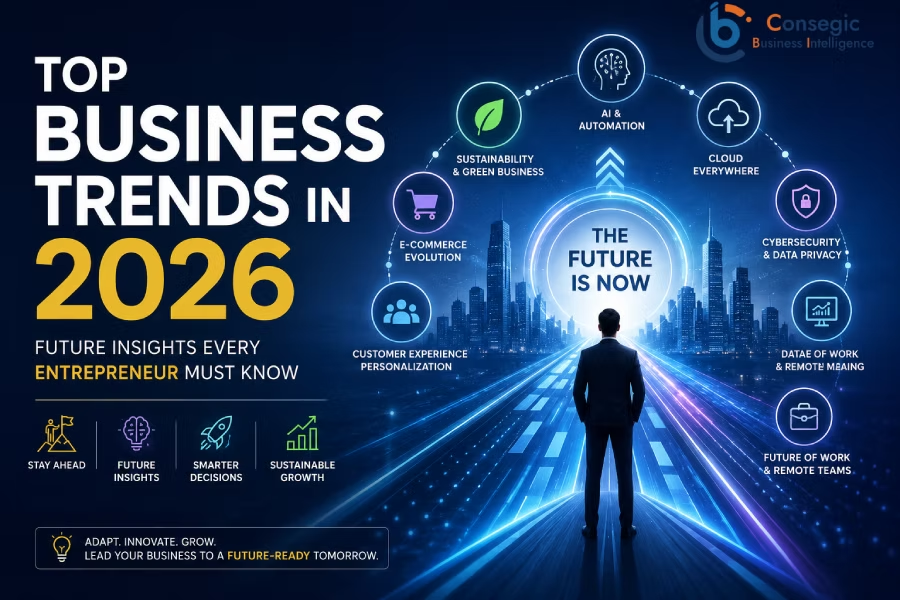
Here's what's actually shaping business in 2026 and what it means for you.
What Are the Business Trends 2026 Entrepreneurs Can't Ignore?
Seven shifts stand out above the noise this year: agentic AI moving into real operations, AI skills becoming a baseline hire requirement, digital trust as a competitive asset, sustainability shifting from marketing to performance, small businesses closing the customer experience gap, leaner and more disciplined growth and geopolitical or climate-driven supply chain risk. Each one is explored below.
- Agentic AI Moves from Experiment to Operations
If 2025 was talking about AI, 2026 is about proving it works. Businesses are no longer asking whether to adopt AI agents- they're asking how fast they can scale the ones already running. Agents that can plan, reason and execute multi-step tasks without constant supervision are now active in sales, customer service, logistics and finance functions across companies of every size.
The catch is that adoption is outpacing integration. Many organizations are running a dozen or more AI agents, but a large share of them operate in isolation rather than as a coordinated system. The entrepreneurs who win this round won't just deploy agents- they'll connect them, using emerging standards for agent-to-agent communication so that a customer service bot, a sales assistant and an inventory tool can actually talk to each other. For small businesses, the message is simple: an unconnected pile of point solutions is wasted potential. Map your workflows first, then layer in agents that close real gaps rather than create new ones.
- AI Literacy Becomes a Core Business Skill
Small business AI adoption has gone mainstream. A growing majority of small businesses now use generative AI in daily operations, up sharply from just a couple of years ago and most owners report active investment in AI tools rather than one-off experiments. AI-powered chatbots and virtual assistants are increasingly standard for customer service, content creation and data analysis- tasks that once required dedicated staff or expensive agencies.
This shift is also reshaping hiring. Workers with demonstrated AI skills are commanding meaningful wage premiums and many companies are building internal training programs rather than waiting to hire externally, since qualified talent is scarce and slow to find. For entrepreneurs, this means treating AI fluency as a baseline competency for new hires and investing in upskilling current staff rather than treating AI as a side project for one tech-savvy employee.
- Digital Trust Becomes the New Currency
As digital transformation spending climbs into the trillions globally, trust itself has become a competitive asset. Banks, investors, partners and customers increasingly decide who to work with based on how well a company can demonstrate financial, operational and data integrity- not just on price or product. Cybersecurity spending is rising in parallel, reflecting how central digital trust has become to staying in business at all.
It's the stuff that visible, verifiable systems are more persuasive than promises to entrepreneurs. Transparent data policies, security procedures, financial controls- they're no longer merely the "housekeeping" tasks of the back office, they are part of how to win business and support customers who are no longer accepting the claims without verification.
- Sustainability Shifts from Marketing Story to Operating Model
Sustainability has quietly moved from a branding exercise to a genuine driver of purchasing decisions and operational savings. A large majority of consumers say they actively look for environmental information before buying and many are willing to pay more for products that align with their values. But the businesses succeeding with this trend aren't selling virtue they're selling performance: products that last longer, cost less to run, and solve real customer problems while reducing waste along the way.
Circular economy practices- reuse, resale, refurbishment, and closed-loop supply chains- are becoming embedded in core business models rather than treated as side initiatives. Entrepreneurs who can build sustainability into product design and sourcing and communicate it with specific, unembellished claims rather than broad green branding, are positioned to capture customer loyalty that's proving more durable than regulatory mandates.
- Customer Experience Becomes a Structural Advantage for Small Business
Bigger budgets used to mean better customer experience. That advantage is eroding. Smaller, nimbler businesses now have access to the same AI-driven personalization and service tools that once required enterprise resources and customer-centric brands are seeing significantly higher profits and retention than competitors who treat experience as an afterthought.
The opportunity for entrepreneurs is to lean into responsiveness and personal touch- qualities small businesses have always had- and pair them with AI tools that handle routine inquiries, follow-ups and personalization at a scale that used to be impossible without a large team.
- Lean Operations and Disciplined Growth
Geopolitical risk and the disruption caused by the changing climate have been cited as key risks for business operations in 2026. The price of commodities, such as coffee, cocoa and grain which many businesses rely on for their supply chain, have been wildly unstable and will likely remain so with business owners should anticipate instability and design for diversification and flexible pricing with suppliers, rather than viewing disaster as an infrequent anomaly.
- Geopolitical and Climate Risk Demand Real Contingency Planning
Geopolitical risk and the disruption caused by the changing climate have been cited as key risks for business operations in 2026. The price of commodities, such as coffee, cocoa and grain which many businesses rely on for their supply chain, have been wildly unstable and will likely remain so with business owners should anticipate instability and design for diversification and flexible pricing with suppliers, rather than viewing disaster as an infrequent anomaly.
Emerging Business Trends 2026: What's Still Forming
Beyond the seven trends above, a few emerging business trends 2026 are worth watching even though they haven't fully matured yet. Multi-agent AI systems that coordinate across departments are still in early stages for most companies, regulatory frameworks for AI governance are being written in real time and circular economy infrastructure- resale platforms, repair networks, materials recovery- is still being built out rather than fully scaled. None of these are guaranteed to dominate the year, but each is gaining momentum fast enough that entrepreneurs should track them alongside the core trends.
The Bottom Line
There's no single trend that will define 2026- it's the combination of smarter AI adoption, visible trust-building, performance-driven sustainability and disciplined cost management that separates the businesses pulling ahead from those merely reacting.
Entrepreneurs who treat these shifts as immediate operational priorities, not distant forecasts, will be the ones still standing and growing when the year is behind us.