In today’s fast-evolving energy and logistics landscape, Terminal Management Systems (TMS) play a crucial role in optimizing operations across oil, gas, and chemical terminals. As global trade intensifies and environmental regulations become more stringent, terminals are under pressure to enhance efficiency, safety, and transparency. This is where TMS solutions have emerged as an essential technology, integrating various terminal processes through automation, digitalization, and real-time data management.
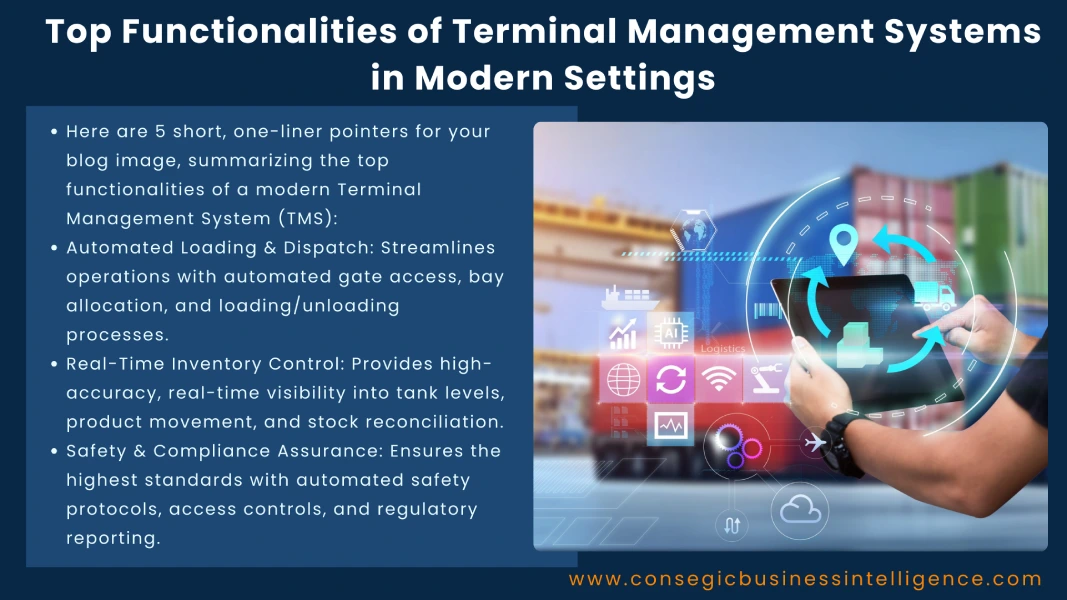
Modern terminal management systems are designed to streamline inventory control, loading operations, order management, and compliance monitoring, ensuring that terminal operators can achieve optimal productivity while maintaining safety and environmental standards. By replacing traditional manual systems with intelligent digital platforms, businesses can manage complex workflows with greater accuracy and reliability.
This blog explores the top functionalities of terminal management systems that are transforming modern fuel, chemical, and bulk terminals into efficient, connected, and data-driven facilities.
- Streamlined Inventory and Product Management
One of the primary functions of a Terminal Management System is inventory management. In industries where even minor discrepancies can lead to significant financial loss, having accurate visibility over stock levels is critical.
TMS platforms provide real-time tracking of stored products such as crude oil, refined fuels, chemicals, and liquefied gases, along with detailed information on product grades and quantities. These systems automatically record inflow and outflow movements, detect discrepancies, and generate digital reports for auditing purposes.
Advanced TMS solutions also integrate with tank gauging systems and flow meters, allowing operators to monitor temperature, density, and volume data in real time. This integration helps minimize manual intervention and ensures product accuracy throughout the terminal.
By providing instant access to inventory data, terminal operators can make informed decisions regarding scheduling, product transfers, and customer deliveries, boosting operational reliability and profitability.
- Automation of Loading and Unloading Operations
Another key functionality of TMS is the automation of loading and unloading processes for trucks, railcars, and marine vessels. Traditionally, these operations involved manual coordination between field operators and control rooms, which often led to delays and safety risks.
Modern systems enable automated batch control, vehicle identification, and load authorization, reducing human error and improving turnaround times. Through integration with weighbridges, loading arms, and safety interlocks, TMS ensures that loading operations are executed within approved parameters.
For instance, when a vehicle arrives at the terminal, its credentials and load order are verified digitally. Once authorized, the system automatically controls valves and pumps to deliver the correct product quantity. The entire process from check-in to exit is recorded electronically, ensuring complete traceability.
This automation not only enhances efficiency but also ensures safety compliance, particularly in hazardous environments where precision and control are essential.
- Secure Access Control and Vehicle Management
Managing the movement of vehicles within a terminal is a complex task, especially at high-traffic sites. TMS platforms offer integrated gate access control and vehicle management functionalities that streamline entry, loading, and exit operations.
Using RFID tags, license plate recognition, or smart cards, vehicles can be automatically identified at terminal gates. The system cross-checks driver and vehicle credentials, verifying safety training records, permits, and load authorization before granting access.
This secure access system minimizes congestion and eliminates manual paperwork. Once inside, TMS directs the vehicle to designated loading or unloading bays based on product type and availability.
By combining vehicle scheduling and route optimization, modern TMS ensures a seamless flow of operations, improving terminal throughput and safety standards while reducing idle time and emissions.
- Integration with ERP and Business Systems
In modern industrial environments, operational efficiency depends on seamless data flow between terminal systems and enterprise platforms. TMS solutions are designed to integrate with ERP, supply chain, and customer management systems, ensuring end-to-end visibility across business operations.
This integration enables automatic synchronization of orders, invoices, and delivery data, reducing administrative workload and improving accuracy. When an order is placed in the ERP system, the TMS can automatically generate a load plan, schedule resources, and update inventory records after dispatch.
Such connectivity ensures that both field operators and business managers have access to consistent, real-time information, facilitating better decision-making and faster response times.
With ERP integration, terminals also benefit from enhanced financial control, enabling automated billing, accurate revenue tracking, and compliance with corporate reporting standards.
- Enhanced Safety and Compliance Monitoring
Safety and environmental compliance are top priorities in terminal operations, particularly when handling flammable or hazardous materials. Modern TMS solutions incorporate safety interlocks, emergency shutdown systems, and environmental monitoring tools to minimize risks.
The system continuously tracks safety parameters such as pressure levels, product temperatures, and gas leak detection to prevent accidents. It also ensures compliance with industry standards like API, OSHA, and ISO, automatically logging events and generating compliance documentation.
Additionally, TMS software allows operators to conduct digital safety checks and training verifications before authorizing loading operations. Real-time alerts notify supervisors in case of irregularities, enabling immediate corrective actions.
These safety-driven features not only protect assets and personnel but also reinforce the terminal’s reputation for reliability and regulatory compliance.
- Real-Time Reporting and Analytics
Data-driven decision-making is at the heart of modern terminal operations. TMS platforms provide comprehensive reporting and analytics dashboards that display real-time information on inventory, loading operations, vehicle traffic, and energy consumption.
Through predictive analytics, operators can forecast demand, identify bottlenecks, and optimize maintenance schedules. Historical data analysis helps detect trends and inefficiencies, allowing continuous improvement in operational performance.
Some advanced systems even integrate with AI and machine learning tools to predict equipment failures or detect anomalies before they impact operations. This proactive approach not only minimizes downtime but also extends asset lifespan and reduces operational costs.
By transforming raw data into actionable insights, TMS empowers managers to make timely, informed decisions that align with business goals.
- Remote Accessibility and Cloud-Based Operations
With the rise of digital transformation, many terminal operators are adopting cloud-based TMS platforms that provide remote access to data and control functionalities. This enables supervisors and decision-makers to monitor terminal operations in real time, regardless of location.
Cloud integration allows for multi-terminal management, ensuring centralized control over geographically distributed facilities. Remote accessibility also enhances collaboration among teams and ensures business continuity, even in challenging circumstances such as system outages or travel restrictions.
The combination of mobility, security, and scalability offered by cloud-based systems is making TMS a vital component of the next-generation terminal infrastructure.
Conclusion
The evolution of Terminal Management Systems reflects the ongoing digital transformation within the energy and logistics industries. From real-time inventory tracking and automated loading to AI-powered analytics and sustainability integration, modern TMS solutions have become indispensable for terminal operators seeking operational excellence.
By centralizing control, enhancing safety, and improving data visibility, these systems are enabling terminals to operate with greater efficiency, compliance, and profitability. As industries continue to adopt automation and cloud technologies, the role of TMS will only grow stronger, driving the shift toward smart, sustainable, and interconnected terminal operations worldwide.
FAQs about Terminal Management System Market:
- What is the market size of Terminal Management System Market?
Terminal Management System Market size is estimated to reach over USD 1,798.27 Million by 2032 from a value of USD 1,140.30 Million in 2024 and is projected to grow by USD 1,186.80 Million in 2025, growing at a CAGR of 5.9% from 2025 to 2032. - What is a Terminal Management System (TMS)?
A Terminal Management System is a digital platform that automates and integrates operations across oil, gas, and chemical terminals to enhance efficiency, safety, and compliance. - How does a TMS improve inventory management?
TMS provides real-time tracking of product quantities, temperature, and flow, ensuring precise inventory control and reducing manual errors or discrepancies. - Why is ERP integration important in Terminal Management Systems?
ERP integration into terminal management systems is important because it enables seamless synchronization of orders, billing, and inventory data, improving operational transparency and business decision-making. - How does TMS enhance safety and regulatory compliance?
TMS continuously monitors critical safety parameters, automates emergency responses, and ensures adherence to industry standards like API and OSHA.