Introduction: The Future of ICT
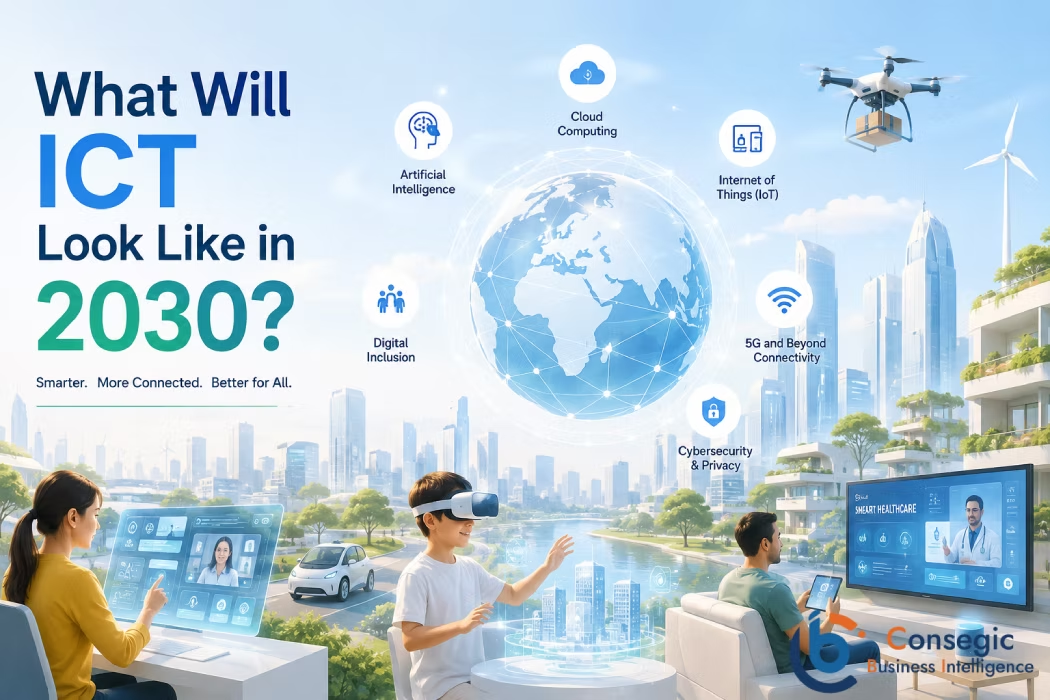
ByBy 2030 Information and Communication Technologies (ICT) will be more advanced, and more connected and smarter than ever before. Today, a lot of innovations such as smart phones, cloud computing, artificial intelligence (AI), the Internet of things (IoT) and 5G networks have begun transforming the process of the people's communication, working, learning and delivery of services. By 2030, these innovations will become even more integral parts of people's daily lives. ICT will not just serve the purpose of connection but also enable intelligent decisions, automation and real-time services through its fast networks, efficient computing systems and large scale data processing. On top of all, ICT is expected to contribute significantly to the operation of various other industries including health care, education, manufacturing, agriculture, transport, banking, and entertainment among others. With the proliferation of connected devices, there will be huge amount of data generated which will further emphasize on the need for cybersecurity and privacy measures. Therefore, ICT by 2030 will likely be more intelligent, personalized, automated, and accessible in addition to being filled with new opportunities and challenges.
AI and Automation Transforming ICT
Artificial intelligence and automation technologies will be among the most significant elements of ICT in 2030. They will be able to analyze huge amounts of information, find patterns, predict events, and assist in making difficult decisions. Companies can take advantage of such tools as part of their activities related to customer service, marketing, cybersecurity, data analysis, recruiting, and forecasting of business development. In addition, automation will allow for decreasing the necessity of human participation in routine and time-consuming tasks. Intelligent software, robots, and automation processes will become more widespread in areas like manufacturing, logistics, healthcare, and finance. AI assistants will become even more advanced and able to understand natural language and help customers. Moreover, generative AI will continue developing and allow people to create texts, images, videos, software, and other digital content. Nevertheless, there will be such problems as job replacement, discrimination, spread of misinformation, and unethical use of people's data associated with the development of AI. Therefore, companies should have relevant policies concerning artificial intelligence. ICT environments that will be the most effective in 2030 will be those where people's creativity and judgment are combined with efficiency of AI.
6G, IoT, and Hyperconnected Networks
By the year 2030, communication networks will have developed to be even faster, reliable, and intelligent. Even as the world becomes connected by 5G network technology currently, future 6G research and development will make connectivity even more advanced within the next decade. With sophisticated networks, extremely low latency, increased capacity, and support for large amounts of interconnected devices may be realized. This will facilitate the expansion of the Internet of Things (IoT) whereby regular objects such as vehicles, household appliances, industrial machinery, medical equipment, and smart-city infrastructure will communicate with each other. Within manufacturing industries, machines will be interconnected and able to relay information regarding their performances and production process. In smart cities, the use of interconnected sensor technology will help to better manage traffic, energy consumption, waste collection and other utilities. In the health sector, connected equipment will aid in monitoring patients and relaying information to health experts. The world will therefore become increasingly connected where data will move seamlessly among people, machines, and organizations. Increased connectivity will however make cybersecurity a serious threat requiring sophisticated network security, encryption, authentication, and privacy in ICT infrastructure by the year 2030.
Cloud Computing, Edge Computing, and Data Security
Cloud computing will be among the most prevalent ICT in 2030, where both individuals and firms would have access to computing resources, applications, storage and data through the use of internet-based services. In future, instead of relying on physical infrastructure, organizations will have the ability to increase their digital resources based on their needs. However, an increase in the number of connected devices will necessitate edge computing solutions. The process involves processing the data closer to where it was generated rather than moving it to far-flung data centers. It helps improve application performance by reducing latencies for the applications that depend on real-time processing such as autonomous cars, industrial automation, smart health care and connected infrastructure. Cybersecurity and data privacy will become crucial in the coming years. With the increasing number of connected devices, governments and organizations will deal with huge amounts of personal, financial, business and operational data that can attract cyber criminals. In 2030, firms are likely to embrace advanced technology that includes AI-powered threat detections, enhanced data encryption, zero trust security model and continuous monitoring to enhance cybersecurity.
The Impact of ICT on Businesses and Everyday Life in 2030
ICT is expected to have an impact on almost all spheres of business and everyday life by 2030. Workplaces can become even more advanced by implementing virtual collaboration, virtual assistants, cloud computing, and advanced forms of communication. Companies will use big data and artificial intelligence for the analysis of customers’ behavior and needs, supply chain management, increasing productivity and decision making. Digital classrooms, customized learning platforms, virtual laboratories and AI tutors can also support the educational process. Healthcare might have remote patient monitoring, connected medical devices, electronic records and assisted AI-based diagnosis. Sensors, drones, satellite imagery and automated machinery can be used in agriculture to improve crop management and the efficiency of use of resources. At the same time, consumers may experience smart homes, connected vehicles, electronic money transfers and digital tailored services. It is also possible that not all people will have equal access to these advantages. Internet access, level of skills, affordability, and technology infrastructure may exacerbate the digital gap. Consequently, the development of ICT should not be only about the growth of the industry but also about the accessibility, affordability, digital literacy, privacy, and sustainable innovation. By 2030, ICT can become the basis of societies.
Conclusion
ICT is predicted to become much smarter, more connected, more automated, and vital by the year 2030. Technologies such as artificial intelligence, 6G, IoT, cloud computing, edge computing, and enhanced cybersecurity will change the way organizations, governments, and people interact and conduct business. These advancements could help increase the efficiency of healthcare, education, transport, agriculture, as well as many other industries through the creation of innovative and economically profitable opportunities. On the other hand, the swift development of ICT may come with such challenges as cyber threats, data breaches, automation of jobs, disinformation campaigns, and the digital divide. Thus, sustainable development and accessibility of technology will be necessary.