The global xylene market is witnessing significant momentum, driven by growing demand across chemical, petrochemical, and industrial manufacturing sectors. Xylene, a colorless aromatic hydrocarbon derived from petroleum or coal tar, plays a crucial role as a solvent and feedstock in the production of key chemical intermediates. Its three isomeric forms ortho-xylene, meta-xylene, and para-xylene, each serve distinct industrial applications, ranging from polyester production to coatings and adhesives.
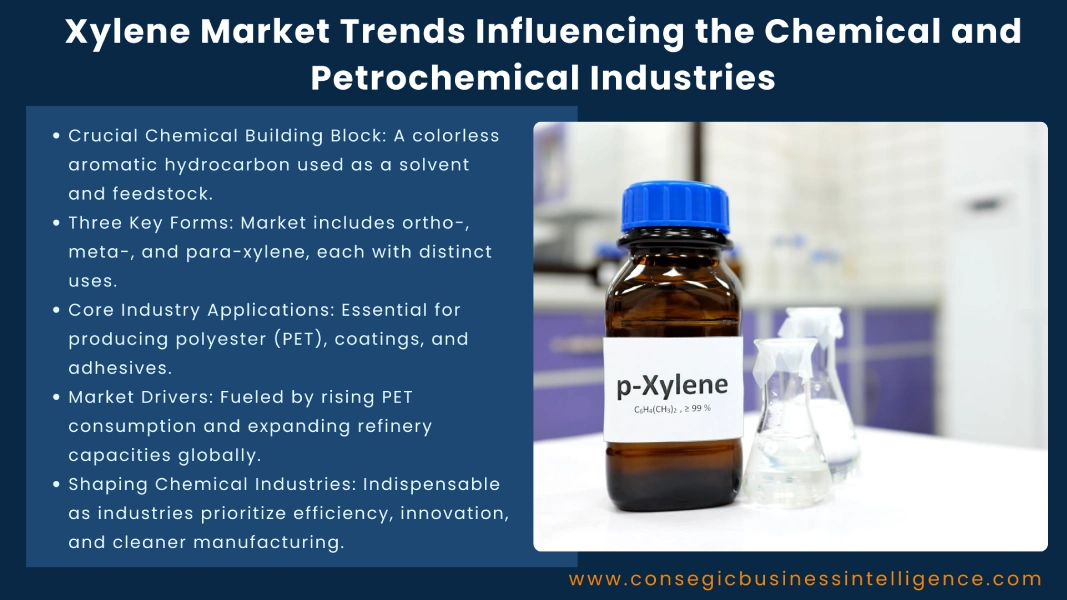
As industries move toward higher production efficiency, material innovation, and sustainability, xylene continues to be an indispensable chemical building block. The increasing consumption of polyethylene terephthalate (PET), expanding refinery capacities, and growing focus on cleaner manufacturing processes are reshaping the xylene market landscape globally. In this blog, we explore the key trends influencing the xylene market and how they are transforming the chemical and petrochemical industries.
- Rising Demand for Para-Xylene in PET and Polyester Production
The para-xylene (p-xylene) segment dominates the xylene market, accounting for the majority of global consumption. P-xylene is primarily used to produce purified terephthalic acid (PTA) and dimethyl terephthalate (DMT) essential intermediates in the manufacture of polyester fibers, films, and PET resins.
The surge in demand for bottled beverages, packaging materials, and synthetic textiles has directly increased p-xylene consumption. With the global packaging industry expanding rapidly, particularly in Asia-Pacific, demand for PET-based packaging continues to climb.
Furthermore, advancements in recycling technologies for PET are creating circular opportunities within the value chain. The integration of xylene-based feedstocks into sustainable polyester production supports the growing trend of resource efficiency and environmental responsibility across consumer goods industries.
- Expansion of Chemical Manufacturing and Derivative Production
Xylene serves as a vital feedstock in the chemical and petrochemical manufacturing sector, where it is processed into a range of derivative products including phthalic anhydride, isophthalic acid, and solvents. These derivatives are integral to the production of coatings, adhesives, dyes, and resins used in construction, automotive, and consumer goods industries.
The chemical industry’s transition toward high-performance and specialty chemicals has further increased xylene’s strategic importance. In particular, ortho-xylene (o-xylene) is widely used for phthalic anhydride production, which finds applications in plasticizers and polyester resins for paints and flexible PVC products.
As demand for advanced coatings, flexible plastics, and synthetic materials continues to rise globally, chemical manufacturers are expanding xylene capacity to secure feedstock supply and reduce dependency on imports.
- Growing Refinery and Aromatics Production Capacity in Asia-Pacific
The Asia-Pacific region has emerged as the dominant hub for xylene production and consumption, supported by expanding refinery and petrochemical complexes in China, India, South Korea, and Japan. The rapid growth of downstream industries, including textiles, packaging, and construction, is fueling regional demand for xylene derivatives.
Major petrochemical players are investing in integrated aromatics production facilities, combining paraxylene, benzene, and toluene production under one system to optimize output. China, in particular, has significantly increased its domestic PTA capacity, reducing import dependency and strengthening its position as a global leader in the polyester value chain.
With ongoing refinery expansions and the rise of energy-efficient aromatic extraction technologies, the Asia-Pacific region is expected to remain the epicenter of xylene market growth in the coming decade.
- Technological Advancements in Catalytic Reforming and Separation Processes
The production of xylene is undergoing technological advancements aimed at improving yield, purity, and energy efficiency. Modern catalytic reforming and isomerization processes are enabling refineries to convert naphtha and reformate streams into high-value aromatic hydrocarbons with improved selectivity.
Innovations in adsorption and distillation techniques, such as simulated moving bed (SMB) technology, have significantly enhanced the separation of xylene isomers, particularly para-xylene. These processes reduce energy consumption and optimize recovery, aligning with the industry’s push for cost-effective and sustainable refining.
Furthermore, emerging bio-based and renewable xylene production routes derived from biomass and waste feedstocks are being explored to lower carbon footprints. As chemical producers invest in cleaner and more efficient production pathways, technological innovation remains central to the market’s long-term sustainability.
- Rising Demand from Coatings, Paints, and Adhesive Industries
Beyond its role as a feedstock, xylene is widely used as a solvent in paints, coatings, and adhesives, due to its excellent solvency, fast evaporation rate, and compatibility with other organic compounds.
The global construction and automotive industries, major consumers of paints and coatings, have seen robust recovery and growth post-pandemic, driving solvent demand. Xylene-based solvents are essential in industrial coatings, protective paints, and varnishes, ensuring superior surface finish and durability.
Additionally, innovations in low-VOC (volatile organic compound) and eco-friendly formulations are encouraging manufacturers to adopt refined xylene grades that meet environmental standards while maintaining performance. As industrial production scales up globally, solvent-grade xylene demand is expected to remain strong.
- Increasing Focus on Circular Economy and Sustainability
Environmental concerns are pushing chemical and petrochemical industries toward more sustainable production models, directly influencing the xylene market. The focus is shifting from traditional petroleum-derived feedstocks toward renewable and recycled raw materials.
Manufacturers are developing technologies for chemical recycling of plastics, where xylene derivatives such as PET are broken down into base monomers and reused to produce new materials. This circular approach not only reduces waste but also stabilizes feedstock demand.
Furthermore, companies are investing in energy-efficient refining units, waste heat recovery systems, and emissions reduction technologies to align with global sustainability targets. The adoption of renewable aromatics and green chemistry is positioning the xylene market as an evolving part of the sustainable industrial ecosystem.
- Volatility in Crude Oil Prices and Supply Chain Realignment
Since xylene production is closely tied to crude oil refining, fluctuations in crude prices directly affect market stability. Geopolitical tensions, changing OPEC policies, and variations in global refinery utilization have caused supply-demand imbalances, influencing xylene pricing.
To mitigate risks, many petrochemical companies are adopting feedstock diversification strategies and securing long-term supply contracts. The industry is also witnessing regional shifts in production capacity, with Middle Eastern and Asian refineries expanding exports to meet global demand.
As energy markets evolve, the xylene industry’s resilience will depend on its ability to adapt to feedstock volatility and optimize refinery integration.
- Emerging Role in Advanced Material and Energy Applications
Recent innovations have expanded xylene’s potential beyond traditional chemical uses. The compound is finding new relevance in battery solvents, carbon nanomaterials, and specialty coatings, driven by the growth of the energy storage and electronics sectors.
In lithium-ion battery production, xylene is being explored as a solvent and binder material for electrode formulations. Similarly, its use in carbon fiber composites and high-performance polymers is gaining attention as industries seek lightweight and durable materials for aerospace and automotive applications.
These emerging applications highlight xylene’s adaptability in supporting next-generation technologies and materials science, paving the way for diversified market expansion.
Conclusion
The xylene market stands at the crossroads of industrial transformation, driven by expanding demand in chemical, polymer, and energy-intensive industries. From serving as a fundamental feedstock in polyester production to powering innovations in coatings, adhesives, and advanced materials, xylene remains integral to modern manufacturing.
Key market trends including technological advancements, sustainable production practices, and regional capacity expansion are shaping the future of the global xylene landscape. As the world shifts toward cleaner, more efficient industrial systems, xylene’s role will continue to evolve, reinforcing its importance as a cornerstone of the chemical and petrochemical sectors.
With innovation, regulation, and sustainability converging, the xylene market is poised for steady growth bridging traditional chemistry with the demands of the next-generation industrial economy.