Jump to Content
Busbar Protection Market - Size, Share, Industry Trends, and Forecasts (2025-2032)
Busbar Protection Market Size:
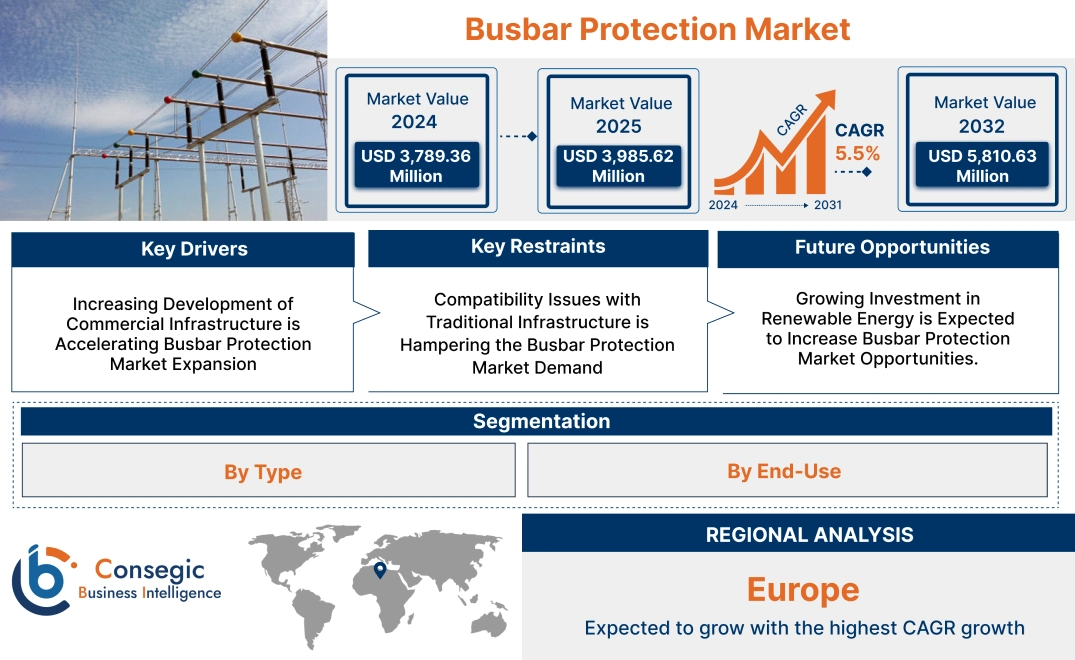
Busbar Protection Market size is growing with a CAGR of 5.5% during the forecast period (2025-2032), and the market is projected to be valued at USD 5,810.63 Million by 2032 from USD 3,789.36 Million in 2024. Additionally, the market value for 2025 is attributed to USD 3,985.62 Million.
Busbar Protection Market Scope & Overview:
Busbars are essential components in power distribution systems. They ensure a smooth flow of electricity. Busbar protection is a system designed to safeguard electrical busbars. They protect them from faults such as short circuits, overloads, and equipment failures. This protection offers several advantages. It includes fast fault detection, which reduces downtime. They provide system stability by preventing faults from spreading. This improves safety for equipment and workers. It is considered cost-effective as it reduces repairs and replacement expenses. There are two main types of protection. It includes low-impedance protection, and high-impedance protection. The protection systems are widely used by utilities such as power generation and distribution, industry such as factories, refineries, and manufacturing plants, and commercial buildings such as data centers, malls, and office buildings.
Busbar Protection Market Dynamics - (DRO) :
Key Drivers:
Increasing Development of Commercial Infrastructure is Accelerating Busbar Protection Market Expansion
Commercial infrastructure includes buildings such as shopping malls, offices, hospitals, data centers, and others. Busbar distributes high-amperage power to various electrical loads. Its protection is used to avoid power failures, reduce equipment damage, and improve energy efficiency. Governments worldwide are focusing on urbanization, and they are increasingly investing in the development of commercial infrastructure.
For instance,
- According to an article published by Datacenter Dynamics, Chinese government has spent USD 6.1 billion in development of data centers in past two years. This has increased utilization of busbar protection in data centers, where power failure causes serious problems. This is driving market share.
Overall, the increasing development of commercial infrastructure is significantly boosting the busbar protection market expansion.
Rising Adoption of Smart Grids Advancements is Driving the Market.
Smart grids are advanced electricity networks that use digital technology to monitor, control, and optimize power distribution. Busbars in smart grids facilitate the efficient management of power flow. Busbar protection ensures grid stability. It prevents cascading failures and isolates faults. There is growing electricity demand and the need for a stable power supply. This has led to increased integration of smart grids.
For instance,
- According to the NC Clean Energy Technology Center, a total of 774 grid modernization actions were taken across all 50 U.S. states. This has required protection systems for busbars in smart grids to ensure fast fault detection.
Thus, rising adoption of smart grids are accelerating the global busbar protection market growth.

Key Restraints:
Compatibility Issues with Traditional Infrastructure is Hampering the Busbar Protection Market Demand
Compatibility issues are a major hurdle in the busbar protection market. Many older electrical systems were not designed for modern protection technologies. Integrating new protection systems for busbar with existing infrastructure requires changes to relays, circuit breakers, and communication systems. This leads to high costs. Another issue is high maintenance. Advanced protection systems need regular testing, calibration, and software updates to function properly. This increases downtime and maintenance expenses, especially for large power grids and industry setups. Additionally, busbar protection systems are complex. If not set up correctly, false tripping or delayed fault detection occur, causing power disruptions. Hence, the compatibility issues along with high maintenance and system complexity are hampering the busbar protection market demand.
Future Opportunities :
Growing Investment in Renewable Energy is Expected to Increase Busbar Protection Market Opportunities.
Busbars in renewable energy facilitate the connection and distribution of power generated by solar panels, wind turbines, or other renewable sources. A protection system for the busbar is used to prevent faults like short circuits. It helps prevent damage and reduces power outages. This also ensures a stable electricity supply. Governments are investing more in renewable energy projects as it reduces pollution.
For instance,
- In 2024, the S. Department of Energy invested USD 149.87 million for clean energy projects across 28 U.S. states. This will increase the demand for busbar, as these projects require protection as well. This creates potential for manufacturers.
Overall, growing investment in renewable energy is expected to increase busbar protection market opportunities.
Busbar Protection Market Segmental Analysis :
By Type:
Based on type, the market is categorized into low-impedance protection and high-impedance protection.
Trends in Type:
- Microprocessor based digital relays are becoming the standard for both low and high-impedance protection. This offers advanced features, communication capabilities, and flexibility.
- Minimizing fault clearing time is crucial to prevent equipment damage and maintain grid stability. Low-impedance protection, with its faster operation, is gaining importance for this reason.
The low-impedance protection segment accounted for the largest market share in 2024.
- Low-impedance segment dominated the busbar protection market trends. It is a differential scheme.
- A low impedance relay monitors the summed CT currents; a fault within the busbar zone disrupts the current balance, triggering the relay to trip circuit breakers and isolating the fault.
- It is used in high-voltage substations and industrial facilities. Rising industrialization has led to increased demand for reliable power supply.
- For instance, according to Energy Information Administration, in 10 U.S. states, the commercial electricity demand from 2019 to 2023 grew by 10%. This has required low-impedance protection systems for busbar, thus driving segment
- Overall, as per the market analysis, the increased need for reliable power supply is driving a segment in the busbar protection market growth.
The high-impedance protection segment is expected to grow at the fastest CAGR over the forecast period.
- High-impedance protection is an emerging segment. This differential scheme uses current transformers connected in parallel with a resistor in series with a relay.
- During internal faults, the current imbalance creates a voltage drop across the resistor, tripping the relay. During external faults, the high impedance limits current, preventing relay operation.
- It's a simpler, cost-effective solution when compared to low-impedance protection, but slower and less sensitive.
- It is used where current transformer matching is difficult, in older substations where retrofitting is challenging.
- According to market analysis, many power systems, especially in developed countries, have aging infrastructure. This will drive segmental growth for the upcoming years.
By End-Use:
Based on end-use, the market is categorized into utilities, industrial, and commercial.
Trends in the End-Use:
- Utilities are increasingly adopting busbar protection systems that integrate seamlessly with smart grid technologies. This will enable real-time monitoring, control, and automation.
- Industrial facilities are moving towards digitalized and automated protection systems for busbar to improve reliability, efficiency, and safety.
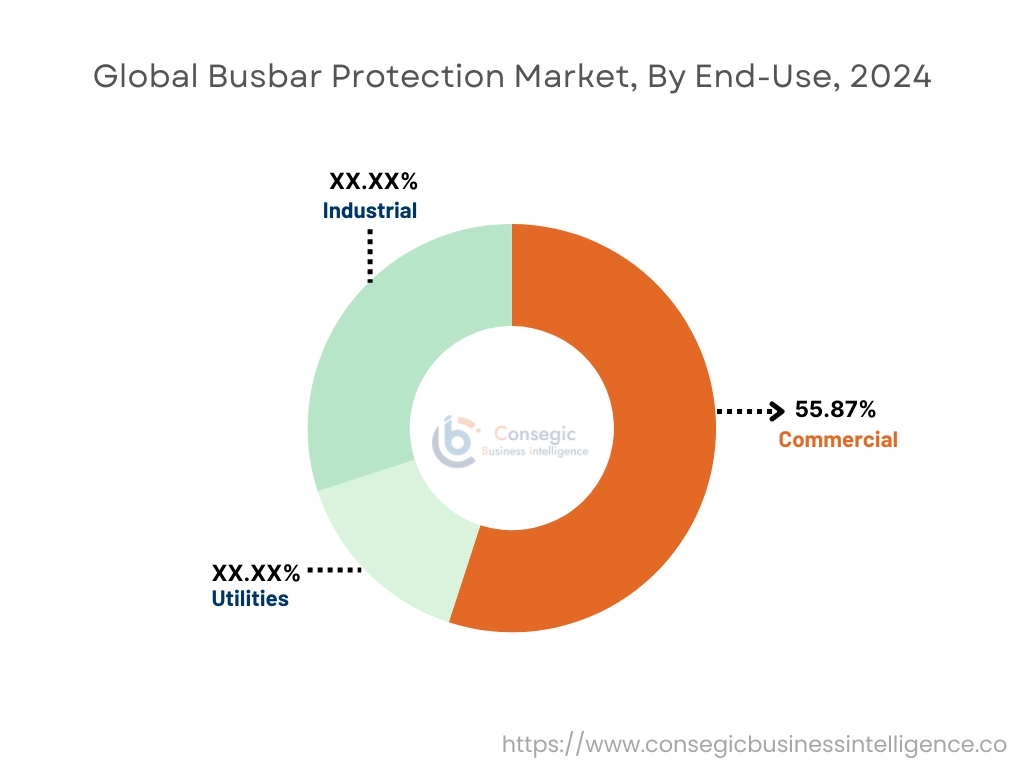
The commercial segment accounted for the largest market share of 55.87% in 2024.
- The commercial segment dominated the busbar protection market trends. It includes buildings, such as offices, shopping malls, and data centers.
- A busbar a rigid conductor. It consolidates and distributes high currents. Protection systems for busbars are important as a fault in busbar cause widespread outages, damage equipment, and create safety hazards.
- The protection system of busbar rapidly detects and isolates the faults. This minimizes disruption and prevents power failures.
- Effective protection systems are also essential for maintaining grid stability, ensuring reliable power delivery, and safeguarding personnel and equipment.
- Overall, as per the market analysis, continuous research and development efforts are leading to the development of more sophisticated protection relays with enhanced capabilities for infrastructure. This will drive segmental growth in the busbar protection industry.
The utilities segment is expected to grow at the fastest CAGR over the forecast period.
- The utilities segment is emerging in market trends. It encompasses companies that provide services such as electricity, gas, and water to consumers and businesses.
- Busbars effectively manage and distribute the flow of electrical power. Its protection system quickly isolates faulty busbars. This prevents outages, equipment damage, and safety hazards. It ensures grid stability
- There is aging infrastructure modernization and the increasing integration of renewable energy sources.
- For instance, according to the IBM, renewable electricity capacity is expected to grow by 7,300 gigawatts between 2023 to 2028. This will require a more protection system for busbars incorporated in solar panels and wind turbines. This creates potential for segment in the market.
- Thus, as per the market analysis, the integration of renewable energy will drive segmental growth for the forecasted years.
Regional Analysis:
The regional segment includes North America, Europe, Asia Pacific, the Middle East and Africa, and Latin America.
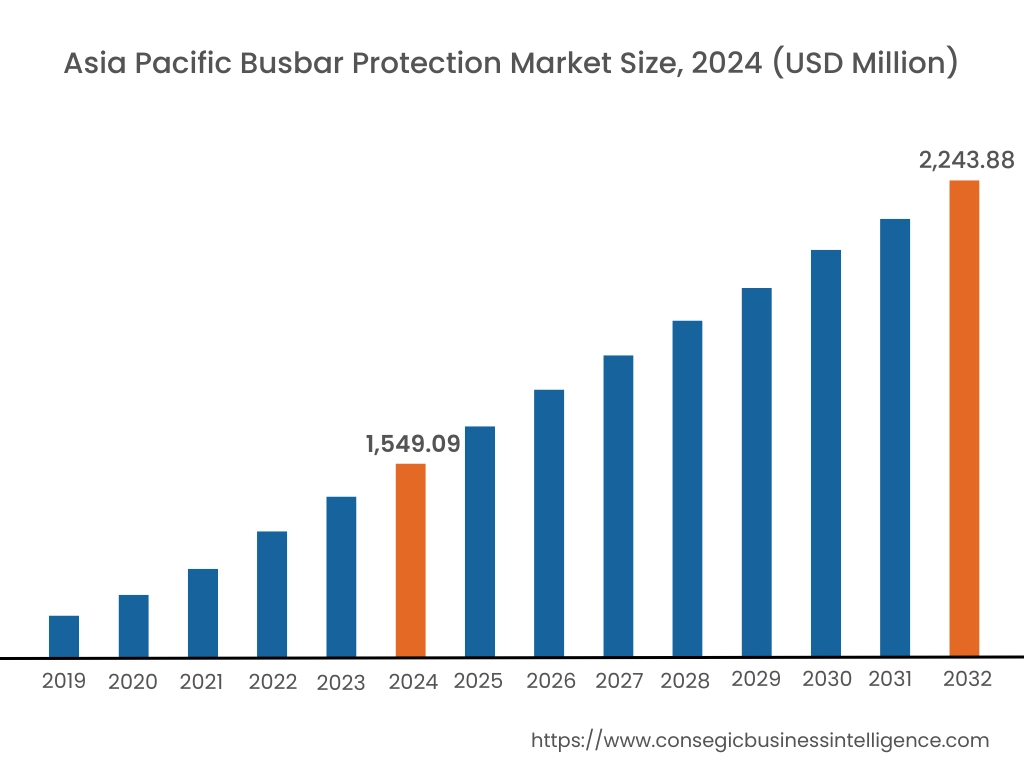
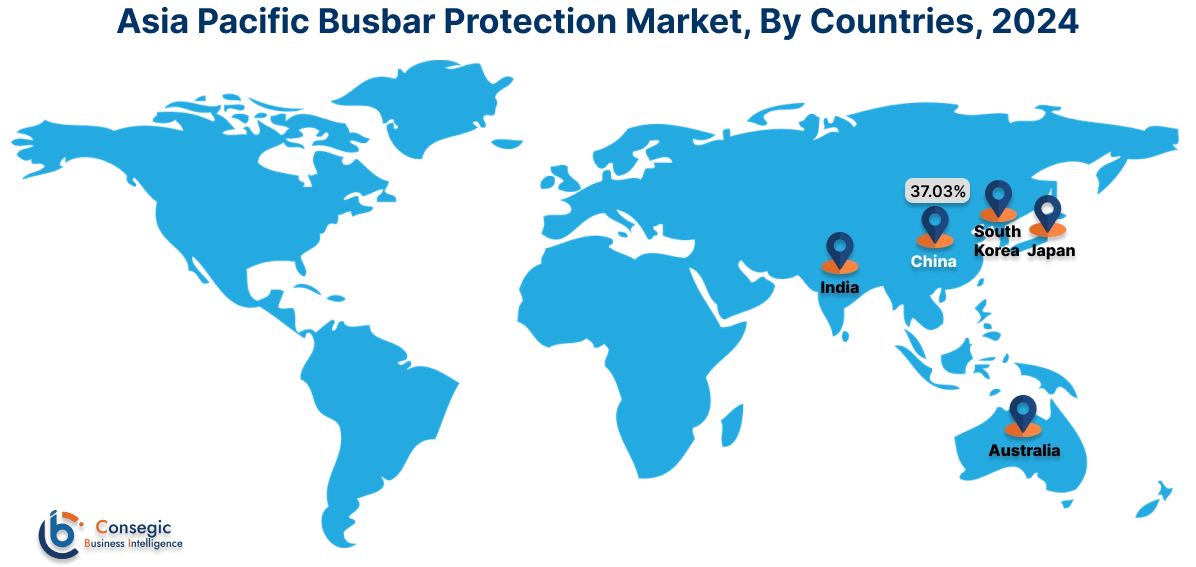
In 2024, Asia Pacific accounted for the highest busbar protection market share at 40.88% and was valued at USD 1,549.09 Million and is expected to reach USD 2,243.88 Million in 2032. In Asia Pacific, the China accounted for the busbar protection market share of 37.03% during the base year of 2024. Industrialization in the region is expanding rapidly. Countries such as China, India, Indonesia, and Vietnam are becoming global manufacturing hubs.
For instance,
- According to the Fifth National Economic Census, the number of legal entities engaged in secondary and tertiary industries in China increased significantly in 2023, with a 52.7% rise compared to 2018. This has required efficient protection for busbars to prevent faults.
Moreover, APAC is witnessing rapid urbanization, leading to the construction of smart buildings, data centers, shopping malls, and office complexes. This further supports the market. Overall, increased urbanization and industrialization is driving the market in the region.
In Europe, the busbar protection market is experiencing the fastest growth with a CAGR of 6.7% over the forecast period. Renewable energy integration is a major trend in Europe. Countries such as Germany, France, and UK are investing heavily in solar, wind, and hydropower to reduce dependence on fossil fuels. To ensure smooth power distribution, utilities are installing advanced busbar protection systems in substations and power plants. These systems help detect faults quickly, prevent failures, and improve grid stability, making them essential for modern energy networks. Moreover, increasing blackout risks and equipment failures are another concern. To prevent such issues, businesses and utilities are investing in high-reliability protection solutions for busbars.
North America’s busbar protection market analysis states that several trends are responsible for the progress of the market in the region. The region’s aging power infrastructure needs upgrades to handle higher electricity demand. Governments are investing in smart grids, which use digital technology for real-time monitoring and automation. Protection systems for busbars play a critical role in these modern grids by ensuring quick fault detection, preventing power failures, and improving overall grid efficiency. Moreover, The U.S. and Canada are home to major tech companies, cloud service providers, and AI-driven businesses, all of which need uninterrupted power. Advanced protection systems for busbar help prevent outages, improve energy efficiency, and reduce maintenance costs.
The Middle East and Africa (MEA) busbar protection market analysis states that the region is also witnessing several trends for a notable surge. Many MEA countries are building large solar farms in Saudi Arabia and wind farms in Egypt. HVDC systems help transport electricity over long distances with less energy loss. HVDC grids need strong protection systems or busbars to prevent faults and ensure stable power flow. Moreover, new commercial projects require uninterrupted power. To prevent failures, companies are investing in advanced protection solutions for busbars to maintain a stable and efficient power network.
Latin America's busbar protection market size is also emerging. Many countries are upgrading their electrical systems with smart relays that offer faster fault detection, remote monitoring, and better automation. Older protection systems are being replaced with digital relays that help prevent blackouts and reduce maintenance costs. Moreover, many Latin American cities are investing in electric buses, metro systems, and EV charging stations to reduce pollution and improve transportation. These projects require strong and reliable electrical infrastructure. Protection for busbars helps prevent power failures in transport networks, ensuring smooth operations.
Top Key Players and Market Share Insights:
The Busbar Protection market is highly competitive with major players providing products to the national and international markets. Key players are adopting several strategies in research and development (R&D) and product innovation to hold a strong position in the global Busbar Protection market. Key players in Busbar Protection industry include-
- ABB, Ltd. (Switzerland)
- Siemens (Germany)
- Basler Electric (U.S.)
- Hitachi Energy (Switzerland)
- NR Electric Co. Ltd (China)
- GE Vernova (U.S.)
- Eaton Corporation (Ireland)
- Schneider Electric (France)
- GRL Group (U.S.)
- Legrand (France)
Busbar Protection Market Report Insights :
| Report Attributes | Report Details |
| Study Timeline | 2019-2032 |
| Market Size in 2032 | USD 5,810.63 Million |
| CAGR (2025-2032) | 5.5% |
| By Type |
|
| By End Use |
|
| By Region |
|
| Key Players |
|
| North America | U.S. Canada Mexico |
| Europe | U.K. Germany France Spain Italy Russia Benelux Rest of Europe |
| APAC | China South Korea Japan India Australia ASEAN Rest of Asia-Pacific |
| Middle East and Africa | GCC Turkey South Africa Rest of MEA |
| LATAM | Brazil Argentina Chile Rest of LATAM |
| Report Coverage |
|
Key Questions Answered in the Report
How big is the Busbar Protection market? −
In 2024, the Busbar Protection market is USD 3,789.36 Million.
Which is the fastest-growing region in the Busbar Protection market? +
Europe is the fastest-growing region in the Busbar Protection market.
What specific segmentation details are covered in the Busbar Protection market? +
Type and End-Use segmentation details are covered in the Busbar Protection market.
Who are the major players in the Busbar Protection market? +
ABB, Ltd. (Switzerland), Siemens (Germany), GE Vernova (U.S.), Eaton Corporation (Ireland), Schneider Electric (France), and GRL Group (U.S.) are some major players in the market.
Overview
Reputation & Certifications


Our Services
- Market Intelligence & Forecasting
- Custom Research Solutions
- Market Entry Strategy
- Competitive Intelligence
- Customer Insights
- Industry Innovation Analysis
- Investment Advisory