Jump to Content
Europe Electrical Bushing Market - Size, Share, Industry Trends, and Forecasts (2025 - 2034)
Market Scope & Overview
The Europe electrical bushing market is a key component of Europe’s power transmission and distribution system, comprising specialized insulation devices that allow electrical conductors to pass through grounded barriers in the transformer, switchgear, and other equipment with high voltage levels. These essential elements find a wide range of applications in utility transmission systems, industrial systems, and renewable energy systems, and in urban distribution systems with the voltage range operating between medium-voltage applications at 1 kV–36 kV and ultra-high-voltage installations beyond 800kV as used in the current grid.
The market includes several technological platforms such as oil impregnated paper (OIP) bushings using traditional kraft paper insulation with mineral oil, resin-impregnated paper (RIP) bushings with epoxy resins treated cellulose materials used, resin impregnated synthetic (RIS) bushings using advanced composite fibers, and gas-insulated designs used in specialized switchgear applications. Other types are condenser bushings used in extra-high voltage systems, wall bushings to be fitted in smaller systems, and special HVDC bushings to transmit direct current systems.
The market was valued at USD 920 million in the base year and is projected to grow significantly to USD 1.42 Billion by the year 2034. This growth pattern reflects a compound annual growth rate of 5.1 percent over the 2026-2034 forecasting period, which will be caused by the Action Plan of Grids of the European Union necessitating EUR 584 billion of infrastructure spending by 2030, by the growing pace of the transition to renewable energy sources which necessitate a significant modernization of the grid, by the systematic substitution of aging power infrastructure with 40 percent of distribution networks being over 40 years old, and by the has undergone significant development and by the rapid expansion of offshore renewable energy sources, which require advanced high-voltage transmission infrastructure and specialized bushing technologies to ensure efficient and reliable power transfer.

Modern electrical bushing technology has undergone significant development shore renewable energy sources with high materials engineering, precision of its manufacturing process, and embedded digital monitoring functions. Recent high voltage bushings use composite insulation systems in which silicone rubber housings are provided with fiberglass-reinforced epoxy cores, which offer significantly improved contamination resistance and mechanical strength than porcelain-designed bushings. The insulation systems are built on nano-enhanced epoxy resins with dielectric strength values of more than 30kV per millimeter and improved capacitance grading techniques to provide an even distribution of electrical stresses throughout the insulation structure enabling compact designs for space-constrained urban applications.
Precision has reached an all-time high with computer-controlled machining holding dimensional tolerances within ±0.03 mm critical conductor interfaces, automated winding systems giving repeatable capacitance layers within variation of less than 1.5 percent, and vacuum impregnation processes that guarantee full penetration of resin throughout complex insulation geometries. Quality control procedures include the partial discharge test at 1.5 times the rated voltage, dielectric loss factor test that identifies insulation degradation with a 0.0005 percent sensitivity and accelerated aging tests that models the 50 years of operation stress cycles under controlled laboratory conditions.
Condition monitoring integration represents a significant technological advancement, and intelligent bushings include fiber optic sensors that measure internal temperature distributions with an accuracy of 0.3°C, real-time capacitance monitoring systems that monitor insulation degradation by real-time continuous power factor analysis, and wireless communication systems that send diagnostic data to centralized asset management systems. Such monitoring systems allow predictive maintenance plans that cut unexpected failures by 65-75 percent over conventional time-based replacement plans and optimize maintenance expenses and durations of operation.
Regional Trends and Insights
- Western Europe
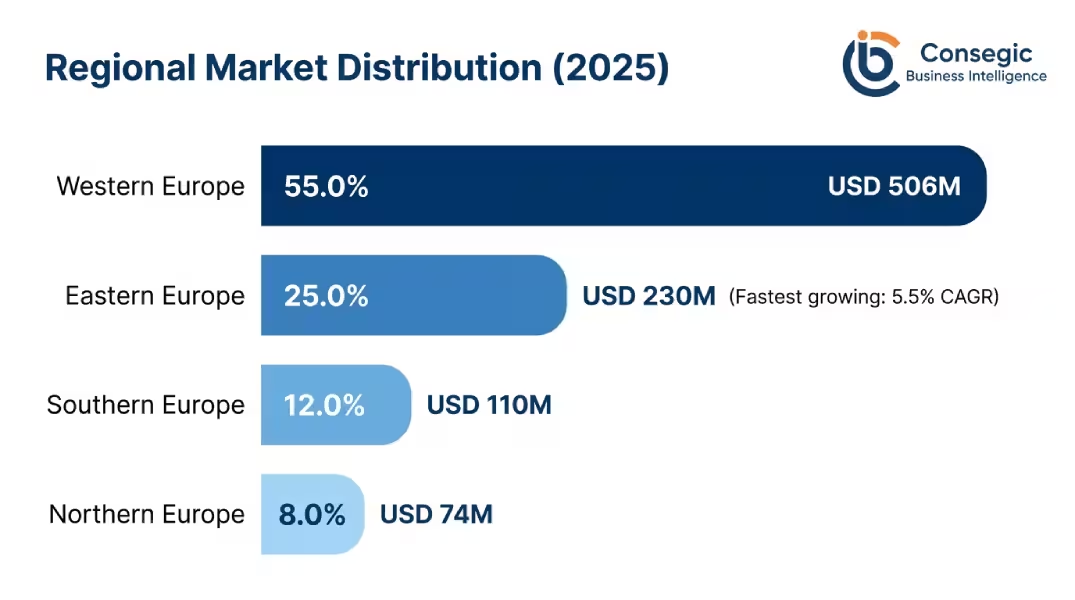
- Largest regional market with USD 506 million (55% share) in 2025, projected to reach USD 781 million by 2034
- Growth driven by major transmission grid expansion and renewable energy integration projects
- Germany, France, and the UK lead the region due to grid modernization, nuclear upgrades, and offshore wind development
- Eastern Europe
- Market valued at USD 230 million (25% share) and expected to reach USD 369 million by 2034, growing at 5.5% CAGR
- Growth supported by large investments in transmission infrastructure and modernization of aging power systems
- Poland, Romania, Czech Republic, and Hungary are key markets due to renewable integration and grid reinforcement projects
Key Drivers
EU Action Plan Implementation and Grid Modernization
The underlying force that is driving the growth of the market is the overall modernization of European electrical grids, as outlined in the European Commission’s Grid Action Plan, whereby infrastructure amounting to EUR 584 billion will need to be invested by 2030 to accommodate the transition toward renewable sources of energy and to meet carbon neutrality goals of 2050. The scale of this huge investment scheme includes the development of 45,000 kilometers of new transmission lines, installation of 200-300 large substations, and modernization of the already existing infrastructure to support the bi-directional power flows of distributed sources of renewable generation.
The challenge of renewable energy integration is especially sharp, and the volume of offshore wind capacity is expected to grow from the current 30 gigawatts, as it is today, but also reach 300 gigawatts already by the year 2050 according to the European Commission planning documents. Every offshore wind installation needs special converter stations and onshore substations, and each facility would need 150-400 high-voltage bushings, depending on configuration and voltage levels. The technical needs of renewable integration stimulate the demand for advanced bushing technologies with the improved stability, the resistance to contamination in the marine conditions and the ability to monitor the state of the bushing remotely.
An example of these trends can be found in the Energiewende program of Germany where investment of EUR 110 billion in transmission grid development is planned by 2030, including a significant north–south transmission grid through which offshore wind power would be moved to the industrial areas. The modernization of France’s nuclear fleet involves the renovation of 56 reactor units that need transformers replacement and installation of bushing worth about EUR 95 million a year. The offshore growth of wind power in the United Kingdom to 50 gigawatts by 2030 will involve 15–20 offshore converter stations, each requiring hundreds of specialized high-voltage bushings in transformers, reactors, and switchgear installations.
Key Restraints:
Long Product Life and Supply Chain Constraints
The European electrical bushing market faces significant limitations to growth due to the nature of long operational life of the well-maintained installations and the rising supply chain complexities to manufacturing and delivery schedules. High-quality bushings produced by reputable manufacturers, when properly installed and working within design limits, normally exhibit a operational lifespan of 30–40 years under good environmental conditions and with most examples of the 1980s and 1990s still in productive service in modern power systems. This long lifespan nature implies that replacement demand is provided on multi-decade cycles as opposed to the short replacement periods characteristic of electronic equipment or mechanical parts.
A key limitation has become the Supply chain unpredictability, especially in relation to the supply of raw materials and their prices of high-quality copper conductors, high-tech porcelain insulators and epoxy resin systems. The global mining restrictions and the high demand of renewable energy installations have led to price volatility in copper to the tune of 25-30 percent and this has had a direct impact on the production costs of high-amperage bushings. The 8–12-week lead times on specialized materials have gone to 20-26 weeks and this is presenting challenges in scheduling of production, and complexities in inventory management to manufacturers serving with time-sensitive utility projects.
Mature power infrastructure in Western European countries makes their capacity relatively stable with low growth rates of 1–2% per annum in transmission infrastructure. Countries such as Germany, France and the United Kingdom have transmission networks which are well developed and are approaching practical saturation, such that new installations are mainly carried out to meet the replacement requirement, as well as, to add capacity to the existing network but not necessarily to expand the network very fast. This level of maturity limits the overall market development potential and puts strain on manufacturers to differentiate by technological advancement and offering services instead of increasing volume.
Key Opportunities
High-Voltage Direct Current (HVDC) Transmission Expansion
Growth prospects are enormous, given the rapidly growing high-voltage direct current transmission infrastructure in all of Europe, where specialized bushing manufacturers have opportunities to supply bespoke technical solutions to suit the seen HVDC converter stations and submarine cable systems. HVDC technology is also more efficient in long distance power transmission over 500 kilometers and is the only viable option over submarine cable connections over 40 kilometers thus is necessary in the integration of offshore wind resources and the reinforcement of cross border interconnections among European countries.
The European Commission infrastructure development network estimates that there are around 28 large-scale HVDC projects scheduled or underway in the next decade with an investment of over EUR 45 billion and each station terminal is equipped with conductor-specific bushings in converter transformers, smoothing reactors, and filter equipment. HVDC converter stations each need 200-350 special high voltage bushings that meet the peculiar electrical demands of direct current use, such as the space charge build up in insulating materials, polarity reversal transients, and harmonic distortion of power electronic converters.
Significant bushing projects that are driving the demand of bushing are the North Sea Wind Power Hub project, which envisions interconnected offshore wind farms with a combined capacity of 70-100 gigawatts interlinked with meshed HVDC networks, and that would need 8-12 offshore converter platforms and related onshore stations. The very high price of HVDC-rated bushings, usually 50-70 percent higher than similar AC voltage ratings offers attractive margin possibilities to manufacturers who invest in product development dedicated to specific products, and long-term qualification testing programs needed to meet these challenging demands.
Market Segmentation Analysis
By Product Type: Technology Platform Analysis
Oil-Impregnated Paper Bushings: Established Technology Foundation
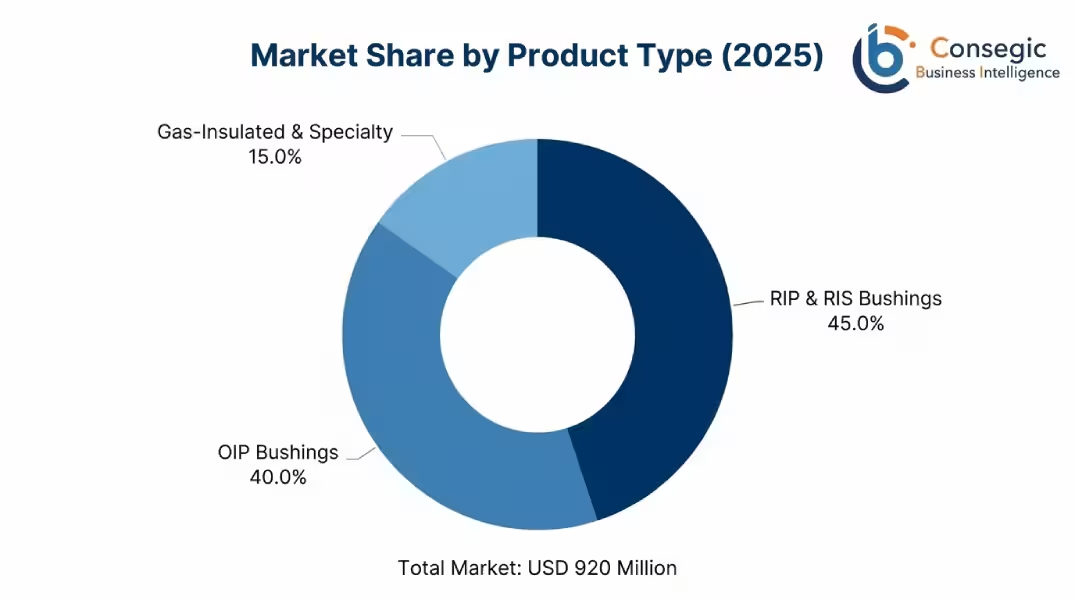
Oil impregnated paper bushings USD 368 million (40.0%) of market value) in 2025 are expected to reach USD 568 Million in 2034. This is a proven technology making use of a number of kraft paper layers wrapped around cores of conductors, which have been impregnated with mineral oil that has the ability to offer electrical insulation as well as heat dissipation aspects. OIP bushings continue to dominate power transformer applications with ratings less than 400kV, distribution transformers, and retrofit of legacy equipment where the ability to be used with existing oil filled equipment is still a requirement. The technology is proven to be very reliable with more than 100 years of operation experience, economical to use in medium voltage applications and simple manufacturing processes that lead to affordable pricing in the market segments that are highly sensitive to price.
Resin-Impregnated Paper and Synthetic Bushings: Performance Enhancement
Resin impregnated paper and synthetic bushings have a market value USD 414 Million (45.0 percent of the total market value) and will grow to USD 639 Million by 2034 to be the fastest developing technology segment. The RIP technology substitutes mineral oil, with epoxy resin impregnation that offers better mechanical force, greater contamination, and absence of oil leak possibilities. The RIS technology goes a notch higher with the use of synthetic fiber materials, rather than natural kraft paper, which has an improved thermal performance, better moisture resistance, and better mechanical properties. The technologies are applied in high-voltage transformer applications of between 145kV to 800kV, gas-insulated switchgear units, and systems that need compact construction systems with small physical dimensions.
Gas-Insulated and Specialty Bushings: Niche Applications
Specialty designs and gas-insulated bushings USD 138 Million (15.0 percent to market value) USD 213 Million by 2034. Such category covers: SF6 gas-insulated bushings used with gas-insulated switch gear, capacitance graded bushings used by voltages above 245kV, wall bushings used in switchgear installations, and bespoke designs used in special purpose equipment such as HVDC converter stations. These are used in high-voltage substations, in compact urban systems and in unique applications that need a custom solution, and are showing greater margins, reflecting the complexity of the engineering design, and specialized manufacturing needs.
By Application: End-Use Market Analysisstry: Application Market Analysis
Power Transformers: Dominant Application Segment
Power transformer applications will require USD 414 Million (45.0 percent of market value), which will grow to USD 639 Million in 2034. This category includes generation step-up transformer bushings in power plants, transmission transformer bushings in substations, and autotransformer bushings in a voltage regulation across transmission networks. Large power transformers require 3–6 high-voltage bushings depending on the winding set-up and voltage, with prices of a single high-voltage bushing of between EUR 5,000 at 145kV to EUR 180,000 at ultra-high 800kV. The Europe’s transformer fleet is aging; as averages of fleets in most networks are above 35 years, the sheer population of transformers requires replacement regardless of the level of new construction.
Distribution and Industrial Applications: Volume Segment
Distribution and industrial applications account for USD 322 Million (35.0 percent of market value) with its growth of USD 497 Million by 2034. It contains bushings of distribution transformers to medium voltage networks, industrial transformers to manufacturing plants and specialized equipment on renewable energy facility installations. Individual unit values are also lower than those of power transformer bushings but the segment advantage is in larger installation quantities with the distribution networks having 12-18 times more transformer units than the transmission systems.
Renewable Energy and HVDC Applications: Growth Segment
Renewable energy and HVDC applications have a market value of USD 184 million (20.0 percent of market value), and it will reach USD 284 Million in 2034 with a growth rate of 5.4 percent CAGR. This market includes offshore wind converter station bushings, solar farm substations, interconnections within energy storage systems and HVDC transmission terminals. The fast-paced growth of renewable energy plants presents a growing demand and each offshore wind converter station requires 200–300 specialized bushings, and each large HVDC terminal has 150-250 high-voltage converter transformer bushings and filter equipment.
By Voltage Rating:
Application-Driven Market Dynamics
Medium Voltage 1-36kV: Core Infrastructure Foundation The market value of medium voltage bushings will reach USD 507 Million in 2034 after achieving a market value of USD 329 Million which represents 35.0% of total market value in 2025. European power distribution networks use this voltage segment as their main power distribution system. Medium voltage applications predominantly utilize oil-impregnated paper and resin-impregnated paper technologies because these materials offer both cost benefits and reliable performance in their designated operational range. The segment generates revenue through existing infrastructure which requires maintenance and replacement, while retrofit applications serve as a primary revenue source. The network expansion projects in emerging European markets together with the Western European distribution equipment modernization efforts create ongoing demand. The segment experiences growth because urban and suburban regions consume more electricity while smart grid infrastructure investments increase and the energy system shifts toward decentralized energy resources that need strong medium voltage interconnection solutions.
High Voltage 36-245kV: Transmission and Distribution Backbone
The year 2025 will see high voltage bushings generate USD 395 million which represents 42 percent of total market value while the market will expand to USD 609 million by 2034 for this voltage classification which covers its largest market segment. The power system of Europe maintains its essential transmission and sub-transmission infrastructure which links generation sites to regional distribution systems. The high voltage bushings within this range utilize oil-impregnated paper technology for traditional transformer applications and resin-impregnated paper technology for advanced installations that demand better performance. The segment maintains its leading position because the extensive backbone infrastructure throughout continental Europe connects thousands of power transformers which operate at these voltage levels through major industrial centers and metropolitan areas and cross-border transmission corridors. The growth drivers for the economy stem from three factors which include creating new transmission links for renewable energy sources and replacing outdated 1970s-1990s infrastructure and implementing grid reliability and redundancy measures after energy security problems emerged across Europe.
Extra High Voltage >245kV: Specialized High-Performance Applications
The market for extra high voltage bushings will grow from USD 216 million which represents 23.0 percent of the market share in 2025 to USD 333 million by 2034. This specialized segment serves ultra-high voltage transmission systems that form the strategic backbone of pan-European power interconnections and long-distance power transmission corridors. Extra high voltage systems require advanced technology, which includes resin-impregnated synthetic bushings and gas-insulated specialty designs, because these systems need to meet critical operational standards. The segment operates with fewer total units but generates much higher revenue per unit because each bushing has a high price point which results from its unique engineering requirements and specialized production methods and its value for essential operations. The segment expands because the European Union's renewable energy transition strategy requires construction of new ultra-high voltage transmission lines which will link offshore wind farms and concentrated solar facilities to power demand areas plus HVDC converter stations for long-distance electricity distribution and replacement of equipment from the 1980s to 2000s. The segment also benefits from increased grid interconnection projects across Eastern and Southern Europe to enhance energy security and facilitate cross-border power flows.
By Distribution Channel: Market Access and Customer Relationships
Direct OEM Sales: Integrated Supply Chain Dominance
Direct OEM sales channels accounted for USD 517 Million (55.0% of total market value) in 2025 and are forecasted to reach USD 797 Million by 2034, establishing this as the dominant distribution pathway for European electrical bushings. The channel contains direct procurement connections which exist between bushing manufacturers and original equipment manufacturers for power transformers and switchgear and other high-voltage equipment. The procurement relationships between OEMs and their suppliers establish long-term supply agreements which support combined product development and just-in-time delivery systems that enhance manufacturing productivity. The major transformer OEMs which include Siemens and ABB and Eaton and European manufacturers of the region keep preferred supplier systems which enable bushing producers to supply them with steady product requirements. The bushing manufacturing industry requires OEMs to obtain supply security through direct supplier arrangements which deliver constant quality and technical backing and support their capital-intensive operations. OEM sales growth occurs because transformer production has increased throughout Europe due to grid development and modernization projects while renewable energy integration initiatives and grid strengthening programs have led to new equipment deployments which enhance OEM sales.
Utility Direct Sales: End-User Procurement and Replacement Market
The utility direct sales channels generated USD 282 Million which accounted for 30 0 percent of market value in 2025 while experts estimate the channels will grow to USD 435 Million by 2034. European electric utilities and transmission system operators and distribution network operators use this channel to directly buy equipment bushings which they need for equipment replacements and maintenance and new infrastructure projects. Utility procurement requires organizations to follow official tender procedures which mandate them to create technical documents that demonstrate their products match the established requirements for existing equipment and operational benchmarks. The channel provides essential support to utilities through its role in managing the end-of-life process for old infrastructure because utilities use it to replace bushings in transformers that are between 30 and 40 years old to prolong transformer operational time without needing to replace the entire transformer. The segment growth emerges from the vast power equipment installed base in Europe which needs constant upkeep while utilities replace first-generation equipment from the 1980s-2000s during planned replacement cycles because these systems have reached their end-of-service-life and they focus on boosting reliability and optimization of their assets. Manufacturers gain crucial market knowledge through their direct utility connections which help them understand how equipment ages and which new technical specifications will emerge in the future.
Wholesale Distribution: Standardized Products and Regional Market Coverage
The wholesale distribution channels generated USD 94 million, which represented 10 percent of the market value in 2025, and they will grow to USD 145 million by 2034. The channel functions through electrical equipment distributors together with specialized high-voltage component wholesalers who hold inventory of standard bushing designs to provide regional market access throughout Europe. Wholesale distributors operate as essential market links who supply industrial clients from smaller companies and regional utilities and equipment repair businesses and retrofit experts with their demand for smaller product volumes and expedited delivery services which they cannot obtain through direct OEM purchases. The distribution channel plays a vital role in assisting the diverse network of smaller European utilities and independent power equipment service centers, particularly in Central and Eastern European regions where distribution systems are still under development. Wholesale channels primarily target high-volume commodity products which include standardized voltage ratings and established technology platforms since inventory management and quick order fulfillment create competitive advantages. The segment experiences growth because more independent equipment maintenance and retrofit operations open across Europe and smaller industrial users require replacement components and wholesale distributor networks expand into new European markets following the EU energy infrastructure development initiatives.
Aftermarket Services: High-Value Support and Specialized Solutions
The aftermarket services together with specialized repair channels produced a market value of USD 47 million which represents 5.0 percent of total market value in 2025 and is expected to grow to USD 72 million by 2034. The specialized technical services segment consists of bushing refurbishment and condition assessment together with emergency replacement services and custom engineering solutions for both legacy equipment and non-standard applications. The aftermarket services channel generates high profit margins through specialized work which requires direct customer relationships built on technical knowledge and allows businesses to offer extra services that go beyond basic component replacements. The service providers in this channel include companies that repair specialized equipment and contractors who maintain transformers and the service divisions of bushing manufacturers which perform field diagnostics through advanced testing equipment and deliver tailored solutions for specific equipment needs. The channel serves as an essential tool for handling obsolete equipment which requires both original specifications and advanced technologies to enhance equipment performance. The European equipment base which is older now drives growth in aftermarket services because customers prefer condition-based maintenance over time-based replacement and because regulations demand detailed equipment documentation and maintenance records and because bushing performance troubleshooting in essential infrastructure systems has become more intricate.
Regional Market Analysis
Western Europe: Market Maturity and Infrastructure Leadership
In 2025, Western Europe controls the electrical bushing market with USD 506 Million (55.0 percent of market value) which is bound to increase to USD 781 Million in 2034. The region demonstrates the strongest performance, accounting for approximately 32% of the Western European market mainly due to the large-scale transmission grid expansion plans supporting integration of renewable energy, the location of large manufacturers of transformers such as Siemens Energy and SGB-SMIT who have to source bushing locally, and the high levels of industrial base that generate constant demand at medium and high voltage equipment.
The German transmission grid expansion plan is a planned 7,700 kilometer of newly built or reconstructed transmission lines by 2030 with investment amounting to EUR 110 billion and providing a sustained demand in bushing due to the need to prepare a significantly greater number of new or expanded substations. France has 26 percent of the value of the Western European market, which is supported by nuclear modernization of the fleet that needs transformer changes in 56 reactor units, reinforcing the transmission net connecting renewable sources to demand centers and interconnections development with the neighboring countries. The United Kingdom contributes 24 per cent of the Western European value, which is driven by the offshore wind growth to 50 gigawatts by 2030 and high investment in interconnector developments between British networks and continental European systems.
Fastest-Growing Regional Market: Eastern Europe
Eastern Europe accounts for USD 230 million (25.0 percent of market value), with a high growth rate of 5.5 percent CAGR to USD 369 Million by 2034. This rapid growth is indicative of intense investment in the transmission infrastructure going forward to compensate decades of underinvestment in the transition periods of post-Soviet states, integration of renewable energy sources especially Poland, Romania and Baltic states as well as modernizing old power infrastructure installed in 1960s-1980s and nearing end of life.
Poland is the strongest in the development of the Eastern European market with the transmission grid investments over PLN 40 billion by 2030, the Baltic Sea electrical interconnections, offshore wind grid connections and the cross-border interconnections enhancing integration with Western European networks. The power sector modernization program in Romania, backed by EUR 5.2 billion in funding provided by the European Union, includes modernization of transmission networks, integration of renewable energy infrastructure and the replacement of the old soviet inspired equipment. Czech Republic and Hungary are also important players in terms of nuclear power plant modernization projects and transmission network reinforcement projects that improve the energy security of the region.
Competitive Landscape and Key Market Players
Strategic Positioning and Market Leadership
Hitachi Energy Ltd. (Switzerland/Sweden) - Leader in Technological Innovation.
Hitachi Energy enjoys market leadership in the electrical bushing market in Europe with projected 2024 European revenues of EUR 195-215 Million, which is around 22-24 percent market share in all product segments with special impetus in extra-high voltage and HVDC systems. The competitive positioning of the company is based on the extensive portfolios of products in terms of voltage, ranging between 1kV to 1,200kV, the production capabilities of 48,000-55,000 bushing units per year, its research and development capabilities to develop next generation insulation materials and integrated monitoring technology.
Hitachi Energy’s technological advancements are evident in proprietary technologies such as RIP-S synthetic insulation technology (weight reduction of 35 percent over conventional designs) and integrated fiber optic monitoring systems that provide real-time information on temperature and partial discharge and a differentiated HVDC bushing design qualified to operate at +-800kV. To be future ready with ultra-high voltage grid capabilities across the transmission network in Europe, the company has well maintained testing facilities that can test bushings to high impulse voltage of 1200kV.
Siemens Energy AG (Germany) - Comprehensive Solutions Provider.
Siemens Energy has a good market share estimated to be EUR 155-175 Million in 2024 in Europe representing approximately 18–20% market share in vertical integration with transformer manufacturing in its operations alongside vast network of services in its offerings that offer quick response services. The competitive edge of the company lies in streamlined bushing designs of Siemens transformers, a solid connection with European utilities after decades of providing equipment, and the overall digital solution, which combines bushings with asset management solutions.
The product portfolios focus on the resin-impregnated paper and synthetic technologies in the high-voltage category, special designs to be used in gas-insulated switchgear installations and monitoring systems that would be compatible with the digital infrastructure of Siemens. Its manufacturing plants in Germany and Austria generate about 38,000-42,000 units of bushing annually, used in internal transformer manufacturing and also on sales of its products to third parties in the manufacture of equipment within the European markets.
Other Key Players in the Market
- ABB Ltd. (Switzerland): EUR 125-145 Million European sales, good penetration of HVDC and gas-insulated switchgear usage in the market with sophisticated monitoring features.
- GE Vernova (Global operations): EUR 95-115 Million European revenues, specializes in grid solutions and renewable energy integration projects.
- Trench Group (Switzerland): 85-105 Million European revenues, specialization of extra-high voltage and tailor-made engineering solutions.
- CG Power and industrial solutions: EUR 65-85 Million European revenues, competitive growth by pricing and regional manufacturing growth.
Recent Industry Developments
Offshore Wind Integration Infrastructure (2024-2025).
Large bushing producers announced significant capacity expansions and product development programs focused on offshore wind operations, based on the European offshore wind capacity forecasts of more than 300 gigawatts by 2050. Hitachi Energy has ordered a special production line in Sweden of marine-environment bushings with increased contamination resistance and corrosion protection, with production of 9,000-11,000 offshore converter platform and onshore substations units annually. Siemens Energy launched compact bushing designs to be used in offshore platforms which reduced weight by 30 percent yet it retained all electric performance criteria.
Digital Monitoring and Predictive Maintenance Solutions (2024-2025)
Top producers unveiled new high-tech digital monitoring devices that convert bushings into an active asset that can maintain a constant stream of condition data to support predictive maintenance initiatives. ABB also implemented extensive monitoring systems with fiber optic temperature sensors with a resolution of 0.2 degrees Celsius, capacitance monitoring to identify the degradation of insulation by evaluating power factor and wireless communications modules to transmit the information to cloud-based analytics systems which identified failures early, usually 8-15 months before the events became critical.
Sustainable Manufacturing and Circular Economy Programs (2024-2025).
Major manufacturers adopted full-scopes sustainability initiatives on environmental issues all the way to product lifecycles in response to European Union policies on the circular economy and utility sustainability. Hitachi Energy has started bushing refurbishment plants that provide complete refurbishment of companies extending operations by 18-25 years, recovering 88-92 percent of materials used in end-of-life bushings and providing remanufactured bushings at a cost 45–55% lower than new ones.
Europe Electrical Bushing Market Report Insights
| Report Attributes | Report Details |
|---|---|
| Study Timeline | 2022–2034 |
| Base Year | 2025 |
| Forecast Period | 2026–2034 |
| Market Size in 2024 | USD 875 Million |
| Market Size in 2025 | USD 920 Million |
| Market Size in 2034 | USD 1.42 Billion |
| CAGR (2026–2034) | 5.1% |
| By Product Type | RIP & RIS Bushings (45.0%), OIP Bushings (40.0%), Gas-Insulated & Specialty (15.0%) |
| By Application | Power Transformers (45.0%), Distribution & Industrial (35.0%), Renewable & HVDC (20.0%) |
| By Voltage Rating | High Voltage 36-245kV (42.0%), Medium Voltage 1-36kV (35.0%), Extra High Voltage >245kV (23.0%) |
| By Distribution Channel | Direct OEM Sales (55.0%), Utility Direct Sales (30.0%), Wholesale Distribution (10.0%), Aftermarket Services (5.0%) |
| By Region | Western Europe (55.0%), Eastern Europe (25.0%), Southern Europe (12.0%), Northern Europe (8.0%) |
| Key Players | Hitachi Energy, Siemens Energy, ABB, GE Vernova, Trench Group, CG Power, Pfiffner Group |
| Report Coverage |
|
Key Questions Answered in the Report
What is the size of the European electrical bushing market? −
The European electrical bushing market exhibits stable growth; at USD 920 Million in 2025 and an anticipated growth to USD 1.42 Billion in 2034 at a compound annual growth rate of 5.1 percent. This market includes an estimated 450,000-520,000-unit volumes of all voltage ratings and application categories with the medium voltage distribution customers constituting 58-62 percent of the unit volumes (high and extra-high voltage applications, respectively 38-42 percent of market value). They have a wide range of end-user customers in the market such as transmission system operators with 320,000 kilometers of high-voltage lines in Europe, distribution network companies with 10.8 million kilometers of medium voltage infrastructure, and manufacturing facilities with special electrical needs.
What are the European market growth drivers? +
The drivers of fundamental growth include the Action Plan to modernize the grids of the European Union that needs an infrastructure investment amounting to EUR 584 billion by 2030, grid modernization programs that would accommodate renewable energy and the requirement in offshore wind expansion to 300 gigawatts in 2050, the aging population of power equipment of which 42-47 percent of the installed transformer capacity is over 30 years old and the high-voltage direct current transmission networks that have 28 major projects amounting to EUR 45 billion. Of particular importance is the renewable energy transition, which needs a large amount of transmission infrastructure and thousands of new substations, each of which needs 150-400 high-voltage bushings, depending on configuration and voltage levels.
Are the European market regional differences significant? +
The market is characterized by substantial regional differences due to the differences in the level of infrastructure maturity, investment priorities, and economic conditions. Western Europe controls 55.0 percent market controlled with the focus on substituting an old equipment and the development of the HVDC infrastructure, spearheaded by the EUR 110 billion transmission expansion program in Germany and France by the nuclear fleet policies. Eastern Europe shows the highest growth potential of 25.0 percent market share due to infrastructure modernization over decades of underinvestment, integration of renewable energy especially in Poland and Romania, and grid synchronization projects in Baltic states which are necessitating a major upgrade in equipment and new installations.
What is the nature of the competitive environment and market form? +
The European market has concentrated competitive structure: technology leadership in extra-high voltage and HVDC applications, Siemens Energy vertical integration with transformer manufactures, and ABB comprehensive product lines and service offerings all have a market share of 22-24 percent, 18-20 percent and 14-16 percent respectively. The market is exhibiting good segmentation whereby the premium segments in terms of technical performance, reliability and higher levels of monitoring capabilities incur price premium of 50-70 percent over the standard products and the medium voltage segments are contested by international manufacturers who are able to provide solutions with lower price tags to applications that are price sensitive.
What are the technology trends influencing the evolution of the market? +
Improvements in technology have been made through the fabrication of resin impregnated synthetic insulation systems that come with a 35 percent weight reduction and better thermal performance than oil impregnated systems, the introduction of fiber optic monitoring systems that offer real-time temperature measurement and partial discharge measurements that allow prediction of future maintenance requirements, specialized HVDC bushing design to eliminate unique electrical stresses such as space charge build-up and polarity reversal transients as well as implementation of sustainable manufacture that has incorporated recycling of material and recovery of bushing components at 88–92% These technological developments support utility concerns to be more reliable, have lower maintenance costs, perform better on environmental issues, and be connected to digital asset managing platforms.
Overview
Reputation & Certifications


Our Services
- Market Intelligence & Forecasting
- Custom Research Solutions
- Market Entry Strategy
- Competitive Intelligence
- Customer Insights
- Industry Innovation Analysis
- Investment Advisory