Jump to Content
Calcium Aluminosilicate Market - Size, Share, Industry Trends, and Forecasts (2025-2032)
Calcium Aluminosilicate Market Size:
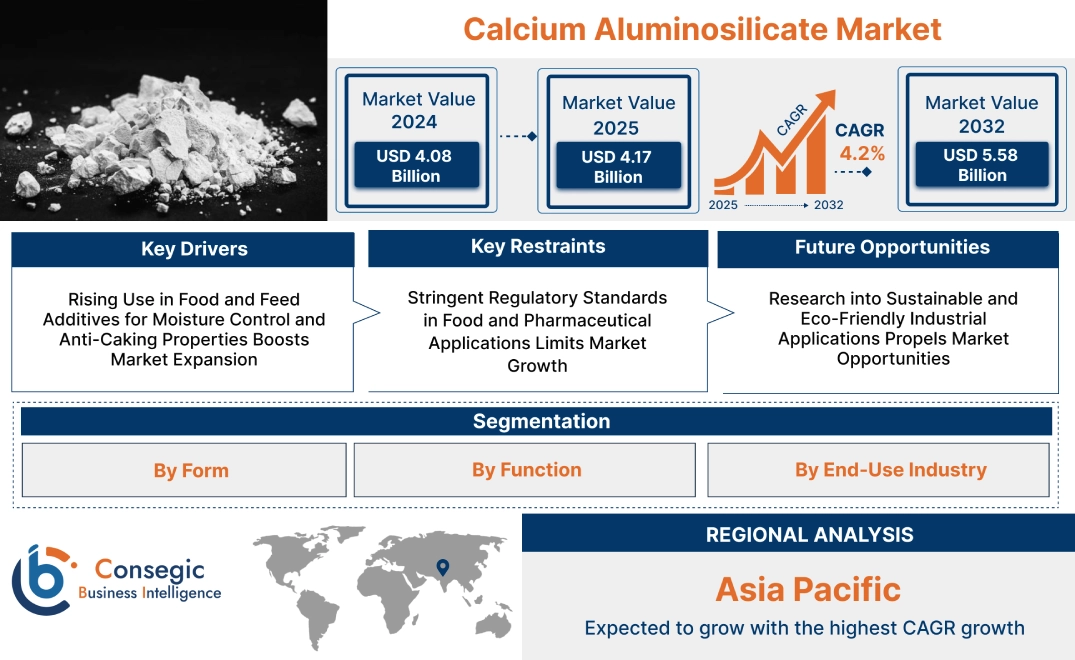
Calcium Aluminosilicate Market size is estimated to reach over USD 5.58 Billion by 2032 from a value of USD 4.08 Billion in 2024 and is projected to grow by USD 4.17 Billion in 2025, growing at a CAGR of 4.2% from 2025 to 2032.
Calcium Aluminosilicate Market Scope & Overview:
Calcium aluminosilicate is a mineral compound composed of calcium, aluminum, and silicon oxides, widely used in industries such as pharmaceuticals, food additives, and construction. It serves as an anti-caking agent, thermal insulator, and structural component in various formulations, enhancing product stability and performance. Its high-temperature resistance and chemical inertness make it suitable for applications requiring durability and reliability.
Key features include excellent moisture absorption, heat resistance, and structural reinforcement properties. The material is utilized in pharmaceutical excipients for controlled drug release, in food processing to prevent clumping, and in refractory applications for thermal stability. Its compatibility with advanced manufacturing techniques ensures consistent performance across diverse industrial applications.
Sectors such as healthcare, food production, and building materials incorporate the chemical to improve efficiency and quality in product formulations. Advancements in material science continue to enhance its functional properties, supporting its role in specialized industrial applications.
Calcium Aluminosilicate Market Dynamics - (DRO):
Key Drivers:
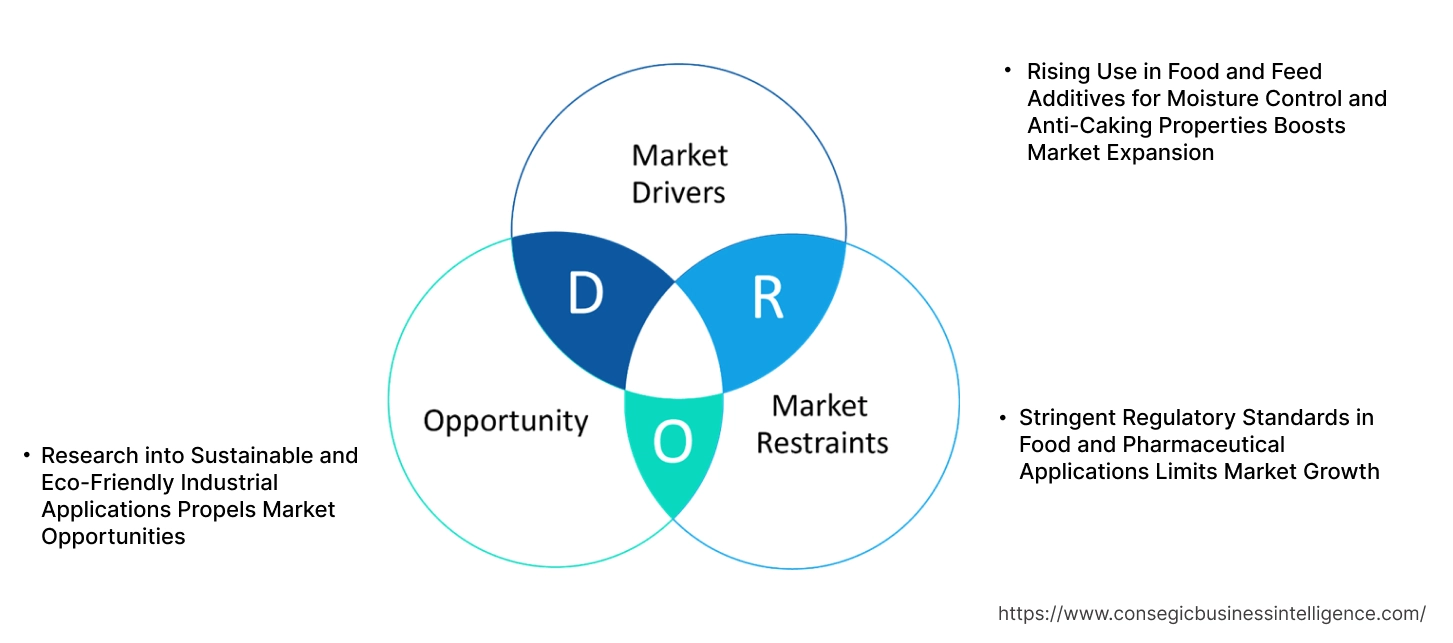
Rising Use in Food and Feed Additives for Moisture Control and Anti-Caking Properties Boosts Market Expansion
In the food sector, calcium aluminosilicate prevents clumping in powdered ingredients, improves flowability, and extends product shelf life in items such as seasonings, dairy powders, and baking mixes. While in animal feed production it enhances nutrient stability, prevents spoilage, and ensures uniform feed composition, supporting better livestock nutrition. As manufacturers prioritize high-quality, free-flowing products, the use of natural and non-toxic anti-caking agents is expanding. Regulatory approvals for safe consumption in food and feed applications are further driving market growth. Additionally, the rising focus on packaged and processed food demand in emerging economies is increasing the need for moisture-resistant additives. As industries shift toward improved product consistency and quality, these trends will continue to fuel calcium aluminosilicate market growth, strengthening its role in food safety and preservation.
Key Restraints:
Stringent Regulatory Standards in Food and Pharmaceutical Applications Limits Market Growth
Government agencies such as FDA, EFSA, and other international bodies enforce safety, purity, and toxicity assessments before approving its use in consumer products. Compliance with stringent food additive and pharmaceutical excipient regulations increases costs for manufacturers, requiring rigorous testing, documentation, and adherence to evolving global standards. The demand for transparency in ingredient sourcing and production processes has led to additional compliance requirements, slowing product approvals in highly regulated markets. Variability in regulations across different regions further complicates global market entry, limiting expansion opportunities for new market players. While advancements in clean-label and natural formulations are influencing product innovation, meeting diverse regulatory standards remains a challenge. Addressing compliance hurdles through scientific validation and sustainable formulation practices is critical for ensuring calcium aluminosilicate market expansion in food and pharmaceutical applications.
Future Opportunities:
Research into Sustainable and Eco-Friendly Industrial Applications Propels Market Opportunities
With industries seeking low-carbon alternatives, researchers are exploring energy-efficient processing methods that reduce environmental impact while maintaining material performance. Advances in waste recovery, recycling technologies, and bio-based formulations are enabling the production of environmentally sustainable additives for construction, ceramics, and coatings. Additionally, the growth of green manufacturing initiatives is expanding the use of calcium aluminosilicate in insulating materials, lightweight composites, and pollution control applications. Companies investing in circular economy strategies and alternative raw material sourcing are well-positioned to benefit from regulatory incentives and consumer preference for eco-conscious products. As industries continue to prioritize sustainability and environmental responsibility, the development of high-performance, low-emission applications is expected to create significant calcium aluminosilicate market opportunities, reinforcing its role in sustainable industrial solutions.
Calcium Aluminosilicate Market Segmental Analysis :
By Form:
By form, the market is segmented into powder, granules, and fibers.
The powder segment held the largest calcium aluminosilicate market share in 2024.
- The powdered form is widely used across industries such as pharmaceuticals, food & beverages, and petrochemicals due to its high absorption capacity and ease of mixing.
- The demand for finely milled calcium aluminosilicate powder is increasing, particularly in anti-caking agents and stabilizing applications.
- Calcium aluminosilicate market analysis indicates that powder form is preferred for applications requiring uniform dispersion and controlled reactivity.
- Segmental trends suggest that ongoing advancements in powder processing techniques are improving the efficiency of its industrial applications.
The fibers segment is expected to experience the fastest CAGR during the forecast period.
- Fiber form is gaining popularity in high-temperature insulation and refractory applications, particularly in the construction and metallurgy industries.
- The need for durable, heat-resistant fiber-based materials is increasing in chemical processing and advanced manufacturing sectors.
- Calcium aluminosilicate market trends highlight the rise in fiber-based solutions, especially for structural reinforcement and thermal insulation.
- With advancements in composite materials and industrial applications, fibers are contributing to its market growth.
By Function:
By function, the calcium aluminosilicate market is categorized into adsorption, ion exchange, anti-caking, stabilization, catalysis, and others.
The anti-caking segment held the largest market share in 2024.
- Calcium aluminosilicate is widely used as an anti-caking agent in food, pharmaceuticals, and industrial applications, ensuring product flowability and stability.
- The need for effective moisture control and anti-clumping additives is rising, particularly in powdered food products, supplements, and chemical formulations.
- Calcium aluminosilicate market analysis highlights its role in preventing agglomeration, maintaining product quality and extending shelf life.
- Segmental trends analysis suggest that new innovations in anti-caking technology are enhancing efficiency and safety standards.
The catalysis segment is expected to have the fastest CAGR during the forecast period.
- It is widely used as a catalyst in petrochemical refining, environmental remediation, and advanced manufacturing.
- The need for efficient and cost-effective catalytic materials is increasing in industries seeking high-performance chemical conversion and pollution control.
- Segmental trends highlight the expanding use of this material in next-generation catalyst formulations, improving industrial efficiency.
- With growing investments in green chemistry and sustainable industrial processes, catalysis applications are driving calcium aluminosilicate market expansion.
By End-Use Industry:
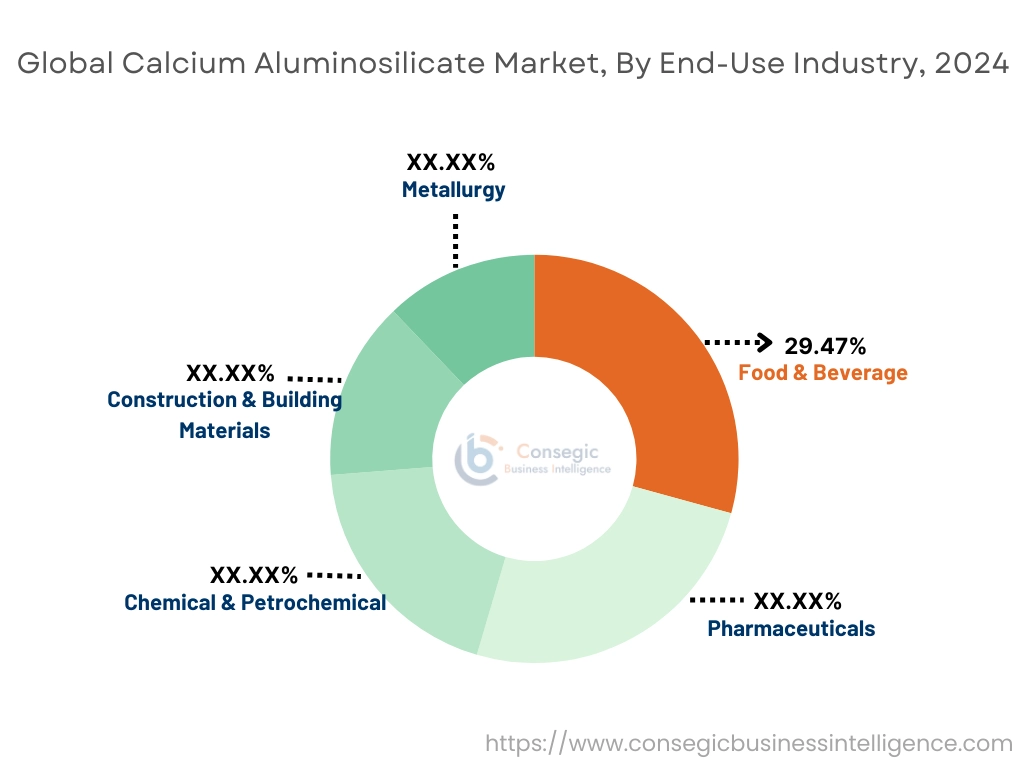
By end-use industry, the market is segmented into food & beverage, pharmaceuticals, chemical & petrochemical, construction & building materials, and metallurgy.
The food & beverage segment held the largest calcium aluminosilicate market share of 29.47% in 2024.
- Calcium aluminosilicate forms a critical ingredient in food processing, serving as an anti-caking and stabilizing agent in various products.
- The need for safe, FDA-approved food additives is driving its adoption in powdered food mixes, seasonings, and instant products.
- Segmental analysis suggests that regulatory approvals and increased focus on food safety are contributing to steady market demand.
- Calcium aluminosilicate market trends indicate that the expansion of the processed food sector is further driving the need for high-performance food additives.
The pharmaceuticals segment is anticipated to experience the fastest CAGR during the forecast period.
- Calcium aluminosilicate is widely used as an excipient in pharmaceutical formulations, improving tablet compression, stability, and controlled drug release.
- The need for multifunctional excipients in pharmaceutical manufacturing is fueling innovation in drug formulations integrating the mineral.
- Segmental trends show increasing adoption in medical applications, particularly in moisture-sensitive drug formulations.
- With growing advancements in pharmaceutical R&D, this segment is playing a key role in calcium aluminosilicate market growth.
Regional Analysis:
The regions covered are North America, Europe, Asia Pacific, the Middle East and Africa, and Latin America.
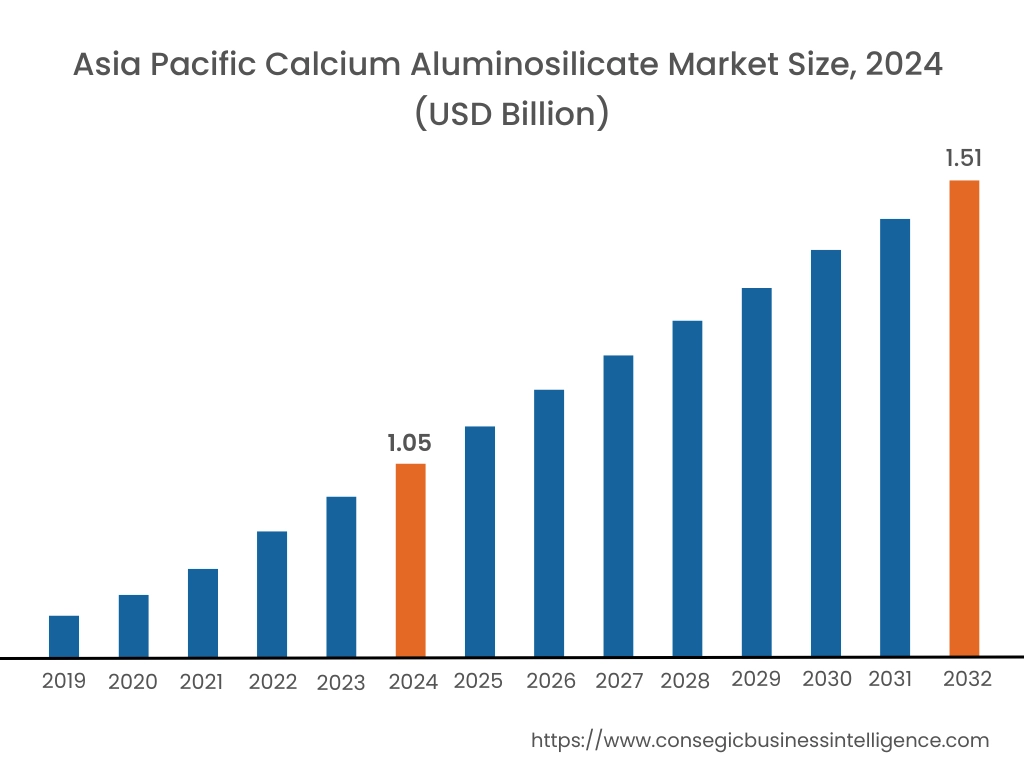
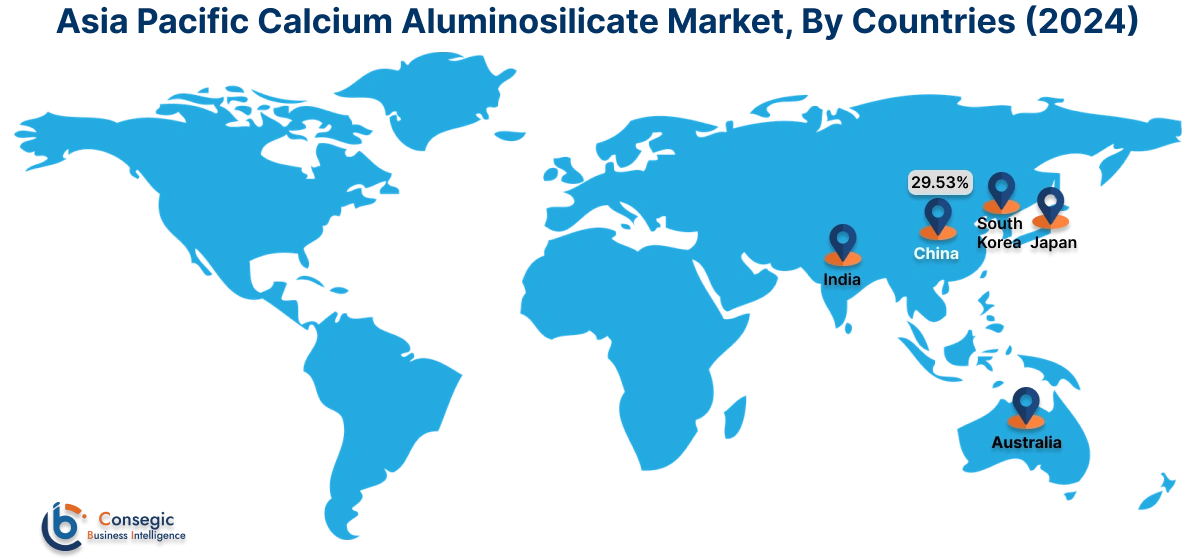
Asia Pacific region was valued at USD 1.05 Billion in 2024. Moreover, it is projected to grow by USD 1.08 Billion in 2025 and reach over USD 1.51 Billion by 2032. Out of this, China accounted for the maximum revenue share of 29.53%. The Asia Pacific region is witnessing rapid growth in the calcium aluminosilicate industry, propelled by urbanization, industrial expansion, and increasing environmental awareness. Countries like China, India, and Japan are investing heavily in infrastructure development, leading to increased demand for construction materials that incorporate this advantageous chemical. Additionally, the region's agricultural sector benefits from its use in improving soil health and crop yields. The expansion of water treatment facilities to address pollution concerns further drives the calcium aluminosilicate market demand in this region.
North America is estimated to reach over USD 1.85 Billion by 2032 from a value of USD 1.37 Billion in 2024 and is projected to grow by USD 1.40 Billion in 2025. In North America, the market is primarily propelled by the agriculture and water treatment sectors. The United States, in particular, has seen substantial adoption of calcium aluminosilicate due to its efficacy in soil conditioning and nutrient management. Its ion exchange and adsorption properties make it valuable for removing contaminants and improving water quality, addressing concerns over water scarcity and safety. The region's focus on sustainable farming practices and environmental conservation further amplifies the calcium aluminosilicate market demand.
Europe exhibits a robust market, driven by stringent environmental regulations and a strong emphasis on sustainable agricultural practices. Countries such as Germany, the United Kingdom, and France are at the forefront, utilizing it to enhance soil structure and fertility. The material's application in water treatment processes to remove heavy metals and toxins aligns with the region's commitment to environmental sustainability. This focus presents a significant calcium aluminosilicate market opportunity for innovative applications and product development.
Latin America's market is gradually gaining traction, influenced by a growing emphasis on sustainable agriculture and environmental management. Countries such as Brazil and Mexico are exploring its use for soil enhancement and water purification applications. The region's abundant mineral resources provide a readily available raw material source, reducing dependence on imports and fostering local industry growth. As awareness of environmental conservation and sustainable practices spreads, the market is poised to experience steady growth, offering opportunities for both local and international stakeholders.
The Middle East and Africa are emerging markets for calcium aluminosilicate, with growth potential linked to increasing construction activities and the demand for effective water treatment solutions. The arid climate in many parts of these regions necessitates efficient water management practices, where its beneficial properties are required. While challenges such as limited awareness and technological adoption persist, the region offers a promising landscape for the expansion of the market as part of broader development initiatives.
Top Key Players & Market Share Insights:
The calcium aluminosilicate market is highly competitive with major players providing products and services to the national and international markets. Key players are adopting several strategies in research and development (R&D), product innovation, and end-user launches to hold a strong position in the global calcium aluminosilicate market. Key players in the calcium aluminosilicate industry include -
- Arkema Group (France)
- Clariant AG (Switzerland)
- CJ Corporation (South Korea)
- Anhui Mingmei MinChem Co. Ltd. (China)
- Blue Pacific Minerals Ltd. (New Zealand)
- Tosoh Corporation (Japan)
- Honeywell International Inc. (USA)
- R. Grace & Co. (USA)
- Zeolyst International (USA)
- Eurecat (France)
Recent Industry Developments :
Product Launches:
- In November 2023, Blue Pacific Minerals launched the new Fixine®, an equine feed formulation containing calcium aluminosilicate. The new formula boasts enhanced customer experience and longer shelf-life.
Calcium Aluminosilicate Market Report Insights:
| Report Attributes | Report Details |
| Study Timeline | 2019-2032 |
| Market Size in 2032 | USD 5.58 Billion |
| CAGR (2025-2032) | 4.2% |
| By Form |
|
| By Function |
|
| By End-Use Industry |
|
| By Region |
|
| Key Players |
|
| North America | U.S. Canada Mexico |
| Europe | U.K. Germany France Spain Italy Russia Benelux Rest of Europe |
| APAC | China South Korea Japan India Australia ASEAN Rest of Asia-Pacific |
| Middle East and Africa | GCC Turkey South Africa Rest of MEA |
| LATAM | Brazil Argentina Chile Rest of LATAM |
| Report Coverage |
|
Key Questions Answered in the Report
How big is the Calcium Aluminosilicate Market? −
Calcium Aluminosilicate Market size is estimated to reach over USD 5.58 Billion by 2032 from a value of USD 4.08 Billion in 2024 and is projected to grow by USD 4.17 Billion in 2025, growing at a CAGR of 4.2% from 2025 to 2032.
What specific segmentation details are covered in the Calcium Aluminosilicate Market report? +
The Calcium Aluminosilicate market report includes specific segmentation details for form, function and end-use industry.
Which is the fastest-growing region in the Calcium Aluminosilicate Market? +
Asia Pacific is the fastest-growing region in the Calcium Aluminosilicate market. These trends are encouraged by urbanization, industrial expansion, and increasing environmental awareness.
Who are the major players in the Calcium Aluminosilicate Market? +
The key participants in the Calcium Aluminosilicate market are Arkema Group (France), Clariant AG (Switzerland), Tosoh Corporation (Japan), Honeywell International Inc. (USA), W.R. Grace & Co. (USA), Zeolyst International (USA), Eurecat (France), CJ Corporation (South Korea), Anhui Mingmei MinChem Co. Ltd. (China) and Blue Pacific Minerals Ltd. (New Zealand).
Overview
Reputation & Certifications


Our Services
- Market Intelligence & Forecasting
- Custom Research Solutions
- Market Entry Strategy
- Competitive Intelligence
- Customer Insights
- Industry Innovation Analysis
- Investment Advisory