Jump to Content
Cerebral Palsy Market - Size, Share, Industry Trends, and Forecasts (2024 - 2031)
Cerebral Palsy Market Scope & Overview:
Cerebral palsy is a group of neurological disorders that affect body movement, muscle coordination, and posture. It originates from brain damage or abnormalities occurring inside the developing brain. Brain damage disrupts the brain's ability to control movement and maintain posture and balance in infancy or early childhood. The types of this condition are classified based on the primary movement disorder, such as spastic, athetoid, or ataxic cerebral palsy.
Prominent symptoms include muscle stiffness or tightness called spasticity, weakness in limbs, difficulty controlling movements or ataxia, involuntary movements known as athetosis, and delayed motor development. Individuals with spastic CP experience stiff muscles, while those with athetoid writhing movements. Ataxic cerebral palsy is characterized by poor balance and coordination.
Cerebral Palsy Market Size:
Cerebral Palsy Market size is growing with a CAGR of 5.1% during the forecast period (2024-2031), and the market is projected to be valued at USD 4,006.77 Million by 2031 from USD 2,714.84 Million in 2023.

Cerebral Palsy Market Dynamics - (DRO):
Key Drivers:
Growing Awareness and Emphasis on Early Intervention is Accelerating Market Growth
The growing awareness and emphasis on early intervention has emerged as a crucial driver in the cerebral palsy market The rising prevalence and incidence of the disorder among children is creating awareness and requirements for effective management of the condition.
An early intervention refers to management solutions applied in the first year or two after birth. Governments and medical professionals are increasingly recognizing the significance of early identification, analysis, and intervention to improve outcomes and quality of life for children with this condition.
- For instance, Disabilities Education Act (IDEA) is a federal law in the U.S. that ensures children with disabilities such as CP receive appropriate education and related services. Part C of IDEA provides early intervention services including physical therapy, occupational therapy, speech-language therapy, special instruction, and other related services for infants and toddlers with developmental delays or disabilities.
- Part B of IDEA provides special education and related services to children with disabilities ages 3-22. It ensures that these children receive a free appropriate public education tailored to their individual needs. This act positively influences is the adoption of early intervention in the effective management of CP.
Early intervention allows healthcare providers to tailor treatment to a child's specific needs as they grow. This also involves spasticity management and rehabilitation, which begin in early childhood. Overall, early intervention for this disorder is a critical step in improving the quality of life for affected children. By addressing the condition early on, it allows healthcare professionals to optimize developmental outcomes and minimize long-term disabilities.
Advancements in the Management of the Disorder is Fuelling the Growth of the Market
The growing requirements for effective management solutions is creating the requirement for the development of innovations and advancements in cerebral palsy market analysis. CP treatment is experiencing significant drive due to advances in therapeutic approaches, medical technologies in assistive devices, and rehabilitation strategies.
The integration of robotic-assisted therapy allows for more intensive and precise interventions. Additionally, pharmaceutical innovations play a crucial role in the development of more effective medications, such as advanced formulations of botulinum toxin and novel muscle relaxants.
- For instance, in July 2021 Allergan, an AbbVie company, announced the USFDA approval for a label addition of BOTOX to include eight new muscles for the treatment of upper limb spasticity in adults. The new muscles for treatment include additional muscles of the elbow and forearm as well as intrinsic hand muscles, and thumb muscles.
Additionally, advancements in assistive technologies such as smart prosthetics and communication devices have created a new market segment while improving patient independence and quality of life. Overall, the convergence of medical advancements and technological innovations is driving significant trends in the cerebral palsy market.
Key Restraints :
High Treatment Cost is Hampering the Market Growth
The high cost of treating cerebral palsy is a significant barrier to cerebral palsy market growth. This condition often requires lifelong care, including therapies, surgeries, medications, and assistive devices. The cumulative cost of these treatments is substantial, especially in developing countries where healthcare infrastructure and insurance coverage are limited.
High costs lead to several constraints including limited access to treatment, reduced quality of life, and financial burden among others. Owing to the high treatment cost families, particularly those in lower-income brackets, struggle to afford the necessary treatments, leading to delayed or inadequate care.
Additionally, delayed or insufficient treatment negatively impacts a child's development, leading to long-term physical, cognitive, and social impairments. The financial strain of continuous treatment affects their overall well-being. Moreover, high treatment costs limit the demand for certain therapies and devices, hindering cerebral palsy market share.
Future Opportunities :
Growing Research and Development on Stem Cell Therapy is Expected to Create Potential Growth Opportunities
The emergence of stem cell therapy presents a novel frontier in treatment offering opportunities for therapeutic advancements in the cerebral palsy market. Stem cells, particularly mesenchymal stem cells and neural stem cells demonstrate potential in regenerating damaged neural tissue and promoting functional recovery in the damaged brain cells responsible for the abnormality.
The ability of these cells to differentiate into various cell types is expected to boost further research and market analysis. This innovative approach is attracting substantial research investment and clinical interest due to the potential to address underlying neurological conditions.
- For instance, in September 2024, Researchers from UMC Utrecht received a grant for a new study on stem cell therapy analysis for newborns with brain damage that leads to the development of this abnormality.
- The funding, provided by Zorginstituut Nederland, ZonMw, the Brain Foundation Netherlands, and the Vrienden UMC Utrecht & Wilhelmina Children's Hospital, will enable a clinical trial to test the efficacy of this promising treatment. The study, known as iSTOP-CP, is a collaborative effort between UMC Utrecht and Maastricht UMC+.
Overall, the intersection of stem cell research and cerebral palsy market holds immense potential. As scientific understanding advances, stem cell therapies have the potential to revolutionize the management of this complex neurological condition for improved quality of life for affected individuals.
Top Key Players & Market Share Insights:
The Cerebral Palsy market is highly competitive with major players providing precise measurement between objects to the national and international markets. Key players are adopting several strategies in research and development (R&D), product innovation, and end-user launches to hold a strong position in the global Cerebral Palsy market. Key players in the market scope include-
- AbbVie Inc (U.S.)
- Novartis AG (Switzerland)
- Ottobock (Germany)
- Bionic Power Inc. (Canada)
- Medtronic (Ireland)
- Merz Pharma (Germany)
- Tobii Dynavox AB (Publ) (Sweden)
- Invacare Corporation (U.S.)
Cerebral Palsy Market Segmental Analysis :
By Type:
Based on type, the market is categorized into spastic cerebral palsy, dyskinetic cerebral palsy, ataxic cerebral palsy, and mixed cerebral palsy.
Trends in the Type:
- The rising trends towards early detection through diagnostic tools.
- Increasing recognition of overlapping symptoms for mixed conditions.
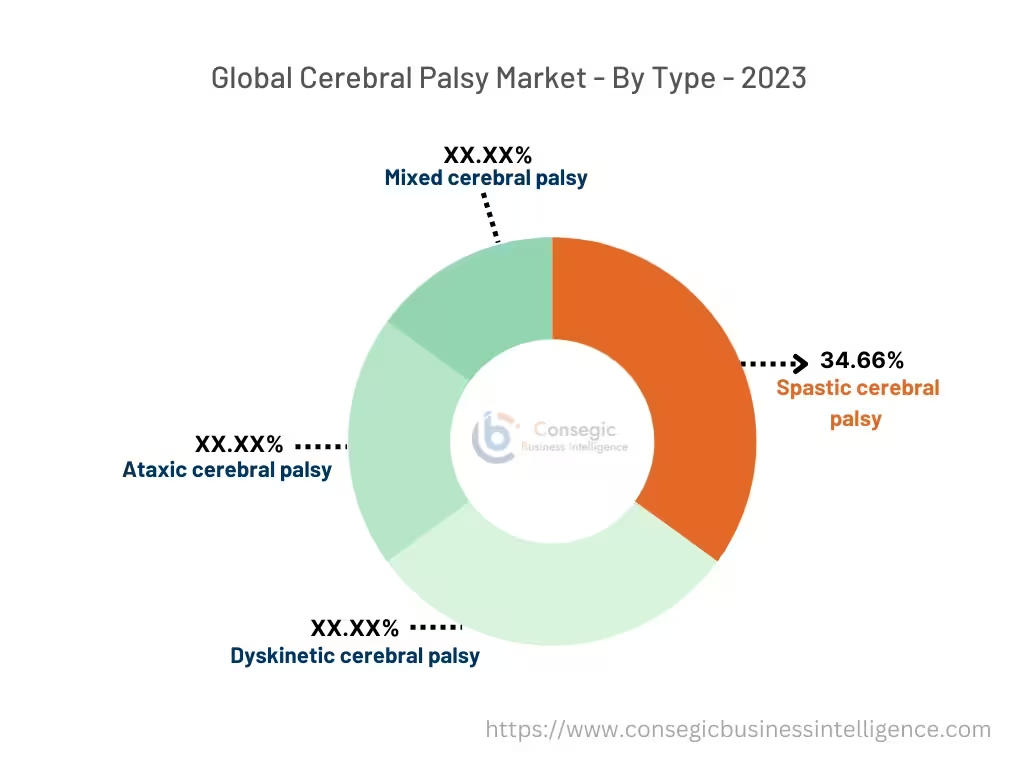
The spastic cerebral palsy segment accounted for the largest share of 34.66% in 2023.
Spastic type is the most common form of this condition. People with this condition experience muscle stiffness and awkward movements. There are several types of spastic abnormality such as spastic hemiplegia/hemiparesis, spastic diplegia/diparesis, and spastic quadriplegia/quadriparesis.
- Spastic hemiplegia/hemiparesis primarily affects one side of the body, often including the arms and legs. Individuals with this condition have shorter limbs and experience speech delays.
- Spastic diplegia/diparesis affects the legs, causing muscle stiffness and difficulty walking. The arms and face are also affected in some cases but to a lesser extent. Individuals with this condition often require assistive devices including walkers or braces.
- Spastic quadriplegia/quadriparesis is the most severe form affecting all four limbs and is often accompanied by intellectual disability. Individuals with this condition experience severe muscle stiffness, difficulty speaking, and frequent seizures.
- This type with a high prevalence severely impacts the quality of life of individuals creating the necessity for treatment solutions.
- For instance, according to the Autism and Developmental Disabilities Monitoring (ADDM) CP Network data, around 82.9% of the children in Alabama, Georgia, Missouri, and Wisconsin identified with the condition have spastic type abnormality.
- Hence, the higher cases and prevalence analysis are boosting the spastic cerebral palsy market.
The mixed cerebral palsy segment is expected to grow at the fastest CAGR over the forecast period.
- Mixed type encompasses a range of symptoms that do not align with any specific type of disorder.
- Individuals with mixed conditions exhibit a combination of characteristics, such as spasticity in some muscle groups and hypotonia or low muscle tone in others. This diverse presentation leads to a wide range of challenges, affecting motor function, sensation, and cognition.
- Children diagnosed with mixed-type have sustained damage to the motor control centers in several parts of the brain.
- Mixed type requires a comprehensive, individualized approach to treatment and management considering the complex nature of symptoms and their impact on daily life.
- Based on cerebral palsy market analysis, significant development in the identification of multiple symptoms, better understanding of complex neurological patterns, and adoption of personalized treatment options is fueling the segment in the cerebral palsy market trend.
By Treatment:
The treatment segment is categorized into medications, surgery, therapies, and others.
Trends in the Treatment:
- Technology-driven rehabilitation is positively impacting the segment.
- Personalized medicine approaches to improve treatment outcomes.
- Stem cell therapy, gene therapy, and regenerative medicine applications are influencing the development of innovative treatment solutions.
The medications segment accounted for the largest share in 2023.
- Medication is a dosage form that contains one or more active and inactive ingredients used to improve and relieve symptoms. Medications serve as the primary and first line of treatment for any disease.
- Several medications help alleviate certain symptoms including muscle stiffness, sleep disturbances, seizures, constipation, pain, and excessive drooling.
- Common medications include benzodiazepines, dantrolene sodium, baclofen, tizanidine, botulinum toxins, phenol, alcohol, and intrathecal baclofen among others.
- These medications fall into these categories: anticholinergics to control involuntary movements, anticonvulsants for seizures, antidepressants for mood disorders, antispastics to relax muscles, anti-inflammatories for pain relief, and stool softeners to address digestive issues among others.
- Ongoing research and development is leading to the introduction of novel medications for the management of the condition. Additionally, the growing concerns over the occurrence of this condition in children are positively impacting the development of innovative medications.
- For instance, according to the data provided by the Centers for Disease Control and Prevention in 2022, it is stated that the disorder is the most common motor disability in childhood with prevalence estimates of this condition ranging from 1 to nearly 4 per 1,000 live births or per 1,000 children.
- Overall, medication plays a crucial role in managing symptoms of abnormality. While existing treatments offer relief, ongoing research, and regulatory approvals are expanding therapeutic options in the cerebral palsy market.
The therapy segment is expected to grow at the fastest CAGR over the forecast period.
- Therapy is a group of management solutions such as training and exercise that support overall improvement in the symptoms. Several therapies such as physical therapy, occupational therapy, and speech therapy amongst others.
- Physical therapy is a prominent therapy for treatment, focusing on enhancing muscle strength, flexibility, balance, and motor skills. Therapists design individualized exercise programs to improve mobility, posture, and coordination.
- Occupational therapy helps individuals with cerebral palsy develop independence in daily living activities. Therapists teach skills including dressing, eating, and using assistive devices to promote self-reliance.
- Speech therapy addresses communication difficulties, including speech clarity, articulation, and language comprehension. Therapists use techniques such as speech exercises, sign language, or augmentative and alternative communication (AAC) devices.
By End Use :
The end-use segment is categorized into hospitals, physiotherapy centers, home care, and others.
Trends in the End Use:
- Increasing establishment of specialized treatment centers.
- Rising adoption of telehealth and remote monitoring solutions.
The hospital segment accounted for the largest share in the year 2023.
- Hospitals serve a crucial role as primary centers for comprehensive treatment, offering a sophisticated ecosystem of medical expertise and advanced technologies.
- Modern hospital-based management begins in the neonatal units where high-risk infants are closely monitored for early signs of neurological complications.
- Additionally, hospitals are equipped with state-of-the-art neuroimaging techniques enabling early detection and precise diagnosis of the disorder.
- The inpatient treatment approach in hospitals has evolved to encompass a multidisciplinary approach making availability of various specialists in a single place. Moreover, hospitals have increasingly invested in outpatient facilities equipped with specialized equipment.
- For instance, in February 2023, Medcare announced the launch of the first and only integrated in for the disorder in UAE. Located inside the Medcare Orthopaedics and Spine Hospital, the specialized clinic provides multidisciplinary care to patients with this abnormality helping them effectively manage the condition.
- Overall, hospitals serve a pivotal role in disorder management, providing comprehensive care from early detection to ongoing treatment. With state-of-the-art facilities and multidisciplinary teams, hospitals are at the forefront of improving the quality of life for individuals with cerebral palsy opportunities.
The home care segment is expected to grow at the fastest CAGR over the forecast period.
- Home care refers to the provision of medical, social, or therapeutic treatment and assistive care by licensed professionals to individuals in their residences. This type of care is designed to help people who are aging, disabled, chronically ill, or recovering from a medical event to improve their quality of life while receiving healthcare services.
- Home care for individuals in this condition is a crucial aspect of their overall well-being. It involves a comprehensive approach that addresses their physical, emotional, and cognitive needs in catering cerebral palsy market demand.
- Rising demand for home-based rehabilitation and therapy services, growing availability of portable assistive devices, and increased adoption of telehealth are accelerating the segment trend in the cerebral palsy market.
Cerebral Palsy Market Report Insights :
| Report Attributes | Report Details |
| Study Timeline | 2018-2031 |
| Market Size in 2031 | USD 4,006.77 Million |
| CAGR (2024-2031) | 5.1% |
| By Type |
|
| By Treatment |
|
| By End User |
|
| By Region |
|
| Key Players |
|
| North America | U.S. Canada Mexico |
| Europe | U.K. Germany France Spain Italy Russia Benelux Rest of Europe |
| APAC | China South Korea Japan India Australia ASEAN Rest of Asia-Pacific |
| Middle East and Africa | GCC Turkey South Africa Rest of MEA |
| LATAM | Brazil Argentina Chile Rest of LATAM |
| Report Coverage |
|
Regional Analysis:
The regional segment includes North America, Europe, Asia Pacific, the Middle East and Africa, and Latin America.
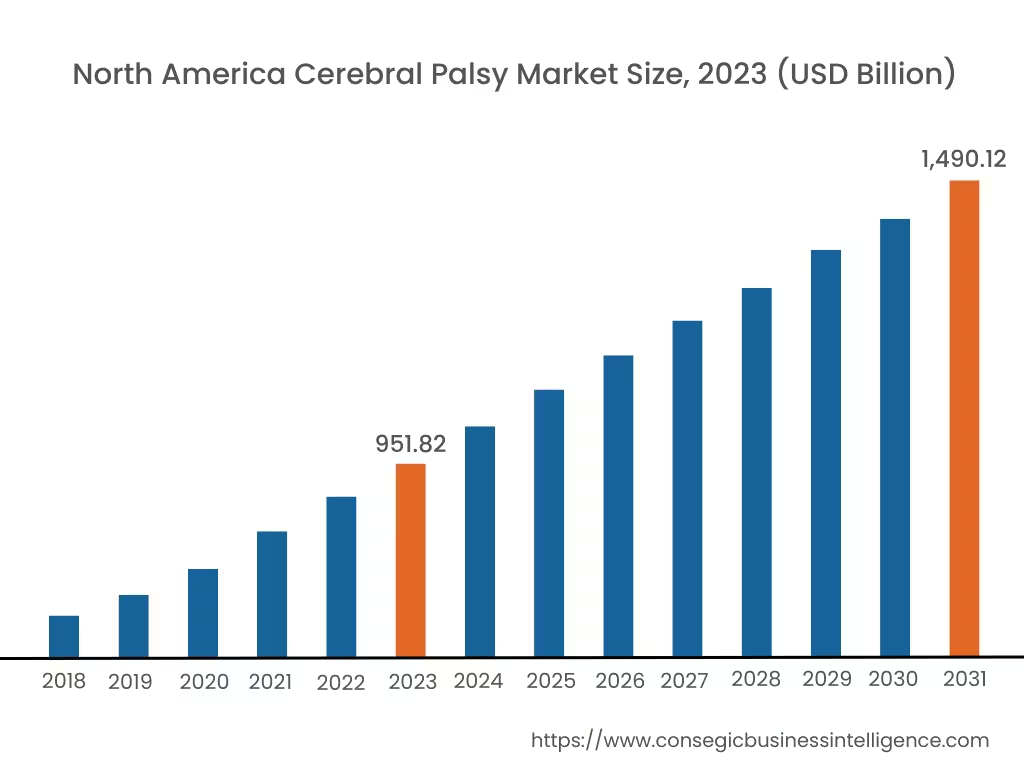
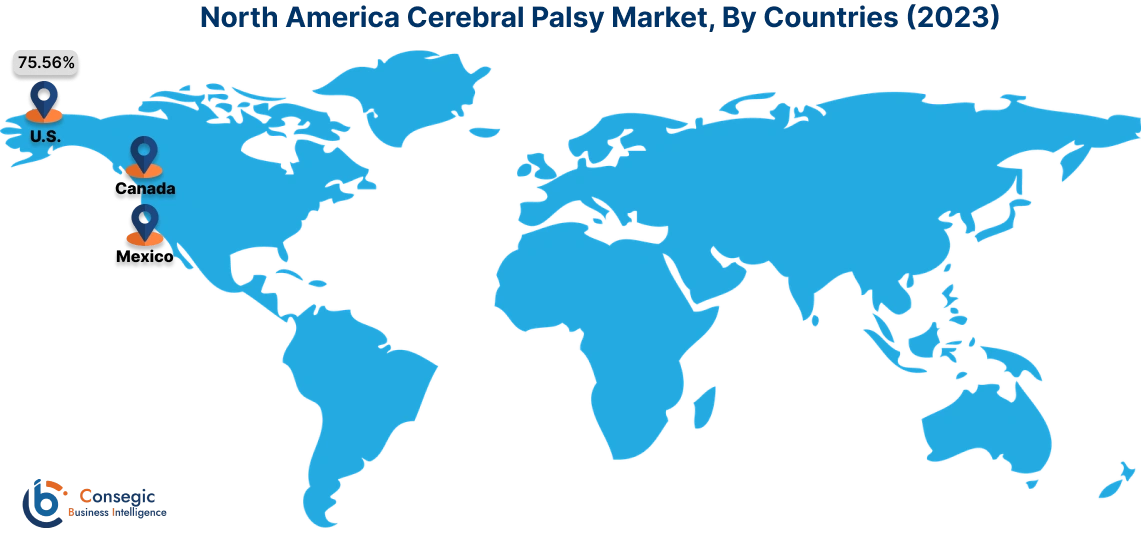
In 2023, North America accounted for the highest market share at 35.06% and was valued at USD 951.82 Million and is expected to reach USD 1,490.12 Million in 2031. In North America, the U.S. accounted for the highest share of 75.56% during the base year of 2023. The market is gaining significant drive in North America owing to the confluence of multiple factors such as the growing prevalence, rising awareness among individuals and healthcare professionals for early diagnosis and treatment, a robust healthcare system, and supportive government initiatives and policies among others.
Additionally, the rising awareness about this condition and its impact on individuals and families has fueled the demand for effective treatments and therapies to boost cerebral palsy market size. This increased awareness has also spurred research and development efforts, leading to innovative therapies and technologies. Moreover, the region boasts a well-developed healthcare infrastructure with advanced diagnostic and treatment facilities. Furthermore, supportive government initiatives and policies aimed at improving the quality of life for individuals with disabilities have contributed to market growth.
- For instance, in March 2023, on the first day of Cerebral Palsy Awareness Month, Congressman Steve Cohen (TN-09) introduced the bipartisan Cerebral Palsy Research Program Authorization Act, to investigate the prevention, diagnosis, treatment, and societal costs of cerebral palsy.
Europe is growing at a CAGR of 5.7% over the forecast period. The European market for cerebral palsy treatment is experiencing expansion. Several factors are driving this rise, including increased awareness of the condition, advancements in medical technology, and supportive government initiatives. As healthcare systems improve and diagnostic capabilities increase, more cases are being identified. This growing patient population creates a significant demand for effective treatments and therapies. Governments in European countries support the need for early intervention and comprehensive care for individuals with this condition, leading to increased funding for the healthcare industry.
The Asia-Pacific region is experiencing steady growth in the market, driven by the growing prevalence of the condition, rising healthcare expenditure, and improvement in healthcare infrastructure. As healthcare infrastructure improves and awareness about the condition rises, more cases are being diagnosed and reported. Growing healthcare investments and expanding access to pharmaceuticals in these countries also propel the market.
The Middle East and Africa (MEA) region is witnessing a notable surge in demand for treatment solutions. This trend is primarily driven by the higher prevalence of this condition within the African population. Perinatal causes, such as premature birth, low birth weight, and infections, are identified as significant risk factors contributing to the increased incidences in African children. Additionally, the burgeoning healthcare sector in the Middle East is playing a pivotal role in driving demand. Countries in this region are investing heavily in modern healthcare infrastructure and advanced medical technologies. This increased investment is facilitating the availability of effective treatment options for individuals with this condition, including therapies, assistive devices, and surgical interventions. The combined impact of these factors is creating a favorable environment for the cerebral palsy market expansion in the MEA region.
Latin America is an emerging region. The combination of increasing prevalence, growing awareness, technological advancements, government support, and rising disposable income is driving the significant expansion of the cerebral palsy market in Latin America. These factors collectively present a promising opportunity for healthcare providers, pharmaceutical companies, and medical device manufacturers to develop and deliver innovative solutions to address the needs of individuals with cerebral palsy market share in Latin America.
Recent Industry Developments :
Product Approvals:
- In May 2024, CYBERDYNE Inc. announced that the Company obtained marketing clearance from the United States Food and Drug Administration for its Medical HAL Lower Limb Type to expand the indication to cerebral palsy.
- In July 2021 Allergan, an AbbVie company, announced the USFDA approval for a label addition of BOTOX to include eight new muscles for the treatment of upper limb spasticity in adults. The new muscles for treatment include additional muscles of the elbow and forearm as well as intrinsic hand muscles, and thumb muscles.
- In July 2020, Allergan a subsidiary of AbbVie company, announced that the U.S. Food and Drug Administration (FDA) approved a supplemental Biologics License Application (sBLA) that supports expanded use of BOTOX for the treatment of spasticity in pediatric patients 2 years of age and older, including those with lower limb spasticity caused by this abnormality.
Acquisitions:
- In May 2024, Tobii Dynavox AB, a player in assistive communication, entered into an agreement to acquire all business activities and assets of its reselling partners Linkassistive Pty Ltd and Link Assistive New Zealand. The Transaction solidifies Tobii Dynavox's presence in the Australian and New Zealand markets, supporting people with disabilities to communicate more effectively.
- In June 2023, Tobii Dynavox AB announced an agreement to acquire German companies EIYott GmbH and Rehadapt Engineering GmbH & Co. KG (together "Rehadapt"). Rehadapt is a worldwide provider of mounting solutions for assistive technology. Tobii Dynavox will pay USD 16.22 million in cash, on a cash and debt free basis.
Key Questions Answered in the Report
How big is the cerebral palsy market? −
In 2023, the cerebral palsy market is USD 2,714.84 Million.
Which is the fastest-growing region in the cerebral palsy market? +
Europe is the fastest-growing region in the cerebral palsy market.
What specific segmentation details are covered in the cerebral palsy market? +
Type, Treatment, and End Use segmentation details are covered in the cerebral palsy market.
Who are the major players in the cerebral palsy market? +
AbbVie Inc, Novartis AG, and Medtronic are some of the well-established players in the market.
Overview
Reputation & Certifications


Our Services
- Market Intelligence & Forecasting
- Custom Research Solutions
- Market Entry Strategy
- Competitive Intelligence
- Customer Insights
- Industry Innovation Analysis
- Investment Advisory