Jump to Content
Coiled Tubing (CT) Market - Size, Industry Share, Growth Trends and Forecasts (2026-2034)
Coiled Tubing (CT) Market Size:
Coiled Tubing (CT) Market size is estimated to reach over USD 10.77 Billion by 2034 from a value of USD 6.53 Billion in 2025 and is projected to grow by USD 6.80 Billion in 2026, growing at a CAGR of 5.2% from 2026 to 2034
Coiled Tubing (CT) Market Key Takeaways
- Rising oil & gas exploration activities and investments in well intervention services are driving market growth.
- Asia Pacific held a significant market share in 2025, supported by growing energy demand.
- Well intervention was the leading application segment, driven by increasing demand for well maintenance.
- Growing focus on mature oilfield optimization is boosting the adoption of coiled tubing for cleanout and stimulation operations.
- Advancements in high-strength tubing materials and real-time monitoring technologies are improving.
- Tenaris, Halliburton, Baker Hughes, SLB, and Weatherford remained key players in the global market.
Coiled Tubing (CT) Market Scope & Overview:
The coiled tubing (CT) is a continuous, flexible length of steel or composite pipe wound onto a large reel. They are mainly used in the oil and gas industry to perform well interventions, cleaning, and stimulations on live wells without removing existing completion strings or using heavy workover rigs. The key advantages driving the coiled tubing (CT) market growth include live well interventions, continuous circulation, enhanced safety, superior speed and efficiency, among others. Further, the recurring need to remove debris, sand, and scale by pumping specialized chemicals or acid into the formation to boost oil and gas production is driving the coiled tubing (CT) market demand.

Market Drivers:
Spurring demand for increasing oil and gas production is driving market growth
The rising global energy demand is driving the need to increase crude production from aging, mature fields. Additionally, the field operators rely heavily on coiled tubing for cost-effective well interventions, maintenance, and stimulation, which in turn is fueling the market growth. Further, the rising need to reduce operational downtime is driving the market demand, as it is faster and less expensive than pulling jointed pipes.
- For instance, in October 2025, Baker Hughes received an award from Aramco for the extension of integrated coiled tubing drilling operations across Saudi Arabia. The expansion aims to accelerate natural gas production from challenging reservoirs.
Therefore, the rising energy demand and reduced operational downtime are in turn proliferating the growth of the market.
Market Restraints:
Operational limitations are restraining the market growth
The tubing process is dependent on the continuous steel string, which cannot be rotated from the surface, and operators are entirely dependent on specialized downhole drilling motors, and the drill is creating mechanical challenges for the operators. Additionally, the tubes are repeatedly bent onto a spool and straightened as they enter the well, which leads to metal fatigue, hindering the market expansion. Moreover, the tubes are constantly under extremely high-pressure environments, which in turn creates challenges for the market.
Therefore, the operational limitations are restraining the coiled tubing (CT) market expansion.
Future Market Opportunities :
Increasing string length capability is expected to promote potential opportunities for market growth
Increasing string length capability is expected to promote potential opportunities for market growth
The increasing string length capability helps in driving industry growth by enabling cheaper, rig-less well interventions that boost production and minimize non-productive time in aging or complex reservoirs. Additionally, the push for longer continuous strings allows operators to mill plugs, clean out sand, and other is creating coiled tubing (CT) market opportunities. Further, the manufacturers are utilizing high-strength, corrosion-resistant alloys to increase the durability and efficiency of the string for increasing string length capability.
- For instance, in June 2025, Tenaris delivered BlueCoil string that measured 30,250 feet in length to the US shale market, which has set a new industry record. The advancement aims to cater to the need for longer coiled tubing strings to reach further into the well.
Hence, the rising need for increasing string length capability is anticipated to increase the utilization, in turn promoting prospects for market opportunities during the forecast period.
Coiled Tubing (CT) Market Segmental Analysis:
By Product Type:
Based on the product type, the market is bifurcated into equipment and services.
Trends in the Product Type:
- The rising integration of real-time telemetry and fiber-optic sensing onto coiled tubing equipment allows operators to track temperature, pressure, and tubing fatigue, which is driving the coiled tubing (CT) market trend.
- The trend towards rising need for surface equipment such as pumps for operations such as acidizing, cementing, and other is driving the market demand.
The equipment accounted for the largest revenue share in the year 2025.
- The equipment segment consists of coiled tubing units (CTUS), coiled tubing tools, coiled tubing reels, and ancillary equipment.
- Also, the equipment allows operators to perform critical well interventions without having to shut them down, which is boosting the coiled tubing (CT) market size.
- Further, the rising adoption of thermal, gas, and chemical injection techniques for efficient fluid placement and reservoir management is driving the adoption of equipment, which in turn is boosting the coiled tubing (CT) market share.
- Further, the rising need to maximize production from complex, horizontal, and unconventional wells is driving the market progress.
- Thus, as per the coiled tubing (CT) market analysis, the need to increase production capabilities is driving the adoption of the equipment segment.
The services is anticipated to register the fastest CAGR during the forecast period.
- The services segment consists of well intervention, drilling, fishing, and recovery operations, and others.
- The services provided help to perform rapid, cost-effective interventions deep inside live oil and gas wells, which is boosting the market share.
- Additionally, the services segment encompasses maintenance, repairs, wellbore cleanouts, and logging for well intervention services. Also, the drilling service is highly prioritized for its smoother penetration and extended reach capabilities.
- Further, the aging mature wells require frequent, cost-effective maintenance without shutting down production to sustain output, which is driving the market size.
- Furthermore, the enlargement of oil and gas exploration has driven a heavy need for well intervention and drilling services.
- Therefore, as per the market analysis, the enlargement of oil and gas exploration and aging mature wellbore are anticipated to boost the market during the forecast period.
By Operation Location:
Based on the operation location, the market is bifurcated into onshore and offshore.
Trends in the Operation Location:
- The trend towards rising deepwater offshore exploration and high-pressure/temperature interventions is propelling the need for CT units at offshore operating locations.
- The trend towards the need for integrating smart industrial control systems to boost efficiency and safety in onshore environments is driving the market progress.
The onshore accounted for the largest revenue share in the year 2025.
- The market is essential for onshore environments due to the highly mobile, self-contained surface equipment. Also, the coil tubing offers a cost-effective alternative for a wide variety of downhole tasks in onshore environments.
- Additionally, most of the world's oil and gas originates from onshore sites, and the aging fields require scale removal, nitrogen lifting, and acidizing to stabilize and extend production levels without stopping the actual production.
- Further, the land-based operations offer significantly lower logistical and operational costs, which in turn allow operators to minimize expensive rig downtime.
- Thus, as per the market analysis, the availability of a large number of onshore sites and the aging fields is driving the market progress.
The offshore is anticipated to register the fastest CAGR during the forecast period.
- The market is vital for deepwater and ultra-deepwater well intervention and maintenance in harsh subsea environments, which in turn is driving the market need.
- The CT units are often placed directly on fixed or floating production platforms to perform routine well maintenance and are mostly operated by remotely operated vehicles (ROVs) for open-water interventions.
- Additionally, most of the crude oil production originates from aging wells, and the market is essential for wellbore cleaning, acidizing, and fishing without pulling the production tubing.
- Further, the rising complexity of offshore well architectures propels the need for safe interventions in harsh, high-pressure environments, which in turn is fueling the need for CT units.
- Therefore, as per the market analysis, the rising complexity of offshore well architectures is anticipated to boost the market during the forecast period.
By End User:
Based on the end user, the market is segmented into oil and gas, chemical and petrochemical, water treatment, mining, and others.
Trends in the End User:
- The natural gas and compressed natural gas consumption continues to increase globally, driving investment in CT units for maintaining and operating the large oil rigs.
- The operators are heavily investing in artificial intelligence (AI) and the internet of things (IoT) to optimize costs and extend wellbore life, which is driving the market trend.
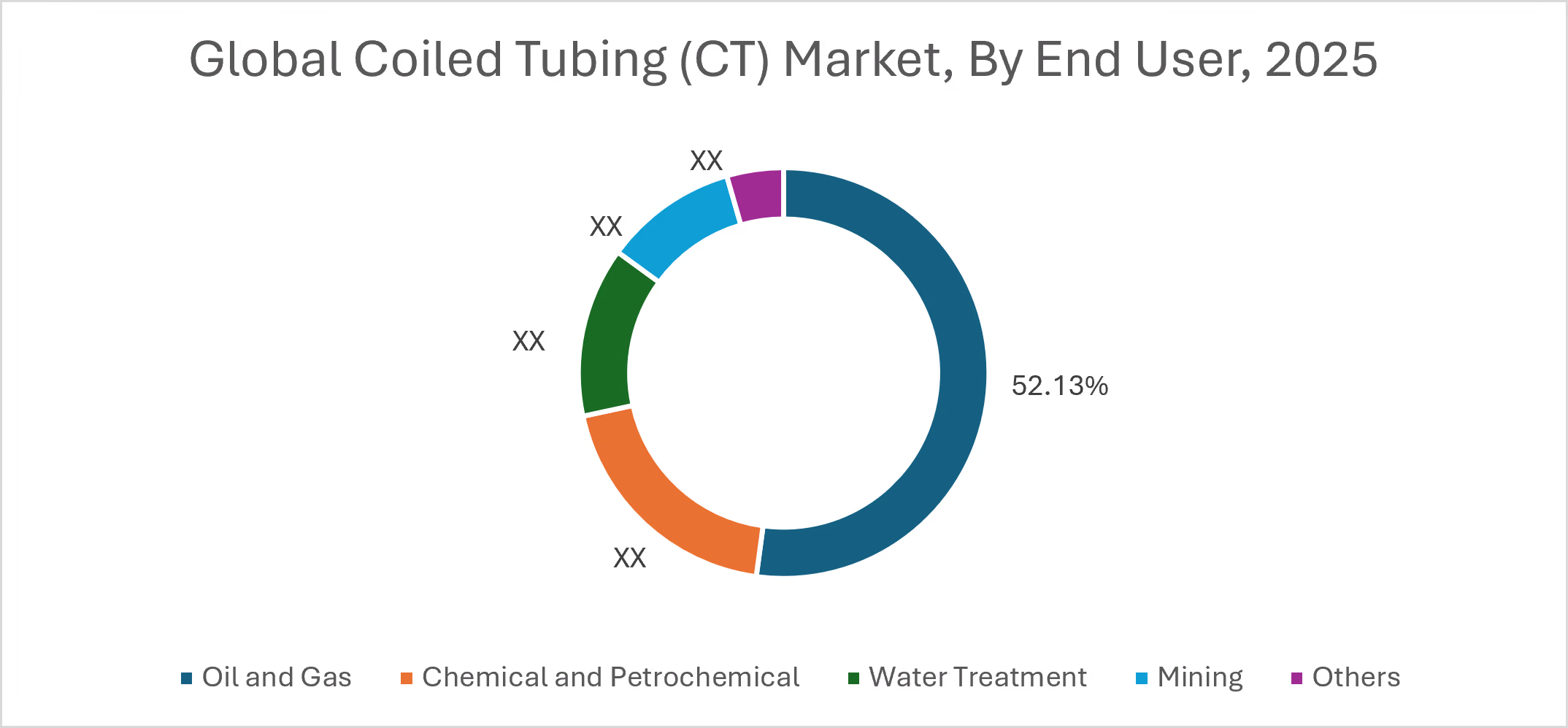
The oil and gas sector accounted for the largest revenue share of 52.13% in the year 2025 and is anticipated to register the fastest CAGR during the forecast period.
- The oil and gas sector requires cost-effective wellbore maintenance without stopping the production, which in turn is fueling the market need.
- Additionally, the aging and mature oil fields represent most of the global crude production and require a solution with the ability to significantly reduce operational costs and rig downtime.
- Further, the government policies worldwide are heavily incentivizing domestic energy exploration, directly boosting the service need, which is driving the market progress.
- Furthermore, the continuous reliance on petroleum fuels for road transportation, aviation, and marine shipping requires recurring maintenance, which drives the market development.
- Thus, as per the market analysis, the rising dependency on petroleum fuels is driving the market progress.
Coiled Tubing (CT) Market Regional Analysis:
The regions covered are North America, Europe, Asia Pacific, Middle East and Africa, and Latin America.
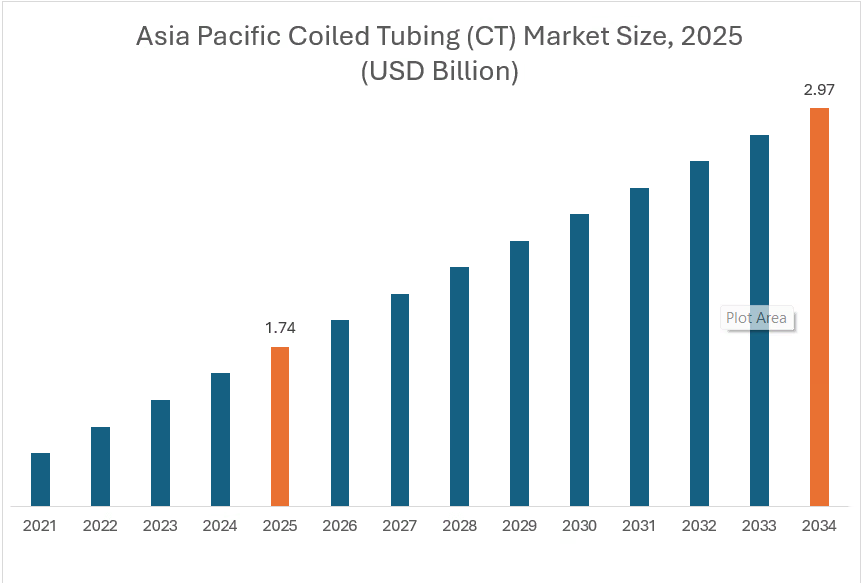
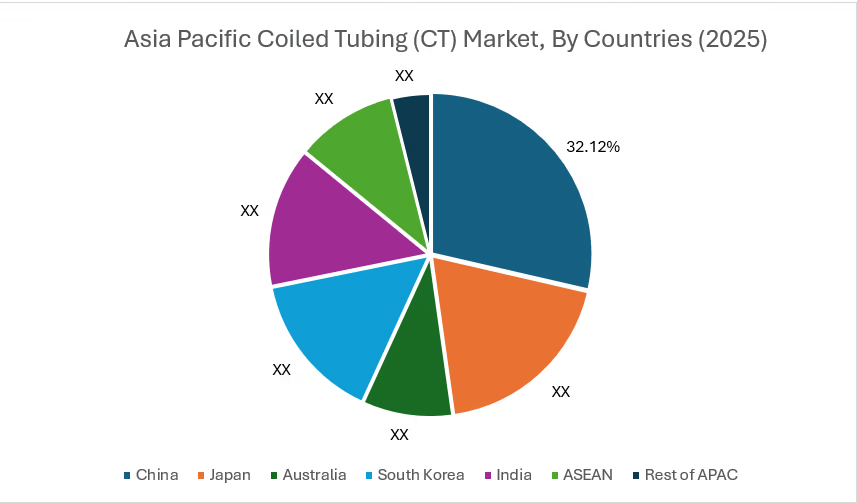
Asia Pacific region was valued at USD 1.74 Billion in 2025. Moreover, it is projected to grow by USD 1.82 Billion in 2026 and reach over USD 2.97 Billion by 2034. Out of this, China accounted for the maximum revenue share of 32.12%. The market progress is mainly driven by surging regional energy demand, aging oilfields requiring enhanced recovery and maintenance requirements. Furthermore, factors including the increased focus on tapping unconventional resources and offshore projects are projected to drive the market progress in Asia Pacific region during the forecast period.
- For instance, in February 2206, PT Pertamina collaborated with Halliburton for the development of advanced well construction and stimulation technologies in Indonesia.
North America is estimated to reach over USD 3.51 Billion by 2034 from a value of USD 2.11 Billion in 2025 and is projected to grow by USD 2.20 Billion in 2026. The North American region's growing need for faster and more cost-effective solutions for well investigation and maintenance offers lucrative growth prospects for the market. Additionally, the integration of real-time monitoring, fiber-optic telemetry, and other technology allows for highly precise operations, which is driving the market progress.
- For instance, in December 2025, Reeflex Solutions Inc. provided USD 3.4 million to Iron Horse Energy Services for the development of a fully customized mast-style coiled tubing rig.
The regional analysis depicts that the surge in offshore decommissioning and well plugging operations is driving the market in Europe. Additionally, the key factor driving the market in Middle East and African region are rising investment in the oil and gas sector, as well as the need to maintain aging reservoirs. Further, the increasing deepwater offshore exploration and ongoing energy sector reformation are paving the way for the progress of the market in Latin America region.
Top Key Players & Market Share Insights:
The global coiled tubing (CT) market is highly competitive with major players providing coiled tubing (CT) to the national and international markets. Key players are adopting several strategies in research and development (R&D), product innovation, and end user launches to hold a strong position in the coiled tubing (CT) industry. Key players in the coiled tubing (CT) market include-
- Baker Hughes (UK)
- Tenaris (USA)
- Halliburton Energy Services, Inc. (USA)
- China National Petroleum Corp. (China)
- SLB (USA)
- Saudi Arabian Oil Co. (Saudi Arabia)
- Weatherford (USA)
- Trican Well Service (Canada)
- Archer (USA)
- TAQA KSA (Saudi Arabic)
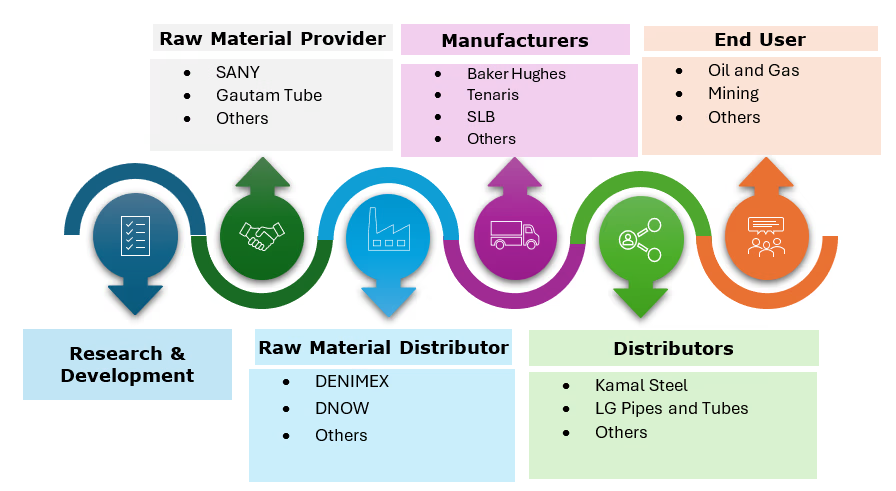
Coiled Tubing Market Ecosysytem:
Recent Industry Developments :
Product Launches
- In December 2025, Iberdrola has begun assembling wind turbines for Portugal’s largest wind farm, a 274 MW project that will generate 55 for around 128,000 households and strengthen the country’s clean power infrastructure.
- In October 2025, Google signed a new 54 MW power purchase agreement with utility Eneco to supply wind-generated electricity from three Belgian wind farms to its data centres, supporting its local infrastructure expansion and carbon-free energy goals.
Coiled Tubing (CT) Market Report Insights :
| Report Attributes | Report Details |
| Study Timeline | 2021-2034 |
| Market Size in 2034 (USD Billion) | USD 10.77 Billion |
| CAGR (2026-2034) | 5.2% |
| By Product Type |
|
| By Operation Location |
|
| By End User |
|
| By Region |
|
| Key Players |
|
Key Questions Answered in the Report
How big is the Coiled Tubing (CT) Market? −
The Coiled Tubing (CT) Market size is estimated to reach over USD 10.77 Billion by 2034 from a value of USD 6.53 Billion in 2025 and is projected to grow by USD 6.80 Billion in 2026, growing at a CAGR of 5.2% from 2026 to 2034.
Which segmentation details are covered in the report? +
The report includes specific segmentation details for product type, operation location, end user, and regions.
Which is the fastest segment anticipated to impact the market growth? +
In the market, the services segment is the fastest-growing segment during the forecast period due to the expansion of oil and gas exploration and the aging of mature wellbore.
Who are the major players in the market? +
The key participants in the market are Baker Hughes (UK), Tenaris (USA), Halliburton Energy Services, Inc. (USA), China National Petroleum Corp. (China), SLB (USA), Saudi Arabian Oil Co. (Saudi Arabia), Weatherford (USA), Trican Well Service (Canada), Archer (USA), TAQA KSA (Saudi Arabia) and others.
What are the key trends in the market? +
The market is being shaped by several key trends including rising investment in artificial intelligence (AI) and the internet of things (IoT) to optimize costs, extend wellbore life, and the rising deepwater offshore exploration and high-pressure/temperature interventions are the key trends driving the market.
Overview
Reputation & Certifications


Our Services
- Market Intelligence & Forecasting
- Custom Research Solutions
- Market Entry Strategy
- Competitive Intelligence
- Customer Insights
- Industry Innovation Analysis
- Investment Advisory