Jump to Content
Concrete Surface Treatment Chemicals Market - Size, Share, Industry Trends, and Forecasts (2025 - 2032)
Concrete Surface Treatment Chemicals Market Size:
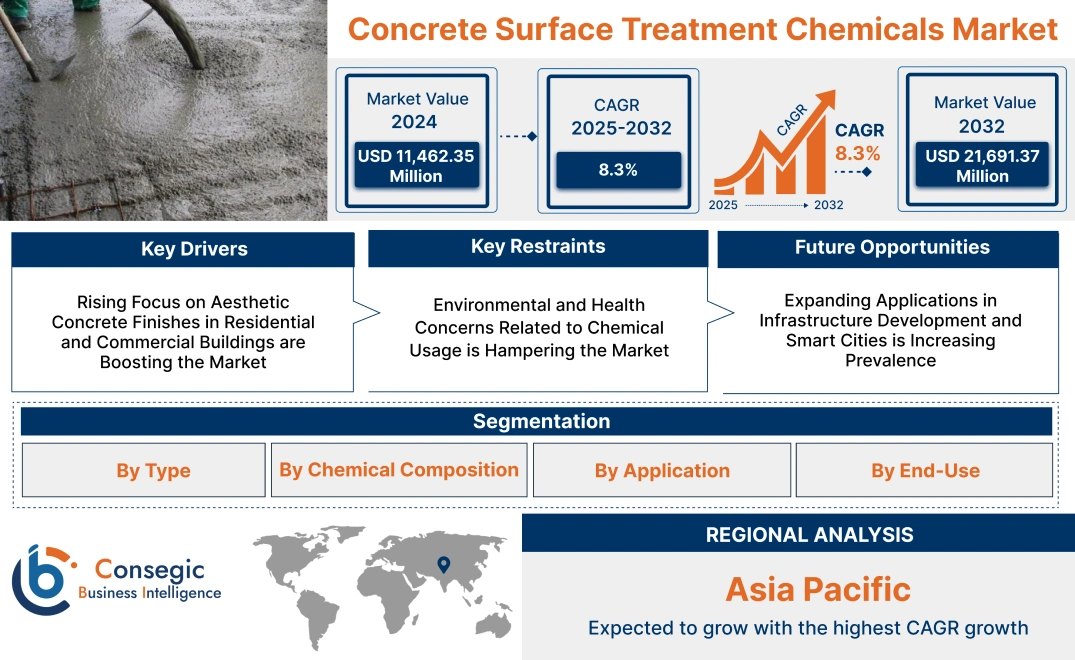
Concrete Surface Treatment Chemicals Market size is estimated to reach over USD 21,691.37 Million by 2032 from a value of USD 11,462.35 Million in 2024 and is projected to grow by USD 12,209.48 Million in 2025, growing at a CAGR of 8.3% from 2025 to 2032.
Concrete Surface Treatment Chemicals Market Scope & Overview:
The concrete surface treatment chemicals formulations are used to enhance the durability, aesthetics, and performance of concrete surfaces in construction applications. These chemicals include curing agents, sealants, hardeners, and waterproofing compounds, which protect concrete from environmental damage, improve surface strength, and extend its lifespan. Key characteristics of concrete surface treatment chemicals include high penetration ability, resistance to abrasion, and compatibility with various concrete formulations. The benefits include reduced maintenance costs, improved resistance to water and chemicals, and enhanced surface appearance. Applications span residential, commercial, and industrial construction projects, including flooring, bridges, highways, and precast structures. End-users include construction companies, infrastructure developers, and contractors, driven by increasing investments in infrastructure, growing trends for sustainable construction practices, and advancements in chemical formulations for enhanced performance.
Concrete Surface Treatment Chemicals Market Dynamics - (DRO) :
Key Drivers:
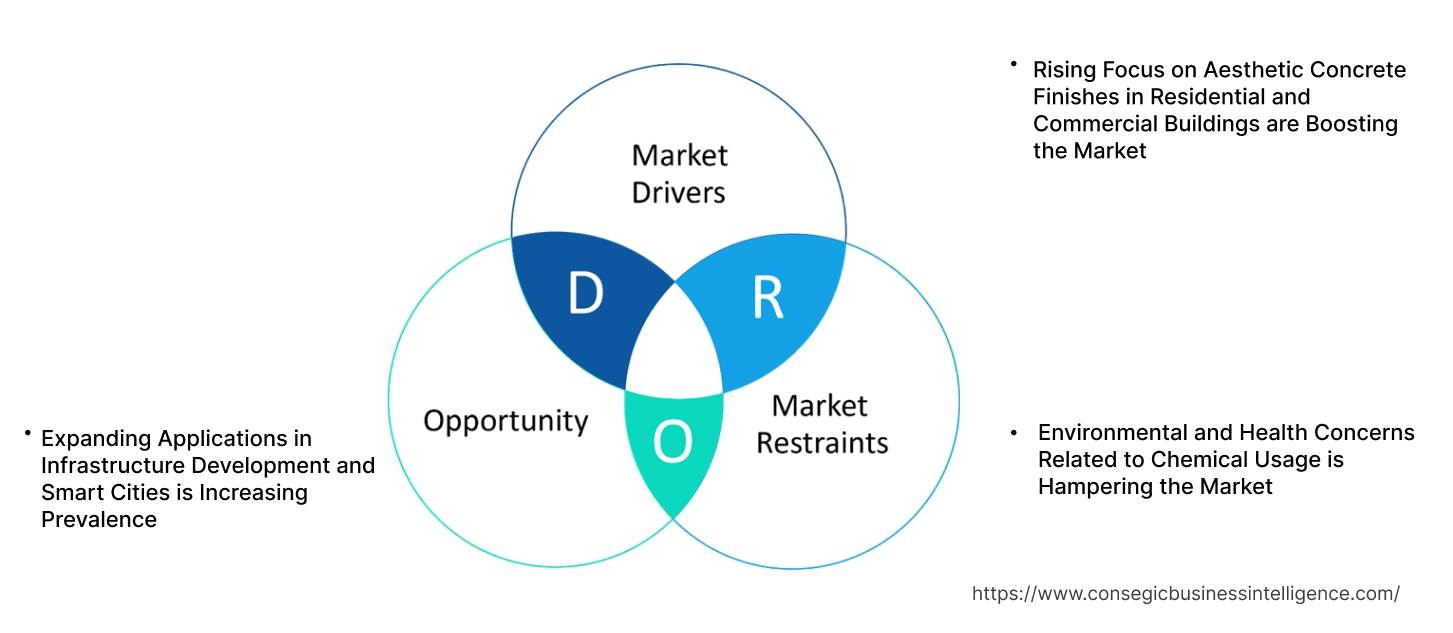
Rising Focus on Aesthetic Concrete Finishes in Residential and Commercial Buildings are Boosting the Market
The increasing popularity of modern architectural designs and polished concrete surfaces has elevated the use of surface treatment chemicals in residential and commercial construction. These chemicals, such as sealers, coatings, and decorative overlays, enhance the visual appeal of concrete while providing long-term protection against stains, wear, and environmental factors. Aesthetic treatments are particularly favored for floors, countertops, patios, and other exposed concrete surfaces in contemporary building projects.
Trends in high-end construction and sustainable design have spurred interest in decorative concrete finishes that combine functionality with style. Surface treatment chemicals play a pivotal role in achieving these finishes by ensuring smooth textures, vibrant colors, and enhanced durability. Analysis suggests that their application in creating visually striking and low-maintenance surfaces aligns with the increasing emphasis on urban sophistication and innovative building solutions.
Key Restraints:
Environmental and Health Concerns Related to Chemical Usage is Hampering the Market
The use of certain concrete surface treatment chemicals, particularly those containing volatile organic compounds (VOCs) and other hazardous substances, has raised environmental and health concerns. These chemicals can negatively impact air quality during application and pose risks to construction workers and building occupants. Furthermore, regulatory frameworks in many regions are imposing stricter limits on VOC emissions, requiring manufacturers to comply with evolving environmental standards.
Trends in sustainable construction practices are pushing for the adoption of low-VOC and eco-friendly alternatives, but the transition presents challenges for manufacturers in terms of cost and formulation complexity. Analysis highlights that addressing these concerns through innovation and compliance will be essential for maintaining market relevance in an increasingly eco-conscious industry.
Future Opportunities :
Expanding Applications in Infrastructure Development and Smart Cities is Increasing Prevalence
The global focus on infrastructure development and the rise of smart city projects present significant opportunities for concrete surface treatment chemicals. Urban landscapes, including roads, bridges, pavements, and public spaces, require durable and aesthetically appealing concrete surfaces to support heavy usage and withstand environmental stresses. Surface treatment chemicals play a crucial role in enhancing the functionality and lifespan of these structures while ensuring visual appeal.
Trends in urbanization and sustainable development highlight the need for advanced surface solutions tailored to modern infrastructure in concrete surface treatment chemicals market demands. Analysis indicates that manufacturers offering innovative products, such as weather-resistant coatings and high-performance sealers, are well-positioned to capitalize on large-scale development initiatives. Targeting smart city projects and sustainable urban infrastructure opens avenues for growth in this expanding market segment.
Concrete Surface Treatment Chemicals Market Segmental Analysis :
By Type:
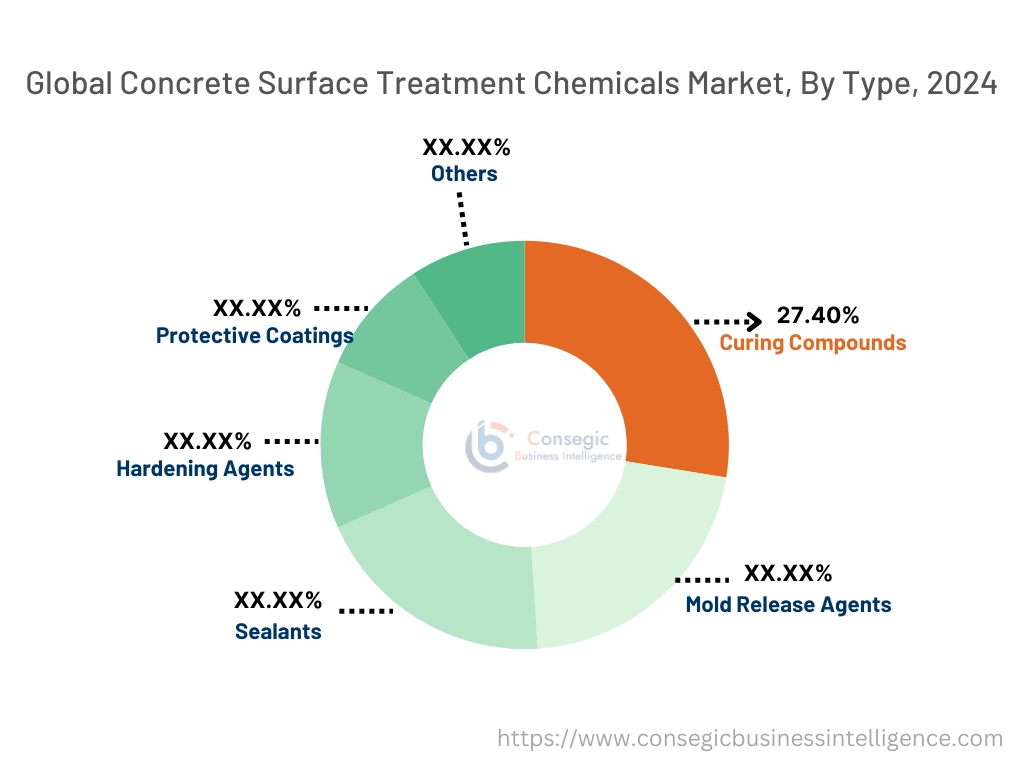
Based on type, the market is segmented into curing compounds, mold release agents, sealants, hardening agents, protective coatings, and others.
The curing compounds segment accounted for the largest revenue share of 27.40% in 2024.
- Curing compounds play a critical role in concrete construction by facilitating proper hydration and reducing moisture loss, which is essential for achieving desired strength and durability.
- These compounds are widely used in infrastructure projects such as bridges, highways, and dams to ensure consistent curing under varied environmental conditions.
- The growing emphasis on durable and long-lasting concrete structures, particularly in large-scale construction and infrastructure development projects, has driven the adoption of curing compounds.
- Their ability to improve the surface finish and reduce shrinkage cracks further enhances their utility across the construction sectors.
The protective coatings segment is anticipated to register the fastest CAGR during the forecast period.
- Protective coatings are increasingly adopted to shield concrete surfaces from environmental factors such as moisture, chemicals, and abrasion.
- These coatings enhance the longevity of concrete structures by preventing corrosion and surface deterioration.
- With rising investments in infrastructure modernization and the increasing concrete surface treatment chemicals market opportunities for sustainable construction practices, the concrete surface treatment chemicals market trends for advanced protective coatings is expected to grow significantly.
- Additionally, innovations in eco-friendly and high-performance coating formulations are driving adoption in residential, commercial, and industrial applications.
By Chemical Composition:
Based on chemical composition, the market is segmented into water-based, solvent-based, epoxy-based, polyurethane-based, and acrylic.
The water-based segment accounted for the largest revenue share in 2024.
- Water-based concrete surface treatment chemicals are highly preferred due to their low environmental impact, non-toxic nature, and ease of application.
- These chemicals are extensively used in residential and commercial construction projects where environmental regulations and indoor air quality are prioritized.
- Their ability to provide excellent adhesion, uniform finish, and compatibility with various surfaces has further bolstered their dominance.
- Additionally, advancements in water-based formulations to enhance durability and performance have increased their adoption across multiple end-use industries.
The epoxy-based segment is anticipated to register the fastest CAGR during the forecast period.
- Epoxy-based chemicals are known for their superior chemical resistance, mechanical strength, and long-lasting protection, making them ideal for high-performance applications.
- They are widely used in industrial construction and infrastructure projects such as bridges and dams, where durability and corrosion resistance are critical.
- The growing demand for epoxy-based solutions in concrete repair and anti-corrosion treatments, coupled with innovations in epoxy formulations to improve sustainability, is expected to drive rapid rise in this segment.
By Application:
Based on application, the market is segmented into concrete protection, concrete repair, waterproofing, surface finishing, anti-corrosion treatments, and others.
The concrete protection segment accounted for the largest revenue in concrete surface treatment chemicals market share in 2024.
- Concrete protection chemicals are essential for enhancing the durability and performance of concrete structures.
- They prevent deterioration caused by moisture, chemicals, and environmental factors, making them indispensable in infrastructure projects such as highways and bridges.
- The increasing concrete surface treatment chemicals market demand for sustainable construction practices and the growing focus on extending the lifespan of existing structures have driven the adoption of concrete protection solutions.
- Additionally, their application in residential and commercial construction for improving surface aesthetics and reducing maintenance costs has further fueled segment growth.
The waterproofing segment is anticipated to register the fastest CAGR during the forecast period.
- Waterproofing chemicals are critical in preventing water infiltration and moisture damage in concrete structures.
- These chemicals are widely used in residential and commercial buildings, as well as in infrastructure projects such as dams and tunnels.
- The rising awareness of the benefits of waterproofing in enhancing structural integrity and reducing repair costs has boosted their adoption.
- Furthermore, the increasing construction of water-intensive facilities and underground structures is expected to drive significant development in the waterproofing segment.
By End Use:
Based on end-use, the market is segmented into residential construction, commercial construction, industrial construction, and infrastructure.
The infrastructure segment accounted for the largest revenue in concrete surface treatment chemicals market share in 2024.
- The infrastructure sector is a major consumer of concrete surface treatment chemicals due to the need for high-performance materials in large-scale construction projects.
- Chemicals such as curing compounds, sealants, and anti-corrosion treatments are extensively used in bridges, highways, and dams to enhance durability and reduce maintenance costs.
- The increasing investments in infrastructure development, particularly in emerging economies, and the rising focus on sustainability in construction are driving concrete surface treatment chemicals market demand in this segment.
The commercial construction segment is anticipated to register the fastest CAGR during the forecast period.
- Commercial construction projects, including office buildings, retail centers, and hospitality facilities, are increasingly adopting concrete surface treatment chemicals to improve aesthetics, durability, and performance.
- The concrete surface treatment chemicals market trends for high-quality finishes, coupled with the growing use of advanced materials for decorative and protective applications, is boosting the adoption of these chemicals.
- Additionally, the rising trend of green buildings and energy-efficient construction is expected to propel growth in the commercial construction segment.
Regional Analysis:
The regions covered are North America, Europe, Asia Pacific, the Middle East and Africa, and Latin America.
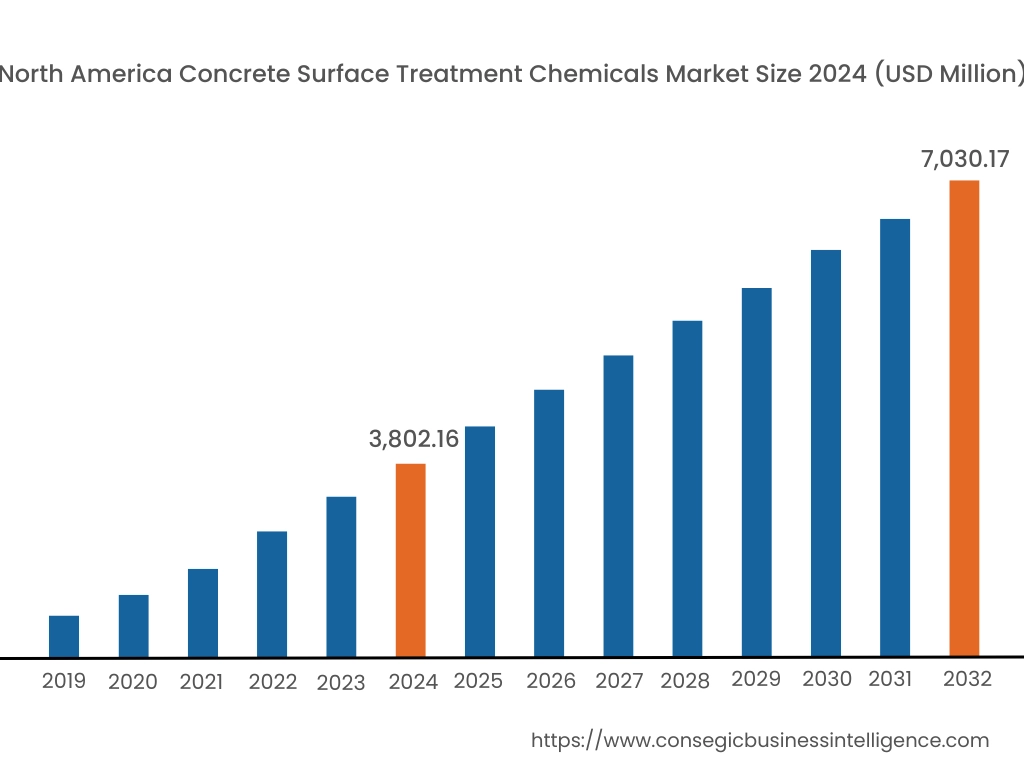
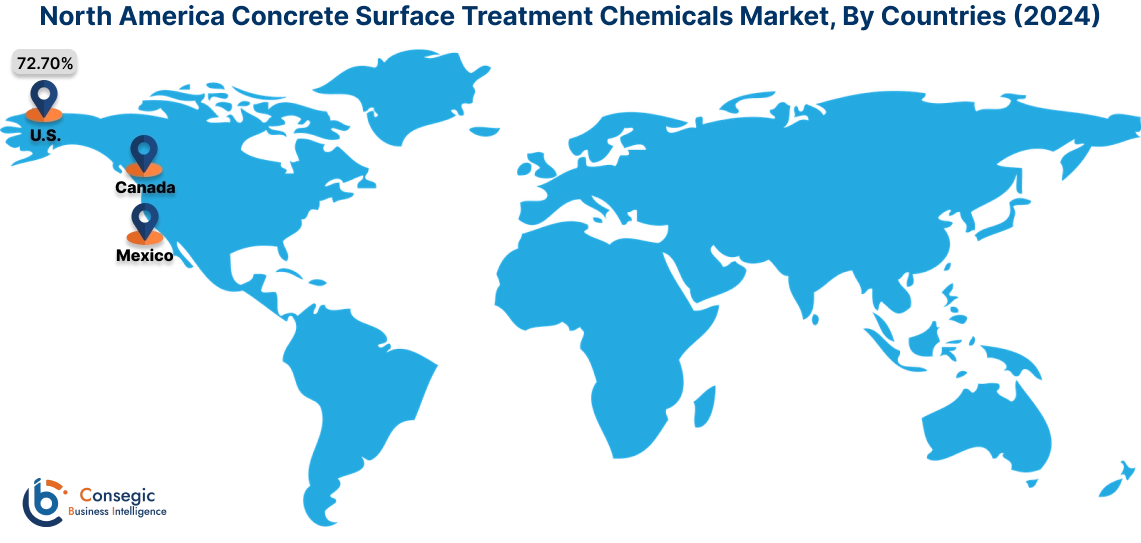
In 2024, North was valued at USD 3,802.16 Million and is expected to reach USD 7,030.17 Million in 2032. In North America, the U.S. accounted for the highest share of 72.70% during the base year of 2024. North America holds a significant share in the concrete surface treatment chemicals market analysis, driven by the growing trends for durable and aesthetically pleasing infrastructure. The U.S. leads the region due to large-scale construction projects, including commercial buildings, roads, and residential developments. The adoption of surface treatment chemicals for sealing, curing, and waterproofing concrete surfaces to enhance durability is a key driver. Canada contributes with rising investments in sustainable construction practices and the increasing use of eco-friendly surface treatment chemicals. However, stringent environmental regulations on chemical formulations may challenge market growth.
In Asia Pacific, the market is experiencing the fastest growth with a CAGR of 8.8% over the forecast period. In the concrete surface treatment chemicals market analysis, fueled by rapid urbanization, industrialization, and infrastructure development in China, India, and Southeast Asia. China dominates the market with extensive use of surface treatment chemicals in large-scale infrastructure projects, including bridges, dams, and commercial buildings. India’s expanding urban housing and government-led infrastructure initiatives drive trends for surface treatment solutions to improve concrete longevity. Southeast Asian countries leverage these chemicals for residential and commercial construction. However, inconsistent enforcement of construction standards and price sensitivity may hinder market growth in emerging economies.
Europe is a prominent market for concrete surface treatment chemicals, supported by stringent regulations promoting sustainable and long-lasting construction practices. Countries like Germany, France, and the UK are major contributors. Germany’s strong focus on infrastructure modernization and industrial construction drives the trends for advanced surface treatment chemicals for waterproofing and curing. France emphasizes the use of surface treatment chemicals in heritage restoration and residential construction, while the UK focuses on environmentally friendly formulations to align with green building standards. However, high costs associated with eco-friendly chemicals may pose challenges in certain segments.
The Middle East & Africa region is witnessing steady growth in the concrete surface treatment chemicals market, driven by increasing investments in infrastructure and urban development projects. Countries like Saudi Arabia and the UAE are adopting advanced surface treatment chemicals for high-profile projects such as skyscrapers, airports, and industrial facilities to ensure durability in harsh climatic conditions. In Africa, South Africa is an emerging market, utilizing these chemicals in residential and infrastructure construction. However, limited local production and reliance on imports may restrict broader concrete surface treatment chemicals market expansion in some parts of the region.
Latin America is an emerging market, with Brazil and Mexico leading the region. Brazil’s large-scale infrastructure projects, including roads, bridges, and commercial buildings, drive the demand for surface treatment chemicals to enhance durability and reduce maintenance costs. As per the regional analysis Mexico focuses on adopting these chemicals in residential construction and industrial projects. The region’s emphasis on improving urban infrastructure further supports market growth. However, economic instability and inconsistent regulatory frameworks may pose challenges to concrete surface treatment chemicals market expansion in smaller economies.
Top Key Players and Market Share Insights:
The concrete surface treatment chemicals market is highly competitive with major players providing products to the national and international markets. Key players are adopting several strategies in research and development (R&D), product innovation, and end-user launches to hold a strong position in the concrete surface treatment chemicals market. Key players in the concrete surface treatment chemicals industry include -
- RPM International Inc. (USA)
- Fosroc International Ltd. (UK)
- Sodamco-Weber (Lebanon)
- CICO Technologies Limited (India)
- Xypex Chemical Corporation (Canada)
- The Dow Chemical Company (Dow Inc.) (USA)
- MAPEI Corporation (Italy)
- Arkema Group (France)
- R. Grace & Co. (USA)
- CHRYSO Group (France)
Recent Industry Developments :
- In November 2023, MCON Rasayan India Ltd., a decade-old manufacturer and supplier of high-quality construction chemicals and building finishing products, is poised to capitalize on this infrastructure push resulting in a strategic focus on pan-India expansion and potential entry into overseas markets, MCON Rasayan aims to deepen its distribution network and reach alternative channels to leverage the growing opportunities in the construction sector.
Concrete Surface Treatment Chemicals Market Report Insights :
| Report Attributes | Report Details |
| Study Timeline | 2019-2032 |
| Market Size in 2032 | USD 21,691.37 Million |
| CAGR (2025-2032) | 8.3% |
| By Type |
|
| By Chemical Composition |
|
| By Application |
|
| By End Use |
|
| By Region |
|
| Key Players |
|
| North America | U.S. Canada Mexico |
| Europe | U.K. Germany France Spain Italy Russia Benelux Rest of Europe |
| APAC | China South Korea Japan India Australia ASEAN Rest of Asia-Pacific |
| Middle East and Africa | GCC Turkey South Africa Rest of MEA |
| LATAM | Brazil Argentina Chile Rest of LATAM |
| Report Coverage |
|
Key Questions Answered in the Report
What is the projected size of the Concrete Surface Treatment Chemicals Market by 2032? −
Concrete Surface Treatment Chemicals Market size is estimated to reach over USD 21,691.37 Million by 2032 from a value of USD 11,462.35 Million in 2024 and is projected to grow by USD 12,209.48 Million in 2025, growing at a CAGR of 8.3% from 2025 to 2032.
What factors are driving the market growth? +
Growth is driven by the rising demand for durable concrete structures, increasing adoption of sustainable construction practices, and advancements in chemical formulations for enhanced performance.
What challenges does the market face? +
Environmental concerns regarding VOC emissions and stringent regulatory standards on chemical usage pose significant challenges to the market.
What opportunities exist in the market? +
Expanding applications in infrastructure development, smart city projects, and the rise of eco-friendly and sustainable concrete solutions offer significant growth opportunities.
Which type of chemical dominates the market? +
Curing compounds hold the largest market share due to their critical role in ensuring proper hydration and durability in large-scale infrastructure projects.
Overview
Reputation & Certifications


Our Services
- Market Intelligence & Forecasting
- Custom Research Solutions
- Market Entry Strategy
- Competitive Intelligence
- Customer Insights
- Industry Innovation Analysis
- Investment Advisory