Jump to Content
Barium Derivatives Market - Size, Share, Industry Trends, and Forecasts (2025-2032)
Barium Derivatives Market Size:
The barium derivatives market size is growing with a CAGR of 4.8% during the forecast period (2025-2032), and the market is projected to be valued at USD 3.99 Billion by 2032 from USD 2.75 Billion in 2024. Additionally, the market value for the 2025 attributes to USD 2.87 Billion.
Barium Derivatives Market Scope & Overview:
Barium derivatives are chemical compounds derived from the barium. They include barium sulfate, barium chloride, barium titanate, barium carbonate among others. These derivatives are used in various applications such as drilling fluids, medical imaging, glass manufacturing, paints and coatings, and other. These derivatives possess characteristics such as high density, chemical stability, and piezoelectricity. Due to these properties, barium derivatives are used in different industries such as oil & gas, construction, automotive, healthcare, and others. These derivatives offer several advantages such as enhanced radiation shielding capability, water pollution control and improved strength in ceramics & glass. Additionally, growing oil and gas exploration activities are driving the use of these derivatives particularly barium sulfate, further driving the market growth.
How is AI Transforming the Barium Derivatives Market?
AI is being used in barium derivatives market, particularly for improving research and development, manufacturing, and supply chain management. AI-powered solutions can accelerate the discovery of new barium compounds, optimize synthesis routes, and predict material properties.
Similarly, during its manufacturing process, AI-powered systems enable predictive maintenance, real-time process control, and quality assurance. Moreover, AI-powered analytics also help in enhancing supply chain operations, in turn improving demand forecasting and logistics. Hence, the above factors are projected to drive the market growth during the forecast period.

Barium Derivatives Market Dynamics - (DRO) :
Key Drivers:
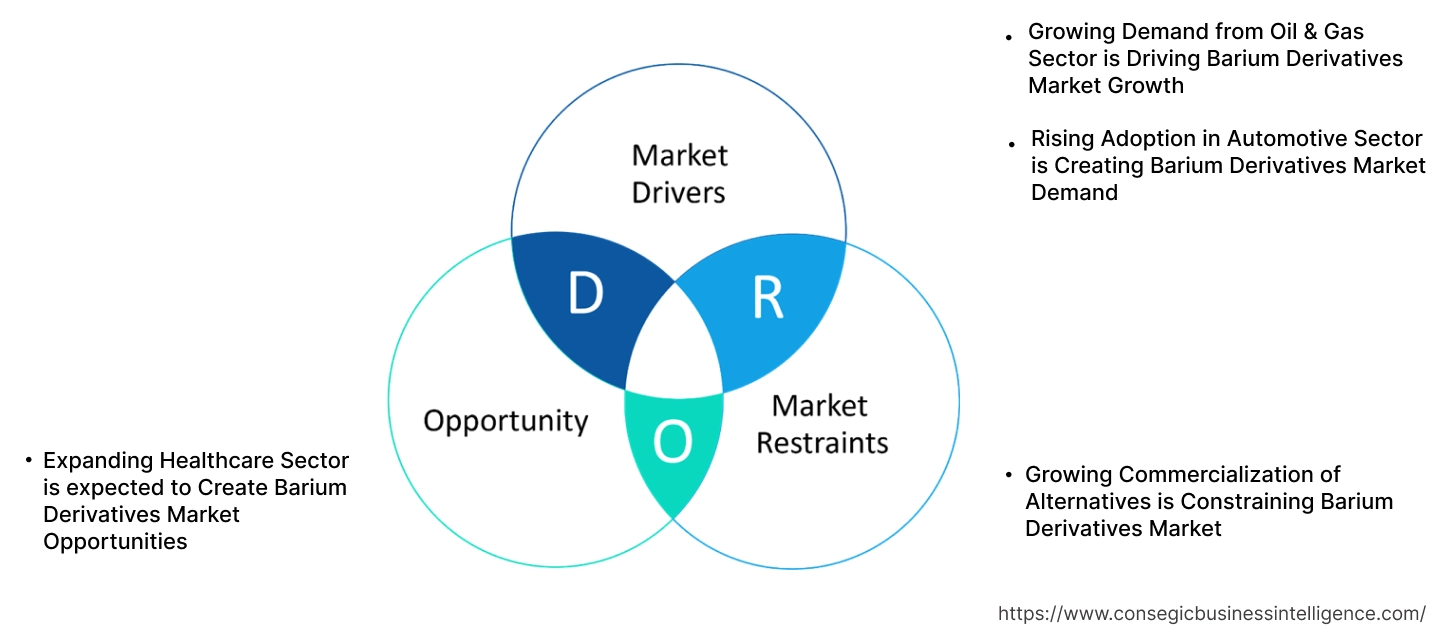
Growing Demand from Oil & Gas Sector is Driving Barium Derivatives Market Growth
Barium derivatives such as barium sulfate are used as a weighting agent in drilling muds in oil and gas sector. It increases the density of the mud and creates hydrostatic pressure to control unexpected fluid surges in the well. The investment in the oil and gas sector is growing due to high energy consumption and government focus on energy security further driving the market.
- According to International Energy Agency, global oil and gas sector investment is increased by 11% in 2023 as compared with 2022. This growing investment is driving the use of barium sulfate in drilling muds to increase the density of the mud.
Hence, growing demand from the oil & gas sector is leading to barium derivatives market expansion.
Rising Adoption in Automotive Sector is Creating Barium Derivatives Market Demand
The derivatives such as barium titanate are used in the automotive sector for solid state batteries to enhance energy density and fast charging capabilities. It is also utilized in electric vehicles for high-performance capacitators. The adoption of electric vehicles is growing, supported by reduced carbon emissions and growing emphasis on sustainability goals further driving the market.
- According to European Commission, electric vehicle sales in Europe is increased by 6% in 2024 as compared to the year 2023. This growing preference for electric vehicles is driving the use of barium titanate in high-performance capacitators.
Hence, rising adoption in the automotive sector is creating barium derivatives market demand.
Key Restraints:
Growing Commercialization of Alternatives is Constraining Barium Derivatives Market
The commercialization of alternative compounds such as titanium oxide, calcium-based additives, and aluminium compounds is growing. They provide similar functions to that of barium derivatives. The titanium oxide is typically preferred over calcium sulfate in paints and coatings due to its superior opacity and brightness. Similarly, in ceramics and glass manufacturing, calcium-based additives and aluminium compounds are used as cost-effective and environmentally friendly alternatives. Additionally, in oil & gas sector, preference for weighting agents such as calcium carbonate is growing as an alternative in drilling fluids. Hence, growing commercialization of alternatives is constraining barium derivatives market growth due to superior properties, low cost, and less toxicity.
Future Opportunities :
Expanding Healthcare Sector is expected to Create Barium Derivatives Market Opportunities
In the healthcare sector, derivatives such as barium titanate are used in the biosensors and ultrasound transducers. It enables efficient sound wave conversion in ultrasound imaging. Barium titanate is also utilized in pacemakers and neural stimulators. The investment in the healthcare sector is witnessing growth due to rising chronic diseases and the increasing global population.
- According to Mint, government investment in healthcare sector in India is increased by 9.8% in 2025 as compared to the year 2024. This will increase the production of ultrasound transducers and biosensors further creating market opportunities supported by use of barium titanate in sound wave conversion.
Thus, expanding healthcare sector is expected to create barium derivatives market opportunities.
Barium Derivatives Market Segmental Analysis :
By Derivative Type:
Based on derivative type, the market is categorized into barium sulfate, barium chloride, barium titanate, barium carbonate, and others.
Trends in Derivative Type:
- As per barium derivatives market trends, barium sulfate is widely utilized in the construction to enhance finish of the concrete surface.
- Adoption of barium titanate is growing in in photonics for high-speed optical modulations as per market trends.
The barium sulfate segment accounted for the largest market share in the year 2024.
- Barium sulfate is used as a filler, enhancing the density and strength of the concrete while reducing the permeability. It also improves the workability and finish of the concrete surface.
- It is also utilized as a pigment extender in coatings and paints to improve opacity, durability, and weather resistance.
- Further, the demand for durable concrete construction is growing due to climate change and rapid urbanization. To cater this, construction companies are adopting barium sulfate to increase the strength of the concrete.
- Hence, the adoption of barium sulfate is growing by construction companies to enhance concrete surface, thereby driving the segment.
The barium titanate segment is expected to grow at the fastest CAGR over the forecast period.
- Barium titanate is used to prepare scaffolds for bone tissue engineering. It also offers high permittivity, piezoelectricity and stability, making it essential for capacitators, sensors, and electronic components.
- It is also used in photonics for high-speed optical modulations, frequency conversion and enhanced light-matter interactions.
- Further, the need for high-sped communication and advancements in quantum computing is growing. To cater this, companies are investing in photonics.
- For instance, in 2023, NY CREATES collaborated with PsiQuantum for integrated photonics research and development wherein barium titanate is used for high-speed optical modulations.
- Hence, investment in photonics is growing which is driving the use of barium titanate for frequency conversion. This will drive the segment for the forecasted years.
By Application:
Based on application, the market is categorized into drilling fluids, medical imaging, glass manufacturing, paints and coatings, and other.
Trends in Application:
- According to barium derivatives market trends, barium sulfate is extensively utilized in drilling fluids to maintain wellbore stability.
- Adoption of derivative such as barium chloride is growing in contrast media as per market trends.
The drilling fluids segment accounted for the largest market share in the year 2024.
- The drilling fluids are specialized fluids used in drilling operations to lubricate the drill bit, remove cuttings, and maintain wellbore stability.
- Barium sulfate is widely used in the drilling fluids to increase mud density, preventing well blowouts and improving drilling efficiency.
- It offers high weight, chemical inertness, and low abrasiveness which is essential in deep drilling operations.
- Further, the demand for drilling fluids is increasing due to rise in oil & gas exploration and deep-water drilling. To cater this, companies are investing in drilling fluids.
- For instance, in 2025, Uzbekneftegaz partnered with CDF to develop local drilling fluids production. This is driving the use of barium sulfate in drilling fluids to increase mud density.
- Hence, production of drilling fluids is increasing which is leading to increased use of barium sulfate to improve drilling efficiency, thereby driving the segment.
The medical imaging segment is expected to grow at the fastest CAGR over the forecast period.
- Medical imaging refers to techniques such as CT scans and MRI to visualize the interior of the body for diagnostic purpose.
- Derivatives such as barium carbonate are used in the production of specialized glass for medical imaging devices, enhancing clarity and radiation shielding.
- Barium chloride is used in certain contrasts agents and as component in refining materials for imaging equipment.
- Further, the hospitals and diagnostic centers are adopting advanced medical imaging devices for early detection of complex disorders such as cancers. This is driving the use of barium carbonate in these devices to enhance clarity.
- Hence, the adoption of advanced medical imaging devices is growing by hospitals and diagnostic centers which requires barium chloride in contrast media. This will drive the segment for the forecasted years.
By End-Use:
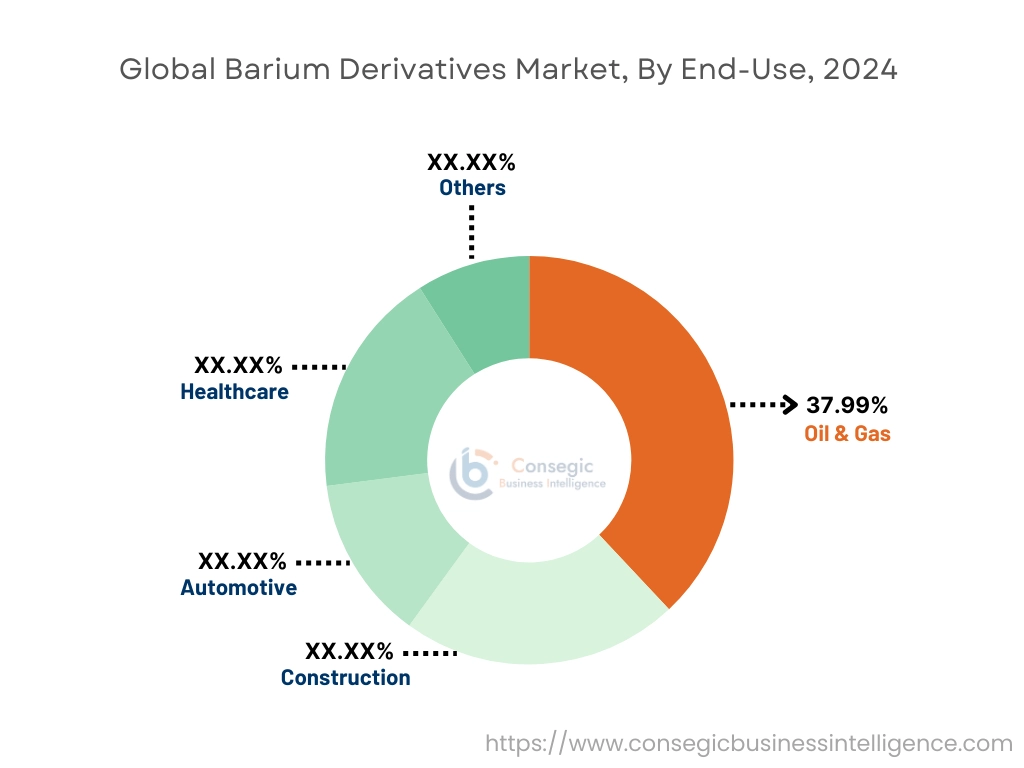
Based on end-use, the market is categorized into oil & gas, construction, automotive, healthcare, and others.
Trends in End-Use:
- As per trends, barium carbonate is used to improve sulfate resistance in well cement in oil & gas operations.
- Adoption of barium sulfate is growing in radiation shielding materials to enhance radiopacity as per market trends.
The oil & gas segment accounted for the largest market share of 37.99% in the year 2024.
- In the oil & gas sector, barium carbonate is used as an additive in well cement to improve density and sulfate resistance, ensuring strong and durable well structures.
- Also, barium sulfate is used in crude oil production for well logging to enhance subsurface readings. It is also used for structural integrity in high pressure environments.
- Further, consumption of crude oil is growing due to rising energy demand and expanding petrochemical sector. To cater this, countries are expanding their crude oil production.
- For instance, according to S. Energy Information Administration, the crude oil production is increased by 8.3% in 2023 in United States as compared to the year 2022. This is driving the use of barium sulfate for well logging to enhance subsurface readings.
- Hence, production of crude oil is increasing which is driving the use of barium sulfate for high pressure environments, thereby driving the segment.
The healthcare segment is expected to grow at the fastest CAGR over the forecast period.
- In the healthcare sector, barium derivatives are utilized in drug formulations and targeted therapies due to their ability to enhance bioavailability and controlled release mechanisms.
- Derivatives such as barium sulfate are used in the protective walls, barriers, and vests for hospitals, laboratories and nuclear medicinal facilities.
- It also provides excellent chemical stability, non-toxicity, and high radiopacity in the shielding materials.
- Further, the healthcare infrastructure investment and stricter radiation safety regulations are growing. To cater this, manufactures of radiation shielding materials are adopting barium sulfate for high radiopacity.
- Hence, the adoption of barium sulfate is growing among manufactures of radiation shielding materials to meet radiation safety regulations. This will drive the segment for the forecasted years.
Regional Analysis:
The regional segment includes North America, Europe, Asia Pacific, Middle East & Africa, and Latin America.
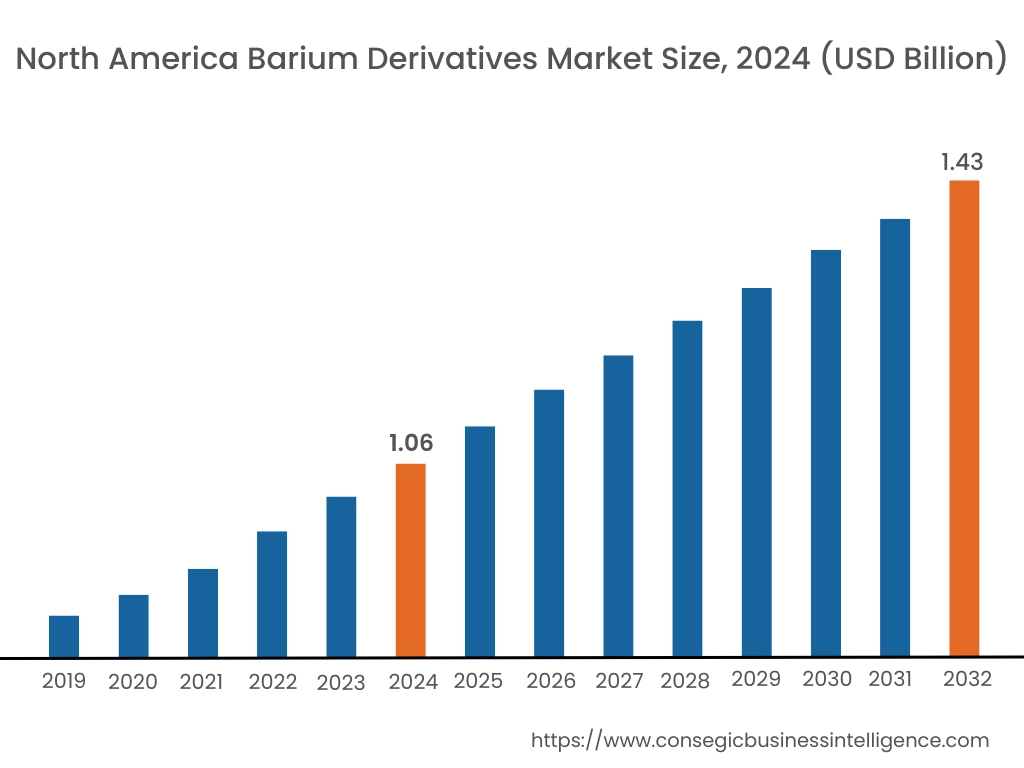
In 2024, North America accounted for the highest market share at 38.59% and was valued at USD 1.06 Billion and is expected to reach USD 1.43 Billion in 2032. In North America, United States accounted for the highest barium derivatives market share of 70.88% during the base year of 2024. As per analysis, North America region holds a dominant position in the market due to expanding construction. Derivatives such as barium chloride are used in the bricks, tiles, and concrete surfaces to reduce formation of white salts. It is also utilized in the production of high-quality construction glass to improve strength and thermal resistance. Countries such as United States, Mexico, and Canada leads the market due to expanding construction sector.
- According to United States Census Bureau, the residential construction in United States is increased by 7.1% in 2024 as compared to the year 2023. This growing construction is driving the use of barium chloride, which is used in bricks, tiles to reduce deposition of white salts.
Therefore, the North America region is dominating in the market, supported by growing construction as per analysis.

Europe is expected to witness the fastest CAGR of 4.6% over the forecast period of 2025-2032. According to barium derivatives market analysis, the Europe region is growing considerably in the market driven by advanced healthcare sector. Derivatives such as barium titanate are used in drug delivery systems due to its controlled drug released mechanisms. It is also used in sensors and diagnostic tools to measure blood pressure and heart rate. Additionally, the government investment in the healthcare sector is also growing further, boosting market growth. Hence, barium derivatives market share of Europe is expected to emerge rapidly through advanced healthcare sector and government support as per analysis.
As per barium derivatives market analysis, the Asia Pacific region is growing rapidly driven by advancements in technology. Innovation in nanotechnology has enhanced the performance, sustainability, and cost-effectiveness of barium derivatives. Countries such as China, India, Japan, and South Korea leads the market due to innovations in automation and artificial intelligence driven process control. These are optimizing production and ensuring high quality derivatives for various applications such as medical imaging and glass manufacturing.
The Middle East & Africa region is experiencing moderate growth in the market driven by the oil and gas sector. Derivatives such as barium chloride are used in treating produced water and pipeline fluids to prevent corrosion in oil and gas transportation. It also removes sulfate impurities in drilling and oil production equipment, extending their life span. Oil and gas exploration activities are growing in the region. This is leading to barium derivatives market expansion.
As per market analysis, Latin America is experiencing steady growth in the market driven by expanding automotive industry. Barium sulfate is used in brake pads and clutches to improve heat resistance and enhance breaking performance. Also, barium carbonate is used in automotive glass construction to enhance impact resistance and clarity. Countries such as Brazil, Mexico, and Argentina are leading the market in the region supported by expanding automobile manufacturing plants.
Top Key Players & Market Share Insights:
The barium derivatives industry is highly competitive with major players providing products to the national and international markets. Key players are adopting several strategies in research and development (R&D) and product innovation to hold a strong position in the global barium derivatives market. Key players in the barium derivatives industry include-
- American Elements (United States)
- Barium & Chemicals, Inc (United States)
- Vishnu Chemicals (India)
- ProChem, Inc (United States)
- GFS Chemical, Inc. (United States)
- CIMBAR RESOURCES, INC. (United States)
- Nippon Chemical Industrial CO., LTD. (Japan)
- China Nafine Group International Co., Ltd (China)
- Solvay (Belgium)
- Norkem (England)
Recent Industry Developments :
Product Launch:
- In 2025, Voyageur Pharmaceuticals launched Frances Creek barium contrast media project. This project is facilitating production of natural, high-purity pharmaceutical-grade barium sulfate.
Product Expansion:
- In 2023, Vishnu Chemicals started production of barium sulphate in India. The production started with a capacity of 30,000 tons per annum further driving the market.
Barium Derivatives Market Report Insights:
| Report Attributes | Report Details |
| Study Timeline | 2019-2032 |
| Market Size in 2032 | USD 3.99 Billion |
| CAGR (2025-2032) | 4.8% |
| By Derivative Type |
|
| By Application |
|
| By End-Use |
|
| By Region |
|
| Key Players |
|
| North America | U.S. Canada Mexico |
| Europe | U.K. Germany France Spain Italy Russia Benelux Rest of Europe |
| APAC | China South Korea Japan India Australia ASEAN Rest of Asia-Pacific |
| Middle East and Africa | GCC Turkey South Africa Rest of MEA |
| LATAM | Brazil Argentina Chile Rest of LATAM |
| Report Coverage |
|
Key Questions Answered in the Report
How big is the barium derivatives market? −
In 2024, the barium derivatives market is USD 2.75 Billion.
Which is the fastest-growing region in the barium derivatives market? +
Europe is the fastest-growing region in the barium derivatives market.
What specific segmentation details are covered in the barium derivatives market? +
Derivative Type, Application, and End-Use are covered in the barium derivatives market.
Who are the major players in the barium derivatives market? +
Barium & Chemicals, Inc (United States), CIMBAR RESOURCES, INC. (United States), and Nippon Chemical Industrial CO., LTD. (Japan) are some of the major players in the market.
Overview
Reputation & Certifications


Our Services
- Market Intelligence & Forecasting
- Custom Research Solutions
- Market Entry Strategy
- Competitive Intelligence
- Customer Insights
- Industry Innovation Analysis
- Investment Advisory