Jump to Content
Vehicle Electrification Market - Size, Share, Industry Trends, and Forecasts (2026 - 2034)
Vehicle Electrification Market Size:
Vehicle Electrification Market is estimated to reach over USD 278.76 Billion by 2034 from a value of USD 110.58 Billion in 2025 and is projected to grow by USD 120.87 Billion in 2026, growing at a CAGR of 9.7% from 2026 to 2034.
Vehicle Electrification Market Key Takeaways
- Rising EV adoption and government incentives are driving vehicle electrification demand globally.
- Asia Pacific led the market, supported by strong EV sales and manufacturing growth.
- Electric Power Steering (EPS) dominated the market due to its efficiency and widespread adoption.
- Passenger vehicles accounted for the largest share, driven by increasing electrification of vehicle systems.
- Advanced battery management systems and high-voltage architectures are accelerating market growth.
- Bosch, Continental, DENSO, Valeo, and BorgWarner were key players in the market.
Vehicle Electrification Market Market Scope & Overview:
Vehicle electrification refers to the integration of electric power and electronic systems to replace or supplement traditional mechanical components in a vehicle's powertrain and auxiliary systems. The transition aims to improve energy efficiency, enhance vehicle performance, and significantly reduce overall carbon emissions. The various types of components include electric power steering, start/stop systems, battery management system, electric water pumps, electric oil pumps, and others. Further, key trends driving the market include the strategic shift toward hybrid and plug-in hybrid vehicles, alongside the rapid integration of software-defined architectures that enable continuous performance improvements via over-the-air updates. Additionally, the industry is increasingly focused on technological advancements in battery chemistry to lower costs and expand infrastructure development.

Vehicle Electrification Market Dynamics - (DRO):
Market Drivers:
Growing Electric Vehicle (EV) Industry Drives the Market
The rapid rise of the Electric Vehicle (EV) sector serves as the primary catalyst for the broader by generating massive, sustained demand for advanced electrified subsystems. As automakers shift toward fully electric platforms, the resulting economies of scale significantly reduce the costs of critical components like power electronics, battery management systems, and thermal management modules. This widespread adoption necessitates robust supply chain development and modular platform designs, which subsequently facilitate the integration of electrification technology into non-EV segments, such as mild-hybrid and traditional internal combustion vehicles. Consequently, increasing government subsidies & tax incentives drives the EV sector.
- For instance, according to the International Energy Agency (IEA), electric vehicle market is experiencing a major surge, with global sales surpassing 17 million units in 2024. Also, momentum is expected to accelerate through 2025, with deliveries expected to exceed 20 million vehicles.
Thus, favorable government policies, rapid technological innovation, and expanding charging infrastructure contribute significantly to the rise in the vehicle electrification market size.
Market Restraints:
High Initial Investment and Supply Chain Complexity are Limiting the Market Growth
High initial investment and supply chain complexity significantly hinder the market by elevating vehicle prices and disrupting production stability. The shift from mechanical to electric auxiliary systems and high-tech components, such as advanced sensors and semiconductors, increases manufacturing costs, often resulting in higher retail prices that deter cost-sensitive consumers. Simultaneously, supply chains are strained by the need for critical raw materials like lithium and cobalt, coupled with the specialized logistics required to transport sensitive components like battery packs. These bottlenecks, aggravated by geopolitical uncertainties and the lack of established high-volume manufacturing ecosystems in some regions, which in turn force OEMs to navigate complex regulatory and sourcing challenges, ultimately slowing global market adoption.
Market Opportunities:
Increasing Emphasis on Software-Defined Mobility Drives Vehicle Electrification Market Opportunities
The increasing emphasis on software-defined mobility acts as a powerful catalyst for the market by shifting the value proposition from static hardware to intelligent, continuously improving digital platforms. By decoupling software from hardware, automakers can optimize battery management, enhance energy efficiency, and deploy performance upgrades via over-the-air updates without physical modifications, thereby extending vehicle utility and life. Furthermore, software-defined architectures enable new, high-margin revenue streams through personalized subscription services, data-driven diagnostics, and fleet management integration, which improve the total cost of ownership for electric vehicle users. This evolution turns electric vehicles into dynamic, evolving assets, making them increasingly competitive and attractive against traditional internal combustion vehicles. Thus, the aforementioned market factors are expected to drive the market opportunities during forecast period.
Vehicle Electrification Market Segmental Analysis:
By Product Type:
Based on the product type, the market is segmented into Electric Power Steering (EPS), start/stop systems, battery management system, electric water pumps, electric oil pumps, electric air-conditioner compressors, regenerative braking system, DC/DC converters, on-board chargers, and others.
Trends in the Product Type:
- The market is prioritizing the development of high-efficiency, ultra-fast charging solutions to reduce waiting times, which is driving the vehicle electrification market trends.
- Regenerative braking is being integrated directly into dedicated EV platforms to maximize energy recovery, which in turn drives the market.
Electric Power Steering (EPS) accounted for the largest revenue share in the year 2025.
- Automakers are increasingly replacing conventional hydraulic systems with EPS to reduce vehicle weight and improve fuel economy, which in turn drives the market.
- Further, growing demand for advanced driver assistance systems (ADAS) and consumer preference for convenient driving experiences are major market drivers.
- Furthermore, EPS systems, particularly steering motors, are being integrated across all vehicle classes, from small passenger cars to heavy-duty trucks, which in turn drives the market.
- Thus, as per the vehicle electrification market analysis, widespread adoption, focus onsafety & comfort, and diverse applications are driving the market.
DC/DC converters is anticipated to register the fastest CAGR during the forecast period.
- The converters are moving from simple voltage step-downs to strategic enablers for vehicles transitioning from 400V to 800V systems.
- Further, adoption of Silicon Carbide (SiC) and Gallium Nitride (GaN) devices is pushing power density and efficiency to new heights, which subsequently propels the vehicle electrification market expansion.
- Furthermore, OEMs are favoring standardized platforms to reduce converter variants while meeting increasingly tight thermal and software performance targets, which in turn drives the market.
- Therefore, based on analysis, the aforementioned factors are anticipated to boost the growth of the market during the forecast period.
By Voltage Architecture:
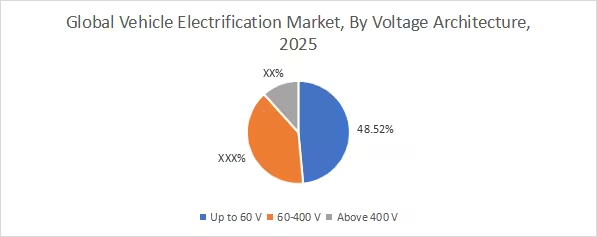
Based on the voltage architecture, the market is segmented into Up to 60 V, 60-400 V, and Above 400 V.
Trends in the Voltage Architecture:
- 400V systems remain the dominant choice for mainstream EVs due to well-established manufacturing supply chains and more affordable component costs, driving the vehicle electrification market demand.
- Most auxiliary components, including pumps, compressors, and DC/DC converters, are optimized for the 400V standard, offering high reliability and lower service warranty costs, driving the vehicle electrification market.
Up to 60 V accounted for the largest revenue share of 48.52% in the year 2025.
- 48V mild-hybrid architectures offer a cost-effective way to meet stringent CO2 emission standards without the expense of full-electric powertrains, which in turn drives the market.
- Further, by moving auxiliary loads to 48V, manufacturers significantly reduce the mass of wiring harnesses, directly improving vehicle efficiency and range, in turn driving the vehicle electrification market.
- Furthermore, 48V systems enable power-intensive features such as electric power steering, active roll stabilization, and electric turbocharging, which in turn drives the market.
- Thus, as per the vehicle electrification market analysis, standardization of 48V systems, wiring harness weight reduction, and others are driving the market.
Above 400 V is anticipated to register the fastest CAGR during the forecast period.
- Operating at higher voltages allows for lower currents, which enables the use of thinner cables and smaller, lighter electronic components, directly increasing overall vehicle range.
- Further, by doubling the voltage to 800V, vehicles can accept much higher power levels, drastically reducing charging times and making long-distance travel more practical, which subsequently propels the market.
- Furthermore, 800V systems are driving the rapid adoption of Silicon Carbide (SiC) and Gallium Nitride (GaN) devices, which handle higher temperatures and switching frequencies more efficiently than traditional silicon, which in turn drives the market.
- Therefore, based on analysis, the aforementioned factors are anticipated to boost the growth of the market during the forecast period.
By Vehicle Type:
Based on the vehicle type, the market is segmented into passenger vehicles and commercial vehicles.
Trends in the Vehicle Type:
- Total Cost of Ownership (TCO) for many electric commercial vehicles has fallen below that of diesel, driving the vehicle electrification market demand.
- The market is becoming more user-focused, with dealerships increasingly providing EV-specific education and insights, helping to normalize the ownership experience for first-time buyers, driving the vehicle electrification market share.
Passenger vehicles accounted for the largest revenue share in the year 2025 and is anticipated to register a significant CAGR during the forecast period.
- There is a sustained integration of electrified components such as electric power steering (EPS) and electric pumps across ICE, mild-hybrid, and hybrid platforms to improve overall vehicle efficiency, which in turn drives the market growth.
- Further, as battery electric vehicles become mainstream, there is a rapid shift toward advanced thermal management solutions, including electric air-conditioner compressors, PTC heaters, and liquid cooling systems, in turn driving the market.
- Thus, as per the analysis, diverse powertrain adoption, thermal management focus, and others are driving the vehicle electrification market expansion.
By Sales Channel:
Based on the sales channel, the market is segmented into OEM and Aftermarket.
Trends in the Sales Channel:
- Aftermarket companies are investing in EV-specific performance parts and accessories, such as specialized tires and corrosion-resistant brake components, which in turn drives the vehicle electrification market growth.
- AI is being embedded into aftermarket workflows to help technicians identify faults more accurately and quickly, propelling the market.
OEM accounted for the largest revenue share in the year 2025 and is anticipated to register a significant CAGR during the forecast period.
- OEMs are increasingly adopting direct-to-consumer models, utilizing Over-the-Air (OTA) updates to manage vehicle performance and software-defined features remotely.
- Further, to manage costs, OEMs are prioritizing modular, scalable electric drivetrain units that can be deployed across various vehicle segments, from compact cars to SUVs.
- Furthermore, OEM strategies are heavily concentrated on next-gen powertrain innovations, such as 800V architectures and silicon-carbide (SiC) power electronics.
- Thus, based on analysis, the aforementioned trends are anticipated to boost the growth of the market during the forecast period.
Vehicle Electrification Market Regional Analysis:
The regions covered are North America, Europe, Asia Pacific, Middle East and Africa, and Latin America.
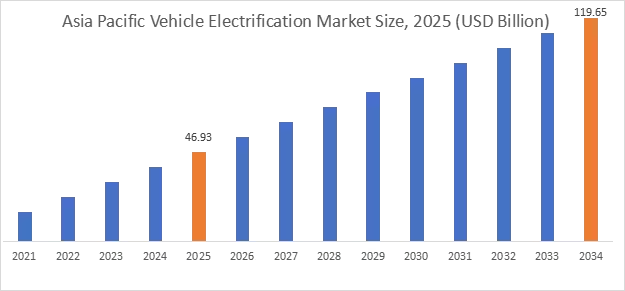
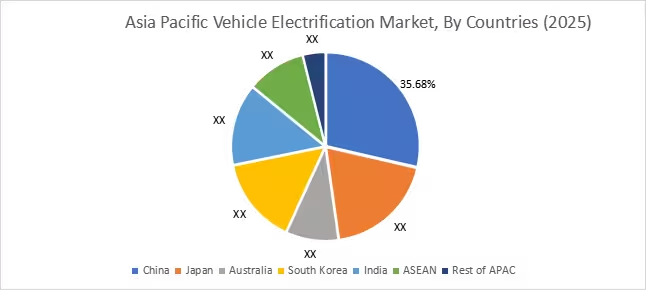
The Asia Pacific region was valued at USD 46.93 Billion in 2025. Moreover, it is projected to grow by USD 51.36 Billion in 2026 and reach over USD 119.65 Billion by 2034. Out of this, China accounted for the maximum revenue share of 35.68%. The market growth is mainly driven by stringent regional emission mandates and aggressive government incentive programs, alongside a robust domestic manufacturing ecosystem that drastically drives down the cost of electrical components and batteries. Furthermore, the rapid expansion of charging infrastructure and a strong shift toward replacing mechanical auxiliary systems drive the market.
- For instance, according to the International Energy Agency (IEA), China solidified its global dominance in the EV sector during 2024, with electric vehicles capturing nearly 50% of the nation's total automotive market. The country sold 11 million units of EV, which in turn drives the market.
North America is estimated to reach over USD 60.52 Billion by 2034 from a value of USD 24.16 Billion in 2025 and is projected to grow by USD 26.39 Billion in 2026. The North American market is primarily driven by supportive government policies such as tax incentives and emissions reduction targets, and substantial investments in charging infrastructure. Additionally, continuous advancements in battery technology, which improve vehicle range and affordability, combined with rising consumer demand for sustainable transportation, drive the market.
- For instance, in November 2025, Volvo Trucks introduced a world-first engine stop/start technology for heavy-duty vehicles, integrated into its latest I-Roll system. This innovation, available for the Volvo FH and FH Aero models equipped with 13-liter diesel engines, can reduce fuel consumption and CO2 emissions by up to one percent on top of existing efficiency gains. This development marks the latest step in Volvo's broader decarbonization strategy.
The regional trends analysis depicts that decarbonization targets, the growing EV sector, and strict safety regulations in Europe are driving the market. Additionally, the factors driving the market in the Middle East and African region are ambitious national economic diversification strategies, rising fuel prices, and increasing investments in local EV manufacturing. Further, modernization of local automotive production facilities and the growing EV sector in the Latin America region are driving the market.
Top Key Players & Market Share Insights:
The global vehicle electrification market is highly competitive with major players providing solutions to the national and international markets. Key players are adopting several strategies in research and development (R&D), product innovation, and end-user launches to hold a strong position in the vehicle electrification industry. Key players in the market include-
- Bosch Ltd. (Germany)
- ZF Friedrichshafen AG (Germany)
- Infineon (Germany)
- Continental (Germany)
- Mitsubishi Electric (Japan)
- DENSO (Japan)
- Valeo (France)
- JTEKT (Japan)
- NSK (Japan)
- BorgWarner (U.S.)
Recent Industry Developments:
Product Launch
- In December 2024, Marelli introduced a pioneering Battery Management System (BMS) at the 2024 CTI Symposium that utilizes Electrochemical Impedance Spectroscopy (EIS) to optimize automotive battery performance and longevity. This innovation provides precise insights into the remaining useful life and residual value of lithium-ion cells while enabling early anomaly detection to prevent safety issues such as thermal runaway.
Vehicle Electrification Market Insights:
| Report Attributes | Report Details |
| Study Timeline | 2021-2034 |
| Market Size in 2034 | USD 278.76 Billion |
| CAGR (2026-2034) | 9.7% |
| By Product Type |
|
| By Voltage Architecture |
|
| By Vehicle Type |
|
| By Sales Channel |
|
| By Region |
|
| Key Players |
|
| Report Coverage |
|
Key Questions Answered in the Report
How big is the vehicle electrification market? −
The vehicle electrification market is estimated to reach over USD 278.76 Billion by 2034 from a value of USD 110.58 Billion in 2025 and is projected to grow by USD 120.87 Billion in 2026, growing at a CAGR of 9.7% from 2026 to 2034.
What specific segmentation details are covered in the report? +
The report includes specific segmentation details for product type, voltage architecture, vehicle type, sales channel, and regions.
Which is the fastest segment anticipated to impact the market growth? +
In the market, DC/DC converters is the fastest-growing segment during the forecast period.
Who are the major players in the market? +
The key participants in the market are Bosch Ltd. (Germany), ZF Friedrichshafen AG (Germany), Infineon (Germany), Continental (Germany), Mitsubishi Electric (Japan), DENSO (Japan), Valeo (France), JTEKT (Japan), NSK (Japan), BorgWarner (U.S.), and others.
What are the key trends in the market? +
The market is being shaped by several key trends including advancement in battery innovation, rapid rise of charging infrastructure, and a strategic shift toward vertically integrated supply chains and software-defined vehicle platforms.
Overview
Reputation & Certifications


Our Services
- Market Intelligence & Forecasting
- Custom Research Solutions
- Market Entry Strategy
- Competitive Intelligence
- Customer Insights
- Industry Innovation Analysis
- Investment Advisory