Jump to Content
Battery Management System Market Size & Industry Share - Growth Trends & Forecasts (2026 - 2034)
Battery Management System Market Size:
Battery Management System Market size is estimated to reach over 57.23 (US$B) by 2034 from a value of 12.8 (US$B) in 2025 and is projected to grow by 15.12 (US$B) in 2026, growing at a CAGR of 18.1% from 2026 to 2034, according to a recent report from Consegic Business Intelligence.
Battery Management System Market Scope & Overview:
A battery management system (BMS) is designed for monitoring, controlling, and protecting rechargeable batteries for ensuring their safe operation, ideal performance, and extended lifespan. Also, BMS is capable of performing main functions such as monitoring voltage, current, and temperature, balancing cells, along with preventing issues like overcharging and deep discharging. Moreover, battery management solutions are used for a several applications, including automotive, consumer electronics, medical, energy, aerospace, and others.
How is AI Impacting the Battery Management System Market?
The incorporation of AI is significantly transforming the battery management system market. AI integration helps in improving battery performance, safety, as well as longevity through predictive diagnostics, optimized charging, along with real-time monitoring. AI capabilities help in improving functions like state-of-charge (SoC) and state-of-health (SoH) estimation, which in turn enables predictive maintenance and also helps in managing complex energy flows in applications such as electric vehicles (EVs) and grid storage.
Additionally, AI-powered controllers are capable of integrating with other systems for supporting adaptive energy flow based on real-time demand, temperature, and battery condition. Hence, the above factors are expected to positively impact the market growth in the upcoming years.

Battery Management System Market Dynamics - (DRO) :

Key Drivers:
Increasing automotive production and rising adoption of electric vehicles are driving the battery management system market growth
Battery management system is primarily used in the automotive industry for protecting and controlling a vehicle's battery pack for facilitating ideal performance, longevity, and safety. Moreover, there is a rising trend towards adoption of electric vehicles (EVs) over traditional internal combustion engines due to several factors such as the prevalence of stringent automotive emission regulations, availability of a broad range of EV models, increasing consumer preference for sustainable transportation, along with availability of subsidies and tax rebates for EVs. In electric vehicles, BMS plays an important role in monitoring key parameters such as voltage, current, and temperature, along with performing essential functions such as cell balancing and thermal management. It is also responsible for communicating with other systems in EVs for managing charging and discharging cycles, preventing damage, along with estimating remaining range.
- For instance, according to the International Energy Agency (IEA), electric car sales reached approximately 14 million in 2023, among which China, Europe and the United States accounted for 95% of the global EV sales.
Hence, the rising automotive production and increasing adoption of electric vehicles are driving the battery management system market size.
Key Restraints :
High initial investment and technical complexity associated with managing multi-chemistry battery systems are restraining the battery management system market growth
The development of a reliable and advanced battery management system usually requires considerable upfront capital for facilitating research, engineering talent, and rigorous testing protocols for fulfilling stringent safety as well as performance standards, particularly in crucial applications like automotive and aerospace, among others. This substantial upfront cost can act as a barrier to entry, particularly for small and medium players with limited budget and financial resources.
Also, managing multi-chemistry battery systems usually introduces a layer of technical complexity that may slow market adoption. Each battery chemistry possesses distinct charging algorithms, voltage curves, temperature sensitivities, along with degradation patterns. Moreover, developing a universal or highly adaptable BMS that is capable of accurately monitoring and optimizing different chemistries requires advanced algorithms, more powerful processors, along with improved calibration. This complexity further results in increased development time, while also increasing hardware and software costs, and making interoperability a challenge. Thus, the aforementioned factors are hindering the battery management system market expansion.
Future Opportunities :
Rising demand for consumer electronics is expected to drive the battery management system market opportunities
The increasing global demand for consumer electronics, ranging from smartphones, laptops, and tablets to wearables and internet of things (IoT) devices, is expected to offer lucrative aspects for market growth. Consumers mostly expect longer battery life, faster charging cycles, along with improved safety features in portable electronic devices, which in turn is encouraging manufacturers to integrate advanced BMS technology in these devices. Also, the incorporation of BMS in consumer electronic devices helps in facilitating precision monitoring of voltage, current, and temperature for preventing overcharging, deep discharging, as well as overheating, which are important safety concerns in high-energy-density lithium-ion batteries.
Additionally, factors including the growing penetration of laptops, smartphones, and other consumer devices, progressions in consumer electronics including IoT and AI, increasing need for cost-efficient electronic devices are key prospects driving the consumer electronics sector.
- For instance, according to the German Electrical and Electronic Manufacturers’ Association (ZVEI), the electronics production in Germany witnessed an annual growth rate of around 3% in 2024. Additionally, the electronics sector in Germany was valued at USD 263.77 billion in 2023, witnessing a growth of 6% from USD 248.32 billion in 2022.
Consequently, the above factors are projected to boost the battery management system market opportunities during the forecast period.
Battery Management System Market Segmental Analysis :
By Type:
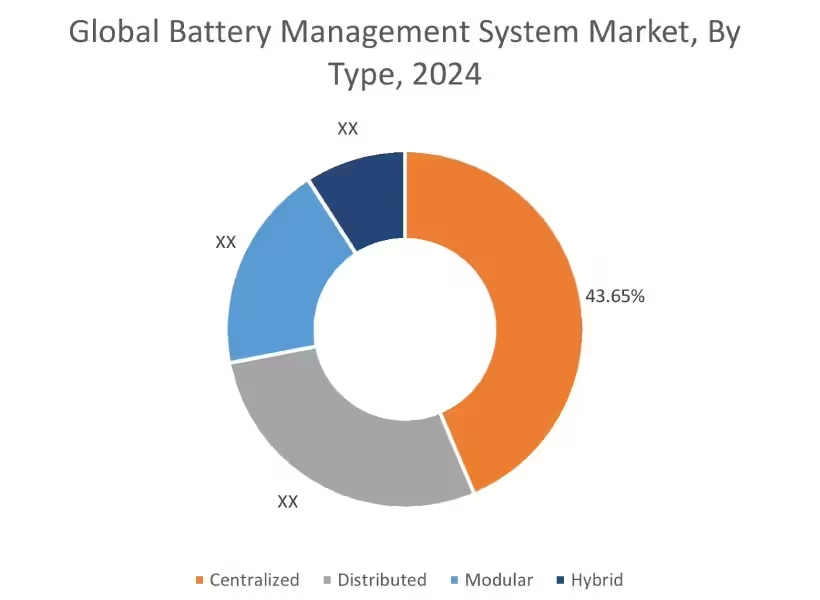
Based on type, the market is segmented into centralized, distributed, modular, and hybrid.
Trends in the type:
- There is growing emphasis on achieving essential safety compliance with a streamlined hardware structure for reducing certification time, which in turn drives the market.
- A growing focus toward standardising the communication interfaces and mechanical form factor of slave modules to allow for easier mixing and matching across different storage platforms is propelling the market.
Centralized segment accounted for the largest revenue share of 43.65% in the battery management system market share in 2024.
- There is an increasing emphasis on reducing the Bill of Materials (BOM) to make Centralized BMS the most cost-effective solution for low-power and low-voltage applications.
- There is a growing focus toward higher integration of passive components and cell-monitoring ASICs onto a single chip to further simplify the design and reduce system dimensions.
- Additionally, integration of basic wireless or low-speed bus communication for simple data logging and monitoring in non-critical, lower-voltage applications drives the adoption of battery management solutions.
- According to the battery management system market analysis, cost optimisation and increased integration are driving the battery management system market size.
The distributed segment is anticipated to register the highest CAGR during the forecast period.
- The rapid shift to Wireless BMS is eliminating 90% of harness wiring, thereby reducing weight and simplifying assembly in large EV battery packs.
- There is growing use of high-speed, noise-immune communication protocols like Ethernet or CAN-FD between the CMUs and CCU to handle massive, real-time data streams from large battery packs.
- Additionally, higher focus on battery management solutions with functional safety (ASIL-D compliance) with redundancy, enabling better isolation of cell faults.
- According to the analysis, wireless adoption, high-speed communication, and enhanced redundancy & safety are projected to boost the market during the forecast period.
By Component:
Based on component, the market is segmented into hardware and software.
Trends in the Component:
- Continuous reduction in the physical dimensions of the Cell Monitoring Units (CMUs) to allow for more flexible placement directly within the battery pack modules, which in turn is driving the market.
- Increasing need for end-to-end service providers who can design, install, test, and commission the entire BMS for large-scale projects, in turn, is propelling the market.
Hardware segment accounted for the largest revenue in the overall battery management system market share in 2024.
- There is a significant focus toward developing battery management solutions that are integrated ASICs, which can directly handle high voltages while reducing external component count.
- Adoption of non-invasive, non-contact current sensors and highly accurate temperature sensors directly embedded in the cell module to improve safety and data fidelity.
- Rising demand for all hardware components to meet stringent AEC-Q100 automotive reliability standards to ensure long-term performance and safety in EVs.
- Therefore, according to the analysis, factors including high-voltage IC integration, increased use of non-contact sensors, and AEC-Q100 qualification are driving the battery management system market trends.
Software segment is anticipated to register the fastest CAGR during the forecast period.
- Integrating advanced cybersecurity protocols directly into the embedded software to protect the BMS from unauthorised access, manipulation, and spoofing.
- Moreover, software platforms are being designed to enable seamless OTA updates for firmware, diagnostics, and algorithm improvements, allowing remote maintenance and feature upgrades.
- Strict focus on achieving software compliance with international safety standards, particularly ISO 26262 ASIL-D, which is critical for autonomous and advanced EV applications, in turn driving the market.
- Hence, cybersecurity as a core feature and Over-the-Air (OTA) updates are projected to boost the market during the forecast period.
By Battery Type:
Based on battery type, the market is segmented into lithium-ion, lead-acid, nickel-based, flow batteries, and others.
Trends in the Battery Type:
- Focus on software algorithms to monitor and predict the degradation of the solid-electrolyte interface, which in turn drives the market.
- Increasing emphasis on developing extremely low-cost, simplified monitoring hardware that provides essential voltage and temperature protection without adding significant cost to the battery itself.
The Lithium-ion segment accounted for the largest revenue share in the battery management system market in 2024, and it is anticipated to register a significant CAGR during the forecast period.
- There is growing emphasis on the development of Artificial Intelligence and Machine Learning models embedded in the BMS for highly accurate thermal runaway prediction and precise, long-term state-of-health monitoring.
- Focus on developing battery solutions that are capable of safely and efficiently managing high-power, ultra-fast charging systems.
- Moreover, rapid adoption of wireless battery management solutions to reduce the weight and complexity of wiring harnesses in large lithium-ion packs, which in turn improves the energy density and assembly speed.
- Therefore, AI/ML for health and safety, higher voltage management, and wired-to-wireless transition are driving the market.
By End Use:
Based on the end use, the market is segmented into automotive, consumer electronics, medical, energy & power, industrial automation, aerospace & defense, and others
Trends in the End Use:
- There is a rising trend towards the adoption of battery management solutions in consumer electronics due to the increasing need for faster charging speeds, extended battery life, and enhanced safety and performance in high-energy-density portable devices.
- BMS is increasingly being integrated with industrial IoT platforms and fleet management software to optimize charging schedules and maintenance for large fleets of automated equipment.
The automotive segment accounted for the largest revenue share in the market in 2024, and it is anticipated to register a substantial CAGR during the forecast period.
- Growing integration of Artificial Intelligence (AI) algorithms in battery management solutions to provide highly accurate, real-time predictions of battery degradation, thermal runaway, and overall lifespan.
- Moreover, battery solutions are incorporating features to enable Vehicle-to-Everything (V2X) capabilities, managing bi-directional power flow for Vehicle-to-Grid applications.
- In addition, strict adherence to the highest safety standards, such as ISO 26262 ASIL-D, drives the need for redundancy and fail-safe mechanisms, which in turn drive the market.
- Hence, the AI-driven predictive diagnostics, V2X integration, and functional safety compliance are driving the market growth.
Regional Analysis:
The regions covered are North America, Europe, Asia Pacific, Middle East and Africa, and Latin America.
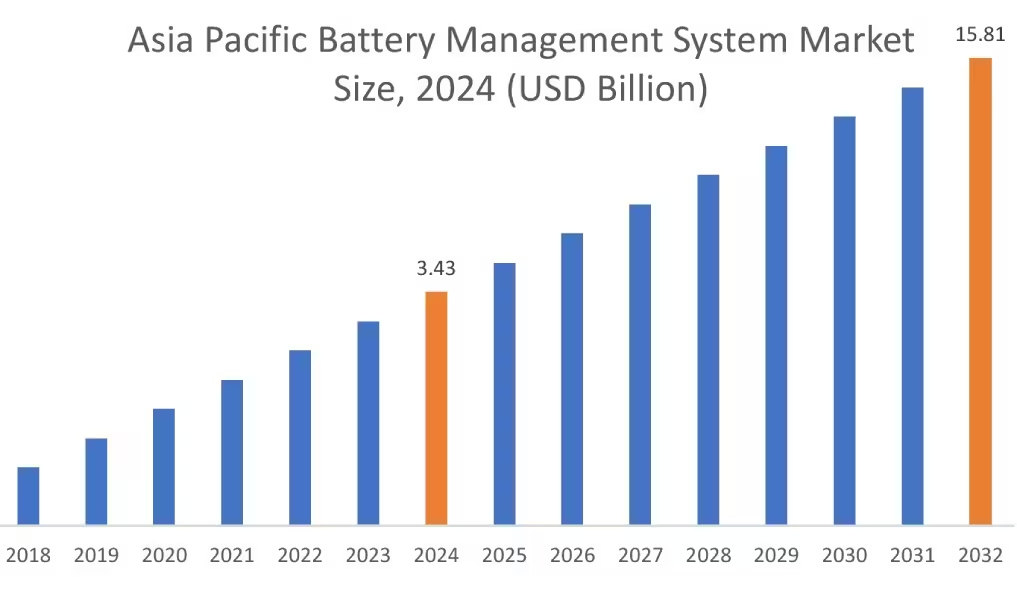
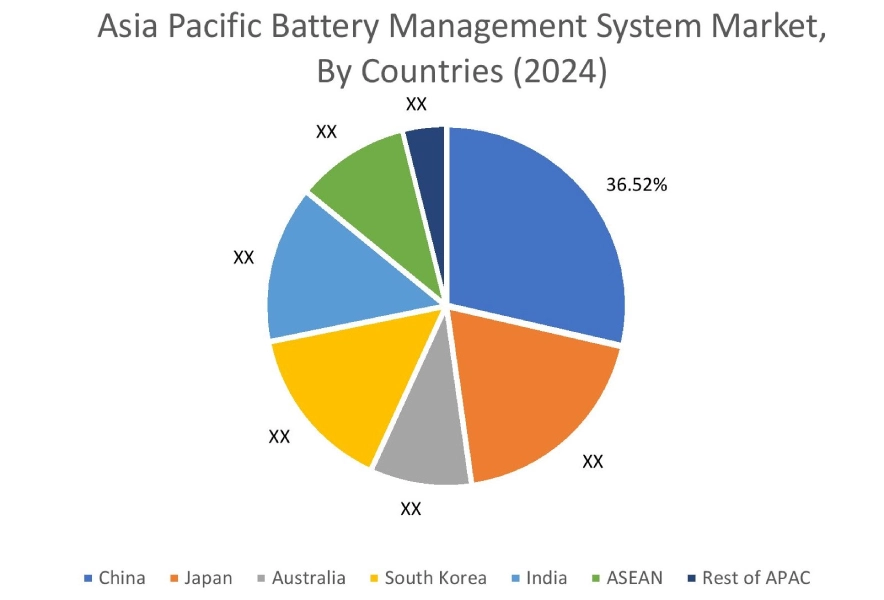
Asia Pacific region was valued at USD 3.43 Billion in 2024. Moreover, it is projected to grow by USD 4.08 Billion in 2025 and reach over USD 15.81 Billion by 2032. Out of this, China accounted for the maximum revenue share of 36.52%. As per the battery management system market analysis, the adoption of battery management solutions in the Asia-Pacific region is primarily driven by growing automotive, consumer electronics, renewable energy, and other sectors. Similarly, the rising production of consumer electronic devices is further accelerating the battery management system market expansion.
- For instance, according to the FDI Invest India, the appliances and consumer electronics sector in India was valued at USD 9.84 billion in 2021, and it is estimated to grow at a significant rate to reach USD 21.18 billion by the end of 2025. The above factors are increasing the need for battery management solutions, in turn driving the market in the Asia-Pacific region.
North America is estimated to reach over USD 11.35 Billion by 2032 from a value of USD 2.52 Billion in 2024 and is projected to grow by USD 2.98 Billion in 2025. In North America, the growth of the battery management system industry is driven by the increasing vehicle production, rising production of medical devices, and growing investments in renewable energy sector, among others. Additionally, increasing adoption of electric vehicles and rising need for effective battery management solutions in modern EVs are further contributing to the battery management system market demand.
- For instance, according to the International Energy Agency, electric car sales in the United States reached 1.5 million units in 2024, depicting an increase from 1.4 million units in 2022. The above factors are expected to propel the battery management system market trends in North America during the forecast period.
Meanwhile, according to the regional analysis, factors including the rising adoption of industrial automation, growing production of medical devices, prevalence of green energy targets, and increasing development of automotive manufacturing facilities are driving the battery management system market demand in Europe. Furthermore, according to the market analysis, the market demand in Latin America, Middle East, and African regions is expected to grow at a considerable rate due to factors such as the growing consumer electronics sector, significant production of automobiles, and rising adoption of electric vehicles, among others.
Top Key Players & Market Share Insights:
The global battery management system market is highly competitive with major players providing solutions to the national and international markets. Key players are adopting several strategies in research and development (R&D), product innovation, and end-user launches to hold a strong position in the battery management system market. Key players in the battery management system industry include-
- Texas Instruments Incorporated (USA)
- Analog Devices Inc. (USA)
- LG Energy Solution (South Korea)
- Renesas Electronics Corporation (Japan)
- Sensata Technologies Inc. (USA)
- Marelli Holdings Co., Ltd. (Japan)
- Infineon Technologies AG (Germany)
- NXP Semiconductors (Netherlands)
- STMicroelectronics (Switzerland)
- Panasonic Corporation (Japan)
- BYD Company Limited (China)
Recent Industry Developments :
Product Launches:
- In December 2024, Marelli introduced its latest battery management system which is designed for automotive applications. The solution aims at improving battery cell management by ensuring optimum and safe operation along with facilitating improved performance of the battery pack.
- In November 2024, NXP announced the launch of its ultra-wideband wireless battery management solution, which aims at simplifying EV assembly along with overcoming development challenges like complex and costly manufacturing processes, thereby accelerating the adoption of electric vehicles.
Partnerships & Collaborations:
- In February 2025, Infineon Technologies AG partnered with Eatron for developing AI-powered battery management solutions for use in industrial and consumer applications. The collaboration helps in combining the benefits of AI-powered battery optimization software with advanced power semiconductor components for creating an advanced solution that is capable of minimizing degradation, detecting safety issues, along with improving performance and reliability of battery-powered systems.
Battery Management System Market Report Insights :
| Report Attributes | Report Details |
| Study Timeline | 2021-2034 |
| Market Size in 2034 | USD 57.23 Billion |
| CAGR (2026-2034) | 18.10% |
| Base Year | 2025 |
| By Type |
|
| By Component |
|
| By Battery Type |
|
| By End Use |
|
| By Region |
|
| Key Players |
|
| North America | U.S. Canada Mexico |
| Europe | U.K. Germany France Spain Italy Russia Benelux Rest of Europe |
| APAC | China South Korea Japan India Australia ASEAN Rest of Asia-Pacific |
| Middle East and Africa | GCC Turkey South Africa Rest of MEA |
| LATAM | Brazil Argentina Chile Rest of LATAM |
| Report Coverage |
|
Key Questions Answered in the Report
How big is the battery management system market? −
The battery management system market was valued at USD 9.12 Billion in 2024 and is projected to grow to USD 41.03 Billion by 2032.
Which is the fastest-growing region in the battery management system market? +
Asia-Pacific is the region experiencing the most rapid growth in the battery management system market.
What specific segmentation details are covered in the battery management system report? +
The battery management system report includes specific segmentation details for type, component, battery type, end use, and region.
Who are the major players in the battery management system market? +
The key participants in the battery management system market are Texas Instruments Incorporated (USA), Analog Devices Inc. (USA), Infineon Technologies AG (Germany), NXP Semiconductors (Netherlands), STMicroelectronics (Switzerland), Panasonic Corporation (Japan), BYD Company Limited (China), LG Energy Solution (South Korea), Renesas Electronics Corporation (Japan), Sensata Technologies Inc. (USA), Marelli Holdings Co., Ltd. (Japan), and others.
Overview
Reputation & Certifications


Our Services
- Market Intelligence & Forecasting
- Custom Research Solutions
- Market Entry Strategy
- Competitive Intelligence
- Customer Insights
- Industry Innovation Analysis
- Investment Advisory