Jump to Content
Industrial Automation Market Size & Industry Share - Growth Trends & Forecasts (2026 - 2034)
Industrial Automation Market Size:
The Industrial Automation market size was valued at 246.6 (US$B) in 2025 and is projected to grow from 270.27 (US$B) in 2026 to 562.71 (US$B) by 2034, at a CAGR of 9.6% from 2026 to 2034, according to a recent report from Consegic Business Intelligence.
Industrial Automation Market Scope & Overview:
Industrial automation involves the use of control systems, computers, and information technology, such as robots, sensors, programmable logic controllers (PLCs), and others, to handle industrial machinery and processes. It reduces the need for human or manual input, increasing safety, speed, and precision in manufacturing, warehousing, and other operations. Moreover, industrial automation offers several benefits, including increased operational efficiency, cost reduction, increased flexibility, scalability, enhanced labor utilization, and others. Additionally, the industrial automation market is experiencing considerable growth, primarily driven by the rising adoption of Industry 4.0, increasing integration of artificial intelligence and the Industrial Internet of Things (IIoT), and a rising focus on energy efficiency, predictive maintenance, and workplace safety.

Industrial Automation MarketDynamics - (DRO) :

Key Drivers:
Rising adoption of factory automation fueled by Industry 4.0 driving the industrial automation market growth
Industry 4.0 enabled manufacturing represents automation readiness, extreme flexibility, minimal human intervention, and highest productivity. Moreover, factory automation enables 24/7 production capabilities, minimizing downtime and maximizing throughput. Manufacturing companies are increasingly focused on improving operational efficiency, and factory automation technologies help achieve this by streamlining processes. Additionally, the use of automated systems in factories can analyze workflows and optimize operations, helping manufacturers to become more agile and responsive to market demands. The utilization of automation technologies in factories offers various benefits such as faster processes, high accuracy & precision, improved worker safety, and improved operational efficiency.
- For instance, in July 2024, Xiaomi launched its completely automated smart factory in Beijing, China. The automated factory spans across 860,000 square feet, and it is developed to manufacture approximately 10 million smartphones each year without any human intervention.
Thus, the rising adoption of automation solutions in manufacturing facilities is driving the industrial automation market size.
Key Restraints :
High initial investment associated with automation systems is restraining the market growth
High initial investment associated with setting up automation systems in industrial facilities is among the primary factors restraining the market growth. The upfront costs associated with the acquisition of automation hardware/equipment, software, along with integrating them into existing systems, can be significantly high, which may cause financial barriers, particularly for smaller businesses or businesses operating on tighter budgets.
Additionally, automation systems can be quite complex to install and integrate, which further necessitates additional expenses on training personnel or hiring specialized experts for implementing and maintaining the automated systems effectively. Hence, the high initial investment associated with setting up automation systems in industrial facilities is hindering the industrial automation market expansion.
Future Opportunities :
Rising advancements associated with automation technologies, such as artificial intelligence (AI) integration, are expected to drive the industrial automation market opportunities
Increasing advancements in artificial intelligence and rising integration of AI in industrial control and automation technologies are contributing to superior operational efficiency, improved decision-making, and hyper-personalized production capabilities. By embedding machine learning algorithms, computer vision, and cognitive analytics directly into programmable logic controllers and distributed control systems, industries can exceed reactive maintenance and rigid scheduling. Furthermore, AI-driven adaptive control loops are capable of automatically adjusting to fluctuating raw material properties and environmental conditions in real time, which in turn ensures improved product quality and lower waste. Consequently, automation solution providers are frequently investing in the development of new technologies, including hardware and software solutions, to ensure its safe and effective utilization in manufacturing facilities for enhanced operational efficiency and minimal human intervention.
- For instance, in April 2026, Siemens introduced the Eigen Engineering Agent, an AI-driven system for automation engineering that moves beyond advisory roles to independently execute industrial tasks within the TIA Portal ecosystem, such as PLC coding and HMI visualization. Backed by significant investment, this agent enhances operational efficiency by up to 50% while accelerating execution cycles by utilizing self-correcting logic to meet safety standards.
Hence, according to the analysis, the above factors are projected to boost market opportunities during the forecast period.
Industrial Automation Market Segmental Analysis :
By Component:
Based on component, the market is segmented into hardware, software, and services.
Trends in the component:
- Increasing technological advancements associated with industrial control and automation devices such as robotics systems, sensors, actuators, controllers, and others.
- There is a rising trend towards utilization of industrial control and automation devices in industrial facilities for constant monitoring, optimization, and improved operational efficiency.
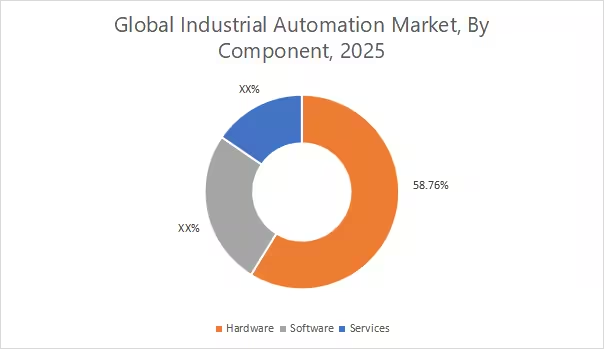
The hardware segment accounted for the largest revenue share of 58.76% in the industrial automation market share in 2025.
- The primary hardware components include programmable logic controllers (PLCs), industrial robots, sensors, actuators, motors, and others.
- PLCs are industrial computers used to control machinery and processes automatically. Industrial robots are used for automating repetitive tasks in factories for increased precision and efficiency.
- Moreover, the aforementioned hardware components help in facilitating automation within industrial facilities, in turn leading to improved efficiency, precision, and safety in manufacturing processes.
- For instance, in August 2024, Okuma America Corporation launched its new ORL series of robotics for facilitating automation within factories. The ORL series products are optimized to seamlessly load and unload workpieces from both new as well as pre-existing Okuma machines for increasing productivity and aiding operators' efficiency.
- According to the analysis, the rising innovations associated with hardware components for facilitating automation within industrial facilities are further driving the industrial automation market.
The software segment is anticipated to register the fastest CAGR during the forecast period.
- Automation software provides a centralized platform for monitoring and controlling the automation systems used within industrial facilities.
- Automation software mostly includes platforms like SCADA (Supervisory Control and Data Acquisition), MES (Manufacturing Execution System), and PLC (Programmable Logic Controller) logic environments, which facilitate the monitoring, control, and optimization of industrial processes with minimal human intervention.
- Moreover, the benefits of integrating automation software include smarter maintenance and effective analysis of factory equipment performance.
- Additionally, the segment is driven by the rising integration of advanced control systems, robotics, and smart manufacturing ecosystems, among others.
- Therefore, the increasing advancements associated with automation software are anticipated to drive the market during the forecast period.
By Automation System Type:
Based on automation system type, the market is segmented into fixed automation, flexible automation, programmable automation, and integrated automation.
Trends in the automation system type:
- There is an increasing trend towards adoption of fixed automation systems within industrial facilities for performing repetitive tasks with minimal effort to increase operational efficiency.
- Rising adoption of programmable automation in industries where the tasks can vary from one batch to another batch is driving the market.
Fixed automation segment accounted for the largest revenue share in the market in 2025, and it is anticipated to register a significant CAGR during the forecast period.
- In fixed automation systems, the machines are permanently set up for performing a particular task. Upon completion of the task, the machines are then reset and typically wait to perform the next task.
- Moreover, fixed automation systems are primarily utilized for discrete mass production or constant flow systems. A primary example of a fixed automation system includes an automated conveyor belt that is designed to move objects with minimum effort while increasing efficiency.
- Additionally, the segment is primarily propelled by rising global demand for standardized mass-produced goods, increasing need to maximize production throughput speed, and sustained investments in high-volume discrete manufacturing sectors, among others.
- For instance, in May 2024, Montech, a Swiss technology company, launched its new belt conveyor line designed for utilization in cleanrooms. The belt conveyors are tested and certified for application in cleanrooms and can be utilized in multiple industries, including pharmaceutical, chemical, semiconductor, and others.
- Therefore, the rising developments associated with fixed automation systems are driving the market.
By Technology:
Based on technology, the market is segmented into programmable logic controller (PLC), distributed control system (DCS), supervisory control and data acquisition (SCADA), programmable automation controller (PAC), and Others.
Trends in the technology:
- There is an increasing trend towards adoption of programmable logic controllers within industrial facilities for real-time processing and operationwhile increasing operational efficiency.
- Rising adoption of distributed control system (DCS) in industries such as oil & gas, power generation, and others is driving the market.
The programmable logic controller (PLC) segment accounted for the largest revenue in the market in 2025, and it is anticipated to register a substantial CAGR during the forecast period.
- Programmable logic controllers (PLCs) are compact, robust digital computers that are specifically designed for controlling manufacturing processes or machinery. Programmable logic controllers utilize programmable software for executing various logic operations and controlling key industrial processes.
- Moreover, PLCs offer a range of benefits including real-time processing and operation, increased flexibility in accommodating different tasks and industrial processes, along with increased reliability and durability while operating in harsh industrial environments.
- For instance, in February 2024,WEG launched its new PLC410 model of programmable logic controller. The newly launched PLC offers a versatile solution for industrial automation in several industries, including pharmaceuticals, pulp and paper, metallurgy, and others.
- According to the market analysis, the rising advancements associated with programmable logic controllers (PLCs) are driving the market.
By End User:
Based on the end user, the market is segmented into process industries and discrete industries.
Trends in the end user:
- Industrial facilities have witnessed a significant growth trend in the utilization of automation systems for optimizing and streamlining industrial processes.
- Factors including the rapid integration of artificial intelligence (AI) and edge computing for predictive maintenance, increasing deployment of collaborative robots (cobots), and rising shift toward flexible, software-defined automation are key prospects driving the market.
The discrete industries segment accounted for the largest revenue share in the market in 2025.
- The discrete industries segment includes sectors like automotive, electronics, aerospace, and machinery manufacturing, which focus on the production of distinct, countable items rather than continuous flows of materials.
- Automation solutions are primarily used in discrete industries to streamline the sequential assembly, sorting, and packaging of individual parts, among others.
- Also, factors including the rapid integration of artificial intelligence (AI) and edge computing for predictive maintenance, increasing deployment of collaborative robots (cobots), and rising shift toward flexible, software-defined automation are key trends driving the segment.
- Consequently, the above factors are further driving the market growth.
The process industries segment is anticipated to register a significant CAGR during the forecast period.
- Process industries mainly include oil & gas, chemicals & petrochemicals, pharmaceuticals, food & beverage, water & wastewater treatment, pulp & paper, and other related sectors.
- The process industries segment involves continuous physical or chemical conversion of raw materials into finished or intermediate goods. Moreover, in process industries, automation solutions are primarily used for continuous control of bulk materials, chemical reactions, and fluid flows to maximize safety, quality, as well as output efficiency.
- Also, the segment is primarily driven by the rising integration of industrial internet of things (IIoT), edge computing, and artificial intelligence, combined with rising governmental incentives promoting smart manufacturing infrastructure.
- Hence, the above factors are expected to boost the market during the forecast period.
Regional Analysis:
The regions covered are North America, Europe, Asia Pacific, Middle East and Africa, and Latin America.
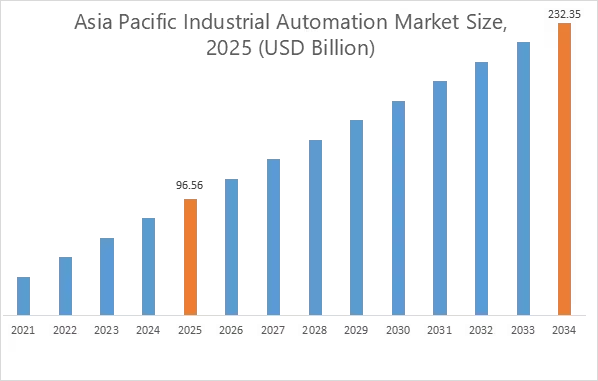
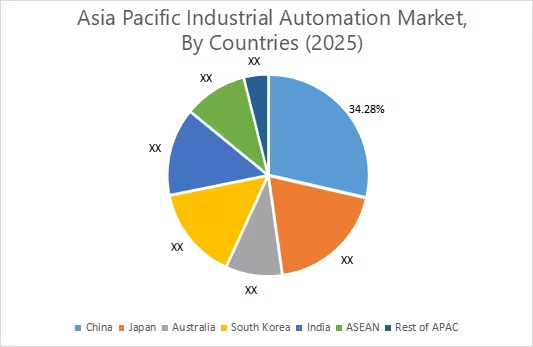
Asia Pacific region was valued at USD 96.56 Billion in 2025. Moreover, it is projected to grow by USD 104.72 Billion in 2026 and reach over USD 232.35 Billion by 2034. Out of this, China accounted for the maximum revenue share of 34.28%. As per the industrial automation market analysis, the adoption of automation solutions in the Asia-Pacific region is primarily driven by the rapid expansion of manufacturing capacities across countries such as China, Japan, South Korea, India, and others, combined with technological advancements in robotics and artificial intelligence. Additionally, government-led modernization frameworks, such as smart factory incentives, production-linked domestic manufacturing policies, and national digitalization roadmaps, along with increasing advancements associated with smart factory solutions, are further accelerating the market expansion.
- For instance, in September 2024, Panasonic Smart Factory Solutions India launched its advanced smart factory solutions and products that are integrated with technologies such as IIoT (industrial internet of things), AI (artificial intelligence), automation, and others. These innovations are optimized to integrate with manufacturing processes seamlessly, in turn driving quality, efficiency, and production capacity to exceptional levels. The above factors are driving the market in the Asia-Pacific region.
North America is estimated to reach over USD 164.06 Billion by 2034 from a value of USD 72.07 Billion in 2025 and is projected to grow by USD 77.68 Billion in 2026. In North America, the market growth is mostly driven by increasing development of smart factories and strict workplace safety mandates that compel facilities to transition toward autonomous systems. Moreover, rising adoption of Industry 4.0 models, marked by the widespread deployment of collaborative robots (cobots), edge computing, and AI-driven predictive maintenance, is further contributing to the industrial automation market demand in the region.
- For instance, in September 2024, Epiroc launched its new its Surface Mining Automation Center (SMAC) in Utah, United States. The new facility aims to develop autonomous haulage solutions for the surface mining sector. The above factors are expected to propel the industrial automation market trends in North America during the forecast period.
Meanwhile, according to the regional analysis, factors including the prevalence of favorable government measures for facilitating industrial automation, increasing development of industrial facilities, combined with the rising adoption of automation solutions in core sectors such as automotive, pharmaceuticals, and food & beverage, are key prospects driving the market demand in Europe. Furthermore, according to the analysis, the market demand in Latin America, Middle East, and African regions is expected to grow at a considerable rate due to factors such as rising investments in development of industrial manufacturing facilities and increasing adoption of automation solutions within factories.
Top Key Players & Market Share Insights:
The global industrial automation market is highly competitive with major players providing solutions to the national and international markets. Key players are adopting several strategies in research and development (R&D), product innovation, and end-user launches to hold a strong position in the industrial automation market. Key players in the industrial automation industry include-
- Siemens(Germany)
- Schneider Electric(France)
- ABB (Switzerland)
- Omron Corporation (United States)
- Honeywell International Inc. (United States)
- Rockwell Automation Inc. (United States)
- Emerson Electric Co. (United States)
- Yokogawa Electric Corporation (Japan)
- Mitsubishi Electric Corporation (Japan)
- FANUC Corporation (Japan)
Recent Industry Developments :
Product Launches:
- In June 2026, Schneider Electric launched its Industrial Automation Modernization as a Service, an initiative developed alongside Hewlett Packard Enterprise (HPE). By integrating EcoStruxure Automation Expert software with HPE SimpliVity hybrid cloud platforms, this solution establishes a resilient, software-driven foundation that allows businesses to upgrade legacy automation systems without halting factory operations.
- In September 2024, Schneider Electric introduced its new ultra-compact Lexium Scara in its automation portfolio. Lexium Scara is a high-speed industrial robot that can be deployed across several industries, including battery manufacturing, warehousing, electronics, and consumer packaging goods, among others.
- In August 2024, Okuma America Corporation launched its new ORL series of robotics that is designed for facilitating automation within factories, increasing productivity, and aiding operators' efficiency.
Acquisition:
- In March 2024, Siemens announced the acquisition of the industrial drive technology business of ebm-papst. The business employs approximately 650 individuals and includes intelligent, integrated mechatronic systems along with innovative motion control This acquisition aims at strengthening Siemens’ position in the field of automation and digitalization.
Industrial Automation Market Report Insights :
| Report Attributes | Report Details |
| Study Timeline | 2021-2034 |
| Market Size in 2034 | USD 562.71 Billion |
| CAGR (2026-2034) | 9.60% |
| Base Year | 2025 |
| By Component |
|
| By Automation System Type |
|
| By Technology |
|
| By End User |
|
| By Region |
|
| Key Players |
|
| North America | U.S. Canada Mexico |
| Europe | U.K. Germany France Spain Italy Russia Benelux Rest of Europe |
| APAC | China South Korea Japan India Australia ASEAN Rest of Asia-Pacific |
| Middle East and Africa | GCC Turkey South Africa Rest of MEA |
| LATAM | Brazil Argentina Chile Rest of LATAM |
| Report Coverage |
|
Key Questions Answered in the Report
How big is the industrial automation market? −
The industrial automation market was valued at USD 250.86 Billion in 2025 and is projected to grow to USD 577.27 Billion by 2034.
Which is the fastest-growing region in the market? +
Asia-Pacific is the region experiencing the most rapid growth in the market.
What specific segmentation details are covered in the industrial automation report? +
The report includes specific segmentation details for component, automation system type, technology, end user, and region.
Who are the major players in the market? +
The key participants in the market are Siemens (Germany), Schneider Electric (France), ABB (Switzerland), Omron Corporation (United States), Honeywell International Inc. (United States), Rockwell Automation Inc. (United States), Emerson Electric Co. (United States), Yokogawa Electric Corporation (Japan), Mitsubishi Electric Corporation (Japan), FANUC Corporation (Japan), and others.
Overview
Reputation & Certifications


Our Services
- Market Intelligence & Forecasting
- Custom Research Solutions
- Market Entry Strategy
- Competitive Intelligence
- Customer Insights
- Industry Innovation Analysis
- Investment Advisory