Jump to Content
Air Purifier Market - Size, Industry Share, Growth Trends and Forecasts (2026 - 2034)
Air Purifier Market Size:
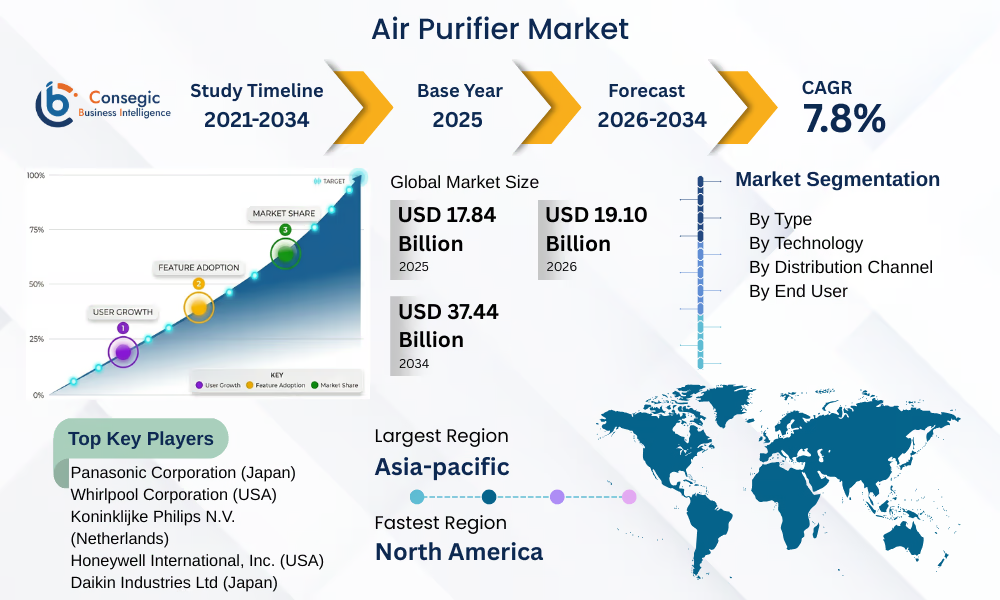
Air Purifier Market size is estimated to reach over USD 37.44 Billion by 2034 from a value of USD 17.84 Billion in 2025 and is projected to grow by USD 19.10 Billion in 2026, growing at a CAGR of 7.8% from 2026 to 2034
Air Purifier Market Key Takeaways
Key Growth Drivers
- Rising air pollution levels and growing health awareness are increasing demand for air purification systems across residential and commercial sectors.
- Rapid urbanization, industrial activities, and agricultural emissions are driving the need for cleaner indoor air environments.
- Increasing adoption of air purifiers in hospitals, schools, and commercial buildings is supporting market growth and safety compliance.
Market Limitations & Challenges
- High upfront costs and recurring expenses for filter replacement and maintenance are limiting product adoption.
- Operational limitations in removing certain gases and volatile organic compounds (VOCs) are restricting market expansion.
Strategic Opportunities
- Integration of IoT, artificial intelligence, and smart monitoring features is creating new growth opportunities in the market.
- Rising demand for app-controlled and remotely managed air purifiers is enhancing consumer convenience and product adoption.
Key Players
- Market Leader: Samsung Electronics Co., Ltd. held a significant share of the global Air Purifier Market in 2025, supported by its advanced air purification technologies, strong global distribution network, and growing demand for smart indoor air quality solutions across residential and commercial sectors.
Air Purifier Market Scope & Overview:
The air purifier is a device designed to pull in contaminated indoor air, trap airborne pollutants, and circulate clean air back into the room to improve respiratory health and remove odors. The device is equipped with a fan and a system of filters with sensors and a display unit, among others, for guiding the end user. The key advantages driving the air purifier market growth include allergy and asthma relief, reduced airborne pathogens, odor neutralization, and the removal of harmful chemicals, among others. Further, the increased health awareness post-pandemic is boosting the air purifier market demand.
Air Purifier Market Dynamics - (DRO) :
Market Drivers:
Rising health & wellness awareness is boosting market growth for air purifier
The rapid urbanization, industrialization, and agricultural burning led to poor outdoor air quality, which in turn is driving the market demand. Also, the surge in public awareness regarding the health risks due to airborne contaminants is driving the market growth. Additionally, the hospitals and educational institutions, among others, are increasingly investing in professional-grade air purification systems to meet ESG and building standards to ensure occupant safety, which is boosting the market progress.
- For instance, according to State of Global Air 2025 report, around 36% of the world population is exposed to PM2.5 pollution. Also, 95% of air pollution-related deaths are due to diabetes, heart disease, and lung disease.
Therefore, the growing air pollution is driving the demand for air purification systems, in turn, proliferating the growth of the market.
Market Restraints:
High cost and operational limitations are restraining the market growth
The air purification system has a higher initial investment and recurring maintenance expenses, such as frequent filter replacements and energy consumption, which significantly increase the cost of ownership. Additionally, the device does not eliminate all types of pollutants, such as certain gases and volatile organic compounds (VOCs), which limits the air purifier market expansion. Further, the purifiers produce varying levels of noise, which affect sleep and concentration, as well as purifiers that use ionization technology, emit ozone, which creates potential health risks, hindering the market expansion.
Therefore, the high costs and aforementioned limitations of the air purification system are restraining the market growth.
Future Opportunities:
Integration of advanced technologies is expected to promote potential opportunities for market growth
The market is expanding from a hardware-centric model into an integrated service ecosystem with advanced technologies such as internet of things (IoT) protocols, artificial intelligence, UV-C light sanitization, and ozone-free systems, which is creating air purifier market opportunities. Additionally, the integration of mobile apps, which allows users to control purifiers remotely, track indoor air quality (IAQ), and receive automated filter-replacement notifications, is boosting the market progress. Further, the integration of AI helps to analyze usage patterns and historical pollution levels to optimize energy consumption and airflow.
- For instance, in December 2025, Smartmi launched Air Purifier 3, which features Fast and Efficient Air Purification, Smart Monitoring and Control, Quiet Comfort, and Stylish Design. The device can be controlled via Mi Home App, and with smart assistants.
Hence, the rising integration of advanced technologies is anticipated to increase the utilization of, in turn, promoting prospects for market opportunities during the forecast period.
Air Purifier Market Segmental Analysis:
By Type:
Based on the type, the air purifier market is bifurcated into standalone/portable and in-duct/fixed.
Trends in the Type:
- The in-duct/fixed purifiers are integrated directly into central HVAC systems, which is driving the air purifier market trends.
- The consumers are shifting toward IoT-enabled units which features app dashboards, and voice-assistant compatibility is driving the market trends.
The standalone/portable accounted for the largest revenue share in the year 2025 and is anticipated to register the fastest CAGR during the forecast period.
- The standalone/portable purifier is a compact, plug-and-play devices that improve indoor air quality. The portable purifier moved from room to room to capture pollutants such as dust and pollen.
- The key advantages of a standalone/portable purifier include zero installation, high flexibility, and localized filtration, among others.
- Further, the rising awareness of respiratory conditions, seasonal allergies, and traffic-related issues is driving the adoption of standalone/portable purifiers, which in turn is boosting the market share.
- The increasing demand for lightweight, HEPA-equipped units to reduce airborne particulate matter and allergens is fueling the market size.
- Thus, as per the market analysis, the rising awareness and demand for lightweight HEPA-equipped units are driving the market progress.
By Technology:
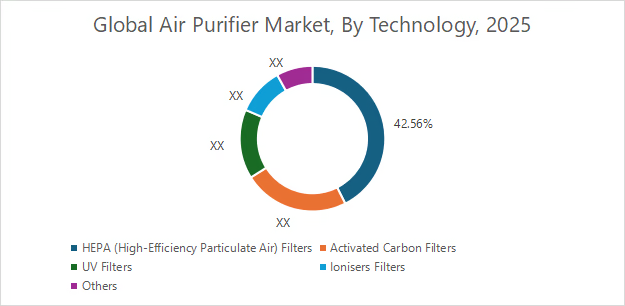
Based on the technology, the market is segmented into HEPA (high-efficiency particulate air) filters, activated carbon filters, UV filters, ionisers filters, and others.
Trends in the Technology:
- The trend towards the integration of HEPA filters, activated carbon filters, UV filters, and other filters into a single unit is driving the market development.
- The trend towards increasing health initiatives and government mandates is driving the adoption of ionizer filters in commercial spaces, which is driving the market development.
The HEPA (high-efficiency particulate air) filters accounted for the largest revenue share of 42.56% in the year 2025.
- The HEPA filter is an essential component in the purification system for improving indoor air quality.
- Additionally, the increased focus on respiratory health, allergies, and airborne pathogens drives consumers to improve indoor spaces, which is propelling the adoption of HEPA filters, which in turn is boosting the air purifier market share.
- Further, the rapid urbanization and deteriorating outdoor air quality have made HEPA filters a necessity to maintain safe residential and commercial environments, fueling the air purifier market size.
- Furthermore, the proliferation of compact air purification systems in modern vehicles is driving the industry.
- Thus, as per the air purifier market analysis, urbanization and deteriorating outdoor air quality are driving the market progress.
The activated carbon filters are anticipated to register the fastest CAGR during the forecast period.
- The activated carbon filters are increasingly being integrated into air purification systems to capture airborne gases, chemicals, and odors. The filter neutralizes invisible threats such as volatile organic compounds and smoke through physical adsorption.
- Additionally, consumers are concerned about airborne contaminants, and overall respiratory health is propelling the market progress.
- Further, the rising PM2.5 and PM10 levels due to seasonal smog incidents and vehicular emissions are propelling the residential and commercial industry to invest in advanced activated carbon filter technology.
- Furthermore, the push for smart, energy-efficient filtration devices equipped with an activated carbon filter, real-time AQI tracking, and IoT-enabled app controls is fueling the market progress.
- Therefore, as per the market analysis, the technological advancement and increasing concern about airborne contaminants, and overall respiratory health are anticipated to boost the market during the forecast period.
By Distribution Channel:
Based on the distribution channel, the market is bifurcated into online channel and offline channel.
Trends in the Distribution Channel:
- The trend towards the rising investment in the e-commerce platform by premium brands for providing an ecosystem to manage the entire user experience and build long-term subscription models for replacement filters.
- The rising focus on expanding digital footprint is propelling the adoption of online channels, which in turn is fueling the market trend.
The offline channel accounted for the largest revenue share in the year 2025.
- The consumer preference for physically evaluating the product, assessing noise levels, and verifying physical size is driving the progress of the offline channel.
- Also, offline channels allow buyers to witness demonstrations of filtration efficiency and receive expert in-store guidance.
- Additionally, the ability to take a unit home the same day and secure immediate installation makes the offline channel demanding.
- Further, the rising health concerns are propelling residential and commercial end users to adopt the air purification system.
- Furthermore, the offline channel is preferred by offices, hospitals, and hospitality to negotiate bulk pricing and installation services, which is boosting the market progress.
- Thus, as per the market analysis, the aforementioned factors are driving the market development.
The online channel is anticipated to register the fastest CAGR during the forecast period.
- The convenience of e-commerce and increasing internet penetration are propelling the adoption of the online channel for the purchase of an air purification system.
- The online channels provide quick, convenient access to top-rated brands, and a wide range of portable options is driving the market progress.
- Additionally, online buyers rely heavily on validated CADR ratings, HEPA certifications, and online reviews to plan the purchase of a purifier.
- Further, the e-commerce platforms offer easy price comparisons, flexible payment options, and wider brand availability compared to physical retail stores, which is boosting the market development.
- Therefore, as per the market analysis, the convenience of e-commerce and increasing internet penetration are anticipated to boost the market during the forecast period.
By End User:
Based on the end user, the market is segmented into commercial, industrial, and residential.
Trends in the End User:
- Industries such as the automotive industry are increasingly adopting air purification systems to protect end users from in-cabin allergens, pathogens, and fine dust.
- Factories in sectors such as cement, chemical processing, and mining are increasingly utilizing large-scale air purification systemsto manage hazardous emissions and meet workplace safety standards.
The residential accounted for the largest revenue share in the year 2025.
- The residential sector, ranging from metropolitan areas to households managing respiratory conditions such as asthma and allergies are increasingly adopting air purification systems across the globe.
- Additionally, the increasing adoption of air purification systems is due to urbanization, rising pollution levels, and rising awareness of indoor air quality.
- Further, the proliferation of smart home automation and the rising adoption of IoT and voice assistants are driving the demand for smart air purification systems.
- Furthermore, the modern residential consumers require lightweight, portable, and low-noise devices that can be easily adjusted in bedrooms, home offices, and living spaces, which is driving the market progress.
- Thus, as per the market analysis, the proliferation of smart home automation is driving the market progress.
The commercial is anticipated to register the fastest CAGR during the forecast period.
- The businesses, healthcare facilities, and educational institutions are increasingly focusing on indoor air quality to ensure occupant health, safety, and productivity.
- Additionally, the commercial end users are propelling manufacturers to develop energy-efficient units equipped with advanced HEPA filters, UV-C sterilization, and smart HVAC integration for real-time monitoring and compliance.
- Further, the rising adoption of air purification systems in healthcare facilities to mitigate airborne pathogens, mold, and nosocomial infections is driving the market progress in the commercial sector.
- Furthermore, the strict workplace safety and indoor air quality (IAQ) regulations are forcing the commercial sector to adopt large-scale air purification systems.
- Therefore, as per the market analysis, the stringent regulations and increasing focus on indoor air quality are anticipated to boost the market during the forecast period.
Air Purifier Market Regional Analysis:
The regions covered are North America, Europe, Asia Pacific, Middle East and Africa, and Latin America.
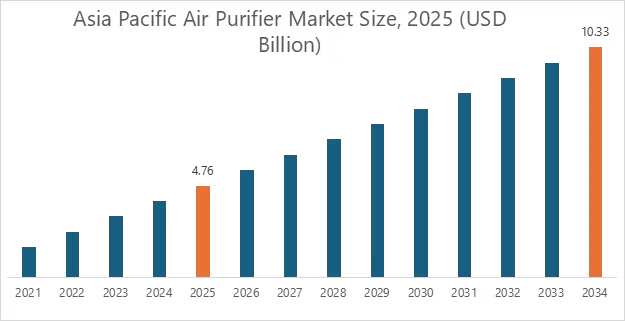
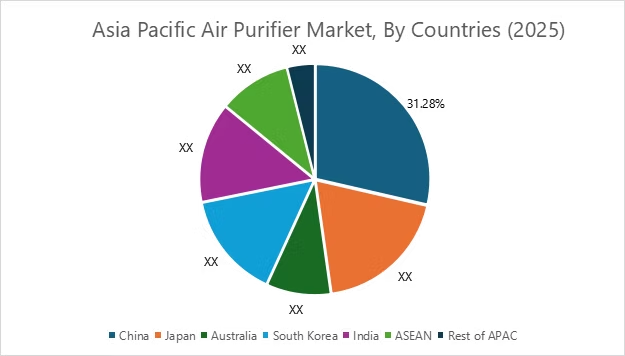
Asia Pacific region was valued at USD 4.76 Billion in 2025. Moreover, it is projected to grow by USD 5.12 Billion in 2026 and reach over USD 10.33 Billion by 2034. Out of this, China accounted for the maximum revenue share of 31.28%. The market progress is mainly driven by rising air pollution and escalating health awareness. Furthermore, factors including the expanding middle-class populations and stricter environmental emissions are projected to drive the market progress in Asia Pacific region during the forecast period.
- For instance, in November 2022, Samsung launched AX46 and AX32 air purifiers designed with IoT and remove 99.97% nano-sized particles. The device features the SmartThings App to remotely control the system.
North America is estimated to reach over USD 12.19 Billion by 2034 from a value of USD 5.76 Billion in 2025 and is projected to grow by USD 6.17 Billion in 2026. The North American region's frequent and severe wildfires in the U.S. and Canada offer lucrative growth prospects for the market. Additionally, the growing prevalence of respiratory diseases and airborne allergies is driving the market progress.
- For instance, in May 2021, Dyson launched an air purification system with fully-sealed HEPA 13 standard filtration as well as the ability to eliminate dangerous indoor pollutants.
The regional analysis depicts that the rising urban pollution and expanding industrialization are driving the market in Europe. Additionally, the key factor driving the market is the massive infrastructure initiatives, as well as increasing awareness of airborne pathogens, respiratory illnesses, and allergens, which is propelling the market adoption in the Middle East and African region. Further, deforestation, vehicular emissions, and a growing consumer focus on health and indoor wellness are paving the way for the progress of the market in Latin America region.
Top Key Players & Market Share Insights:
The global air purifier market is highly competitive with major players providing air purification system to the national and international markets. Key players are adopting several strategies in research and development (R&D), product innovation, and end user launches to hold a strong position in the air purifier industry. Key players in the air purifier market include-
- Samsung Electronics Co., Ltd. (South Korea)
- Breathify Inc. (India)
- Daikin Industries Ltd (Japan)
- Honeywell International, Inc. (USA)
- Koninklijke Philips N.V. (Netherlands)
- Whirlpool Corporation (USA)
- Panasonic Corporation (Japan)
- IQAir (Switzerland)
- Camfil AB (Sweden)
- 3M (USA)
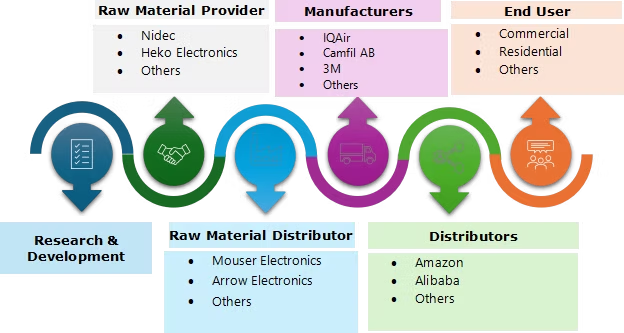
Air Purifier Market Ecosystem:
Recent Industry Developments:
Product launches
- In August 2024, Daikin launchednew plug-and-play air purifier models, which are designed to control, monitor, and schedule air purification through a smartphone or tablet. The model helps to improve indoor air quality and gives access to real-time insights on air quality.
- In July 2024, Blueair launched a new air purification system that features professional-grade air purification, maximum filtration, minimum noise, and smarter air purification.
Air Purifier Market Report Insights :
| Report Attributes | Report Details |
| Study Timeline | 2021-2034 |
| Market Size in 2034 | USD 37.44 Billion |
| CAGR (2026-2034) | 7.8% |
| By Type |
|
| By Technology |
|
| By Distribution Channel |
|
| By End User |
|
| By Region |
|
| Key Players |
|
| Report Coverage |
|
Key Questions Answered in the Report
How big is the air purifier market? −
The air purifier market size is estimated to reach over USD 37.44 Billion by 2034 from a value of USD 17.84 Billion in 2025 and is projected to grow by USD 19.10 Billion in 2026, growing at a CAGR of 7.8% from 2026 to 2034.
Which segmentation details are covered in the report? +
The report includes specific segmentation details for type, technology, distribution channel, end user, and regions.
Which is the fastest segment anticipated to impact the market growth? +
In the market, the activated carbon filter technology is the fastest-growing segment during the forecast period due to technological advancement and increasing concern about airborne contaminants and overall respiratory health.
Who are the major players in the market? +
The key participants in the market are Samsung Electronics Co., Ltd. (South Korea), Breathify Inc. (India), Daikin Industries Ltd (Japan), Honeywell International, Inc. (USA), Koninklijke Philips N.V. (Netherlands), Whirlpool Corporation (USA), Panasonic Corporation (Japan), IQAir (Switzerland), Camfil AB (Sweden), 3M (USA) and others.
What are the key trends in the market? +
The market is being shaped by several key trends including the integration of HEPA filters, activated carbon filters, UV filters, and other into single unit and shift toward IoT-enabled purification units which features app dashboards, voice-assistant compatibility are the key trends driving the market.
Overview
Reputation & Certifications


Our Services
- Market Intelligence & Forecasting
- Custom Research Solutions
- Market Entry Strategy
- Competitive Intelligence
- Customer Insights
- Industry Innovation Analysis
- Investment Advisory