Jump to Content
E-commerce Market - Size, Share, Industry Trends, and Forecasts (2025-2032)
E-commerce Market Size:
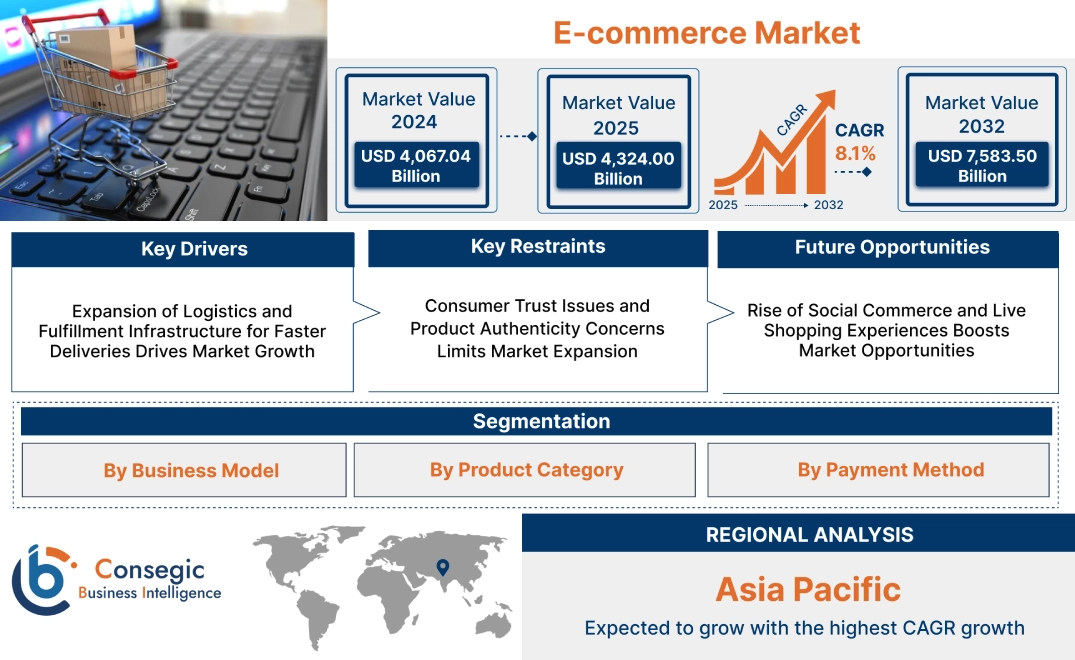
E-commerce market size is estimated to reach over USD 7,583.50 Billion by 2032 from a value of USD 4,067.04 Billion in 2024 and is projected to grow by USD 4,324.00 Billion in 2025, growing at a CAGR of 8.1% from 2025 to 2032.
E-commerce Market Scope & Overview:
E-commerce refers to the buying and selling of goods and services through digital platforms, enabling seamless transactions across various industries. It incorporates online marketplaces, direct-to-consumer websites, and business-to-business portals, offering accessibility to a global customer base. Advanced payment gateways, secure transactions, and personalized shopping experiences enhance convenience for both consumers and businesses.
Key features include real-time inventory management, AI-driven recommendations, multi-channel integration, and automated logistics. These capabilities streamline operations, reduce transaction costs, and improve efficiency in supply chain management. The adoption of digital payment solutions, data-driven marketing strategies, and mobile commerce further enhance customer engagement and business scalability.
Retailers, manufacturers, and service providers leverage these digital platforms to expand market reach, optimize sales strategies, and improve customer satisfaction. The continuous evolution of technology ensures that digital commerce remains adaptable, driving efficiency in global trade and enhancing the overall shopping experience.
How is AI Impacting the E-Commerce Market?
AI is revolutionizing the e-commerce market by enhancing customer experiences, optimizing operations, and boosting sales. AI integration enables personalized product recommendations, streamlined logistics, and more effective marketing campaigns. AI-powered tools are also improving fraud detection and customer service, leading to a more seamless and secure online shopping experience. Additionally, AI algorithms analyze customer data (browsing history, purchase patterns, etc.) to offer tailored product suggestions, personalized content, and targeted marketing messages. Further, the key factor driving the growth of e-commerce is transportation and logistics sector and AI is optimizing logistics by predicting demand, streamlining inventory management, and improving delivery processes. Thus, leading to reduced costs, faster delivery times, and better customer service.
E-commerce Market Dynamics - (DRO) :
Key Drivers:
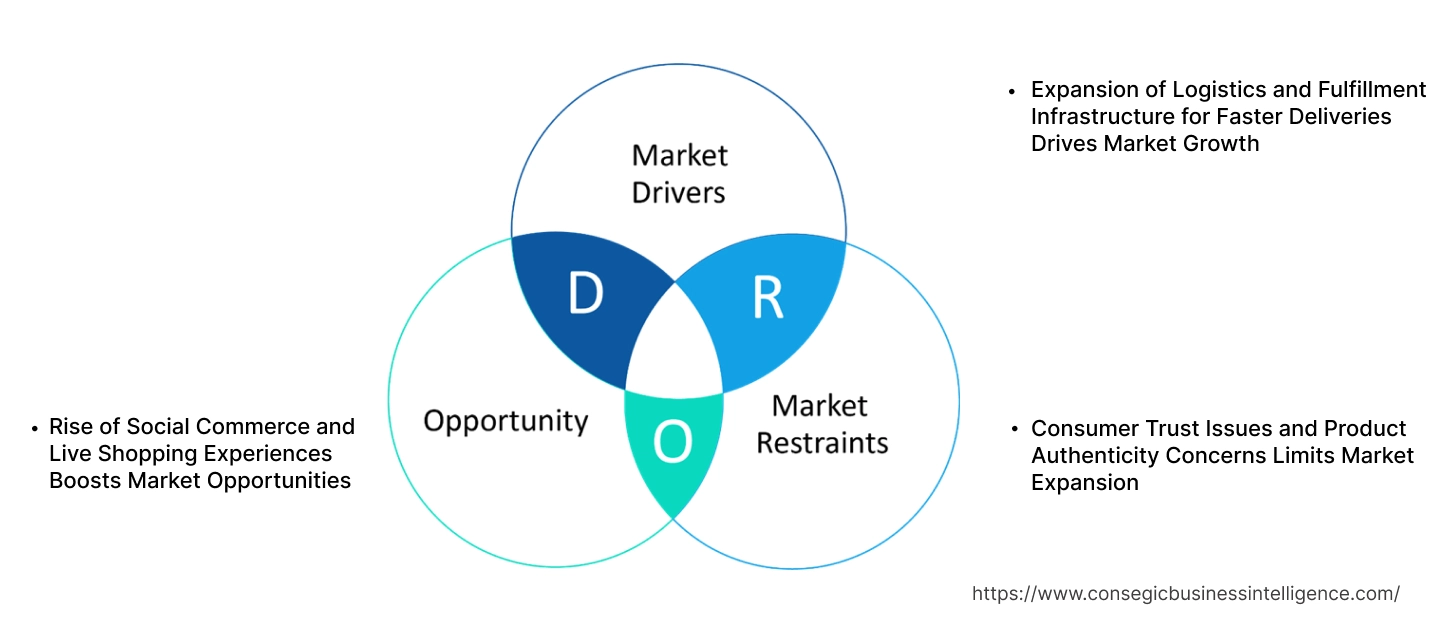
Expansion of Logistics and Fulfillment Infrastructure for Faster Deliveries Drives Market Growth
As consumer expectations shift toward same-day and next-day delivery services, e-commerce companies are investing in automated warehouses, advanced inventory management systems, and AI-driven logistics solutions to streamline operations. The demand for faster fulfillment has led to the development of micro-fulfillment centers, urban distribution hubs, and drone-based deliveries, reducing transit times and improving last-mile logistics. Additionally, strategic partnerships with third-party logistics providers (3PLs) and autonomous vehicle companies are optimizing supply chain efficiency, lowering operational costs, and enhancing delivery precision. The integration of predictive analytics, real-time tracking, and smart routing technologies is further improving fulfillment reliability.
- For instance, in November 2024, Locad raised $9 Billion in Pre-Series B funding round for smart digital logistics and global expansion. The company aims to build a supply chain infrastructure connecting brands to consumers in growing markets with aglobal cloud supply chain as-a-service. Brands will be able to connect with all sales channels through a single pool of inventory and a smart logistics network which will provide real-time visibility, analytics, and AI-enhanced workflow automation.
As logistics networks evolve to support high-volume transactions, these advancements are expected to accelerate e-commerce market expansion, enhancing customer satisfaction and boosting industry competitiveness.
Key Restraints:
Consumer Trust Issues and Product Authenticity Concerns Limits Market Expansion
The rise of third-party sellers and counterfeit goods has led to increased skepticism among consumers regarding product quality, accurate descriptions, and seller credibility. Many online platforms struggle to regulate fraudulent listings, misleading advertisements, and fake reviews, undermining buyer confidence. Consumers expect transparency, secure payment options, and reliable customer service, increasing the demand for stricter seller verification and product authentication measures. Additionally, industries such as luxury goods, electronics, and pharmaceuticals are particularly vulnerable to counterfeit sales, resulting in financial losses and reputational damage. Platforms are implementing AI-driven fraud detection, blockchain-based tracking, and enhanced return policies to reinforce trust, but concerns persist. Addressing these challenges through regulatory compliance, stricter marketplace policies, and advanced authentication solutions will be critical for long-term e-commerce market growth, ensuring sustained consumer confidence and industry development.
Future Opportunities :
Rise of Social Commerce and Live Shopping Experiences Boosts Market Opportunities
Social media platforms are integrating seamless shopping functionalities, allowing users to explore and purchase products directly through interactive features such as shoppable posts, live-stream sales, and influencer-led promotions. Consumers are increasingly drawn to real-time, interactive shopping experiences where they can view product demonstrations, ask questions, and receive instant recommendations. The demand for a more immersive and personalized shopping journey is driving brands to leverage AI-powered chatbots, augmented reality (AR) product trials, and influencer marketing to enhance conversions. Social commerce thus fosters brand loyalty and long-term relationships through personalized experiences, contributing to e-commerce market growth.
- For instance, in September 2024, Colgate-Palmolive, recognizing the growing interest in oral beauty, launched the new Visible White Purple toothpaste in India. While available for sale on all major e-commerce platforms (Amazon, Flipkart & Nykaa), the company also engaged in a large-scale campaign with the help of influencers across beauty, fashion, entertainment, and lifestyle.
Additionally, live shopping events generate higher engagement and impulse purchases, particularly in categories such as fashion, beauty, and electronics. This transformation presents a significant e-commerce market opportunity, enabling businesses to capitalize on shifting consumer behaviors and new revenue streams.
E-commerce Market Segmental Analysis :
By Business Model:
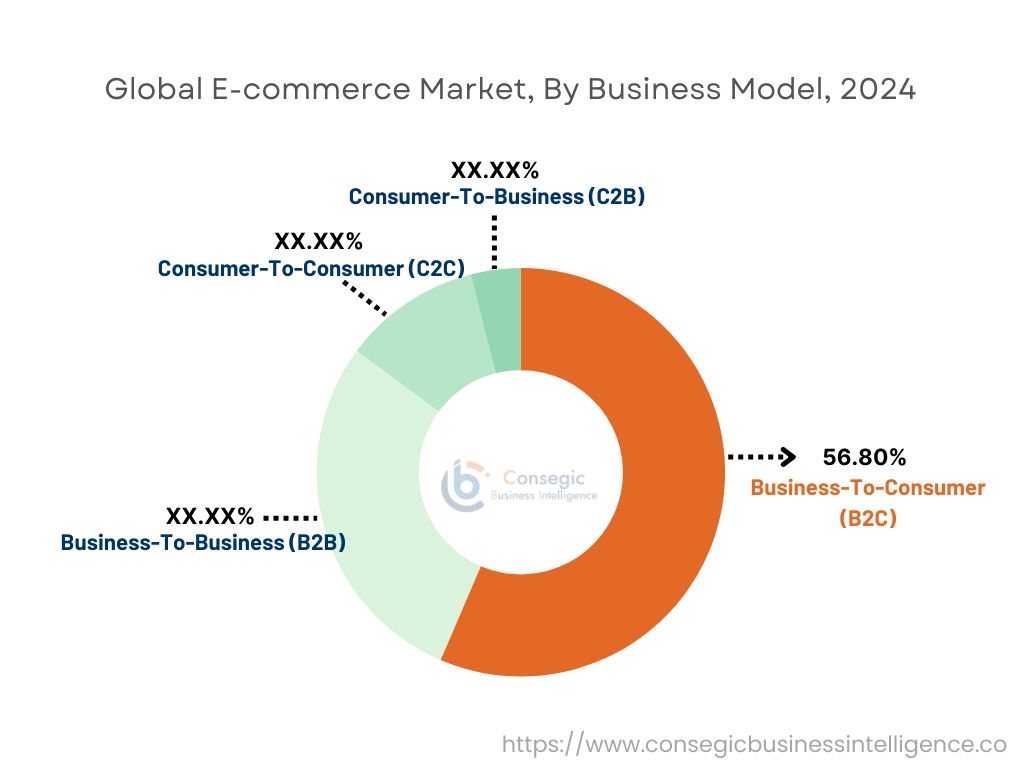
Based on business models, the e-commerce market is segmented into business-to-consumer (B2C), business-to-business (B2B), consumer-to-consumer (C2C), and consumer-to-business (C2B).
The Business-to-Consumer (B2C) segment held the largest e-commerce market share of 56.80% in 2024.
- The B2C segment continues to dominate as consumers increasingly prefer digital shopping platforms over traditional retail stores.
- The growth of personalized marketing, AI-driven recommendations, and mobile commerce has enhanced customer engagement.
- Evolving consumer preferences and rapid digital payment adoption are fueling the rise of B2C platforms.
- Segmental market analysis highlights that the rise of subscription-based models and same-day delivery services is further shaping industry trends.
The Business-to-Business (B2B) segment is anticipated to have the fastest CAGR during the forecast period.
- The rising demand for digital procurement solutions and bulk purchasing platforms is accelerating this segment’s growth.
- Cloud-based solutions, automated order management, and AI-powered analytics are transforming supply chain operations.
- E-commerce market trends indicate a significant shift toward self-service platforms, enabling businesses to streamline purchasing and vendor management.
- In May 2024, Delhivery announced a partnership with SUGAR Cosmetics for an expanded logistics mandate specifically for Pan-India B2B shipments.
- Analysis of transaction patterns suggests that digital trade platforms are expanding globally, driven by cross-border e-commerce growth.
By Product Category:
By product category, the e-commerce market is categorized into electronics & media, fashion & apparel, health & beauty, home & furniture, food & beverage, toys & baby products, automotive parts & accessories, and others.
The electronics & media segment held the largest revenue share in 2024.
- Increased consumer reliance on digital devices, smart gadgets, and online content subscriptions is fueling this segment.
- The rise of 5G connectivity, AI-powered devices, and immersive media experiences is reshaping online shopping behaviors.
- Online retailers are leveraging real-time pricing strategies and dynamic advertising to drive sales across digital media platforms.
- Segmental trends analysis suggests a growing emphasis on seamless digital experiences, including AR-based product visualization and virtual showrooms, boosting e-commerce market demand.
The health & beauty segment is expected to experience the fastest CAGR during the forecast period.
- Shifting consumer preferences toward organic skincare, personalized beauty products, and wellness supplements is driving growth.
- The integration of AI-powered skin analysis, virtual try-on tools, and influencer-driven marketing strategies is transforming sales patterns.
- Market analysis highlights the rise of direct-to-consumer (DTC) brands, optimizing online shopping experience with subscription models and rapid delivery.
- In January 2025, Unrivaled announced Sephora U.S. as the official beauty partner. As a groundbreaking professional women’s basketball league, this partnership aligns with Sephora’s dedication to advocating for equity and in turn expanding its market presence.
- Furthermore, e-commerce market trends indicate an increasing focus on sustainability, with brands offering eco-friendly packaging and ethically sourced ingredients.
By Payment Method:
Based on the payment method, the e-commerce market is segmented into credit & debit cards, digital wallets, bank transfers, cash-on-delivery (COD), cryptocurrency, and buy now, pay later (BPL) services.
The digital wallets segment held the largest e-commerce market share in 2024.
- The adoption of contactless transactions, biometric authentication, and AI-driven fraud detection systems is accelerating digital wallet usage.
- The demand for secure and convenient checkout solutions has led to increased integration of digital payment systems across platforms.
- Global players such as PayPal, Apple Pay, and Google Pay continue to innovate, enhancing cross-border payment efficiency.
- In November 2024, GlobalData reported that mobile and digital wallets have eclipsed traditional payment modes. According to its Financial Services Consumer Survey 2024, 30% of respondents indicated using Google Pay most frequently, followed by PhonePe (13%), Amazon Pay (13%), and Paytm (12%).
- Market trends indicate continued growth in digital wallets, supported by increased smartphone penetration and mobile commerce sales resulting in e-commerce market expansion.
The buy now, pay later (BNPL) services segment is anticipated to experience the fastest CAGR during the forecast period.
- BNPL solutions are gaining traction due to their flexible payment options and zero-interest installment plans, attracting younger consumers.
- E-commerce platforms and fintech providers are forming strategic partnerships, expanding BNPL accessibility across various retail categories.
- E-commerce market analysis suggests that consumer credit preferences are shifting, with BNPL services becoming a preferred alternative to traditional credit cards.
- Trends show an increase in BNPL adoption across fashion, electronics, and high-value purchases, driven by financially inclusive initiatives.
Regional Analysis:
The regions covered are North America, Europe, Asia Pacific, the Middle East and Africa, and Latin America.
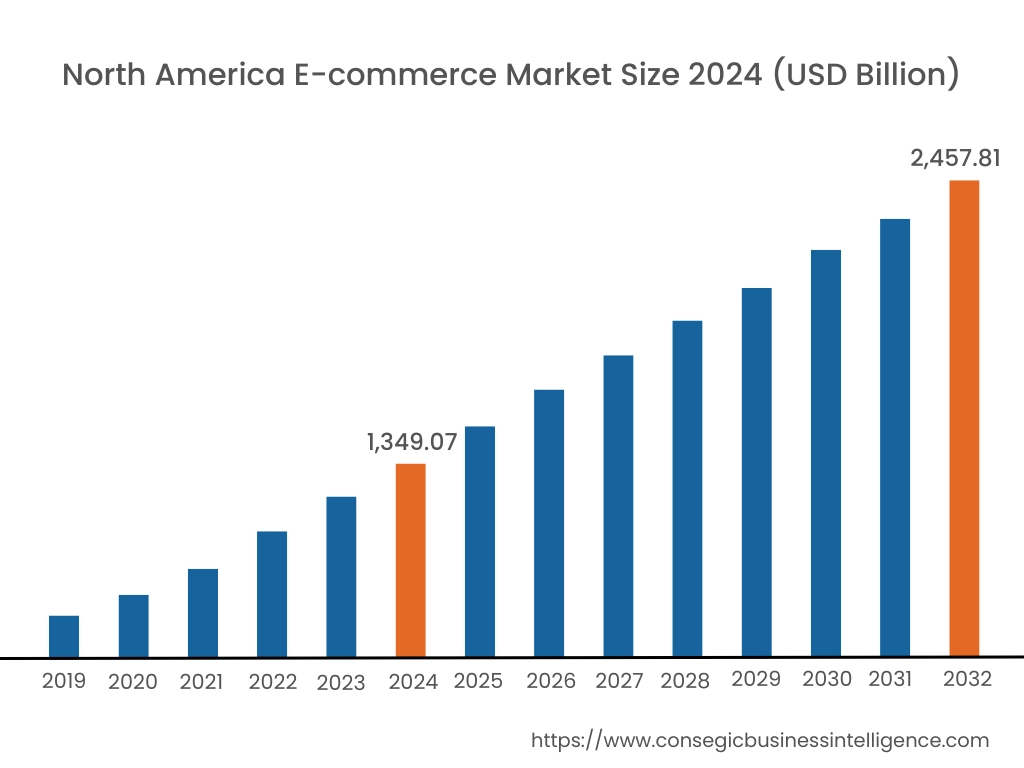
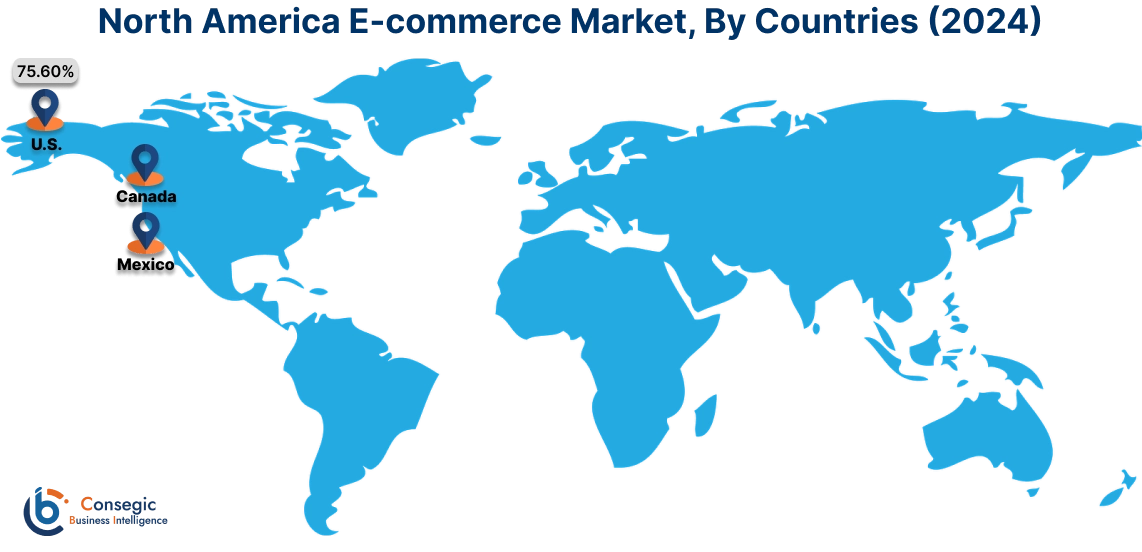
North America is estimated to reach over USD 2,457.81 Billion by 2032 from a value of USD 1,349.07 Billion in 2024 and is projected to grow by USD 1,431.57 Billion in 2025. In North America, the U.S. accounted for the highest share of 75.60% during the base year of 2024.
North America remains a dominant player in the e-commerce sector, characterized by a well-established digital infrastructure, high consumer spending power, and a mature online retail ecosystem. A defining trend in this region is the integration of artificial intelligence (AI) and data analytics to provide personalized shopping experiences, optimize supply chains, and enhance customer engagement. Retailers are increasingly investing in automation and last-mile delivery solutions to address logistical challenges and improve service efficiency. The presence of major e-commerce giants, along with the rapid adoption of subscription-based services, further strengthens the region’s competitive edge. While the sector continues to flourish, challenges such as evolving data privacy regulations and cybersecurity concerns necessitate constant innovation and adaptation.
Asia Pacific region was valued at USD 1,197.78 Billion in 2024. Moreover, it is projected to grow by USD 1,277.06 Billion in 2025 and reach over USD 2,309.17 Billion by 2032. Asia-Pacific is witnessing the most rapid transformation in the e-commerce industry, fueled by rising internet penetration, smartphone adoption, and evolving digital payment ecosystems. The region is a key hub for mobile commerce, with countries like China, India, and Indonesia experiencing a surge in social commerce, where online shopping is integrated directly into social media platforms. The dominance of local giants such as Alibaba, JD.com, and Flipkart underscores the competitive nature of the market, with each company investing heavily in AI-driven recommendation systems and cloud-based retail infrastructure. E-commerce market demand is being further influenced by innovative payment solutions, including QR-based transactions and digital wallets, which facilitate seamless online purchases. Despite the dynamic market landscape, logistical complexities, and varying regulatory frameworks across countries pose operational challenges for such businesses seeking cross-border expansion.
The European e-commerce market is driven by an emphasis on sustainability, regulatory compliance, and seamless cross-border trade within the European Union. Countries like Germany, the UK, and France are at the forefront of online retail, leveraging digital payment systems and logistics advancements to streamline operations. One notable trend is the rise of sustainable e-commerce practices, where retailers are focusing on eco-friendly packaging, carbon-neutral delivery methods, and responsible sourcing. Consumers in Europe place a high value on trust and security, leading to stringent data protection regulations such as the General Data Protection Regulation (GDPR), which influences how online retailers handle customer data. The increasing popularity of digital wallets and Buy Now, Pay Later (BNPL) services is further shaping the e-commerce landscape, providing flexible payment options to enhance customer experience.
The Middle East and Africa (MEA) are experiencing steady advancements in e-commerce adoption, with increasing digital literacy and mobile penetration shaping online retail trends. Countries like the UAE and Saudi Arabia are investing in digital transformation initiatives to boost online retail, supported by government policies that promote cashless payments and smart logistics solutions. The e-commerce market opportunity in Africa is largely untapped, with regions such as Nigeria, Kenya, and South Africa demonstrating increasing online shopping activity, driven by improvements in internet access and digital payment adoption. However, infrastructural challenges, including inconsistent last-mile delivery services and payment security concerns, continue to hinder market scalability. The entrance of global e-commerce platforms into these markets is expected to foster innovation and address existing logistical barriers.
Latin America’s e-commerce market is evolving rapidly, with Brazil and Mexico emerging as key regions due to rising internet penetration and changing consumer shopping preferences. The adoption of instant payment systems such as Brazil’s Pix is revolutionizing digital transactions, providing consumers with faster and more secure payment options. This advancement is particularly significant as it enables a broader segment of the population to engage in online commerce. A growing trend in Latin America is the increasing reliance on local marketplaces that cater to region-specific consumer preferences, offering localized payment solutions and diverse product selections. While the market presents substantial potential, economic volatility and regulatory inconsistencies remain challenges that these businesses must navigate to ensure sustainable success.
This regional e-commerce market analysis highlights the distinct opportunities and challenges within the global online retail sector. While North America and Europe continue to refine digital commerce through technological advancements and regulatory compliance, Asia-Pacific leads in mobile and social commerce adoption. Meanwhile, Latin America and the Middle East & Africa are experiencing promising developments that present lucrative business prospects for global retailers. Strategic investments in infrastructure, security, and localization will be critical in shaping the future of this market across all regions.
Top Key Players and Market Share Insights:
The e-commerce market is highly competitive with major players providing products and services to the national and international markets. Key players are adopting several strategies in research and development (R&D), product innovation, and end-user launches to hold a strong position in the global market. Key players in the e-commerce industry include -
- Amazon (US)
- Alibaba Group (China)
- Flipkart (India)
- MercadoLibre (Argentina)
- Zalando (Germany)
- eBay (US)
- Shopify (Canada)
- Walmart (US)
- com (China)
- Rakuten (Japan)
Recent Industry Developments :
Collaborations:
- In February 2025, Flipkart Commerce Cloud and Persistent Systems forged a strategic collaboration to accelerate global expansion and equip retailers and enterprises with scalable, data-driven solutions that streamline operations and enhance customer experiences in today’s competitive retail landscape.
Product Launches:
- In July 2024, EMX launched ‘EMX International’ as an international solution for parcel delivery across the Gulf Cooperation Council (GCC) region to streamline logistics and save significant time and operational costs.
- In June 2024, com launched JD.Vision, a native Apple Vision Pro app that provides an immersive shopping experience leveraging spatial computing. It delivers an experience that closely mirrors in-store visits, transcending the limitations of traditional shopping.
E-commerce Market Report Insights :
| Report Attributes | Report Details |
| Study Timeline | 2019-2032 |
| Market Size in 2032 | USD 7,583.50 Billion |
| CAGR (2025-2032) | 8.1% |
| By Business Model |
|
| By Product Category |
|
| By Payment Method |
|
| By Region |
|
| Key Players |
|
| North America | U.S. Canada Mexico |
| Europe | U.K. Germany France Spain Italy Russia Benelux Rest of Europe |
| APAC | China South Korea Japan India Australia ASEAN Rest of Asia-Pacific |
| Middle East and Africa | GCC Turkey South Africa Rest of MEA |
| LATAM | Brazil Argentina Chile Rest of LATAM |
| Report Coverage |
|
Key Questions Answered in the Report
How big is the E-commerce Market? −
E-commerce market size is estimated to reach over USD 7,583.50 Billion by 2032 from a value of USD 4,067.04 Billion in 2024 and is projected to grow by USD 4,324.00 Billion in 2025, growing at a CAGR of 8.1% from 2025 to 2032.
What specific segmentation details are covered in the E-commerce market report? +
The e-commerce market report includes specific segmentation details for business model, product category and payment method.
Which is the fastest-growing region in the E-commerce Market? +
Asia Pacific is the fastest-growing region in the e-commerce market. These trends are encouraged by rising internet penetration, smartphone adoption, and evolving digital payment ecosystems.
Who are the major players in the E-commerce Market? +
The key participants in the e-commerce market are Amazon (US), Alibaba Group (China), eBay (US), Shopify (Canada), Walmart (US), JD.com (China), Rakuten (Japan), Flipkart (India), MercadoLibre (Argentina) and Zalando (Germany).
Overview
Reputation & Certifications


Our Services
- Market Intelligence & Forecasting
- Custom Research Solutions
- Market Entry Strategy
- Competitive Intelligence
- Customer Insights
- Industry Innovation Analysis
- Investment Advisory