Jump to Content
Dual Carbon Battery Market - Size, Share, Industry Trends, and Forecasts (2025-2032)
Dual Carbon Battery Market Size:
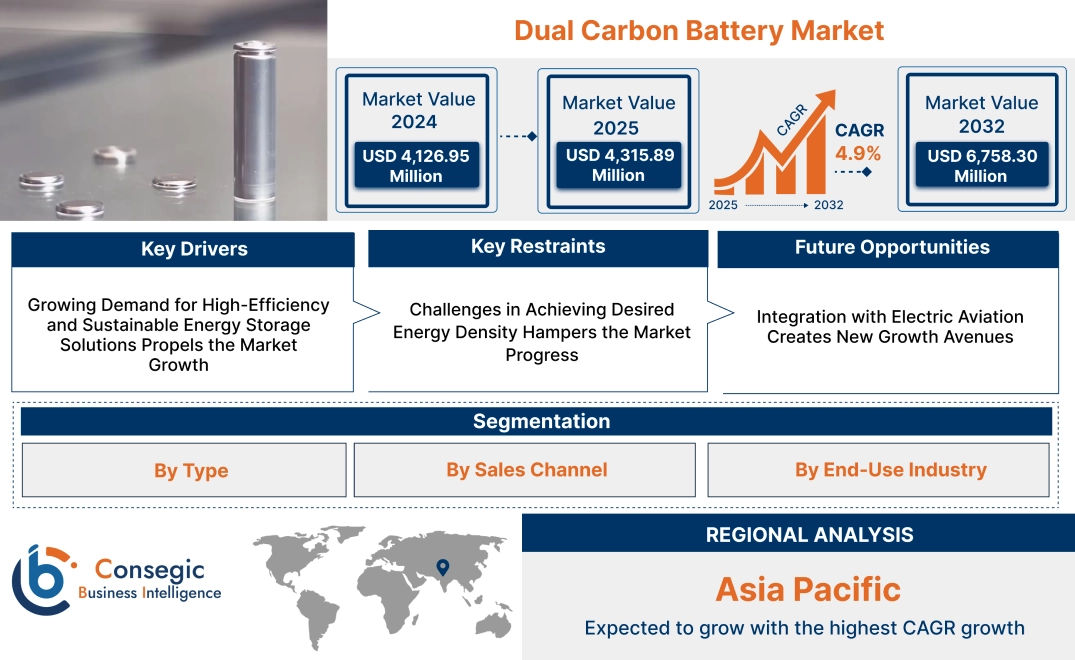
Dual Carbon Battery Market size is estimated to reach over USD 6,758.30 Million by 2032 from a value of USD 4,126.95 Million in 2024 and is projected to grow by USD 4,315.89 Million in 2025, growing at a CAGR of 6.4% from 2025 to 2032.
Dual Carbon Battery Market Scope & Overview:
A dual carbon battery is an advanced energy storage solution that uses carbon-based materials for both the anode and cathode. This innovative design enhances energy efficiency, charge-discharge rates, and overall battery performance. These batteries are known for their environmental friendliness, as they use fewer rare materials and are fully recyclable, making them suitable for a variety of applications.
Dual carbon batteries are characterized by high thermal stability, long cycle life, and fast charging capabilities. They are designed for use in applications such as electric vehicles, renewable energy storage, and consumer electronics, where efficiency and durability are critical. These batteries are also lightweight and offer a high energy density, making them ideal for portable and large-scale energy solutions.
End-users include industries such as automotive, energy, and electronics, where reliable and efficient energy storage systems are essential. Dual carbon batteries play a significant role in advancing sustainable energy technologies and addressing modern power storage needs.
Dual Carbon Battery Market Dynamics - (DRO) :
Key Drivers:
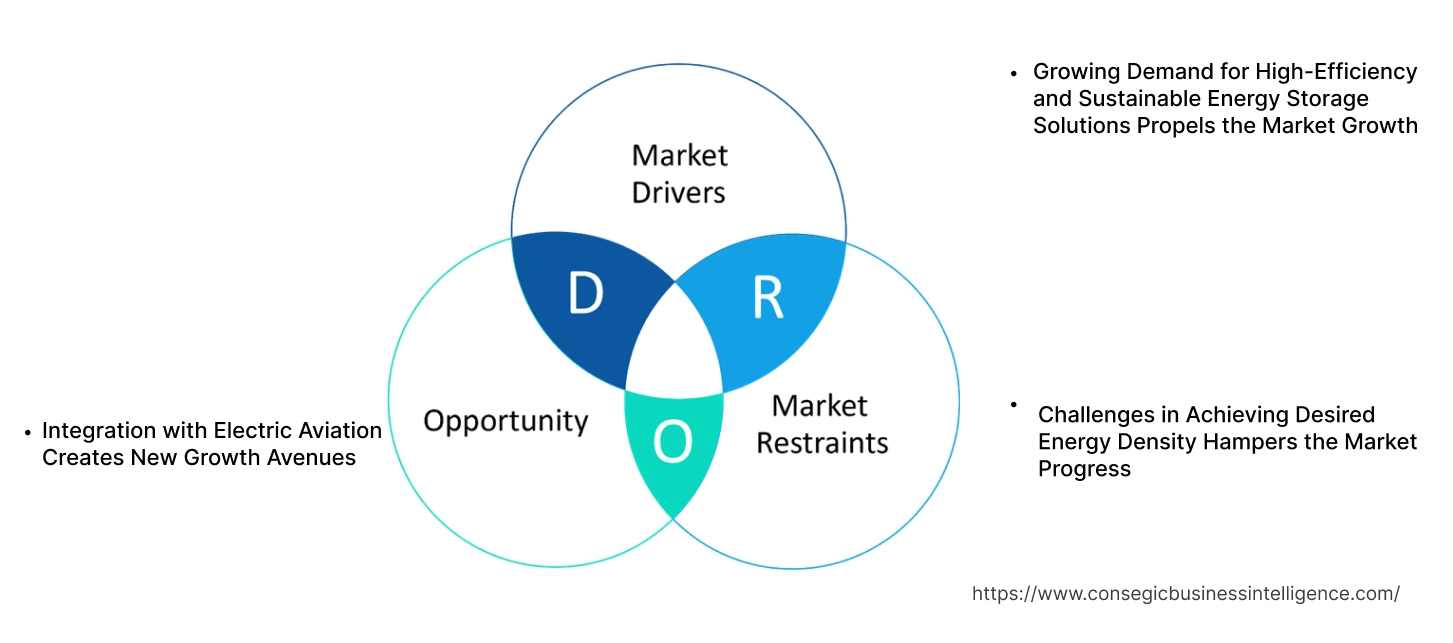
Growing Demand for High-Efficiency and Sustainable Energy Storage Solutions Propels the Market Growth
Dual carbon batteries, which use carbon for both the anode and cathode, offer several advantages over traditional lithium-ion batteries, including higher efficiency, better sustainability, and lower environmental impact. These batteries store and release energy more effectively, with longer lifespans and faster charge/discharge cycles, making them a promising solution for energy storage needs in renewable energy applications like solar and wind. As the world moves toward decarbonization and more sustainable energy practices, the need for dual carbon batteries as a cost-effective, environmentally friendly alternative to conventional energy storage solutions continues to grow. This fuels the dual carbon battery market demand, driven by the increasing need for long-lasting, scalable, and sustainable energy storage systems across industries.
Key Restraints:
Challenges in Achieving Desired Energy Density Hampers the Market Progress
One of the key restraints for dual carbon batteries is their issue in achieving energy densities comparable to lithium-ion batteries. While dual carbon batteries offer advantages like longer lifespan and faster charging times, their energy density tends to be lower than that of traditional lithium-ion batteries. This limitation restricts their applicability in high-energy-demand sectors, such as electric vehicles (EVs) and large-scale grid storage systems. The lower energy density means that dual carbon batteries are unable to store as much energy per unit of weight, reducing their range and effectiveness for applications where high energy capacity is essential. As a result, while dual carbon batteries have great potential in certain markets, their performance in energy-intensive applications is constrained by this energy density gap, making them less suitable for widespread adoption in sectors that need large, long-lasting energy storage solutions. Thus, the aforementioned factors are hindering the dual carbon battery market growth.
Future Opportunities :
Integration with Electric Aviation Creates New Growth Avenues
The growing focus on electric aviation offers a significant opportunity for dual carbon batteries, particularly for small to medium-sized electric aircraft. These batteries will provide a more efficient and lighter alternative to traditional lithium-ion batteries, which is crucial for aviation where weight and energy efficiency are key factors. Dual carbon batteries, with their higher charge/discharge cycles and sustainability, are well-suited to meet the power requirements of electric aircraft, enabling longer flight times and quicker turnaround times. In regional air mobility systems, such as electric vertical takeoff and landing (eVTOL) aircraft, dual carbon batteries will offer the necessary performance while reducing environmental impact. Furthermore, small drones used for commercial deliveries will benefit from the lightweight and fast-charging characteristics of dual carbon batteries, improving operational efficiency. As the aviation industry continues to prioritize sustainability, dual carbon batteries will play a pivotal role in powering the next generation of green aviation technologies, creating significant dual carbon battery market opportunities.
Dual Carbon Battery Market Segmental Analysis :
By Type:
Based on type, the market is segmented into primary dual carbon batteries and secondary (rechargeable) dual carbon batteries.
The secondary (rechargeable) dual carbon batteries segment accounted for the largest revenue of the total dual carbon battery market share in 2024.
- The dominance of this segment is attributed to the growing demand for long-lasting, reusable energy storage solutions in various applications, including electric vehicles and renewable energy systems.
- These batteries offer a high charge/discharge cycle life and fast charging capabilities, making them ideal for consumer electronics and automotive applications.
- The rise in government initiatives promoting sustainable energy storage solutions further boosts the adoption of rechargeable dual carbon batteries.
- As per market trends, the segment benefits significantly from technological advancements that enhance energy density and efficiency, solidifying its market position and fueling the dual carbon battery market expansion.
The primary dual carbon batteries segment is expected to register the fastest CAGR during the forecast period.
- The segment's growth is driven by its application in low-power, disposable electronics and specialized industrial applications where non-rechargeable batteries are preferred.
- These batteries are valued for their lightweight design, eco-friendliness, and ability to provide stable power over extended periods.
- Growing use in remote monitoring systems, medical devices, and military applications is further propelling requirement in this segment.
- As per the dual carbon battery market analysis, the simplicity of primary batteries and their cost-effectiveness also attract end-users in emerging markets.
By Sales Channel:
Based on sales channel, the market is bifurcated into online sales and offline sales.
The offline sales segment accounted for the largest revenue of the total dual carbon battery market share in 2024.
- Retail stores and distributors dominate the distribution channel, as consumers prefer hands-on inspection and physical purchase of batteries.
- Established relationships between manufacturers and offline distributors also contribute to the dominance of this segment.
- Industrial buyers often rely on offline distribution for bulk procurement, ensuring product authenticity and post-purchase services.
- As per market trends, the reliability and immediacy associated with offline channels play a crucial role in sustaining their market dominance, which further drives the dual carbon battery market demand.
The online sales segment is expected to grow at the fastest CAGR during the forecast period.
- The convenience of doorstep delivery and the availability of a wide range of products drive the growth of online sales.
- Discounts, promotional offers, and easy comparison options attract customers to online platforms.
- Increased internet penetration and the rise of e-commerce platforms, particularly in emerging economies, further boost this segment.
- As per the dual carbon battery market trends, technological integration, such as AR-based product demonstrations, enhances the online buying experience for dual carbon batteries.
By End-Use Industry:
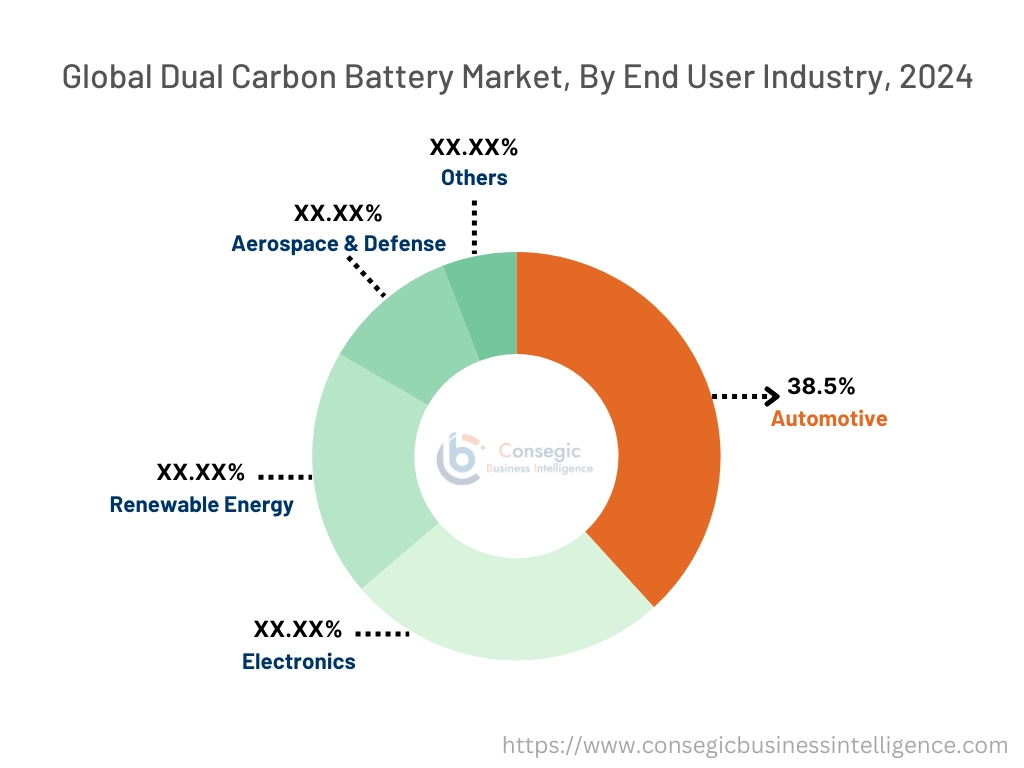
Based on end-user industry, the market is segmented into automotive, electronics, renewable energy, aerospace & defense, and others.
The automotive segment accounted for the largest revenue of 38.5% share in 2024.
- Growing adoption of electric and hybrid vehicles drives need for high-performance energy storage solutions, positioning the automotive sector as the largest consumer.
- Dual carbon batteries are preferred in the automotive sector due to their fast-charging capabilities, long lifespan, and eco-friendly characteristics.
- Government policies and subsidies for electric vehicle adoption further bolster the demand in this segment.
- As per the dual carbon battery market analysis, technological advancements in battery management systems enhance the reliability and efficiency of dual carbon batteries in automotive applications.
The renewable energy segment is expected to register the fastest CAGR during the forecast period.
- Increasing focus on sustainable energy sources like solar and wind power necessitates efficient energy storage solutions, driving demand in this segment.
- Dual carbon batteries' ability to handle large energy storage and provide consistent performance makes them ideal for renewable energy applications.
- Government initiatives and investments in renewable energy infrastructure significantly boost market potential.
- As per the dual carbon battery market trends, the integration of dual carbon batteries in smart grids and off-grid renewable energy systems further accelerates the growth of this segment.
Regional Analysis:
The regions covered are North America, Europe, Asia Pacific, the Middle East and Africa, and Latin America.
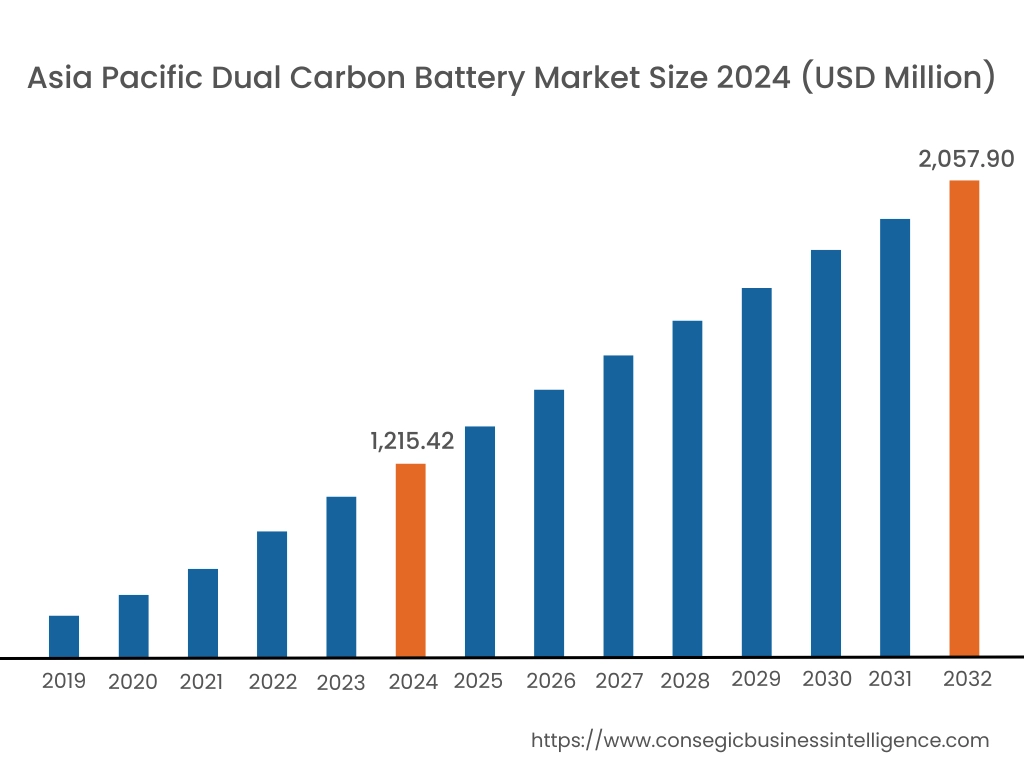
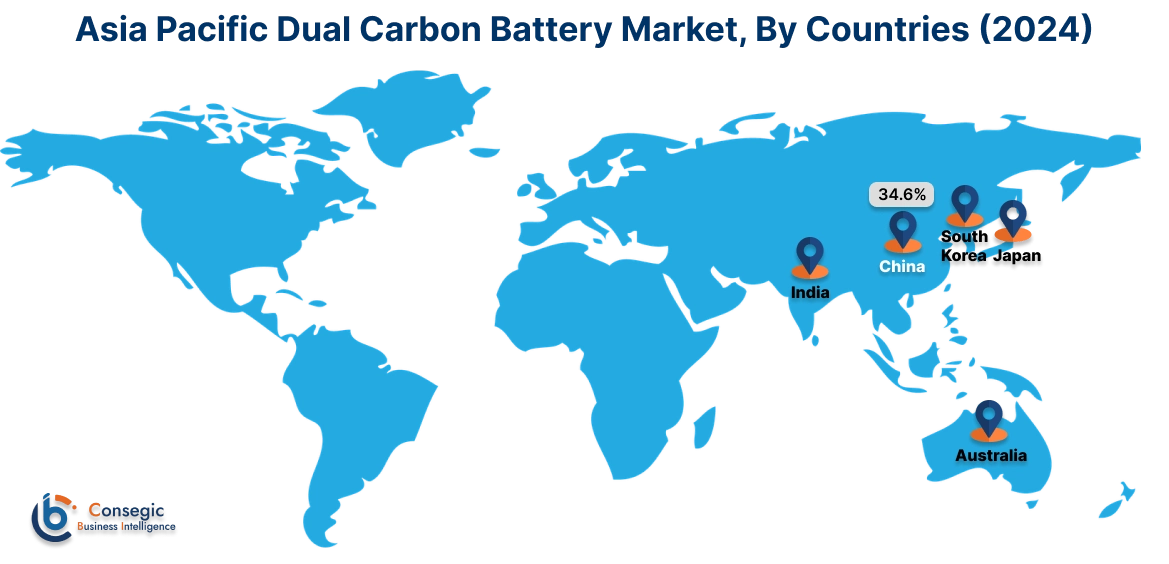
Asia Pacific region was valued at USD 1,215.42 Million in 2024. Moreover, it is projected to grow by USD 1,274.66 Million in 2025 and reach over USD 2,057.90 Million by 2032. Out of this, China accounted for the maximum revenue share of 34.6%. The Asia-Pacific region is witnessing rapid advancements in the dual carbon battery market, attributed to the expanding consumer electronics sector and the burgeoning market for electric vehicles. A prominent trend is the development of cost-effective and high-performance dual carbon batteries by countries like China and Japan, aiming to cater to the increasing consumer requirement for efficient energy storage solutions. Analysis indicates that rising disposable incomes in the region have led to an increase in purchasing power, further driving the dual carbon battery market growth.
North America is estimated to reach over USD 2,190.37 Million by 2032 from a value of USD 1,368.94 Million in 2024 and is projected to grow by USD 1,428.88 Million in 2025. This region holds a substantial share of the dual carbon battery market, driven by the increasing adoption of electric vehicles (EVs) and a strong emphasis on sustainable energy solutions. A notable trend is the integration of dual carbon batteries in consumer electronics, offering benefits such as rapid charging and enhanced safety. Analysis indicates that the U.S. automotive industry is observing significant utilization of energy-efficient batteries, with projections to introduce numerous battery-electric models in the forthcoming years.
European countries, particularly Germany, France, and the UK, are key players in the dual carbon battery market, with a strong emphasis on reducing carbon emissions and enhancing energy storage solutions. A significant trend is the collaboration between research institutions and manufacturers to develop advanced battery technologies that align with the European Union's stringent environmental regulations. Analysis suggests that the region's focus on renewable energy integration and smart grid development is propelling the dual carbon battery market opportunities for efficient and sustainable battery solutions.
In the Middle East, the market is influenced by the region's efforts to diversify energy sources and invest in sustainable technologies. The focus is on adopting advanced battery solutions to support renewable energy projects and enhance energy security. In Africa, the market is gradually developing, with initiatives to improve access to electricity through sustainable and efficient energy storage systems. Analysis suggests that international collaborations and investments in energy infrastructure are crucial for market development in these regions.
Latin American countries are increasingly recognizing the importance of advanced battery technologies in supporting renewable energy integration and improving grid stability. A notable trend is the adoption of dual carbon batteries in portable power applications and transportation sectors. However, economic constraints and limited technological infrastructure may impact the pace of adoption. Analysis indicates that government initiatives to promote clean energy and investments in technological advancements plays a pivotal role in advancing the dual carbon battery market expansion in this region.
Top Key Players and Market Share Insights:
The dual carbon battery market is highly competitive with major players providing products and services to the national and international markets. Key players are adopting several strategies in research and development (R&D), product innovation, and end-user launches to hold a strong position in the global dual carbon battery market. Key players in the dual carbon battery industry include -
- PJP Eye Ltd. (Japan)
- JSR Corporation (Japan)
- Samsung SDI Co., Ltd. (South Korea)
- BYD Company Limited (China)
- Johnson Controls International plc (Ireland)
- Hitachi (Japan)
- Loxus Inc. (USA)
- Panasonic Corporation (Japan)
- LG Chem Ltd. (South Korea)
Dual Carbon Battery Market Report Insights :
| Report Attributes | Report Details |
| Study Timeline | 2019-2032 |
| Market Size in 2032 | USD 6,758.30 Million |
| CAGR (2025-2032) | 6.4% |
| By Type |
|
| By Sales Channel |
|
| By End-Use Industry |
|
| By Region |
|
| Key Players |
|
| North America | U.S. Canada Mexico |
| Europe | U.K. Germany France Spain Italy Russia Benelux Rest of Europe |
| APAC | China South Korea Japan India Australia ASEAN Rest of Asia-Pacific |
| Middle East and Africa | GCC Turkey South Africa Rest of MEA |
| LATAM | Brazil Argentina Chile Rest of LATAM |
| Report Coverage |
|
Key Questions Answered in the Report
What is the size of the Dual Carbon Battery Market? −
The Dual Carbon Battery Market size is estimated to reach over USD 6,758.30 Million by 2032 from a value of USD 4,126.95 Million in 2024 and is projected to grow by USD 4,315.89 Million in 2025, growing at a CAGR of 6.4% from 2025 to 2032.
What are the key segments in the Dual Carbon Battery Market? +
The market is segmented by type (primary dual carbon batteries, secondary (rechargeable) dual carbon batteries), sales channel (online sales, offline sales), and end-use industry (automotive, electronics, renewable energy, aerospace & defense, others).
Which segment is expected to grow the fastest in the Dual Carbon Battery Market? +
The primary dual carbon batteries segment is expected to grow at the fastest CAGR during the forecast period, driven by its use in low-power, disposable electronics and industrial applications.
Who are the major players in the Dual Carbon Battery Market? +
Key players in the Dual Carbon Battery market include PJP Eye Ltd. (Japan), JSR Corporation (Japan), Hitachi (Japan), Loxus Inc. (USA), Panasonic Corporation (Japan), LG Chem Ltd. (South Korea), Samsung SDI Co., Ltd. (South Korea), BYD Company Limited (China), Johnson Controls International plc (Ireland).
Overview
Reputation & Certifications


Our Services
- Market Intelligence & Forecasting
- Custom Research Solutions
- Market Entry Strategy
- Competitive Intelligence
- Customer Insights
- Industry Innovation Analysis
- Investment Advisory