Jump to Content
Ectropion Market - Size, Share, Industry Trends, and Forecasts (2025-2032)
Ectropion Market Size:
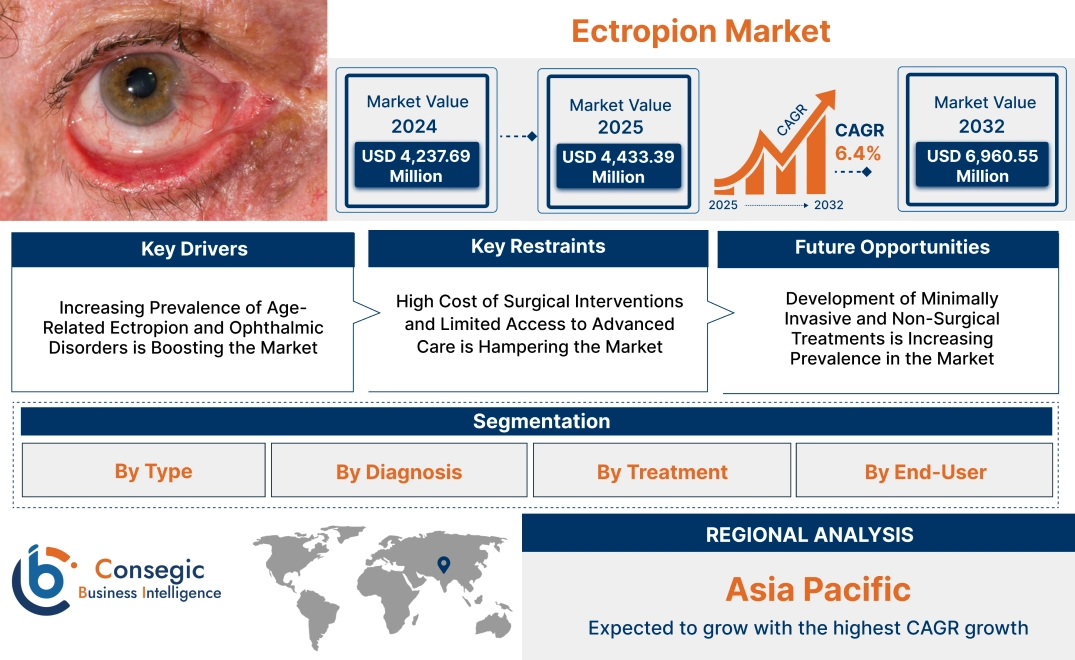
Ectropion Market size is estimated to reach over USD 6,960.55 Million by 2032 from a value of USD 4,237.69 Million in 2024 and is projected to grow by USD 4,433.39 Million in 2025, growing at a CAGR of 6.4% from 2025 to 2032.
Ectropion Market Scope & Overview:
Ectropion is a condition where the eyelid turns outward, exposing the inner surface of the eyelid and potentially leading to irritation, excessive tearing, and an increased risk of infections. The market encompasses pharmaceutical treatments such as lubricating eye drops, antibiotics, and anti-inflammatory medications, as well as surgical interventions like eyelid tightening procedures and skin grafting for severe cases.
Key characteristics of its treatment include addressing the underlying cause, relieving symptoms, and preventing long-term complications such as corneal damage. The benefits include improved eye comfort, restored eyelid function, and enhanced visual quality.
Applications span hospitals, ophthalmology clinics, and ambulatory surgical centers. End-users include ophthalmologists, plastic surgeons, and patients, driven by increasing awareness of eyelid disorders, advancements in surgical techniques, and a rising geriatric population prone to conditions such as ectropion.
Ectropion Market Dynamics - (DRO) :
Key Drivers:
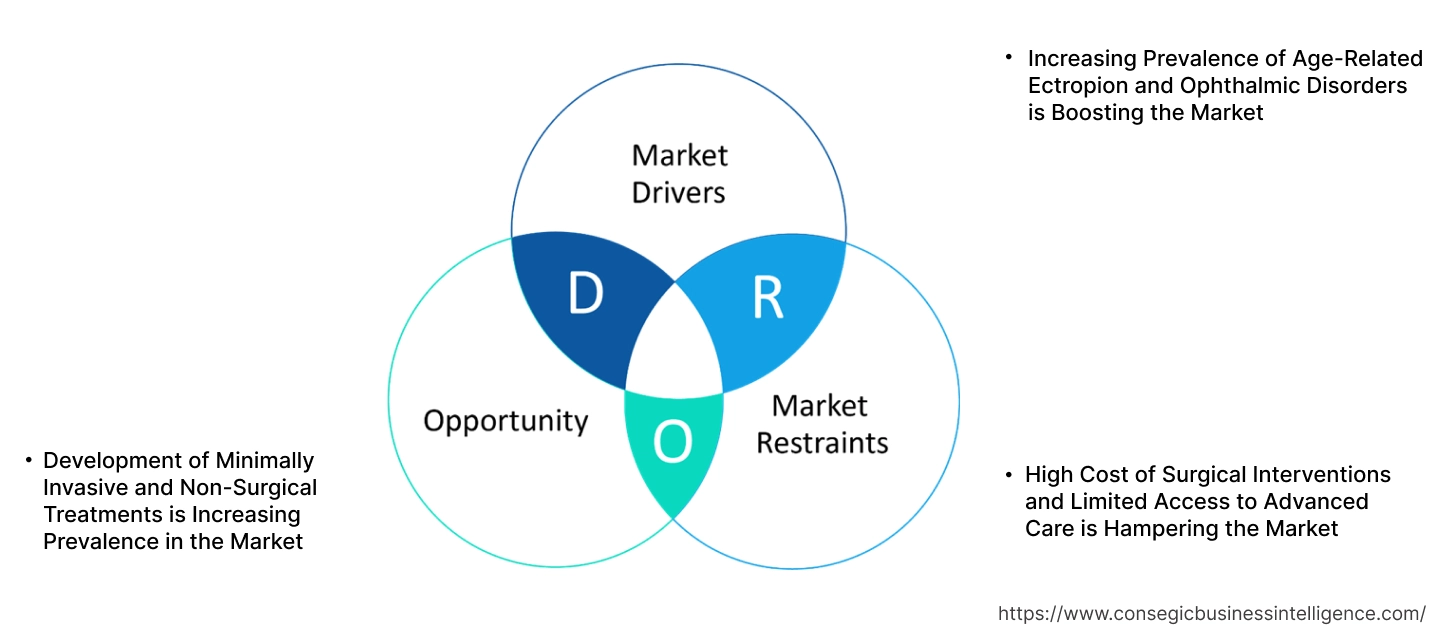
Increasing Prevalence of Age-Related Ectropion and Ophthalmic Disorders is Boosting the Market
The rising prevalence of age-related ectropion and other ophthalmic disorders is a primary driver for the market. Ectropion, a condition where the eyelid turns outward, is most associated with the aging population due to weakening eyelid muscles and connective tissue. The global increase in the geriatric population has led to a higher incidence of this condition, fueling the demand for effective diagnostic and treatment options. Additionally, factors such as facial nerve paralysis, trauma, or previous eyelid surgeries contribute to the growing number of cases, further driving ectropion market growth. The increasing awareness about early diagnosis and the availability of advanced surgical interventions for ectropion correction have also supported market expansion.
Key Restraints:
High Cost of Surgical Interventions and Limited Access to Advanced Care is Hampering the Market
The high cost of surgical interventions, such as eyelid tightening procedures and skin grafting, is a significant restraint in the market. While surgical correction is often the most effective treatment for ectropion, it requires skilled ophthalmic surgeons and access to advanced medical facilities, which can be prohibitively expensive for patients in low- and middle-income regions. Furthermore, limited access to specialized ophthalmic care in rural and underserved areas exacerbates the issue, leading to delayed treatment and complications such as corneal damage or chronic eye infections. This disparity in access to quality care remains a significant challenge for the market.
Future Opportunities :
Development of Minimally Invasive and Non-Surgical Treatments is Increasing Prevalence in the Market
The development of minimally invasive and non-surgical treatment options presents a significant opportunity for the market. Innovations such as injectable dermal fillers, advanced adhesive tapes, and laser-based therapies are gaining traction as alternatives to traditional surgical interventions. These treatments are particularly appealing to patients seeking less invasive solutions with shorter recovery times. Additionally, research into regenerative therapies using growth factors and tissue-engineered scaffolds offers potential for improving eyelid muscle strength and elasticity, addressing the underlying causes of ectropion. Companies focusing on developing cost-effective, patient-friendly treatment modalities are well-positioned to address the unmet needs of patients and expand their market presence.
These dynamics highlight the growing ectropion market demand for effective management solutions, driven by the aging population and rising awareness of treatment options. While challenges related to cost and access to care persist, advancements in minimally invasive treatments and regenerative therapies offer promising avenues for market trends and improved patient outcomes.
Ectropion Market Segmental Analysis :
By Type:
Based on type, the market is segmented into involutional ectropion, cicatricial ectropion, mechanical ectropion, congenital ectropion, and paralytic ectropion.
The involutional ectropion segment accounted for the largest revenue in ectropion market share in 2024.
- Involutional ectropion, caused by aging-related laxity in eyelid tissues, is the most common form of ectropion.
- The growing aging population globally has increased the prevalence of this condition, driving ectropion market growth.
- Increasing availability of minimally invasive surgical solutions for correcting age-related ectropion supports segment dominance.
- Rising awareness among older adults about treating eyelid malpositions for improved quality of life boosts trends.
The paralytic ectropion segment is anticipated to register the fastest CAGR during the forecast period.
- Paralytic ectropion, associated with facial nerve palsy, has been increasingly diagnosed due to rising cases of neurological disorders.
- Advancements in reconstructive surgeries and nerve repair techniques have enhanced treatment options for this condition.
- Increasing awareness of the cosmetic and functional benefits of treating paralytic ectropion drives trends.
- Expanding access to specialized ophthalmic care, particularly in emerging economies, supports rapid segment analysis.
By Diagnosis:
Based on diagnosis, the market is segmented into physical examination, slit-lamp examination, and imaging tests (CT scan and MRI).
The slit-lamp examination segment accounted for the largest revenue in ectropion market share in 2024.
- Slit-lamp examinations provide detailed visualization of eyelid margins and conjunctival tissue, aiding in accurate diagnosis.
- Widespread use of slit-lamp tools in ophthalmic clinics and hospitals supports this segment’s dominance.
- Increasing adoption of advanced imaging-enabled slit lamps for precise diagnosis enhances trends.
- Rising awareness about routine eye check-ups contributes to the popularity of slit-lamp analysis.
The imaging tests segment is anticipated to register the fastest CAGR during the forecast period.
- Imaging tests, including CT and MRI scans, are increasingly used to diagnose complex cases of ectropion caused by trauma or underlying conditions.
- Growing demand for detailed diagnostic imaging to plan surgical interventions drives this segmental analysis.
- Technological advancements in imaging equipment improve diagnostic accuracy and patient outcomes.
- Expanding access to advanced imaging facilities in hospitals and specialty clinics supports growth.
By Treatment:
Based on treatment, the market is segmented into non-surgical treatment and surgical treatment.
The surgical treatment segment accounted for the largest revenue share in 2024.
- Surgical intervention is the definitive treatment for ectropion, particularly in severe cases where functional or cosmetic correction is needed.
- Increasing adoption of minimally invasive surgical techniques, such as tarsal strip procedures, supports market dominance.
- Rising availability of skilled ophthalmic surgeons and specialized surgical centers enhances access to treatment.
- Growing focus on post-surgical care and rehabilitation further supports ectropion market demand for surgical treatments.
The non-surgical treatment segment is anticipated to register the fastest CAGR during the forecast period.
- Non-surgical treatments, including lubricating eye drops, ointments, and taping techniques, are preferred for mild cases or for interim management.
- Increasing awareness about non-invasive options among patients supports trends in this segment.
- Advancements in therapeutic solutions, such as anti-inflammatory eye drops, improve symptom relief and patient outcomes.
- Rising trends for homecare solutions and outpatient care contributes to the rapid ectropion market opportunities for non-surgical treatments.
By End-User:
Based on end-user, the market is segmented into hospitals, specialty ophthalmic clinics, and ambulatory surgical centers (ASCs).
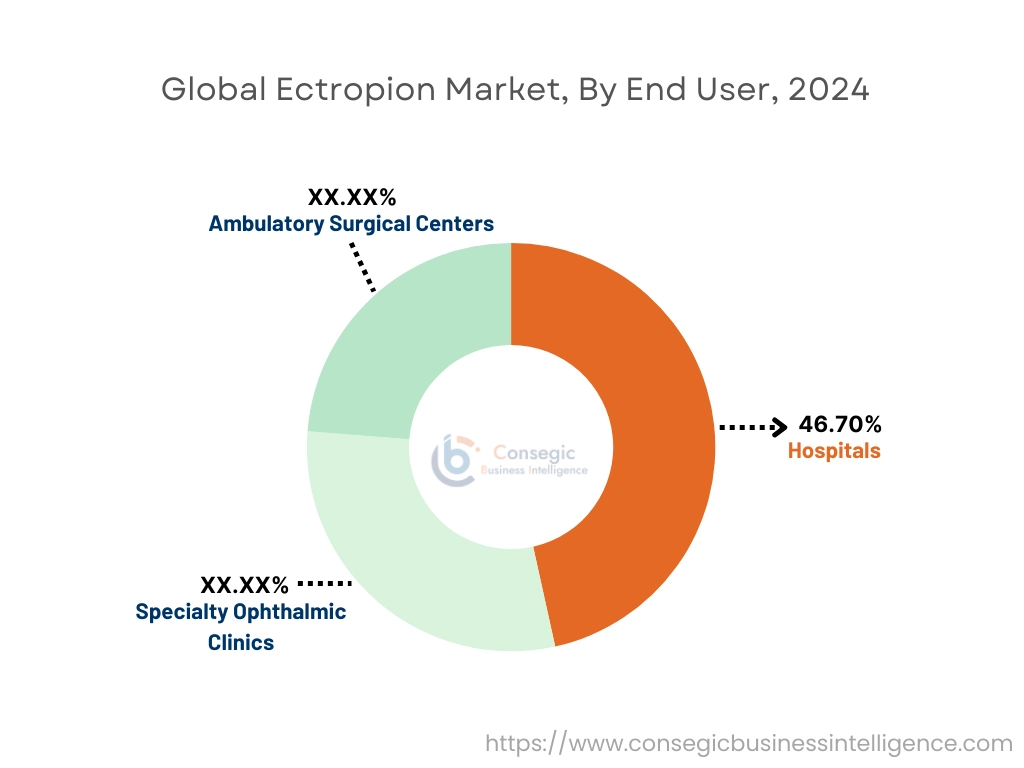
The hospitals segment accounted for the largest revenue of 46.70% share in 2024.
- Hospitals are the primary centers for diagnosing and treating complex ectropion cases requiring advanced surgical interventions.
- Increasing hospital admissions for ocular surgeries and post-trauma care support this segment’s dominance.
- Availability of multidisciplinary care in hospital settings enhances treatment outcomes for patients with ectropion.
- Rising government funding and investments in hospital infrastructure drive growth in this segment.
The specialty ophthalmic clinics segment is anticipated to register the fastest CAGR during the forecast period.
- Specialty ophthalmic clinics provide targeted care, offering specialized diagnostic and treatment solutions for ectropion.
- Increasing patient preference for outpatient care and personalized treatment supports trends in this segment.
- Expanding access to skilled ophthalmologists and advanced diagnostic tools in clinics enhances patient outcomes.
- Rising awareness of cosmetic and functional benefits of treating ectropion drives demand for specialized care.
Regional Analysis:
The regions covered are North America, Europe, Asia Pacific, the Middle East and Africa, and Latin America.
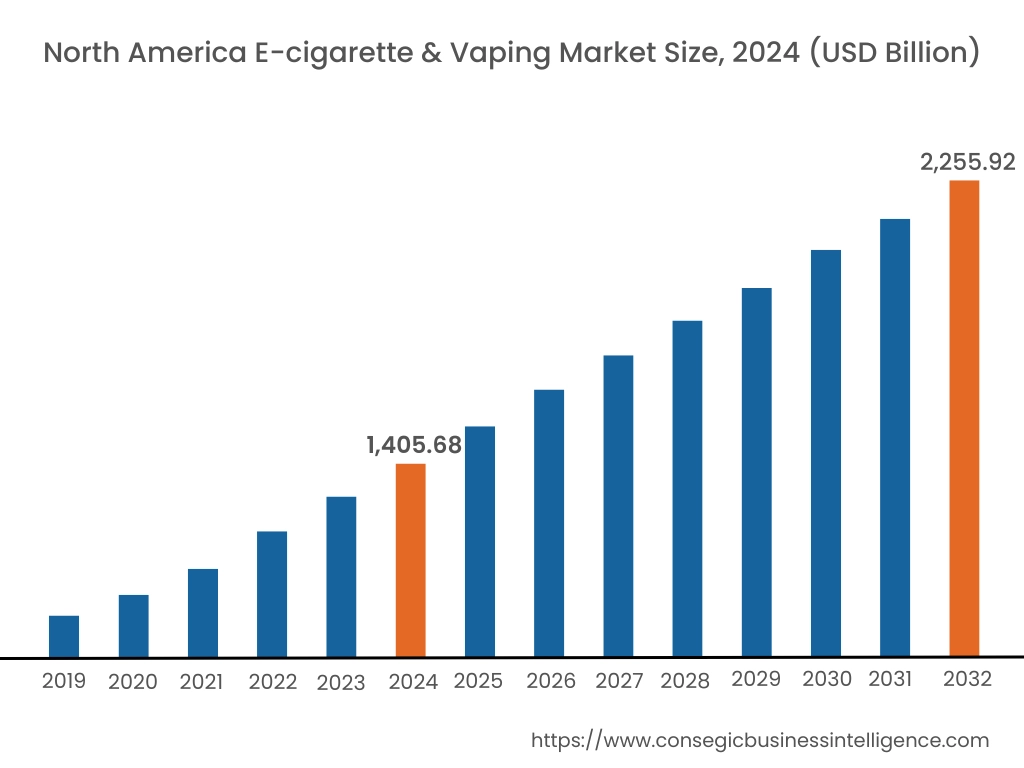
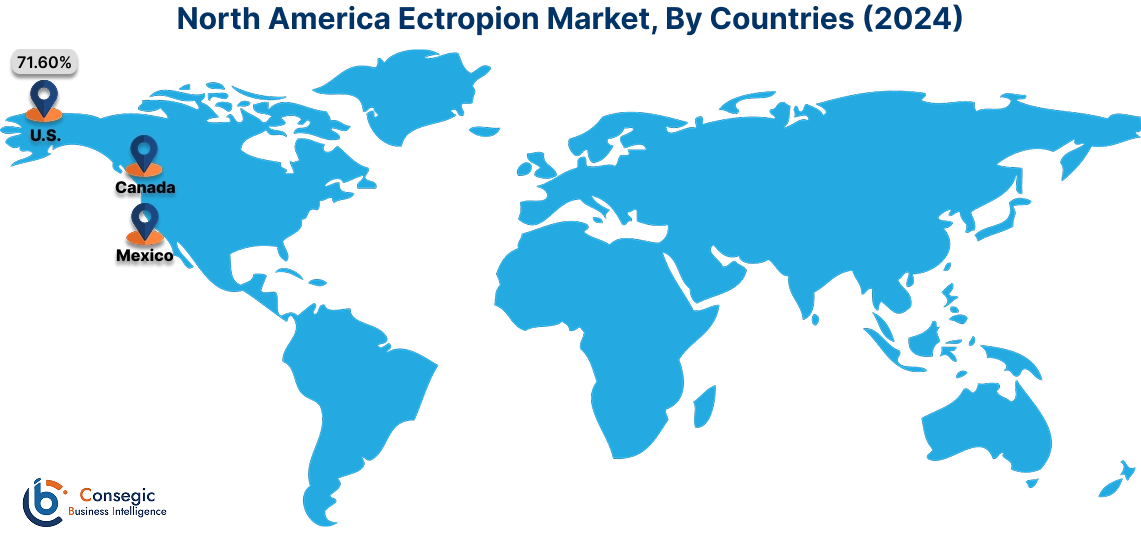
In 2024, North America was valued at USD 1,405.68 Million and is expected to reach USD 2,255.92 Million in 2032. In North America, the U.S. accounted for the highest share of 71.60% during the base year of 2024. North America holds a significant share in the global ectropion market, driven by advanced healthcare infrastructure, increasing awareness about ocular conditions, and a high prevalence of age-related ectropion cases. The U.S. dominates the region due to the availability of skilled ophthalmologists, advanced surgical techniques, and insurance coverage for corrective procedures. Additionally, the growing geriatric population and rising cases of facial paralysis further contribute to the market. Canada supports the market with increasing access to ophthalmic care and government initiatives to improve awareness about eye health. However, the high cost of corrective surgeries and limited access to specialized care in rural areas may pose challenges.
In Asia Pacific, the market is experiencing the fastest growth with a CAGR of 6.8% over the forecast period. The ectropion market analysis, is fueled by an aging population, rising awareness about ocular health, and improving healthcare access in China, India, and Japan. China dominates the region with increasing demand for corrective surgeries and non-invasive treatments, supported by healthcare reforms and rising disposable incomes. India’s expanding healthcare sector drives the adoption of cost-effective treatments, particularly in urban areas where awareness is higher. Japan emphasizes precision ophthalmology and advanced surgical techniques, leveraging its strong R&D capabilities in medical technology. However, limited access to specialized eye care in rural areas may hinder ectropion market expansion in certain parts of the region.
Europe is a prominent market for ectropion treatment, supported by a growing elderly population, increasing prevalence of ocular disorders, and well-established healthcare systems. Countries like Germany, France, and the UK are key contributors. As per the ectropion market analysis, Germany leads the market with advanced ophthalmic surgical techniques and significant investments in healthcare innovation. The UK emphasizes early diagnosis and public health initiatives for eye care, while France focuses on integrating advanced therapeutic options into its healthcare infrastructure. However, variations in reimbursement policies and budget constraints in public healthcare systems may impact access to surgical treatments in some regions.
The Middle East & Africa region is witnessing steady growth in the market, driven by increasing investments in healthcare infrastructure and rising awareness about ocular conditions. Countries like Saudi Arabia and the UAE are adopting advanced surgical techniques and therapies to address ectropion cases, supported by government initiatives to modernize healthcare systems. In Africa, South Africa is emerging as a key market, focusing on improving access to ophthalmic care through public health campaigns and partnerships with international healthcare organizations. However, limited local expertise and insufficient access to advanced medical facilities in many parts of the region may restrict broader market development.
Latin America is an emerging market for ectropion treatment, with Brazil and Mexico leading the region. Brazil’s growing healthcare sector and rising prevalence of age-related ocular conditions drive trends for surgical and non-surgical treatments. The regional analysis shows, Mexico focuses on expanding access to ophthalmic care through public health programs and collaborations with global healthcare providers. The region is also benefiting from increasing awareness campaigns promoting early diagnosis and treatment of eye disorders. However, economic instability and inconsistent healthcare infrastructure in smaller economies may pose challenges to ectropion market trends.
Top Key Players & Market Share Insights:
The ectropion market is highly competitive with major players providing products and services to the national and international markets. Key players are adopting several strategies in research and development (R&D), product innovation, and end-user launches to hold a strong position in the global ectropion market. Key players in the ectropion industry include -
- Allergan (AbbVie Inc.) (United States)
- Bausch Health Companies Inc. (Canada)
- Sun Pharmaceutical Industries Ltd. (India)
- Horizon Therapeutics plc (Ireland)
- Teva Pharmaceutical Industries Ltd. (Israel)
- Johnson & Johnson (United States)
- Alcon Inc. (Switzerland)
- Novartis AG (Switzerland)
- Pfizer Inc. (United States)
- Santen Pharmaceutical Co., Ltd. (Japan)
Ectropion Market Report Insights:
| Report Attributes | Report Details |
| Study Timeline | 2019-2032 |
| Market Size in 2032 | USD 6,960.55 Million |
| CAGR (2025-2032) | 6.4% |
| By Type |
|
| By Diagnosis |
|
| By Treatment |
|
| By End-User |
|
| By Region |
|
| Key Players |
|
| North America | U.S. Canada Mexico |
| Europe | U.K. Germany France Spain Italy Russia Benelux Rest of Europe |
| APAC | China South Korea Japan India Australia ASEAN Rest of Asia-Pacific |
| Middle East and Africa | GCC Turkey South Africa Rest of MEA |
| LATAM | Brazil Argentina Chile Rest of LATAM |
| Report Coverage |
|
Key Questions Answered in the Report
What is the current market size and projected growth of the ectropion market? −
Ectropion Market size is estimated to reach over USD 6,960.55 Million by 2032 from a value of USD 4,237.69 Million in 2024 and is projected to grow by USD 4,433.39 Million in 2025, growing at a CAGR of 6.4% from 2025 to 2032.
What are the key market drivers and restraints influencing the growth of the ectropion market? +
The report highlights significant drivers such as the aging population and rising awareness about ocular conditions, as well as restraints like the high cost of surgical interventions and limited access to advanced care in certain regions.
What are the main opportunities shaping the future of the ectropion market? +
Opportunities, such as the development of minimally invasive and non-surgical treatments, are discussed in detail, alongside their impact on expanding the market landscape.
How is the ectropion market segmented, and what is the performance of each segment? +
The market is segmented by type, diagnosis, treatment, and end-user. The report provides insights into the performance and growth trends of each segment, including which segments dominate the market and which are expected to grow the fastest.
Overview
Reputation & Certifications


Our Services
- Market Intelligence & Forecasting
- Custom Research Solutions
- Market Entry Strategy
- Competitive Intelligence
- Customer Insights
- Industry Innovation Analysis
- Investment Advisory