Jump to Content
Facial Fat Transfer Market - Size, Share, Industry Trends, and Forecasts (2025-2032)
Facial Fat Transfer Market Size:
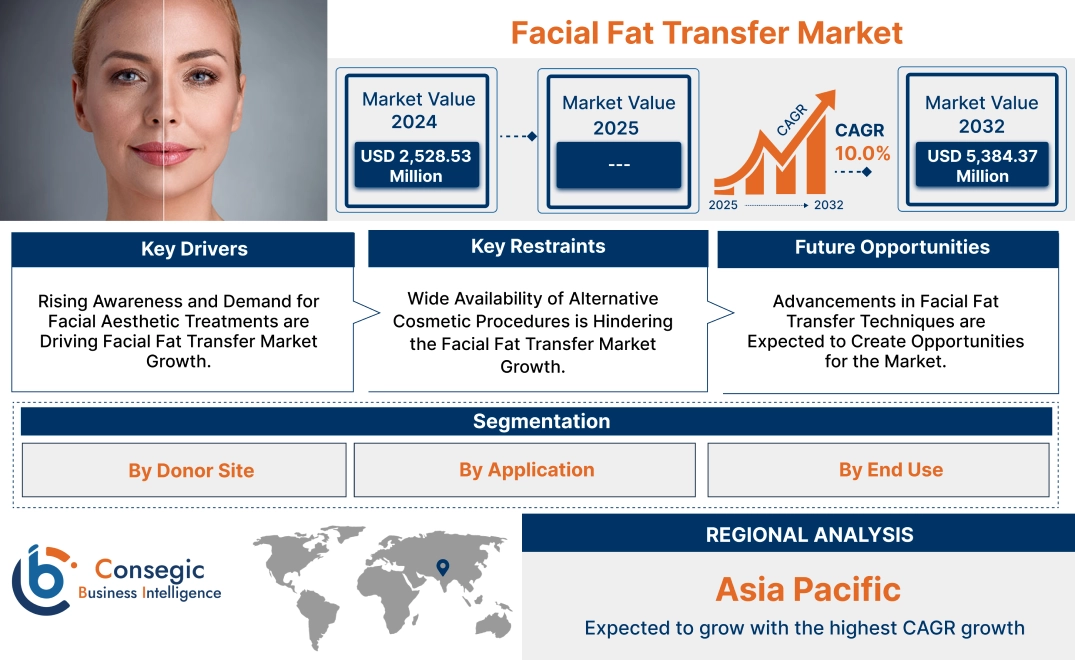
Facial Fat Transfer Market size is growing with a CAGR of 10.0% during the forecast period (2025-2032), and the market is projected to be valued at USD 5,384.37 Million by 2032 from USD 2,528.53 Million in 2024.
Facial Fat Transfer Market Scope & Overview:
Facial fat transfer, also known as fat grafting, is a minimally invasive cosmetic surgical procedure. It involves harvesting fat from a donor site such as the abdomen, thighs, buttocks, and flanks on the patient's body through liposuction. This fat is then carefully processed and injected into areas of the face that have experienced volume loss due to aging. Facial fat grafting is a permanent method to restore lost facial volume and reverse facial ageing as well as address defects and asymmetries. Common areas for fat transfer include the cheeks, around the nostrils, nasolabial folds, forehead, lips, under-eye areas, and the hollows of the eyes. Facial fat grafting is considered a permanent filler, as the transplanted fat cells can survive and contribute to long-term volume restoration.
Facial Fat Transfer Market Dynamics - (DRO) :
Key Drivers:
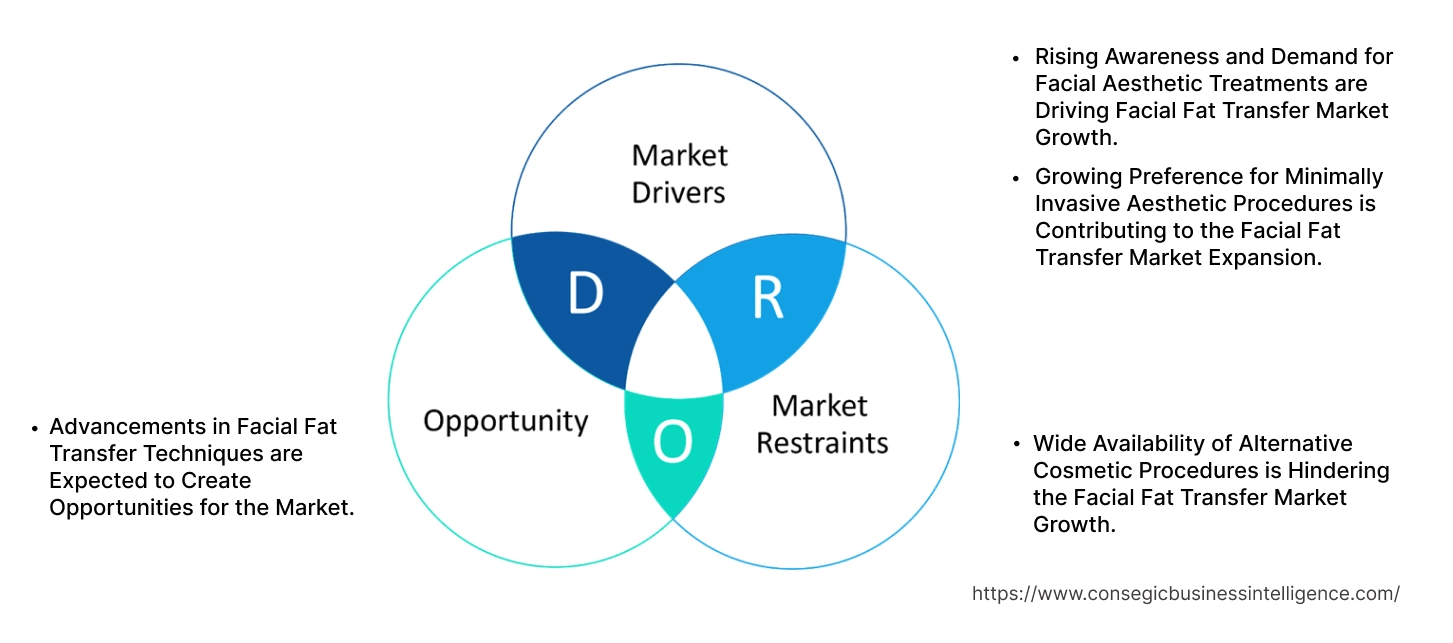
Rising Awareness and Demand for Facial Aesthetic Treatments are Driving Facial Fat Transfer Market Growth.
Facial aesthetic treatments encompass a range of procedures aimed at enhancing facial appearance by addressing concerns related to skin aging, imperfections, or dissatisfaction with facial features. These treatments, such as fat transfer, aim to improve facial aesthetics and boost self-confidence.
The rising awareness of facial aesthetic treatments is significantly influenced by social media influencers. These individuals narrate their experiences with cosmetic procedures, providing authentic narratives and showcasing transformations before and after treatments. This widespread exposure has contributed to the normalization of facial aesthetic procedures within society, consequently increasing requirement for these treatments.
- For instance, according to the report published by American Society of Plastic Surgeons in 2023, it is stated that facial procedures continued to be in high demand in 2023. The number of facial cosmetic procedures performed in 2023 rose by 5%, from 1,498,361 in 2022 to 1,575,244.
Overall, the rising awareness of facial aesthetics, driven by social media, fuels adoption of procedures like fat transfer further driving the market trajectory.
Growing Preference for Minimally Invasive Aesthetic Procedures is Contributing to the Facial Fat Transfer Market Expansion.
Minimally invasive aesthetic surgeries bridge the gap between non-invasive treatments and traditional open surgeries. MIS-AS uses instruments and imaging technology to access the surgical site through small incisions. On the other hand, traditional open surgeries require large incisions. This approach helps to minimize tissue damage. It also allows for faster recovery times compared to traditional open surgical techniques. This has led to a surge in the popularity of minimally invasive cosmetic procedures.
- For instance, according to the 2023 ASPS Procedural Statistics provided by The American Society of Plastic Surgeons (ASPS), minimally invasive procedures saw a 7% growth year over year, suggesting that patients are opting for less-invasive options to maintain their beauty regimens economically.
Facial fat transfer aligns perfectly with this need. This approach offers several advantages that align with the growing preference for minimally invasive aesthetic procedures. Patients typically experience minimal downtime following the procedure, compared to more invasive surgical options. These advantages have contributed to the increasing popularity of facial fat grafting among individuals seeking to improve their facial appearance.
Key Restraints:
Wide Availability of Alternative Cosmetic Procedures is Hindering the Facial Fat Transfer Market Growth.
Facial fat transfer is one of the few options for restoring facial volume. Alternative treatments to this exist which function as a restraint to the market. Few of these alternative treatments are thread lift, dermal fillers, among others. Dermal fillers, including calcium hydroxylapatite, hyaluronic acid fillers, and poly-L-lactic acid. These ingredients offer temporary to long-lasting volume reconstruction.
Another treatment is the utilization of thread lifts. They utilize inserted threads to lift and tighten sagging tissues. Additionally, laser resurfacing removes the outer layers of skin, improving skin quality. These alternative treatments provide a range of options for individuals seeking facial rejuvenation. In addition to this, their availability puts pressure on its pricing of fat transfer and limits its market.
Future Opportunities :
Advancements in Facial Fat Transfer Techniques are Expected to Create Opportunities for the Market.
Advancements in facial fat transfer techniques, such as micro- and nanofat grafting, refined fat processing, 3D imaging, and stem cell enrichment, significantly improve outcomes by enhancing graft survival, minimizing invasiveness, and achieving more natural and predictable results. A key advancement in fat grafting techniques lies in the increased emphasis on precision and customization. Incorporating specialized injection methods and refining fat processing techniques, allows practitioners to tailor treatments to individual patient needs and achieve highly individualized results.
A notable advancement in fat grafting techniques involves the integration of regenerative medicine principles. By incorporating growth factors, stem cells, and other bioactive substances, practitioners aim to enhance tissue regeneration and optimize fat graft survival, leading to more natural and long-lasting rejuvenation outcomes. Nanofat grafting is a new technique that involves emulsifying fat with stem cells and growth factors. This fat processing technique improves skin quality without increasing volume. Additionally, adoption of advanced navigation technology such as augmented reality guidance system supports accuracy and effectiveness, of this facial fat grafting procedure.
- For instance, according to the research study published in BioMed Central Journal in September 2024, it is stated that error in facial soft tissue defect reconstruction assisted by the augmented reality guidance system in is significantly lower than conventional methods. Additionally, the time required for facial defect filling reconstruction using this system is shorter than the time needed with conventional methods such as artificial markers.
These advancements are creating facial fat transfer market opportunities by enabling more precise, personalized, and effective facial rejuvenation procedures.
Facial Fat Transfer Market Segmental Analysis :
By Donor Site:
Based on donor site, the market is categorized into abdomen, thighs, buttocks, and others.
Trends in the Donor Site:
- Increased focus on techniques to enhance fat graft survival and minimize complications like fat necrosis.
- Development of less invasive liposuction methods for fat harvesting, reducing patient discomfort and recovery time.
The abdomen segment accounted for the largest facial fat transfer market share in 2024.
- The abdominal region currently dominates the donor site segment within the market. This dominance is attributed to several key factors. The abdomen often provides a readily available source of fat for harvesting.
- Additionally, fat harvested from the abdomen tends to exhibit higher survival rates when transplanted to facial areas, contributing to more successful and long-lasting outcomes. Moreover, liposuction procedures in the abdominal area are generally considered less technically demanding for experienced surgeons.
- For instance, a survey conducted among members of the International Society of Plastic Regenerative Surgeons (ISPRES) in March 2023 revealed a strong preference for the abdomen as the primary donor site for fat grafting procedures. The survey found that 35.5% of surgeons favored the abdomen, while only 4.8% preferred to let patients choose the donor area. Furthermore, when asked about their preferred fat harvesting zones, surgeons indicated the abdomen with 88.7% as the most common choice. These findings highlight the significant role of the abdomen in current fat grafting practices among plastic surgeons.
- Overall, as per analysis, the abdominal region dominates facial fat grafting donor sites due to abundant fat, high graft survival, and easier liposuction.
The thighs segment is expected to grow at the fastest CAGR over the forecast period.
- The thigh segment within the facial fat transfer market trend is demonstrating a significant trajectory. This surge is attributed to several key factors such as Firstly, many patients express a preference for fat removal from the thighs, as it addresses areas of concern such as inner or outer thigh fullness.
- Additionally, advancements in liposuction techniques and fat processing methods have significantly improved the suitability of thigh fat for transplantation.
- Moreover, emerging research suggests that fat harvested from the thighs exhibits favorable characteristics, such as improved graft survival and reduced complications, further enhancing the appeal of this donor site.
By Application:
Based on application, the market is categorized into facial volume enhancement and facial deformity correction.
Trends in Application:
- Moving beyond standardized approaches to individualized treatment plans considering patient age, facial anatomy, lifestyle, and desired outcomes.
- Integrating fat grafting with other minimally invasive procedures like microneedling, platelet-rich plasma, and dermal fillers for synergistic rejuvenation effects.
The facial volume enhancement segment accounted for the largest facial fat transfer market share in the year 2024.
- Facial volume enhancement includes cheek augmentation, under-eye hollows, nasolabial folds, and others.
- Facial fat transfer is used to address volume loss in various areas of the face. Cheek augmentation is a highly popular application, aiming to restore volume in the midface for a more youthful appearance.
- Temple filler addresses the hollowing temples often associated with aging, contributing to a more balanced facial appearance.
- Additionally, under-eye filler is used to address under-eye hollows and dark circles by replenishing lost volume. Nasolabial folds, deep creases extending from the nose to the corners of the mouth, are also treated with fat grafting.
- Moreover, fat transfer is also employed to augment the lips, address marionette lines, and treat other areas experiencing volume loss. As patients seek more comprehensive facial rejuvenation, there is growing interest in these applications of fat grafting.
- This segment is experiencing a substantial trajectory, driven by several key factors. The aging population is a major driver, as individuals seek to address age-related volume loss in the face, such as hollowed cheeks, sunken temples, and diminished under-eye areas. Furthermore, there is a growing need for facial aesthetic procedures that support the segment trajectory.
- For instance, according to the survey data published by The International Society of Aesthetic Plastic Surgery in 2023, it is found that number total face and head procedures performed increased by 19.6% from 5,438,157 in 2022 to 6,505,843 in 2023.
- Overall, as per analysis, growing demand for natural looking facial rejuvenation is driving the segment trend.
The facial deformity correction segment is expected to grow at the fastest CAGR over the forecast period.
- The use of fat transfer for facial deformity correction is steadily increasing. Key applications of fat transfer for facial deformity correction include the correction of soft tissue defects, contour irregularities, and scarring resulting from trauma or burns.
- Fat grafting is also utilized to refine contours and address irregularities following other facial surgeries, such as rhinoplasty or rhytidectomy.
- Furthermore, emerging applications involve the correction of congenital craniofacial anomalies such as cleft lip and palate, with the aim of improving facial symmetry and functioncreating new avenues for the application of fat grafting in pediatric and congenital conditions.
By End User:
Based on end use, the market is categorized into hospitals and clinics, cosmetic surgery centers, medical spas, and others.
Trends in the End Use:
- Hospitals are increasingly focusing on complex procedures, such as facial reconstruction following trauma or burns, and the treatment of severe deformities.
- Adoption of quick-drying and fast-curing coatings to reduce repair times and improve efficiency.
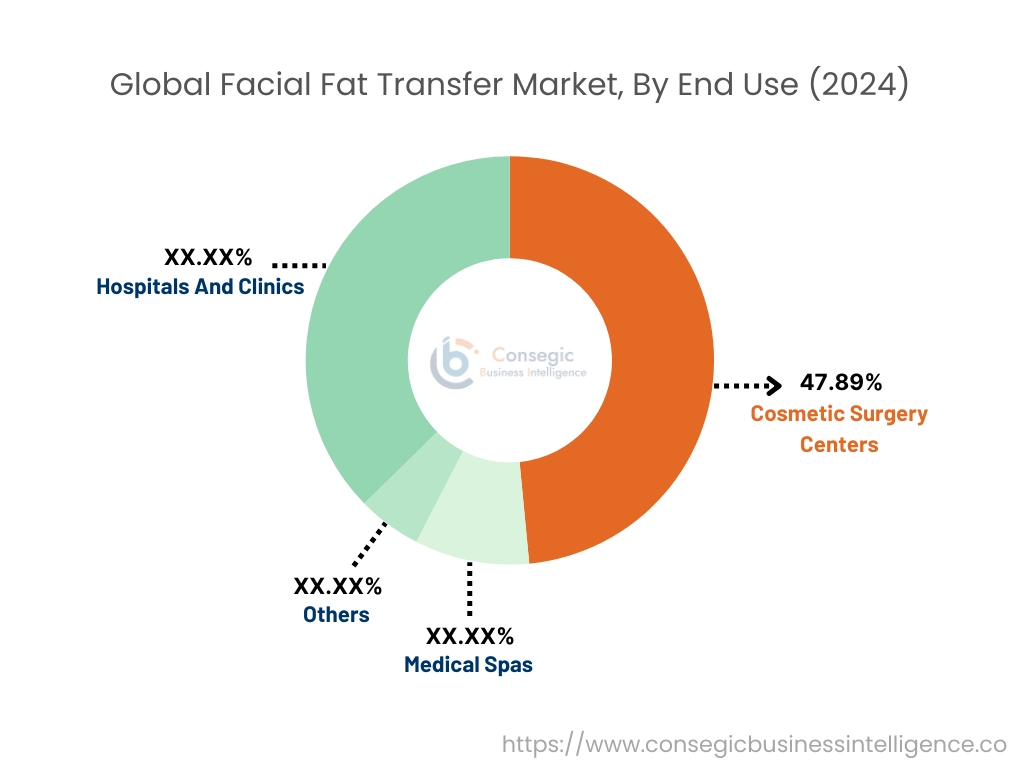
The cosmetic surgery centers segment accounted for the largest market share of 47.89% in the year 2024.
- Cosmetic surgery centers are specialized medical facilities that primarily focus on performing aesthetic procedures.
- These centers specialize in aesthetic procedures, offering a focused and streamlined approach to patient care. Equipped with state-of-the-art facilities, they provide a comfortable and safe environment for patients.
- Highly experienced and board-certified plastic surgeons lead the teams, ensuring expertise in cosmetic procedures. Prioritizing patient satisfaction, these centers offer personalized treatment plans and a dedicated focus on the patient experience.
- Additionally, as people become more aware of the importance of safety and quality in healthcare, they are increasingly choosing accredited facilities for aesthetic procedures including aesthetic lift threads for the face.
- For instance, according to the data published by the Aesthetic Society in 2023, it is found that 64% of aesthetic surgeries are performed at Accredited Surgical Centers. This influences the end use of fat transfer for the face in cosmetic surgical centers.
- Overall, as per analysis, cosmetic surgery centers, with their specialized focus, state-of-the-art facilities, experienced surgeons, and patient-centric approach, are poised for significant trajectory in the facial fat transfer market demand.
The hospitals and clinics segment is expected to grow at the fastest CAGR over the forecast period.
- Aesthetic procedure hospitals and clinics are specialized healthcare facilities that focus on providing cosmetic treatments and procedures aimed at enhancing physical appearance and addressing aesthetic concerns. These facilities offer a wide range of non-invasive and minimally invasive treatments designed to improve skin quality, reduce signs of aging, and enhance facial features.
- The adoption of aesthetic fat transfer for face in hospitals is growing due to several factors. The reputation of hospitals for providing high-quality, evidence-based care plays a significant role in adoption of aesthetic procedures including facial fat grafting.
- The rigorous standards and regulatory oversight that hospitals adhere to instill confidence in patients regarding the safety and efficacy of the treatments they receive. This trust factor is particularly crucial in fat transfer for the face, where patients prioritize outcomes and safety above all else. Patients seeking fat grafting for face feel more secure opting for a hospital setting with its established healthcare infrastructure and industry.
- Moreover, hospitals house a range of qualified medical professionals, including dermatologists, anesthesiologists, and critical care specialists. This multidisciplinary approach allows for a holistic treatment plan, addressing not just aesthetic concerns but also potential medical complexities.
- Overall, as per facial fat transfer market analysis, hospitals and clinics, with their focus on high-quality care, rigorous standards, and multidisciplinary approach, are driving adoption of facial fat grafting.
Regional Analysis:
The regional segment includes North America, Europe, Asia Pacific, the Middle East and Africa, and Latin America.
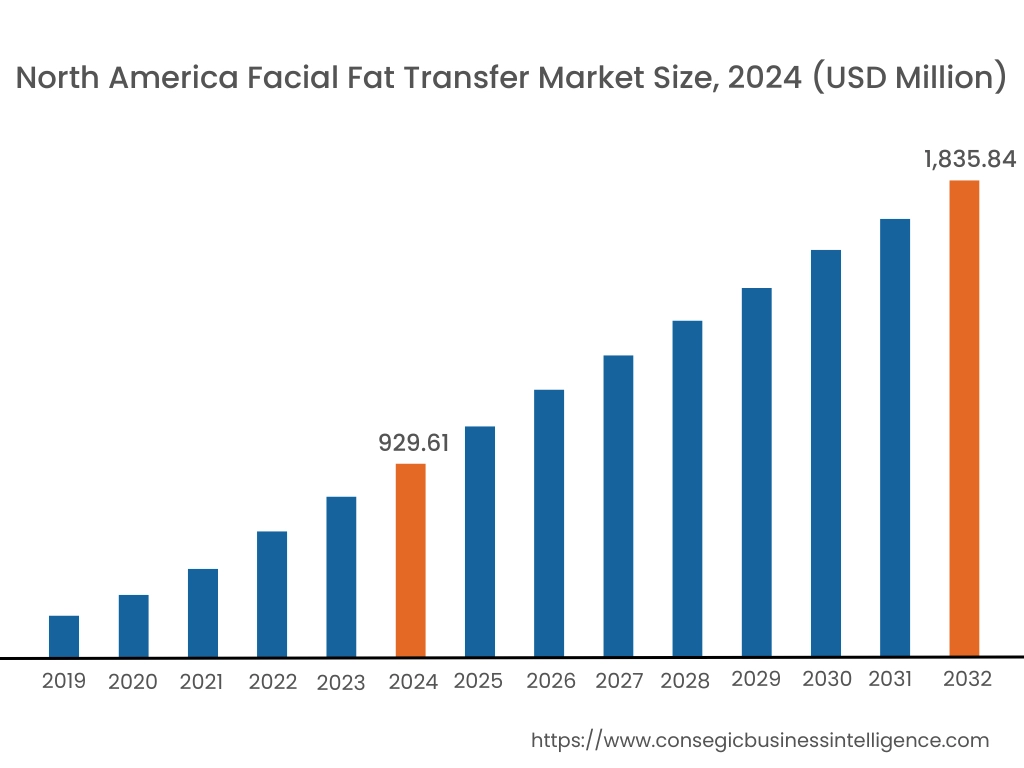
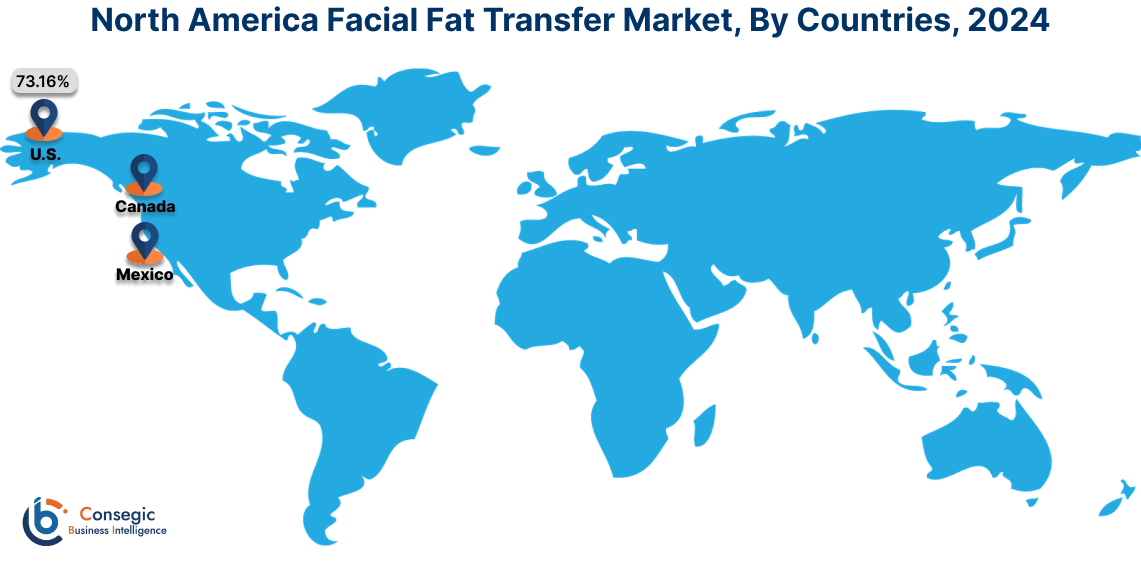
In 2024, North America accounted for the highest market share at 36.77% and was valued at USD 929.61 Million and is expected to reach USD 1,835.84 Million in 2032. In North America, the U.S. accounted for the highest market share of 73.16% during the base year of 2024.
North America dominates the, primarily due to the high disposable income, allowing individuals to afford aesthetic procedures. Additionally, the region boasts a well-developed healthcare industry with presence of skilled plastic surgeons and advanced medical facilities. Furthermore, a cultural emphasis on youthfulness and beauty has driven a high requirement for cosmetic procedures. This creates a demand for cosmetic procedures including facial fat transfer in North America.
- For instance, according to the report published by American Society of Plastic Surgeons in 2023, it is stated that total number of cosmetic procedures increased by 19% from 1,255,228 in 2019 to 1,498,361 2022.
The aging population also significantly impacts market, as individuals seek to address age-related volume loss and restore a more youthful appearance. Additionally, the early adoption of advanced technologies, such as minimally invasive techniques and innovative fat processing methods, has contributed to market. The combination of the aforementioned factors and trends is driving a substantial trajectory in the North America market.
Asia Pacific is experiencing the fastest growth with a CAGR of 11.8% over the forecast period. The facial fat transfer market trend across the region is attributed to factors such as rising middle class with increasing disposable incomes, leading to a greater need for aesthetic procedures. Furthermore, shifting social norms and an escalating emphasis on youthfulness and beauty are significantly supporting this trend. The growing awareness of advanced cosmetic procedures further contributes to the market's trajectory. Key growth markets within this region include China, India, and South Korea. These factors coupled with the increasing availability of skilled professionals and advanced technologies, are projected to fuel the Asia Pacific facial fat transfer market expansion in the upcoming years.
Europe presents a significant contribution to the facial fat transfer market analysis. Europe presents a well-established healthcare industry with a high concentration of skilled plastic surgeons and advanced medical facilities. The aging population within Europe fuels adoption of procedures that address age-related facial volume loss. Furthermore, a growing preference for minimally invasive and less invasive cosmetic procedures makes facial fat grafting an increasingly attractive option. European patients often prioritize natural-looking results, which aligns well with the natural outcomes achievable with fat grafting. These factors, combined with the increasing availability of innovative techniques and technologies, are expected to sustain steady expansion within Europe.
The Middle East and Africa (MEA) region is witnessing notable facial fat transfer market demand characterized by significant potential. This demand is primarily driven by a rise in middle class with increasing disposable income, enabling access to aesthetic treatments. Key growth markets within this region include the United Arab Emirates, a significant market with a well-developed healthcare infrastructure and a growing interest in aesthetic procedures, Saudi Arabia, a rapidly developing market with a surging adoption of cosmetic procedures, and South Africa, a relatively mature market within the region with a growing focus on aesthetic procedures. These factors, combined with the increasing availability of skilled professionals and advanced technologies, are projected to create substantial facial fat transfer market opportunities across the Middle East and Africa in the coming years.
Latin America is an emerging region in the facial fat transfer market, with significant potential for innovation. A growing interest in cosmetic procedures, driven by cultural factors and a desire for enhanced appearance, is a key driver. Furthermore, a burgeoning middle class with increasing disposable income is fueling requirement for aesthetic treatments. These factors, coupled with the increasing availability of skilled professionals and advanced technologies, are projected to drive substantial trajectory within the Latin American market in the coming years. This analysis presents a substantial opportunity for facial fact transfer providers to capitalize on this growing market and contribute to the region's market.
Top Key Players and Market Share Insights:
The Facial Fat Transfer market is highly competitive with major players providing precise products to the national and international markets. Key players are adopting several strategies in research and development (R&D) and product innovation to hold a strong position in the global Facial Fat Transfer market. Key players in the Facial Fat Transfer industry include-
- AbbVie (U.S.)
- Black Tie Medical, Inc. (U.S.)
- Genesis Biosystems, Inc. (U.S.)
- MicroAire (U.S.)
- Johnson & Johnson MedTech (U.S.)
- Bimini Health Tech (U.S.)
- Sorensen Clinic (UK)
- Sientra, Inc. (U.S.)
- Eurosurgical Ltd. (UK)
- Medicon eG (Germany)
Facial Fat Transfer Market Report Insights :
| Report Attributes | Report Details |
| Study Timeline | 2019-2032 |
| Market Size in 2032 | USD 5,384.37 Million |
| CAGR (2025-2032) | 10.0% |
| By Donor Site |
|
| By Application |
|
| By End User |
|
| By Region |
|
| Key Players |
|
| North America | U.S. Canada Mexico |
| Europe | U.K. Germany France Spain Italy Russia Benelux Rest of Europe |
| APAC | China South Korea Japan India Australia ASEAN Rest of Asia-Pacific |
| Middle East and Africa | GCC Turkey South Africa Rest of MEA |
| LATAM | Brazil Argentina Chile Rest of LATAM |
| Report Coverage |
|
Key Questions Answered in the Report
How big is the Facial Fat Transfer market? −
In 2024, the Facial Fat Transfer market is USD 2,528.53 Million.
Which is the fastest-growing region in the Facial Fat Transfer market? +
Asia Pacific is the fastest-growing region in the Facial Fat Transfer market.
What specific segmentation details are covered in the Facial Fat Transfer market? +
Donor Site, Application, and End Use segmentation details are covered in the Facial Fat Transfer market.
Who are the major players in the Facial Fat Transfer market? +
AbbVie (U.S.), Black Tie Medical, Inc. (U.S.), and Bimini Health Tech (U.S.) are some of the major players in the market.
Overview
Reputation & Certifications


Our Services
- Market Intelligence & Forecasting
- Custom Research Solutions
- Market Entry Strategy
- Competitive Intelligence
- Customer Insights
- Industry Innovation Analysis
- Investment Advisory