Jump to Content
Flight Data Recorder Market Size & Industry Share - Growth Trends & Forecasts (2026 - 2034)
Flight Data Recorder Market Size:
The Flight Data Recorder market size was valued at 3,363.66 (US$M) in 2025 and is projected to grow from 3,494.84 (US$M) in 2026 to 4,746.27 (US$M) by 2034, at a CAGR of 3.9% from 2026 to 2034, according to a recent report from Consegic Business Intelligence.
Flight Data Recorder Market Scope & Overview:
A flight data recorder (FDR), commonly referred to as a "black box," is an essential device used in aviation to record specific aircraft performance parameters during flight. These devices capture critical data points such as altitude, airspeed, engine performance, and control inputs, providing a comprehensive record of the aircraft's operational status. They are built to withstand extreme conditions, including high-impact forces and severe heat, ensuring data preservation in the event of an accident or incident.
The application of FDR extends across commercial aviation, military aircraft, and private jets, where they play a vital role in monitoring aircraft systems and supporting flight safety investigations. The information gathered by these devices helps in analyzing flight performance, identifying potential technical issues, and reconstructing events during investigations. Modern FDRs also integrate with cockpit voice recorders (CVRs), offering a synchronized audio and data timeline for comprehensive analysis.
End-users of FDR include airlines, aircraft manufacturers, aviation regulatory bodies, and accident investigation agencies. These stakeholders rely on FDR data for enhancing safety protocols, conducting maintenance checks, and improving overall flight operations through detailed performance analysis.

Flight Data Recorder Market Dynamics - (DRO) :
Key Drivers:
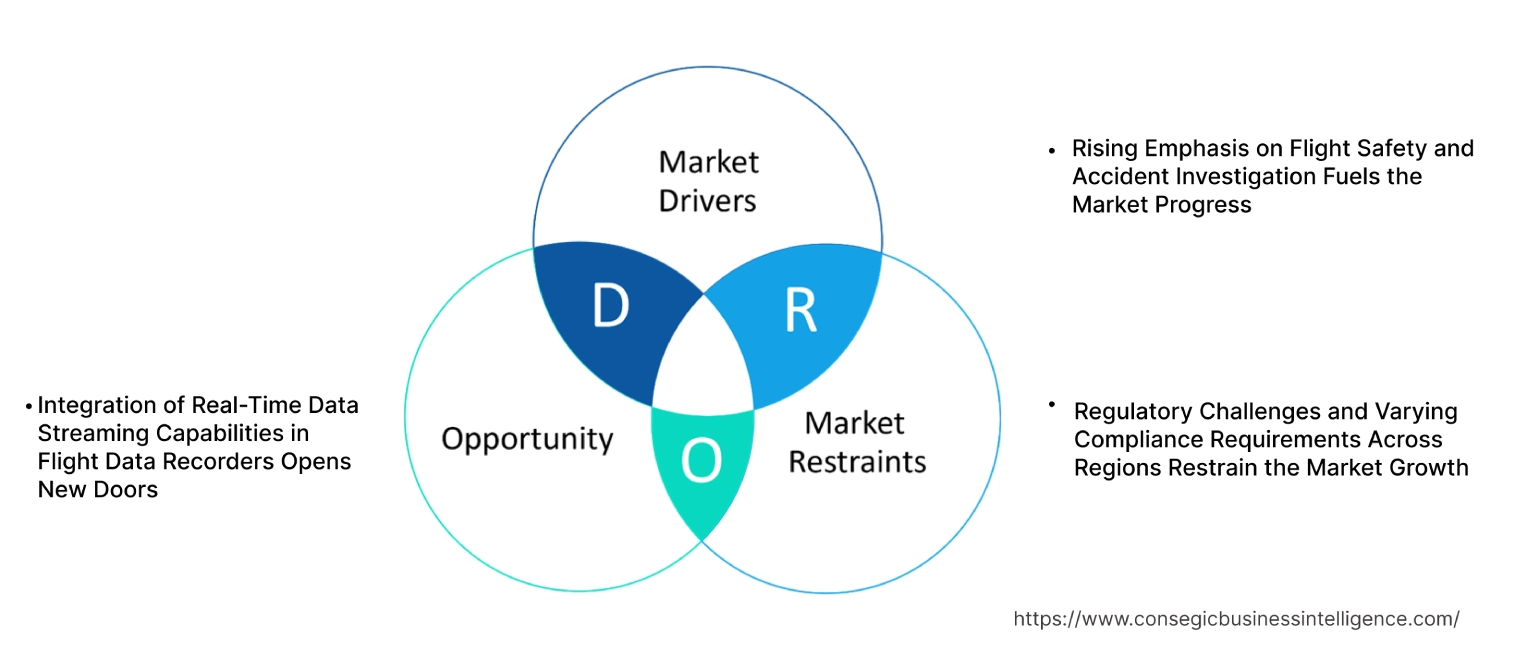
Rising Emphasis on Flight Safety and Accident Investigation Fuels the Market Progress
Flight data recorders, often referred to as "black boxes," play a crucial role in capturing critical flight parameters, including altitude, speed, engine performance, and pilot inputs. In the event of an incident, the data collected by these devices is invaluable for reconstructing the sequence of events leading up to the accident, helping investigators identify the root cause and prevent similar occurrences in the future. With global aviation regulatory bodies like the Federal Aviation Administration (FAA) and the European Union Aviation Safety Agency (EASA) enforcing stricter safety mandates, the need for advanced flight data recording technologies is growing. The rising emphasis on enhancing safety standards across commercial and military aviation segments is driving the adoption of next-generation recorders equipped with enhanced data storage, real-time data transmission capabilities, and increased durability. Therefore, the flight data recorder market demand is surging as the aviation sector adopts advanced technologies to enhance safety and meet stringent regulatory requirements globally.
Key Restraints :
Regulatory Challenges and Varying Compliance Requirements Across Regions Restrain the Market Growth
International aviation organizations like the International Civil Aviation Organization (ICAO) set global standards for the recorders, individual countries and regions often have their own specific regulations and certification requirements. This lack of standardization complicates the development and deployment of flight data recording systems, as manufacturers must ensure their products meet diverse regulatory criteria. Additionally, compliance with stringent safety regulations involves rigorous testing and certification processes, which are time-consuming and costly. These regulatory constraints may deter some airlines and aircraft manufacturers from adopting new technologies, impacting the flight data recorder market growth, particularly in regions with evolving or less harmonized aviation safety regulations.
Future Opportunities :
Integration of Real-Time Data Streaming Capabilities in Flight Data Recorders Opens New Doors
Traditional recorders store information locally on the device, which is only accessible after the aircraft lands or in the event of an accident. However, advancements in satellite communication and data transmission technologies now enable the integration of real-time streaming features, allowing critical flight data to be transmitted continuously to ground-based systems during the flight. This capability enhances situational awareness for airline operators and air traffic controllers, enabling proactive responses to potential safety issues. Real-time data streaming will also aid in predictive maintenance by providing continuous monitoring of aircraft performance, helping to identify anomalies before they escalate into serious problems. As airlines seek to enhance operational safety and efficiency, the adoption of recorders with real-time data transmission capabilities is expected to increase. Thus, the integration of real-time data streaming capabilities highlights promising flight data recorder market opportunities, driven by innovations in safety, operational efficiency, and predictive maintenance solutions.
Flight Data Recorder Market Segmental Analysis :
By Type:
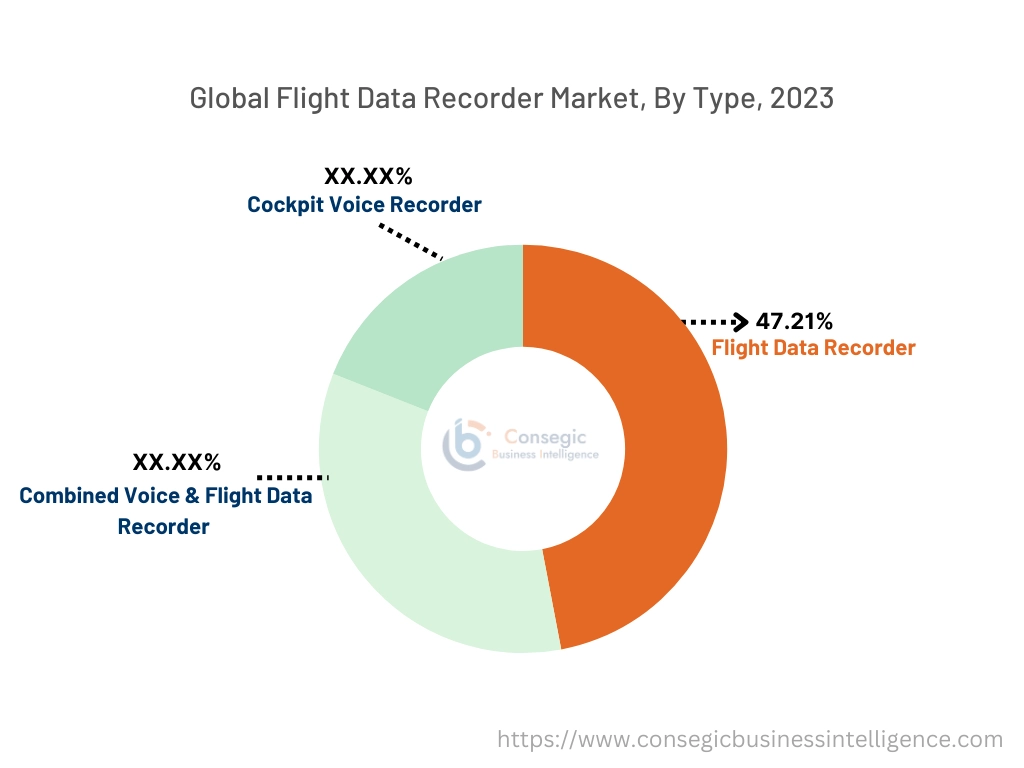
Based on type, the market is segmented into Cockpit Voice Recorder (CVR), Flight Data Recorder (FDR), and Combined Voice & Flight Data Recorder (CVFDR).
The Flight Data Recorder (FDR) segment accounted for the largest revenue of 47.21% in 2023.
- FDRs are critical for recording a wide range of flight parameters, providing invaluable data for accident investigations and operational analysis.
- These devices monitor vital flight data, including altitude, airspeed, and engine performance, ensuring compliance with aviation safety regulations.
- The increasing emphasis on flight safety, coupled with regulatory mandates for FDR installation in all commercial aircraft, drives the dominance of this segment.
- The adoption of advanced solid-state FDRs, offering improved durability and storage capacity, further supports market growth.
- As per flight data recorder market trends, the dominance of the FDR segment is attributed to its extensive use in both commercial and military aviation for flight performance monitoring.
The Combined Voice & Flight Data Recorder (CVFDR) segment is expected to register the fastest CAGR during the forecast period.
- CVFDRs integrate the functionalities of both cockpit voice recorders and flight data recorders, providing comprehensive data in a single device.
- These recorders are increasingly adopted in modern aircraft to save space and reduce the complexity of separate systems.
- The rising demand for efficient, lightweight recording systems in next-generation aircraft is driving the adoption of CVFDRs.
- The CVFDR segment is projected to grow rapidly due to its cost-effectiveness, space-saving design, and comprehensive recording capabilities which further facilitate flight data recorder market expansion.
By Component:
Based on components, the market is segmented into Recorder Units, Memory Modules, Cockpit Voice Interface, and Data Management Systems.
The recorder units segment accounted for the largest revenue of the total flight data recorder market share in 2023.
- Recorder units form the core of flight data recorders, housing the hardware necessary for data capture and storage during flights.
- Modern recorder units utilize advanced solid-state technology, ensuring enhanced durability, reliability, and resistance to extreme conditions like high-impact crashes.
- The increasing deployment of lightweight, compact recorder units in new-generation aircraft supports their strong market position.
- As per flight data recorder market analysis, the dominance of the recorder units segment is attributed to its critical role in enabling accurate data recording and compliance with aviation safety regulations.
The data management systems segment is expected to register the fastest CAGR during the forecast period.
- Data management systems facilitate the efficient retrieval, analysis, and storage of flight data, enhancing decision-making and operational insights for airlines and aviation authorities.
- These systems integrate advanced analytics tools to process recorded data, enabling predictive maintenance and improving fleet efficiency.
- The rising adoption of real-time data streaming and cloud-based solutions is driving the growth of the data management systems segment.
- The data management systems segment is expected to grow rapidly, driven by the increasing emphasis on data-driven decision-making in the aviation industry further encouraging the flight data recorder market demand.
By Application:
Based on application, the market is segmented into Accident Investigation, Fleet Monitoring, Air Traffic Management, and Performance Analysis.
The accident investigation segment held the largest revenue share of the total flight data recorder market share in 2023.
- FDRs are indispensable for accident investigations, providing critical insights into the sequence of events leading to incidents or crashes.
- Regulatory mandates across the aviation sector require the installation of FDRs and CVRs to ensure transparency and accountability during investigations.
- The need for advanced flight data recording systems with enhanced storage capacity and survivability features drives this segment’s dominance.
- As per flight data recorder market trends, the dominance of the accident investigation segment is due to the increasing focus on aviation safety and the crucial role of recorders in identifying causes of accidents.
The fleet monitoring segment is expected to register the fastest CAGR during the forecast period.
- Fleet monitoring applications utilize real-time data from flight recorders to optimize operations, improve fuel efficiency, and ensure compliance with maintenance schedules.
- Airlines and fleet operators are increasingly adopting data analytics platforms integrated with flight recorders to monitor fleet performance and identify potential issues proactively.
- The fleet monitoring segment is projected to grow rapidly due to the rising demand for predictive maintenance and enhanced operational efficiency across the aviation industry further fueling the flight data recorder market growth.
By End-User:
Based on end-user, the market is segmented into Airlines, Aircraft Manufacturers, Military & Defense, and Aviation Authorities.
The airline segment accounted for the largest market share in 2023.
- Airlines are the primary users of FDRs, leveraging them to ensure safety, compliance, and efficient fleet management.
- The growing adoption of real-time data streaming capabilities in flight recorders enables airlines to enhance operational efficiency and reduce downtime.
- As per flight data recorder market analysis, the dominance of the airline segment is due to the large-scale deployment of flight recorders across commercial fleets and the rising focus on operational excellence.
The military & defense segment is expected to register the fastest CAGR during the forecast period.
- The military & defense sector uses flight data recorders for mission analysis, pilot training, and post-flight performance evaluation.
- Advanced recorders tailored for military applications feature enhanced security and rugged designs to withstand extreme operating conditions.
- The growth of the military & defense segment is supported by increased defense budgets and the integration of cutting-edge recording technologies in military aircraft, which promotes new flight data recorder market opportunities.
Regional Analysis:
The regions covered are North America, Europe, Asia Pacific, the Middle East and Africa, and Latin America.
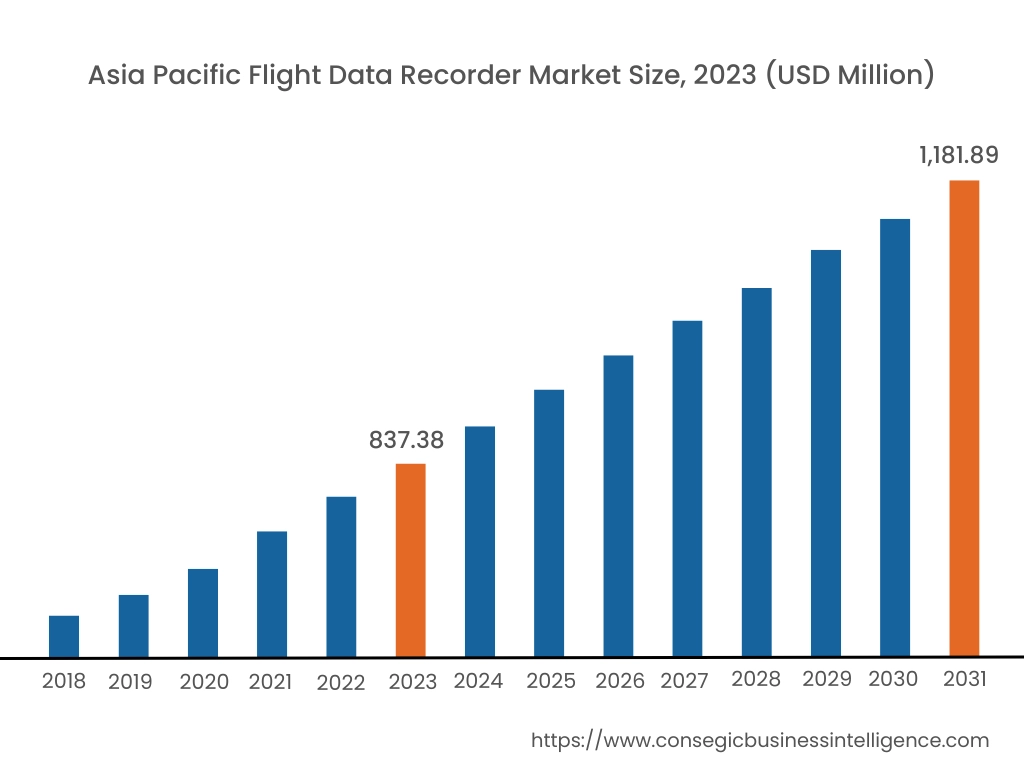
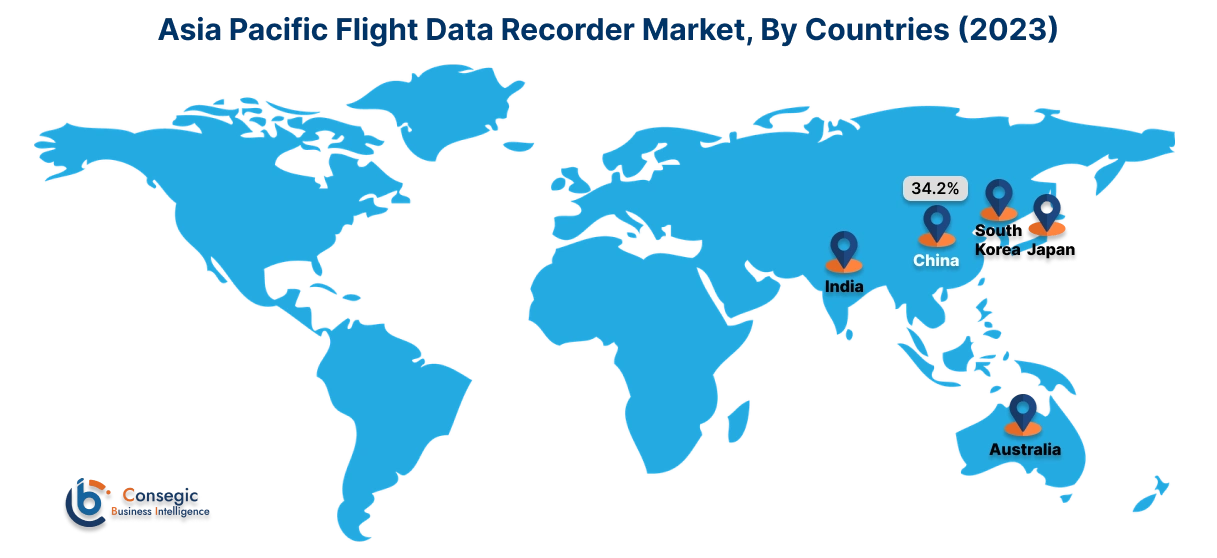
Asia Pacific region was valued at USD 837.38 Million in 2023. Moreover, it is projected to grow by USD 858.00 Million in 2024 and reach over USD 1,181.89 Million by 2031. Out of these, China accounted for the largest share of 34.2% in 2023. Asia-Pacific is the fastest-growing region in the market, led by China, Japan, and India, driven by rapid growth in the commercial aviation sector and increasing aircraft deliveries. China's expanding aviation sector, bolstered by rising air travel needs and local manufacturing initiatives, significantly boosts the FDR market. Japan's focus on enhancing aircraft safety and India's growing investments in modernizing its fleet contribute to the flight data recorder market expansion.
North America is estimated to reach over USD 1,290.64 Million by 2031 from a value of USD 965.18 Million in 2023 and is projected to grow by USD 984.46 Million in 2024. North America remains a key region in the market, driven by its robust aviation sector and stringent safety regulations enforced by agencies like the Federal Aviation Administration (FAA). The U.S. leads the market with a strong presence of major aircraft manufacturers, such as Boeing, and a high volume of commercial and defense aircraft operations. The increasing focus on enhancing aircraft safety and data analytics for flight monitoring drives demand for advanced flight data recorders.
Europe is a significant contributor to the market, with Germany, France, and the UK at the forefront, supported by the region's strong aerospace manufacturing base and regulatory compliance requirements set by EASA (European Union Aviation Safety Agency). The adoption of next-generation recorders equipped with real-time data streaming capabilities is rising, particularly among commercial airlines. Airbus, as a key player in the European market, drives demand through its extensive aircraft production.
The Middle East & Africa (MEA) region is witnessing an increasing need for flight data recorders, particularly in countries like Saudi Arabia, the UAE, and South Africa. The region's emphasis on expanding its aviation infrastructure, driven by rising passenger traffic and the growth of national carriers like Emirates and Qatar Airways, supports market expansion. The adoption of advanced FDR systems with enhanced data recording capabilities is being prioritized to meet international safety standards.
Latin America is an emerging market for flight data recorders, with Brazil and Mexico leading the charge due to their expanding aviation sectors and increasing focus on safety enhancements. The region's growing air travel need and the push towards modernizing airline fleets are key drivers for FDR adoption. Brazil's strong aerospace sector, spearheaded by Embraer, contributes significantly to the demand for advanced flight data recording systems.
Top Key Players & Market Share Insights:
The Flight Data Recorder market is highly competitive with major players providing products and services to the national and international markets. Key players are adopting several strategies in research and development (R&D), product innovation, and end-user launches to hold a strong position in the global Flight Data Recorder market. Key players in the Flight Data Recorder industry include –
- L3Harris Technologies (USA)
- Honeywell Aerospace (USA)
- Universal Avionics Systems Corporation (USA)
- Curtiss-Wright Corporation (USA)
- Flight Data Technologies (USA)
- Teledyne Controls (USA)
- KGB Aviation (USA)
- Diversified Technical Systems (USA)
- Penny & Giles (UK)
- Indra Sistemas (Spain)
Recent Industry Developments :
Launch:
- In January 2023, Curtiss-Wright introduced the industry’s first 25-hour Cockpit Voice and Data Recorder (CVDR) that combines flight data acquisition and recorder independent power supply (RIPS) functionality. This innovative device meets and exceeds regulatory requirements while providing extended recording capacity for critical voice and data. The integrated solution is designed to enhance safety and efficiency in aviation operations by ensuring data is securely stored, even in the event of a power failure.
- In November 2023, Hensoldt unveiled its latest flight data recorder at European Rotors 2023, designed to enhance safety for helicopters and aircraft. The compact recorder meets international safety standards and integrates state-of-the-art technologies for data and voice recording. It features improved crash protection, extended recording durations, and advanced data retrieval capabilities, making it suitable for diverse aviation needs. This innovation highlights Hensoldt’s commitment to advancing aerospace safety and compliance.
Partnerships:
- In November 2024, Honeywell and Curtiss-Wright partnered to create next-generation Cockpit Voice Recorders (CVRs) that meet the latest 25-hour recording safety requirements mandated by aviation regulators. These advanced devices are designed for use in Boeing and Airbus aircraft, enhancing data recording capabilities while improving compliance with global safety standards. The collaboration reflects a shared commitment to advancing aviation technology and ensuring passenger and crew safety.
Contracts:
- In July 2024, L3Harris secured an avionics contract to supply Air India with advanced voice and flight data recorders for its next-generation aircraft. These state-of-the-art systems will enhance operational safety and comply with global aviation mandates, including extended recording capabilities. The partnership underscores L3Harris's commitment to supporting modernized and safer air travel through innovative avionics solutions.
Flight Data Recorder Market Report Insights :
| Report Attributes | Report Details |
| Study Timeline | 2021-2034 |
| Market Size in 2034 | USD 4,746.27 Million |
| CAGR (2026-2034) | 3.90% |
| Base Year | 2025 |
| By Type |
|
| By Component |
|
| By Application |
|
| By End-User |
|
| By Region |
|
| Key Players |
|
| North America | U.S. Canada Mexico |
| Europe | U.K. Germany France Spain Italy Russia Benelux Rest of Europe |
| APAC | China South Korea Japan India Australia ASEAN Rest of Asia-Pacific |
| Middle East and Africa | GCC Turkey South Africa Rest of MEA |
| LATAM | Brazil Argentina Chile Rest of LATAM |
| Report Coverage |
|
Key Questions Answered in the Report
How big is the Flight Data Recorder market? −
Flight Data Recorder Market size is estimated to reach over USD 4,231.61 Million by 2031 from a value of USD 3,109.38 Million in 2023 and is projected to grow by USD 3,176.11 Million in 2024, growing at a CAGR of 3.9% from 2024 to 2031.
What specific segmentation details are covered in the Flight Data Recorder Market report? +
The Flight Data Recorder market report includes segmentation by type (Cockpit Voice Recorder, Flight Data Recorder, Combined Voice & Flight Data Recorder), component (recorder units, memory modules, cockpit voice interface, data management systems), application (accident investigation, fleet monitoring, air traffic management, performance analysis), end-user (airlines, aircraft manufacturers, military & defense, aviation authorities), and region (Asia-Pacific, Europe, North America, Latin America, Middle East & Africa).
Which segment holds the largest revenue share in the Flight Data Recorder market? +
The Flight Data Recorder (FDR) segment accounted for the largest revenue share in 2023 due to its critical role in monitoring flight performance parameters like altitude, speed, and engine data, making it essential for accident investigations and ensuring compliance with aviation safety regulations.
Who are the major players in the flight data recorder market? +
Major players in the flight data recorder market include L3Harris Technologies, Honeywell Aerospace, Universal Avionics Systems Corporation, Curtiss-Wright Corporation, Flight Data Technologies, Teledyne Controls, KGB Aviation, Diversified Technical Systems, Penny & Giles, and Indra Sistemas.
Overview
Reputation & Certifications


Our Services
- Market Intelligence & Forecasting
- Custom Research Solutions
- Market Entry Strategy
- Competitive Intelligence
- Customer Insights
- Industry Innovation Analysis
- Investment Advisory