Accueil > > Matériaux et Produits Chimiques > > Revêtements pour bois Marché Rapport sur la taille, la part et l'industrie 2031 | CBI
Marché des revêtements de bois - Taille, part, tendances de l'industrie et prévisions (2024 - 2031)
ID : CBI_1694 | Mis à jour le : | Auteur : Pavan C | Catégorie : Matériaux et Produits Chimiques
Marché des revêtements de bois Size:
Marché des revêtements de bois size is estimated to reach over USD 13,935.86 Million by 2031 from a value of USD 10,394.67 Million in 2023, growing at a CAGR of 3.8% from 2024 to 2031.
Marché des revêtements de bois Scope & Overview:
Wood coatings are a kind of material to be applied on wooden surfaces to protect the wood from scratch, heat, and other damage. Features of wood coatings include durability, aesthetic appeal, water and chemical resistance, and more. There are different types of wood coatings on the basis of resin type such as polyurethane coatings, nitrocellulose coatings, acrylic coatings, and others. Further, in resin type, polyurethane coatings are widely used due to their durability and versatility. Benefits of wood coatings include protection from sun and moisture, prevention of rotting, preservation of aesthetics, and others. There are various applications of wood coatings in furniture, flooring, cabinets, decorative and others. Among applications, wood coatings are widely used in furniture due to the rising demand for durable and aesthetically appealing wooden furniture. Recent developments such as water-borne and ultraviolet-curved wood coatings have led to the Marché des revêtements de bois expansion.

Marché des revêtements de bois Dynamics - (DRO) :

Key Drivers:
Growing furniture industry is driving the Marché des revêtements de bois demand.
The growth of the furniture industry is a significant driver for expanding the Marché des revêtements de bois size due to the need for durable, aesthetically pleasing, and high-performance coatings for wooden furniture. Wood coatings play a crucial role in enhancing the longevity and appearance of wood used in furniture, enhancing their appearance and protection from damages such as scratches, heat, moisture, and more.
- In 2022, according to the India Brand Equity Foundation, the Indian furniture marketis expected to rise at a CAGR of 10.9% by 2026. Higher adoption rate of wood in the furniture industry leads to a growing preference for wood coatings. Thus growing furniture sector is promoting the Marché des revêtements de bois due to the strong demand for durable and high-performance wood coatings.
In conclusion, the proliferation of the furniture sector is playing a pivotal role in driving the Marché des revêtements de bois growth supported by the increasing need for high-quality wood coatings.
Adoption of bio-based compounds in wood coatings development is driving market growth.
The development of bio-based compounds is a significant driver in the Marché des revêtements de bois, fueled by a global shift towards sustainable and eco-friendly wooden products. Bio-based coatings derived from renewable resources like lignin, vegetable oils, plant extracts, and others are gaining popularity due to their reduced environmental impact. Lignin is a bio-based compound and represents about 20–30% of the total mass of wood.
- In 2022, according to the Journal of Korean Wood Science and Technology, the addition of lignin increases the hydrogen-bond-based interaction in the wood coatings. This hydrogen-bond-based interaction restores chemical damage of wood coatings to extreme wetness and also repairs a physically damaged structure. Lignin also provides better coating stability and increases the durability of the wood coating.
Thus, the use of bio-based compounds in the development of wood coatings is driving the Marché des revêtements de bois size by promoting sustainability and reducing environmental impact.
Key Restraints :
Stringent environmental regulations are constraining the Marché des revêtements de bois.
Environmental regulations have become a major restrain in the wood processing market, particularly concerning volatile organic compound (VOC) emissions. VOC are harmful chemicals released into the atmosphere during the application and drying of solvent-based wood coatings, contributing to air pollution and health hazards. Regulatory bodies like the Environmental Protection Agency (EPA) in the U.S. have imposed strict limitations on VOC emissions levels in wood coatings.
- According to the Environmental Protection Agency (EPA), the VOC limit for the Shellac wood coating and other wood stain coatings is 730 and 550 grams per liter of wood coatings respectively. Every manufacturer and exporter of wood coatings in the U.S. must adhere to this VOC limit and is subject to strict action taken by the EPA if there is any violation of rules and regulations.
In conclusion, these environmental regulations increase cost and operational constraints for wood coatings manufacturers and exporters further restraining the market.
Future Opportunities :
Development of water-borne wood coatings is expected to create lucrative Marché des revêtements de bois opportunities.
Water-borne wood coatings emerge as a future opportunity in the Marché des revêtements de bois due to their environmental advantages and evolving performance capabilities. These coatings use water as the primary solvent, significantly reducing VOC emissions compared to traditional solvent-based wood coatings. Additionally, consumer preference for eco-friendly wood coatings has led to the development of water-borne wood coatings.
- In 2024, Akzonobel introduced NDuraSilk 1k water-borne coatings. The NDuraSilk 1k water-borne coatings combine the high performance of a 2k solvent-borne coating. It offers the benefits of convenient 1k waterborne coatings, enabling manufacturers to reduce processing times and increase productivity. It increases wood coatings' durability making them suitable for furniture and flooring.
Thus, water-borne wood coatings are expected to create Marché des revêtements de bois opportunities through innovation and sustainability.
Marché des revêtements de bois Segmental Analysis :
By Resin Type:
Based on the resin type, the Marché des revêtements de bois is divided into polyurethane coatings, nitrocellulose coatings, acrylic coatings, and others.
Trends in Resin type:
- In Marché des revêtements de bois trends, there is development of high-build, pigmented polyurethane coatings providing robust protection for wood against wear and moisture.
- Development of fluorosurfactant-free acrylic wood coatings as per market trends.
Polyurethane coatings are accounted for the largest market share of the Marché des revêtements de bois by resin type.
- Polyurethane coatings are among the most widely used resin types in the Marché des revêtements de bois due to their exceptional durability and versatility.
- They provide superior resistance to scratches, moisture, and chemicals, making them ideal for flooring and furniture.
- Polyurethane coatings also enhance the aesthetic appeal of wood by delivering a smooth, glossy finish and highlighting the natural grain.
- These coatings are available in both solvent and water-based formulations, with later gaining popularity due to low VOC emissions and compliance with environmental regulations.
- In 2024, AkzoNobel launched the Selva Pro range of 2K polyurethane wood coatings for the professional and industrial woodworking community. The Selva Pro range comprises two polyurethane coatings- Selva Pro Chiaro and Selva Pro Bianco. Both are high-build, high-solids, clear, and pigmented 2K polyurethane wood coatings which provide robust protection for wood against wear and moisture, driving wood coating market growth.
- Thus, polyurethane coatings are expected to dominate the market offering a wide range of applications and better protection of wood.
The acrylic coatings in the resin type are expected to grow at the fastest CAGR over the forecast period.
- Acrylic coatings are typically water-based resins offering low VOC content as compared to traditional solvent-based options, making them a preferred choice in an environmentally conscious market.
- These coatings are widely used in both interior and exterior applications, with a region focusing on sustainable and low-maintenance wood finishes.
- Acrylic coatings are rapidly gaining popularity due to their excellent color retention, UV resistance, and eco-friendly properties.
- The development of fluorosurfactant-free acrylic wood coatings has further improved their performance, offering better scratch resistance and adhesion to various wood types.
- For instance, in 2024, Engineered Polymer Solutions (EPS) launched EPS® 2460, fluorosurfactant-free acrylic coating for industrial wood coatings. Notably, EPS® 2460 is formulated without fluorosurfactants and engineered for high-performance exterior pigmented wood coatings. This makes them ideal for a diverse range of applications including decks, shutters, windows, and doors.
- Thus, acrylic coatings are emerging rapidly capitalizing on both need and offering sustainable options in wood coatings.
By Application:
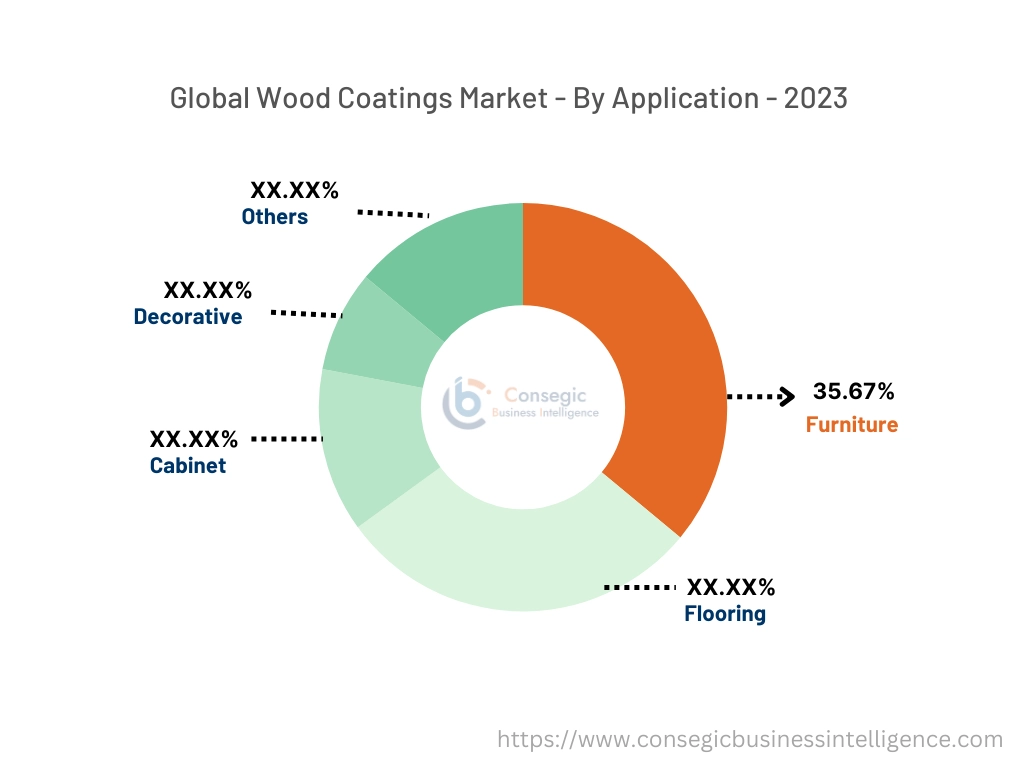
By application, the Marché des revêtements de bois is divided into furniture, flooring, cabinet, decorative, and others.
Trends in Application:
- As per Marché des revêtements de bois trends, water-based, acrylic wood coatings are being rapidly used for furniture.
- Wood coating application in flooring is emerging rapidly due to increasing consumer demand for durable and visually appealing floors as per market trends.
The furniture accounted for the largest market share of 35.67% in the year 2023.
- The wood coatings application in the furniture segment is driven by a rising preference for aesthetically appealing and durable wooden furniture.
- Wood coatings such as polyurethane, acrylic, and water-based options are used to enhance the appearance of furniture while providing protection against wear, scratches, and moisture.
- These coatings help to preserve the natural texture and color of wood, adding a glossy or matte finish that is highly sought after in both residential and commercial spaces.
- In 2024, Berger Paints launched its Innova wood coating products at the 19th National Furniture Fair. It includes Innova Putty, Innova Filler, and other wood coating products. These products offer a premium-looking smooth and durable finish that protects against water, heat, and household scratches, improving the wood coatings used in furniture.
- Thus, wood coatings are widely used in furniture, driven by rising demand for aesthetically appealing and durable wooden furniture.
The flooring in the application is expected to grow at the fastest CAGR over the forecast period.
- The wood coating application in flooring is emerging rapidly due to increasing consumer preferences for durable and aesthetic nature in both residential and commercial spaces.
- Factors like rising disposable incomes, rapid urbanization, and aesthetic preference for hardwood flooring have increased the need for wood coatings.
- Additionally, advancement in protective coatings, including waterborne and ultraviolet-cured wood coatings has accelerated its use for flooring.
- In 2024, PALLMANN® announced the expansion of the PALL-X 2-KOLORIT range with three new stain colors: KONA, SPECIAL WALNUT, and WEATHERED OAK. PALL-X 2-KOLORIT is a range of wood coatings used for flooring and this expansion will lead to increased use of wood coatings in flooring.
- Thus, the use of wood coating in flooring is increasing rapidly due to consumer preferences for aesthetically designed flooring in the latest trends.
Regional Analysis:
The regional segment includes North America, Europe, Asia Pacific, the Middle East and Africa, and Latin America.
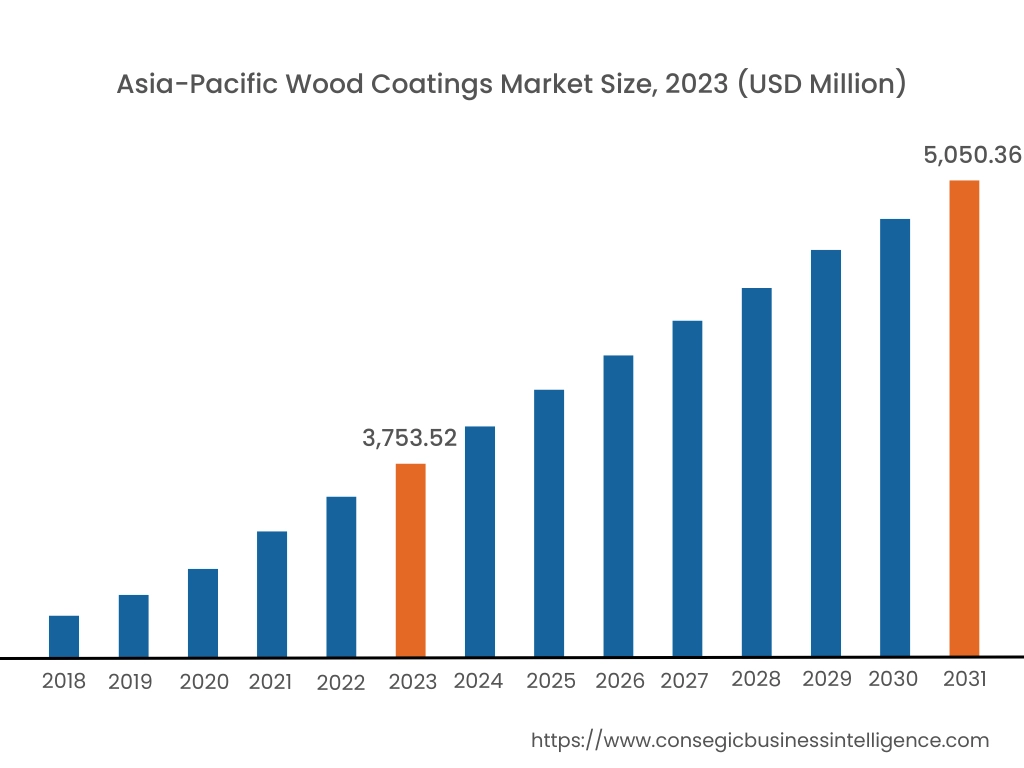
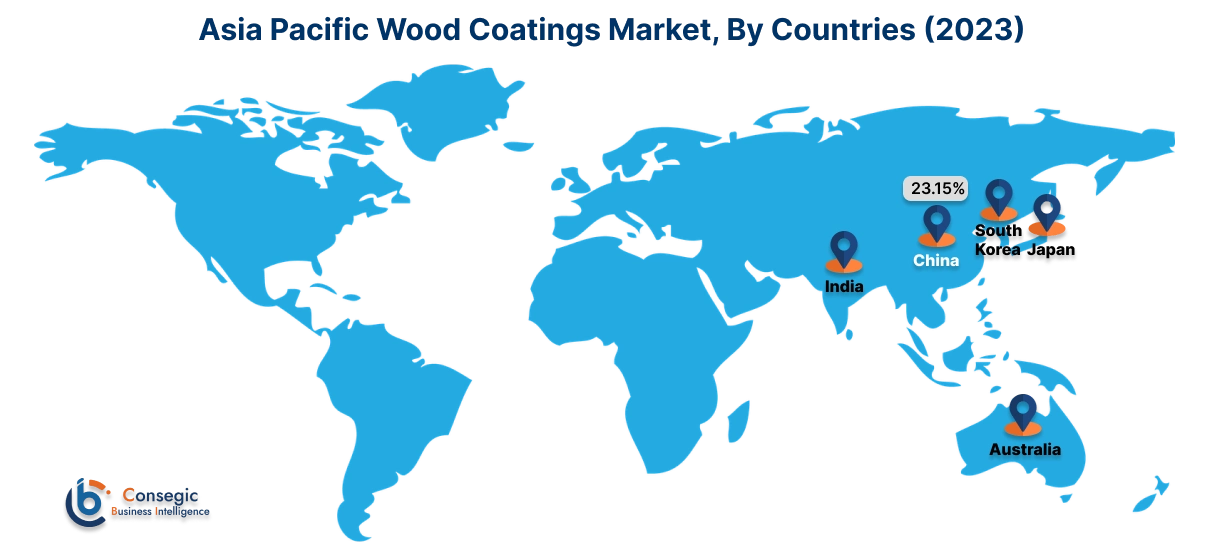
In 2023, Asia-Pacific accounted for the highest market share at 36.11% and was valued at USD 3,753.52 Million, and is expected to reach USD 5,050.36 Million in 2031. In Asia-Pacific, China accounted for the highest market share of 23.15% during the base year of 2023. As per the Marché des revêtements de bois analysis, Asia-Pacific is dominating driven by rising disposable incomes and lifestyle changes, increasing the need for high-quality wooden furniture. Governments in countries like China and India reinforcing strict regulations on VOC emissions, driving the adoption of water-based and low-VOC coatings. Asia-Pacific countries are major consumers as well as exporters of furniture and wood products to North America and Europe. Additionally, the construction sector is rapidly growing in countries like India and China, further boosting the market.
- In 2023, Sirca Paints India Limited entered into an exclusive Manufacturing license Agreement with Sirca S.P.A (Italy) to manufacture 10 different Polyurethane wood coating products in India. This strategic move will allow the company to cut down the import of wood coatings from Italy and strengthen the Marché des revêtements de bois in India.
Thus, Asia-Pacific is expected to dominate the Marché des revêtements de bois due to growing urbanization and preferences for aesthetic wooden products as per market analysis.
North America is expected to witness the fastest CAGR over the forecast period of 4.3% during 2024-2031.
As per market analysis, the Marché des revêtements de bois in North America is growing rapidly due to strong preferences for premium-quality wooden furniture, cabinetry, and flooring in residential and commercial spaces. The United States and Canada are the dominant contributors, with robust construction and remodeling activities boosting the market proliferation. The region’s focus on sustainability and environmental compliance has led to a shift toward water-based and low-VOC coatings, aligning with stringent regulations led by the Environmental Protection Agency (EPA). Also leading manufacturers like AkzoNobel, and Sherwin-Williams are investing in research and development in wood coatings, further propelling the Marché des revêtements de bois expansion.
- In 2023, AkzoNobel opened a new North American research and development center in North Carolina. It functions as a product development facility and customer support center for the wood coatings business, fueling the Marché des revêtements de bois growth.
Thus, the Marché des revêtements de bois in North America is expanding, due to strong demand for premium-quality wooden furniture and technological advancements according to the Marché des revêtements de bois analysis.
As per market analysis, the European market for wood coatings is a mature yet steadily growing sector. It is driven by stringent regulations and an increasing need for sustainable and high-performance coatings. Countries like Germany, Italy, France, and the UK are key players, with strong furniture manufacturing and construction industries. The region focuses on eco-friendly and low-VOC coatings, in compliance with strict European Union regulations. Growth in the renovation and remodeling sector, coupled with rising consumer preference for aesthetically appealing wooden furniture and flooring is driving the wood coatings industry in this region. Innovations in coating technologies such as advanced polyurethane and acrylic coatings are also gaining traction. The region remains a significant market due to its need for premium, sustainable wood coatings in both residential and commercial applications.
The Marché des revêtements de bois share in the Middle East and Africa is witnessing moderate growth. It is particularly driven by increasing construction projects and a growing need for premium furniture and interior decor. The rapid urbanization and infrastructural developments in countries like the UAE, Saudi Arabia, and South Africa are key contributors to market rise. The hospitality sector, particularly in Gulf Council Countries is fueling the wood coatings industry due to the need for high-quality, decorative wooden finishes in luxury hotels and resorts. Additionally, the rise in residential house projects and government investments in infrastructure, as growing preferences for water-based wood coatings are boosting the Marché des revêtements de bois demand as per the analysis.
Latin America’s Marché des revêtements de bois share is experiencing steady proliferation. It is driven by increasing construction activities and rising need for furniture and decorative wooden products. Key countries like Brazil, Mexico, and Argentina are leading this market due to rapid urbanization and expanding residential and commercial sectors. The region’s growing furniture sector, particularly in Brazil and Mexico, is spurring the need for high-performance wood coatings. Additionally, the adoption of eco-friendly coatings, such as water-based and low-VOC products, is gaining momentum due to environmental concerns and regulatory changes. The rise in middle-class income and evolving consumer preferences position this region as a promising market for wood coatings as per the analysis.
Top Key Players & Market Share Insights:
The Global Marché des revêtements de bois includes several key players known for their significant contributions to wood coatings.
- Akzo Nobel N.V. (Netherlands)
- Asian Paints (India)
- Kansai Paint Co., Ltd (Japan)
- PPG Industries, Inc. (United States)
- Sherwin-Williams (United States)
- Axalta Coating Systems (United States)
- CERAMIC INDUSTRIAL COATINGS (United States)
- Gemini (United States)
- Hempel A/S (Denmark)
- Jotun (Norway)
Recent Industry Developments :
Mergers and Acquisitions:
- In 2023, Canlak Coatings Inc. acquired Ceramic Industrial Coatings. The acquisition of Ceramic Industrial Coatings aligns with the Canlak Coatings' vision to create specialized wood coating systems. It will accelerate its growth in the North American Marché des revêtements de bois.
Business Expansions:
- In 2024, Kamdhenu Ventures Ltd set to expand its Premium product line with the introduction of a new wood coatings range, adhering to international quality standards. It has ramped up production capacity utilization from 36,000 kilolitres per year to 49,000 kilolitres per year, driving the wood coating market in India.
Launches:
- In 2021, Axalta launched a new Wood Coatings Pro mobile app for iOS and Android devices. The new app provides simple and quick access to product information, the latest industry color trends, and best practices for the Marché des revêtements de bois.
Marché des revêtements de bois Report Insights :
| Report Attributes | Report Details |
| Study Timeline | 2018-2031 |
| Market Size in 2031 | USD 13,935.86 Million |
| CAGR (2024-2031) | 3.8% |
| By Resin Type |
|
| By Application |
|
| By Region |
|
| Key Players |
|
| North America | U.S. Canada Mexico |
| Europe | U.K. Germany France Spain Italy Russia Benelux Rest of Europe |
| APAC | China South Korea Japan India Australia ASEAN Rest of Asia-Pacific |
| Middle East and Africa | GCC Turkey South Africa Rest of MEA |
| LATAM | Brazil Argentina Chile Rest of LATAM |
| Report Coverage |
|
Key Questions Answered in the Report
Quelle est la taille du marché des revêtements pour bois ? −
La taille du marché mondial des revêtements pour bois devrait atteindre plus de 13 935,86 millions USD d'ici 2031, contre une valeur de 10 394,67 millions USD en 2023, avec un TCAC de 3,8 % de 2024 à 2031.
Quels détails de segmentation spécifiques sont couverts dans le rapport sur le marché des revêtements en bois ? +
Le rapport sur le marché des revêtements en bois comprend des détails de segmentation spécifiques pour le type de résine et l'application.
Quelle est la région qui connaît la croissance la plus rapide sur le marché des revêtements pour bois ? +
L’Amérique du Nord est la région qui connaît la croissance la plus rapide sur le marché des revêtements pour bois.
Quels sont les principaux acteurs du marché des revêtements pour bois ? +
Les principaux acteurs du marché des revêtements pour bois sont Akzo Nobel N.V. (Pays-Bas), Asian Paints (Inde), Axalta Coating Systems (États-Unis), CERAMIC INDUSTRIAL COATINGS (États-Unis), Gemini (États-Unis), Hempel A/S (Danemark), Jotun (Norvège), Kansai Paint Co., Ltd (Japon), PPG Industries, Inc. (États-Unis), Sherwin-Williams (États-Unis)