Jump to Content
Resin Market Size & Industry Share - Growth Trends & Forecasts (2026 - 2034)
Resin Market Size:
The Resin market size was valued at 649.95 (US$B) in 2025 and is projected to grow from 682.45 (US$B) in 2026 to 1,008.29 (US$B) by 2034, at a CAGR of 5.0% from 2026 to 2034, according to a recent report from Consegic Business Intelligence.
Resin Market Scope & Overview:
Resins are a broad class of viscous, organic substances, either naturally occurring or synthetically derived, that solidify into permanent forms and are primarily used as the fundamental base material in plastics, coatings, adhesives, and composites. Benefits, including superior adhesion & bonding strength, excellent environmental & chemical resistance, design flexibility, and cost-effectiveness, are driving the market. Further, key trends driving the demand include accelerating global focus on sustainability and a circular economy, increasing use of high-performance polymers for lightweighting in the automotive/aerospace sectors, and adoption in the expanding electronics and renewable energy industries for crucial component protection.
How is AI Impacting the Resin Market?
Artificial Intelligence is transforming the market by fundamentally changing how new materials are discovered and manufactured. AI, particularly machine learning, significantly accelerates material R&D by predicting properties, performance, and compatibility from vast datasets, drastically reducing costly trial-and-error formulation time for specialized products like bio-based and high-temperature polymers. Furthermore, AI is integrated into production to enable smart manufacturing, optimizing reactor conditions, performing real-time quality control with vision systems, and predicting equipment failure to ensure batch-to-batch consistency and dramatically cut energy consumption and material waste. This shift facilitates faster time-to-market for innovative, customized, and sustainable solutions.

Resin Market Dynamics - (DRO) :
Key Drivers:
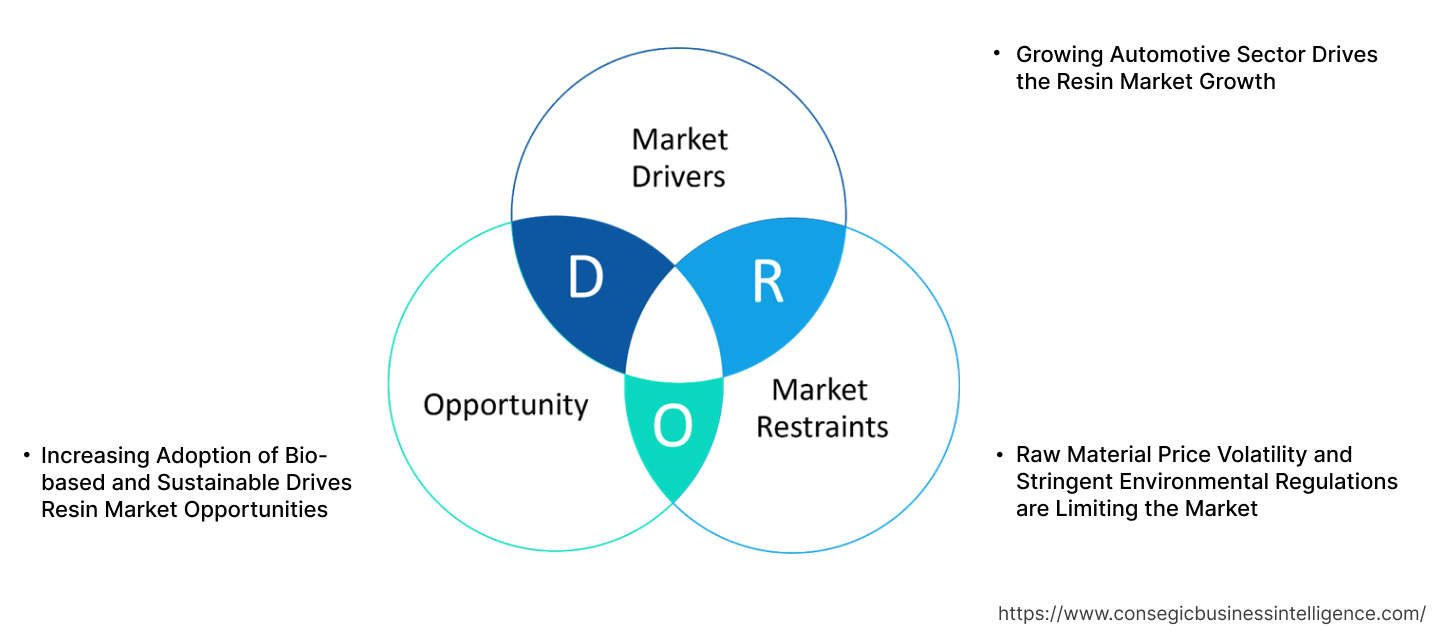
Growing Automotive Sector Drives the Resin Market Growth
The automotive sector is a primary driver of resin market growth, fundamentally because of the global shift towards lightweighting to enhance fuel efficiency and extend the crucial driving range of Electric Vehicles (EVs). Strict emissions and safety standards compel manufacturers to replace heavy metal components with advanced, high-performance thermoplastics and thermoset composites like carbon fiber reinforced epoxy. These materials are indispensable for producing high-strength, durable, and crashworthy parts, including body panels, interior systems, and, most critically, protective, electrically insulating battery enclosures and thermal management systems, thereby accelerating demand for specialized polymer formulations.
- For instance, according to the International Energy Agency (IEA), European electric car sales have maintained a strong upward trajectory, increasing from 2.3 million units in 2021 to an estimated 3.4 million units in 2024, representing a 6.3% increase over the 3.2 million sold in 2023.
Thus, the increasing need for specialized, high-performance materials required for Electric Vehicle (EV) components, battery systems, and lightweight structural composites contributes significantly to the resin market size.
Key Restraints :
Raw Material Price Volatility and Stringent Environmental Regulations are Limiting the Market
Raw material price volatility severely limits the market by making production costs unpredictable, as most conventional materials are derived from petrochemical feedstocks like crude oil and natural gas, impacting manufacturer margins and final product pricing. Simultaneously, increasingly stringent environmental regulations, particularly those targeting plastic waste, single-use plastics, and VOC emissions, restrain market expansion by imposing higher compliance costs, forcing substantial investment in complex reformulation, and accelerating the costly shift toward recycled, bio-based, and difficult-to-process waterborne resin systems.
Future Opportunities :
Increasing Adoption of Bio-based and Sustainable Drives Resin Market Opportunities
The increasing adoption of bio-based and sustainable materials presents a major market opportunity driven by global efforts to reduce carbon footprints and plastic pollution. This trend is fueled by stringent government regulations, strong corporate sustainability commitments (especially in packaging and automotive), and consumer preference for eco-friendly products. Consequently, manufacturers of these materials are heavily investing in sourcing renewable feedstocks like corn starch and sugarcane and developing innovative formulations, such as bio-based epoxies and polyurethanes, that offer performance comparable to petroleum-based polymers while supporting a circular economy model.
- For instance, in 2025, Huntsman introduced new bio-based I-BOND resins for composite wood products. These two new products, I-BOND PB BIO 1025 resin and I-BOND OSB BIO 1025 resin, incorporate up to 25% bio-based content.
Thus, rising investment in the research and commercialization of bio-based and advanced recycled material formulations drives the resin market opportunities.
Resin Market Segmental Analysis :
By Type:
Based on the type, the market is segmented into thermoplastic resins and thermosetting resins.
Trends in the Type:
- The rise of additive manufacturing for prototyping and end-use parts is fueling specialized demand for high-quality ABS, Nylon, and PEEK polymers, driving the resin market trends.
- Thermosets, combined with carbon or glass fibers, are being increasingly used in advanced structural components for vehicles, which in turn drives the resin market size.
Thermoplastic Resins accounted for the largest revenue share of 35.49% in the year 2024.
- There is a growing trend of global regulatory and consumer-driven focus on increasing the use of recycled and bio-based thermoplastics, driving the resin market share.
- Further, the shift to Electric Vehicles (EVs) is accelerating the replacement of metal components with high-performance engineering thermoplastics, which in turn drives the resin market expansion.
- Furthermore, innovation in the massive packaging industry, focusing on mono-material structures, drives the resin market trends.
- Thus, as per the resin market analysis,recyclability, advanced packaging solutions, and lightweighting in automotive are driving the market growth.
Thermosetting Resins is anticipated to register the fastest CAGR during the forecast period.
- The proliferation of complex electronics (5G, automotive sensors, power components) is fueling demand for thermosets like Epoxy and Phenolic polymers for encapsulation, potting, and molding compounds, which in turn drives the resin market share.
- Further, there is an emerging trend to develop bio-based alternatives for thermosets, primarily using natural oils or derivatives, driving the resin market demand.
- Therefore, based on the analysis, the aforementioned trends are anticipated to boost the market during the forecast period.
By Application:
Based on the Application, the market is segmented into paints and coatings, adhesives and sealants, composites, encapsulation materials, and others.
Trends in the Application:
- Manufacturers are actively researching and commercializing materials that are derived from renewable sources (like vegetable oils or biomass) to reduce the carbon footprint of the coating products and meet sustainability mandates, driving the resin market demand.
- The rapid growth of e-commerce requires fast-curing, high-performance hot-melt and water-based adhesives for carton closing, labeling, and flexible pouch lamination, in turn driving the resin market.
Paints & Coatings accounted for the largest revenue share of 39.12% in the year 2024 and is anticipated to register a significant CAGR during the forecast period.
- Stringent regulations on Volatile Organic Compound (VOC) emissions globally, drive the replacement of traditional solvent-based materials with water-based acrylics and polyurethane dispersions.
- Further, there is an increased demand for powder coatings in industrial and automotive applications, as they don’t release VOC, which in turn drives the resin industry.
- Furthermore, there is a rising focus on coatings that offer more than just color and protection, such as self-healing coatings and anti-microbial coatings in turn is driving the market.
- Thus, as per resin market analysis, the growth of smart and functional coatings, the adoption of powder coatings, and others are driving the market.
By End User Industry:
Based on the end use, the market is segmented into packaging, automotive & transportation, building & construction, electrical & electronics, consumer goods, agriculture, and others.
Trends in the End Use:
- The continued growth of online retail requires specialized, durable, and sometimes temperature-controlled packaging materials, which in turn drives the resin market expansion.
- Need for premium interior finishes in an automobile requires specialty polymers for soft-touch surfaces, scratch-resistant coatings, and high-performance adhesives, which subsequently propel the resin market.
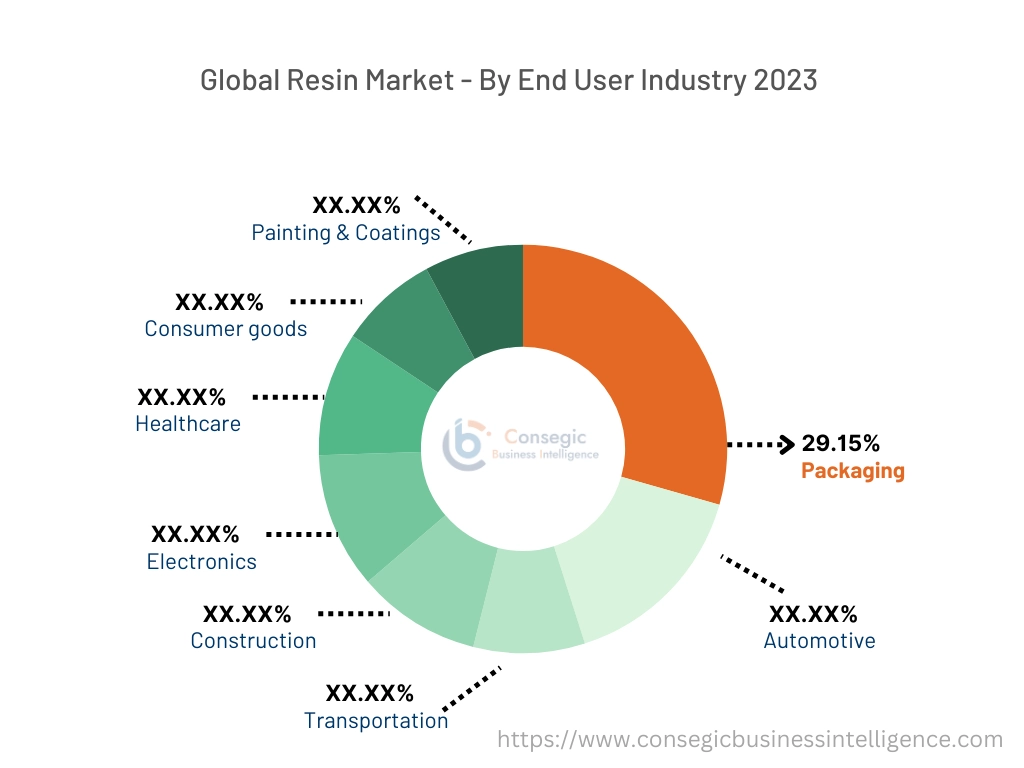
Packaging accounted for the largest revenue share in the year 2024 and is anticipated to register a significant CAGR during the forecast period.
- Regulatory and consumer pressure on sustainability is the biggest factor, leading to massive investment in mechanical and chemical recycling infrastructure, which in turn drives the market.
- Further, there is a strong movement to replace multi-layer, multi-polymer films with films made entirely of a single polymer type, most commonly Polyethylene (PE).
- The market is seeing increased commercialization of bio-based materials and biodegradable polymers, which in turn drives the market.
- Thus, based on analysis, the adoption of biodegradable polymers, the shift to mono-material solutions, and circular economy mandates are driving the market.
Regional Analysis:
The regions covered are North America, Europe, Asia Pacific, Middle East and Africa, and Latin America.
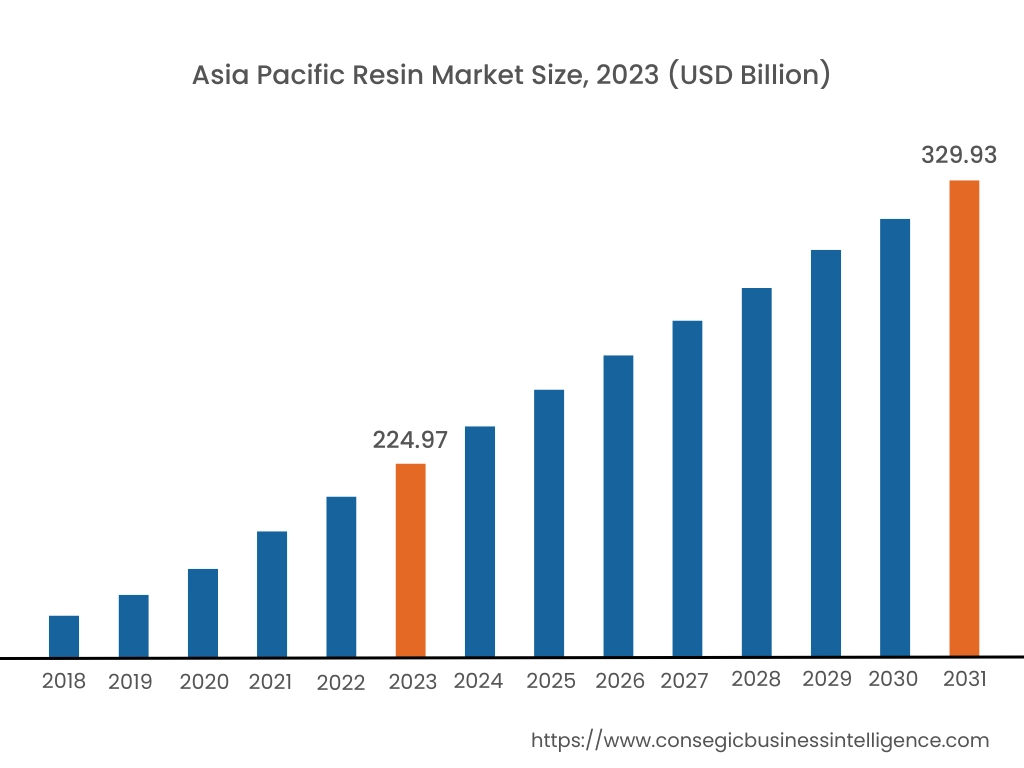
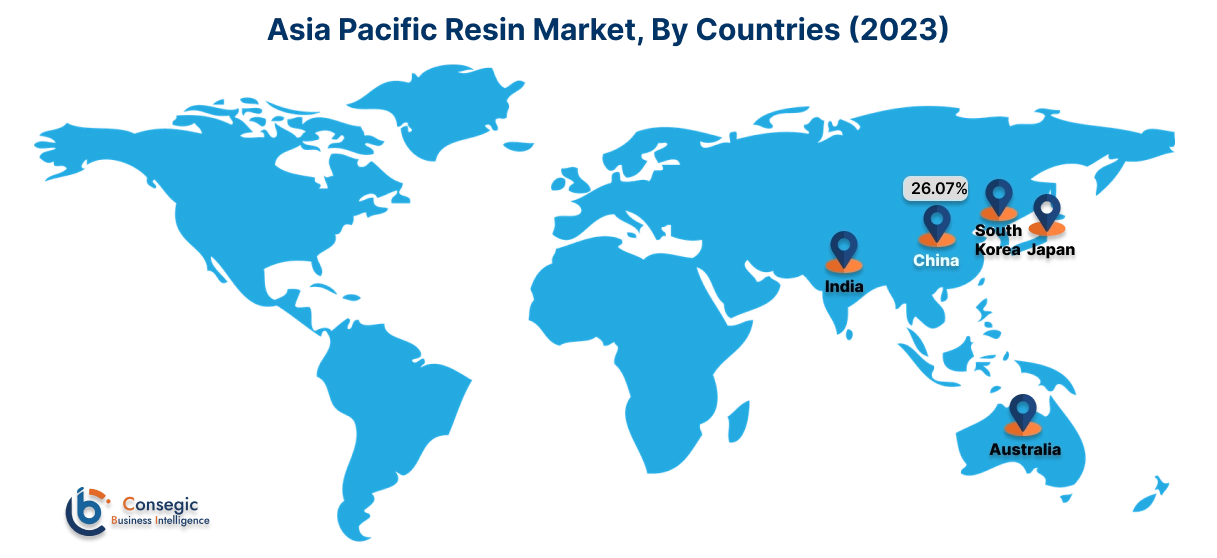
Asia Pacific region was valued at USD 244.40 Billion in 2024. Moreover, it is projected to grow by USD 255.53 Billion in 2025 and reach over USD 382.92 Billion by 2032. Out of this, China accounted for the maximum revenue share of 32.44%. The market growth is mainly driven by rapid industrialization, sustained urbanization, and a continuous rise across major end-use sectors like packaging, construction, and automotive.
- For instance, in December 2022, BASF SE introduced a new automotive coating in China. This product utilizes renewable materials via a biomass balance approach and is projected to achieve a 20% reduction in carbon footprints.
North America is estimated to reach over USD 221.50 Billion by 2032 from a value of USD 142.63 Billion in 2024 and is projected to grow by USD 149.02 Billion in 2025. Based on analysis, the North American market is primarily driven by the need for lightweighting solutions in the automotive sector, robust consumption in the packaging and construction industries, and the accelerating shift towards bio-based and recycled sustainable materials.
- For instance, in February 2022, DuPont announced a definitive agreement to divest the majority of its Mobility & Materials segment to Celanese Corporation. This sale includes the engineering polymers business line and specific product lines within the performance resins and advanced solutions businesses.
The regional analysis depicts that stringent environmental regulations and circular economy initiatives in Europe are driving the market. Additionally, the factors driving the market in the Middle East and African region are massive investments in construction and infrastructure projects, governmental efforts toward industrial diversification, and a growing e-commerce sector. Further, increasing urbanization and a rise in construction and infrastructure development are paving the way for the progress of market in Latin America region.
Top Key Players & Market Share Insights:
The global resin market is highly competitive with major players providing solutions to the national and international markets. Key players are adopting several strategies in research and development (R&D), product innovation, and end-user launches to hold a strong position in the resin industry. Key players in the global resin market include-
- BASF SEGermany)
- DuPont(U.S.)
- SABIC (Saudi Arabia)
- INEOS Holdings Ltd. (U.K.)
- LyondellBasell (Netherlands)
- Mitsui Chemicals (Japan)
- Arkema (France)
- Sumitomo Chemical Co., Ltd. (Japan)
- Nova Chemicals (Canada)
- Toray Group (Japan)
Recent Industry Developments :
Partnership
In March 2025, BASF and Sika partnered to launch Baxxodur EC 151, a new amine building block for curing epoxy resins, targeting sustainable solutions in the construction industry. This hardener is specifically useful for flooring applications as it facilitates high-gloss, durable, and color-stable coatings.
Product Launch
In March 2025, Westlake Corporation announced the launch of EpoVIVE, a new portfolio of epoxy products with sustainable characteristics. The EpoVIVE portfolio, which includes epoxy phenolic resins and curing agents, is designed to support customer sustainability initiatives and represents a major commitment to driving sustainable innovation.
Resin Market Report Insights :
| Report Attributes | Report Details |
| Study Timeline | 2021-2034 |
| Market Size in 2034 | USD 1,008.29 Billion |
| CAGR (2026-2034) | 5% |
| Base Year | 2025 |
| By Type |
|
| By Application |
|
| By End Use |
|
| By Region |
|
| Key Players |
|
| North America | U.S. Canada Mexico |
| Europe | U.K. Germany France Spain Italy Russia Benelux Rest of Europe |
| APAC | China South Korea Japan India Australia ASEAN Rest of Asia-Pacific |
| Middle East and Africa | GCC Turkey South Africa Rest of MEA |
| LATAM | Brazil Argentina Chile Rest of LATAM |
| Report Coverage |
|
Key Questions Answered in the Report
How big is the resin market? −
The resin market is estimated to reach over USD 914.55 Billion by 2032 from a value of USD 590.95 Billion in 2024 and is projected to grow by USD 617.22 Billion in 2025, growing at a CAGR of 5.0% from 2025 to 2032.
What specific segmentation details are covered in the resin report? +
The resin report includes specific segmentation details for type, application, end use, and regions.
Which is the fastest segment anticipated to impact the market growth? +
In the resin market, thermosetting resins is the fastest-growing segment during the forecast period.
Who are the major players in the resin market? +
The key participants in the resin market are BASF SE (Germany), DuPont (U.S.), SABIC (Saudi Arabia), INEOS Holdings Ltd. (U.K.), LyondellBasell (Netherlands), Mitsui Chemicals (Japan), Arkema (France), Sumitomo Chemical Co., Ltd. (Japan), Nova Chemicals (Canada), Toray Group (Japan), and others.
What are the key trends in the resin market? +
The resin market is being shaped by several key trends including growing need from end-use industries like construction, automotive, and packaging, a strong focus on sustainability leading to increased adoption of bio-based and recycled resins, and technological advancements in resin production and application.
Overview
Reputation & Certifications


Our Services
- Market Intelligence & Forecasting
- Custom Research Solutions
- Market Entry Strategy
- Competitive Intelligence
- Customer Insights
- Industry Innovation Analysis
- Investment Advisory