Accueil > > Matériaux et Produits Chimiques > > lauryl éther sulfate de sodium Marché Rapport sur la taille, la part, les tendances et l'analyse régionale d'ici 2032
Marché du sulfate d'éther de sodium - taille, part, tendances de l'industrie et prévisions (2025-2032)
ID : CBI_3118 | Mis à jour le : | Auteur : Pavan C | Catégorie : Matériaux et Produits Chimiques
Sodium Lauryl Ether Sulfate Market Size:
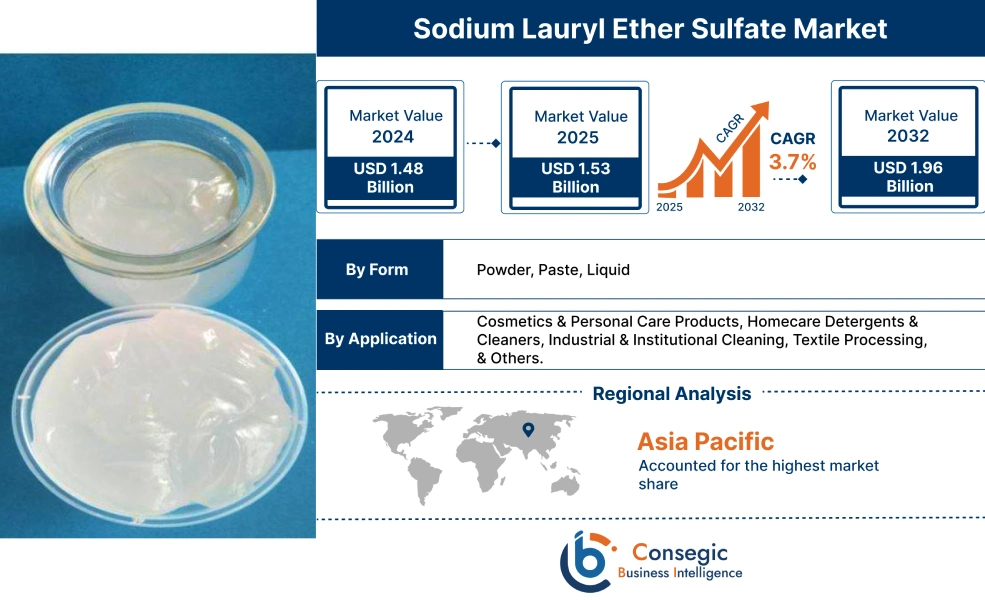
The Sodium Lauryl Ether Sulfate Market size is growing with a CAGR of 3.7% during the forecast period (2025-2032), and the market is projected to be valued at USD 1.96 Billion by 2032 from USD 1.48 Billion in 2024. Additionally, the market value for 2025 is attributed to USD 1.53 Billion.
Sodium Lauryl Ether Sulfate Market Scope & Overview:
Sodium Lauryl Ether Sulfate (SLES), also known as sodium laureth sulfate, anionic lipid which is a naturally occurring detergent molecule presenting amphipathic properties. The compound is distinguished by its exceptional foaming, emulsifying, and cleaning properties. Derived from lauryl alcohol through an ethoxylation process, sodium laureth sulfate effectively lowers the surface tension of water. This in turn allows for efficient removal of dirt and oils. Considering these properties, the compound serves as a key anionic surfactant in personal care and home care products such as shampoos, body washes, and dishwashing liquids among others. Additionally, its use is also prevalent in industrial & institutional cleaning solutions and textile processing agents.
Sodium Lauryl Ether Sulfate Market Dynamics - (DRO) :
Key Drivers:
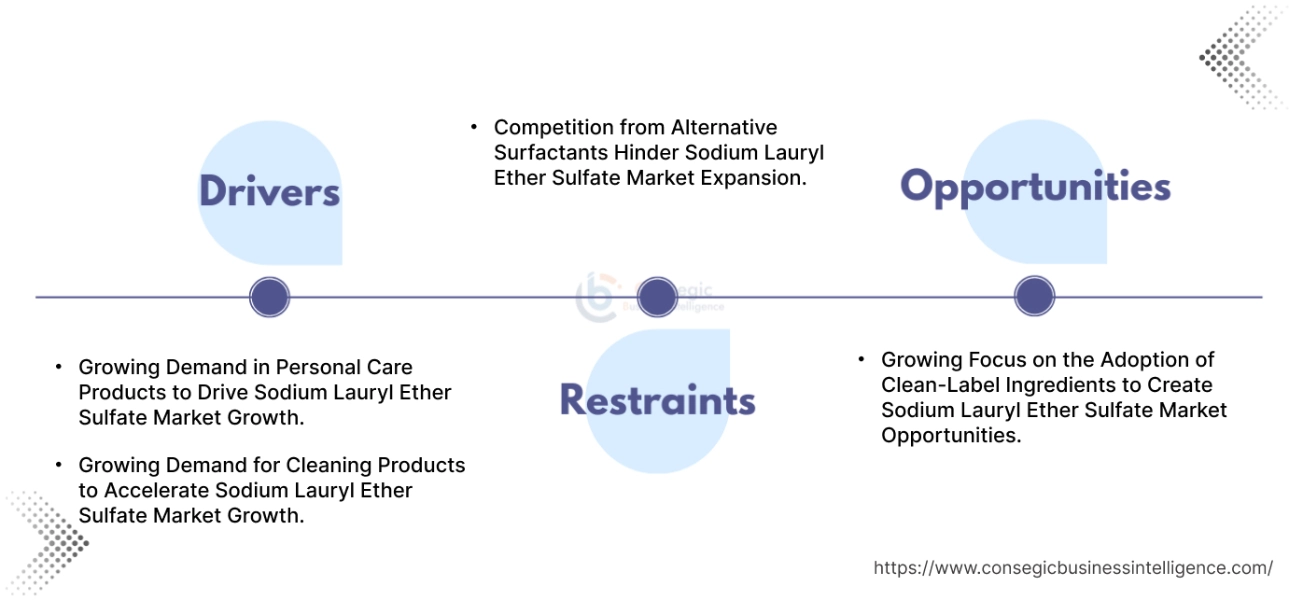
Growing Demand in Personal Care Products to Drive Sodium Lauryl Ether Sulfate Market Growth.
Sodium laureth sulfate is distinguished by excellent cleaning, foaming, and lathering properties. These characteristics make it key ingredient in wide range of personal care products. It offers effective cleaning action to shampoos, body washes, liquid hand soaps, and facial cleansers among others. Growing consumer awareness of personal hygiene fuel the adoption of this primary foaming and cleansing agent. As global demand for higher quality personal care products accelerates, the industry's requirement for the compound surges, thereby impacting market demand.
- For instance, according to U.S. Bureau of Labor Statistics, in U.S. the consumer spending on personal care products increased by 9.7% in 2023.
Thus, due to the above-mentioned factors, the market for the compound in personal care products is witnessing significant growth.
Growing Demand for Cleaning Products to Accelerate Sodium Lauryl Ether Sulfate Market Growth.
SLES serves as key surfactant in a wide range of household cleaning products. The rise in demand for several cleaning products, particularly in the household sector, is one prominent factor driving the market revenue. The use of cleaning products is driven by the awareness for hygiene and sanitation, germs and bacteria, and need for cleaner living spaces.
- For instance, according to the analysis published by BUYER POINT, it is stated that consumer spending a on home care products across the Italy increased by 3.7% in 2024 from 2023.
This growing emphasis on cleanliness apart from households is having a positive impact on the commercial and industrial areas as well. Thus, rise in necessity of cleaning products is consequently impacting positively on the sodium lauryl ether sulfate market demand.
Key Restraints:
Competition from Alternative Surfactants Hinder Sodium Lauryl Ether Sulfate Market Expansion.
The market faces a significant constraint on its growth due to the widespread presence and established utilization of substitute surfactants. Sodium laureth sulfate faces stiff competition from a range of other cleansing agents capable of fulfilling similar foaming and detergency functions in personal care and home care products. Sodium Lauryl Sulfate (SLS) offers similar foaming properties and is often a more cost-effective alternative in certain formulations. Other prominent substitutes include sodium cocoyl isethionate, coco-glucoside and decyl, sodium methyl cocoyl taurate, and sodium cocoyl glycinate among others. This abundance of readily available, often competitively priced, and increasingly preferred substitutes creates competitive landscape for sodium laureth sulfate. It continuously encourages formulators and product developers to adopt alternatives, thereby limiting the sodium lauryl ether sulfate market expansion.
Future Opportunities :
Growing Focus on the Adoption of Clean-Label Ingredients to Create Sodium Lauryl Ether Sulfate Market Opportunities.
The growing focus on adopting clean-label ingredients presents a growth potential for market, primarily by creating requirement for more purified and sustainably sourced versions of the surfactant. As consumers increasingly scrutinize product labels for ingredients perceived as natural, safe, or chemical-free, sodium laureth sulfate manufacturers are offering ultra-low 1,4-dioxane grades aligning with environmental safety. Furthermore, the push for transparency also favors SLES derived from bio-based feedstocks such as coconut or palm oils, aligning with consumer preference for renewable and plant-based origins.
- For instance, according to a report from The NPD Group, 68% of consumers are now actively seeking skincare products formulated with clean label ingredients.
Henceforth, the biodegradable nature of the compound is creating lucrative sodium lauryl ether sulfate market opportunities over the forecast period.
Sodium Lauryl Ether Sulfate Market Segmental Analysis :
By Form:
Based on form, the market is categorized into powder, paste, and liquid.
Trends in the Form:
- Growth in requirement for ultra-low 1,4-dioxane liquid SLES to meet evolving clean beauty and safety standards is a trend positively impacting the market.
- The demand for liquid sodium lauryl ether sulfate in vast and expanding global market for liquid shampoos, body washes, and dishwashing detergents is a key trend.
The liquid segment accounted for the largest sodium lauryl ether sulfate market share in 2024 and is expected to grow at the fastest GAGR over the forecast period.
- The liquid form of sodium laureth sulfate is supplied as an aqueous solution, typically with active matter concentrations ranging from 25-70%.
- The preference for liquid form dominates due to its ease of handling and blending large-scale industrial and consumer product manufacturing.
- In addition to this, liquid form of compound effectively integrates into liquid product formulations such as shampoos, body washes, and detergents among others.
- Moreover, the growing adoption of liquid household cleaning products necessitates a correspondingly large and consistent consumption of liquid form of sodium laureth sulfate.
- For instance, in December 2023, Godrej Consumer Products launched Godrej Fab, a new liquid detergent, in the South Indian markets. The liquid formulations of Godrej Detergents are incorporated with sodium laureth sulfate.
- Consequently, as per the analysis, owing to the high adoption in liquid industrial and consumer products, the liquid form dominates the sodium lauryl ether sulfate market demand.
By Application:
Based on the application, the market is categorized into cosmetics & personal care products, homecare detergents & cleaners, industrial & institutional cleaning, textile processing, and others.
Trends in the Application:
- A shift towards sulfate-free and clean beauty formulations is a trend positively impacting the market.
- Increased demand for highly concentrated and sustainable homecare products such as laundry pods and refillable solutions is a key sodium lauryl ether sulfate market trend.
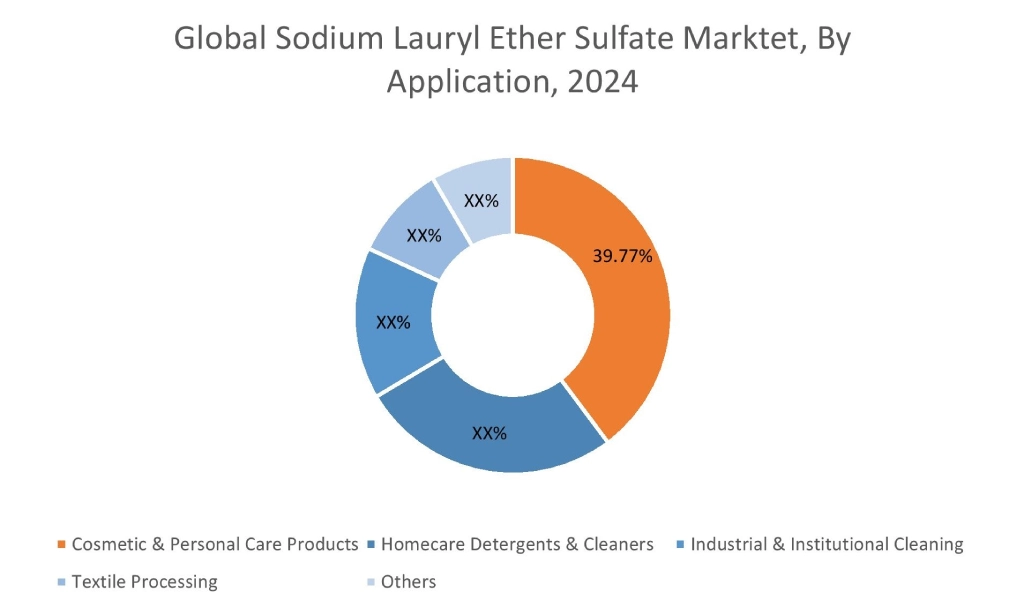
The cosmetics & personal care products segment accounted for the sodium lauryl ether sulfate market share of 39.77% in 2024.
- SLES serves as a primary surfactant in vast array of products used for personal hygiene, cleansing, and beauty. This compound provides excellent foaming, lathering, and cleansing properties.
- It effectively removes dirt, oil, and impurities while creating the rich foam texture that consumers associate with cleanliness.
- Some of the key products utilizing this compound are shampoos, body washes, shower gels, liquid hand soaps, facial cleansers, bubble baths, toothpastes, and baby care products among others.
- The growth in this segment is influenced by increasing global hygiene awareness along with the growing consumer spending on cosmetics & personal care products.
- For instance, as per analysis published by the Government of Canada, average consumer spending on personal care products in 2023 saw a substantial increase of 30.1% compared to 2021.
- Thus, as per the sodium lauryl ether sulfate market analysis, the cosmetics & personal care products segment holds dominating share in sodium lauryl ether sulfate market trends.
The homecare detergents & cleaners segment is expected to grow at the fastest CAGR over the forecast period.
- The homecare detergents & cleaners segment encompasses a broad range of products essential for household cleaning and laundry.
- In this sector, sodium laureth sulfate functions as a crucial detergent and foaming agent distinguished its high efficacy in cutting through grease, lifting dirt, and generating stable foam attributes critical for effective cleaning.
- Key products leveraging this compound include manual dishwashing liquids, liquid laundry detergents, and various all-purpose, surface, bathroom, and toilet bowl cleaners.
- There's a global demand from consumers opting for liquid laundry detergents and dishwashing liquids over powder or bar forms, driven by perceived superior performance, ease of use, and less residue. This factor continues to support this segment's revenue in future year.
- Overall, aforementioned factors are expected to fuel segment trends in the forecast period.
Regional Analysis:
The regional segment includes North America, Europe, Asia Pacific, the Middle East and Africa, and Latin America.
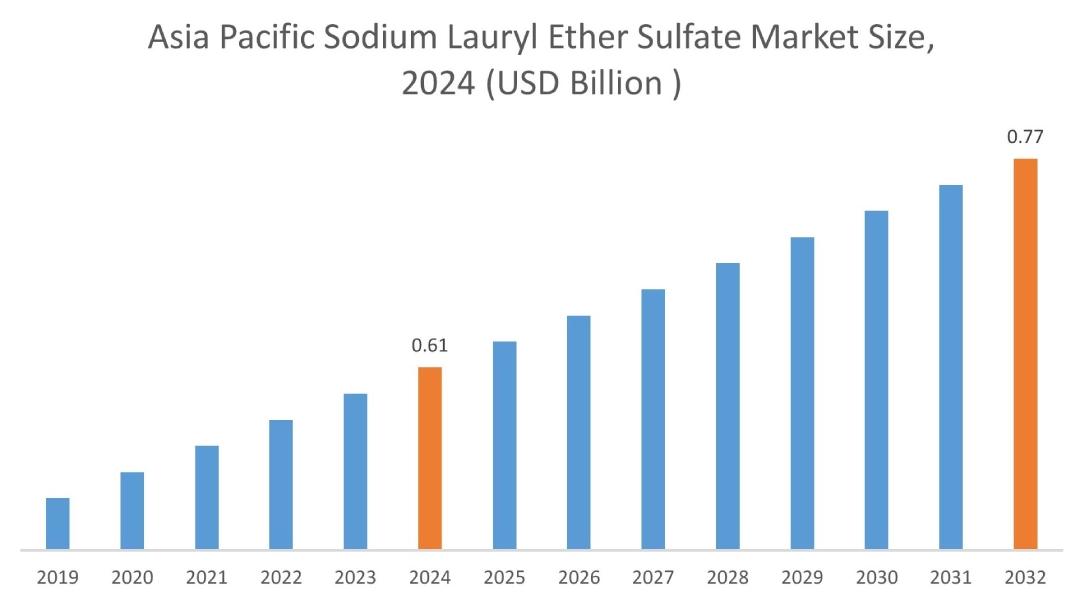
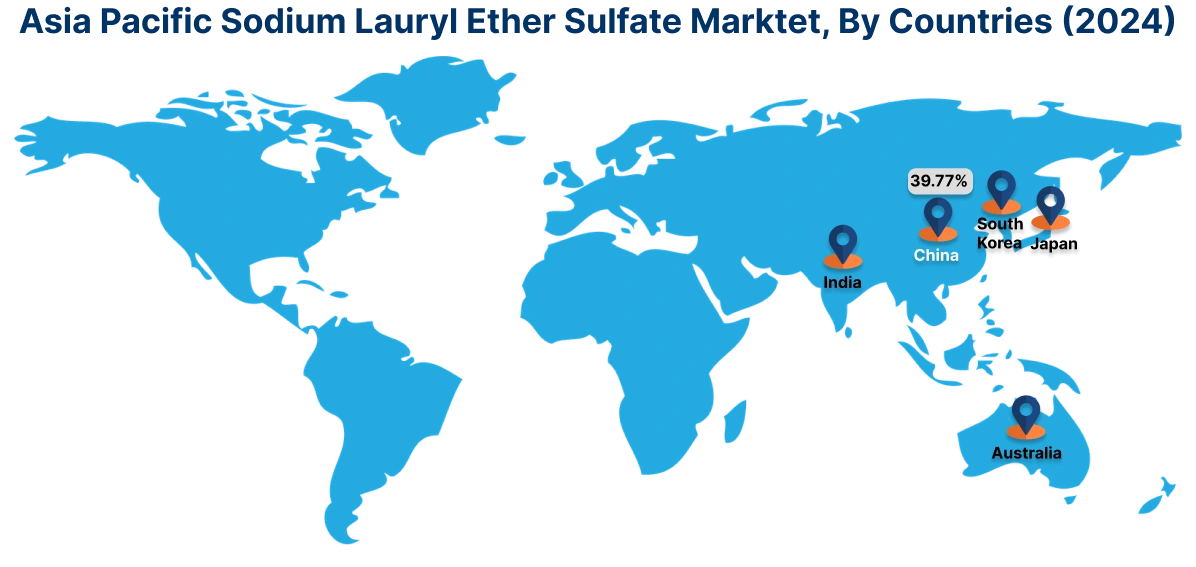
In 2024, Asia Pacific accounted for the highest market share at 41.34% and was valued at USD 0.61 Billion and is expected to reach USD 0.77 Billion in 2032. In Asia Pacific, China accounted for a market share of 39.77% during the base year of 2024. The rising need for cleaning products is the key factors that is leading to the upward market trajectory of sodium lauryl ether sulfate in Asia Pacific. This surge in requirement is fueled by a growing emphasis on hygiene and cleanliness. There is a greater need for effective cleaning solutions for households, commercial spaces, and public areas as populations in Asia Pacific continues to urbanize. The expansion of beauty and personal care industry in countries such as China, Japan, South Korea, and India due to the increasing consumer awareness of skincare and haircare is creating the high adoption of the compound in the product formulations. Moreover, hygiene and cleanliness awareness are creating the need for effective cleaning and sanitizing products.
- For instance, in November 2024, Hindustan Unilever Limited and the Ministry of Housing and Urban Affairs signed a Memorandum of Understanding to launch the Centre of Excellence to help improve public hygiene & sanitation in India.
Therefore, as per market analysis, the increased need for cleaning products results in requirement for chemicals, for the formulation of various cleaning products in the Asia Pacific region.
In Europe, the sodium lauryl ether sulfate industry is experiencing the fastest growth with a CAGR of 4.9% over the forecast period. Shift towards natural and sustainable products serves a primary part in upward market trajectory in Europe. European consumers are increasingly conscious of environmental and health impacts. European countries present some of the strictest regulations across the globe. Hence, stringent regulations and consumer requirement is promoting European companies to invest in research and development to produce this compound from renewable sources. These factors collectively present a positive impact on the European market.
The North American market for SLES is significantly defined by consistently high consumer spending on personal care and home care products. The region's need for high-quality shampoos, body washes, and liquid detergents all reliant on the compound is driving market revenue. In addition, significant trend is the strong consumer preference for sulfate-free and clean beauty formulations, alongside increasing regulatory scrutiny regarding 1,4-dioxane. This has compelled manufacturers to invest in advanced purification technologies to produce ultra-low 1,4-dioxane sodium laureth sulfate, creating significant market opportunities.
The consumers in Latin America are increasingly demanding more customized and personalized products, personal care product. This trend is influenced because of the rise in the requirement of products that cater to the specific needs and lifestyle changes. These changes have encouraged the manufacturers to produce and offer a wide range of formulations. These formulations consist of enhanced properties such as high viscosity, biodegradability, and foaming characteristics. Additionally, personalized services allow consumers to customize the properties of products such as shampoos, body washes among others. Thus, these factors are influencing the sodium lauryl ether sulfate market analysis.
The rapid urbanization and rise in the disposable income are primary factors that are influencing the rise in the use of home care products across the Middle East and Africa. Additionally, consumers in this region are increasingly adopting modern lifestyle. This focuses on the rise in emphasis on cleanliness and hygiene. This rise in awareness is influencing the use of effective cleaning solution. They include laundry detergent, surface cleaner and dishwashing solution among others. These solutions readily utilize sodium laureth sulfate because of enhanced cleaning and emulsifying properties.
Top Key Players and Market Share Insights:
The Global Sodium Lauryl Ether Sulfate Market is highly competitive with major players providing products to the national and international markets. Key players are adopting several strategies in research and development (R&D) and product innovation to hold a strong position in the global Sodium Lauryl Ether Sulfate market. Key players in the Sodium Lauryl Ether Sulfate industry include
- BASF SE (Germany)
- Evonik (Germany)
- Galaxy (India)
- Huntsman International LLC (U.S.)
- ALPHA CHEMICALS PVT. LTD. (India)
- Stepan Company (U.S.)
- Syensqo (Belgium)
- Croda International Plc (United Kingdom)
- Kao Corporation (Japan)
- Merck KGa (Germany)
Sodium Lauryl Ether Sulfate Market Report Insights :
| Report Attributes | Report Details |
| Study Timeline | 2019-2032 |
| Market Size in 2032 | USD 1.96 Billion |
| CAGR (2025-2032) | 3.7% |
| By Form |
|
| By Application |
|
| By Region |
|
| Key Players |
|
| North America | U.S. Canada Mexico |
| Europe | U.K. Germany France Spain Italy Russia Benelux Rest of Europe |
| APAC | China South Korea Japan India Australia ASEAN Rest of Asia-Pacific |
| Middle East and Africa | GCC Turkey South Africa Rest of MEA |
| LATAM | Brazil Argentina Chile Rest of LATAM |
| Report Coverage |
|
Key Questions Answered in the Report
Quelle est la taille du marché du lauryl éther sulfate de sodium ? −
En 2024, le marché du lauryl éther sulfate de sodium représente 1,48 milliard de dollars américains.
Quelle est la région qui connaît la croissance la plus rapide sur le marché du lauryl éther sulfate de sodium ? +
L'Europe est la région du marché du lauryl éther sulfate de sodium qui connaît la croissance la plus rapide.
Quels sont les détails de segmentation spécifiques abordés dans le marché du lauryl éther sulfate de sodium ? +
Le marché du lauryl éther sulfate de sodium est analysé en détail selon la segmentation par forme et application.
Qui sont les principaux acteurs du marché du lauryl éther sulfate de sodium ? +
BASF SE (Allemagne), Stepan Company (États-Unis), Syensqo (Belgique) sont quelques-uns des principaux acteurs du marché.