Accueil > > Semi-conducteurs et Électronique > > Système d'épitaxie par jets moléculaires Marché La taille dépasse 327,30 millions de dollars d'ici 2032
Marché des systèmes d’épitaxie par faisceau moléculaire – Taille, part, tendances de l’industrie et prévisions (2025-2032)
ID : CBI_3116 | Mis à jour le : | Auteur : Rashmee Shrestha | Catégorie : Semi-conducteurs et Électronique
Molecular Beam Epitaxy System Market Size:
Molecular Beam Epitaxy System Market size is estimated to reach over USD 327.30 Million by 2032 from a value of USD 196.50 Million in 2024 and is projected to grow by USD 206.02 Million in 2025, growing at a CAGR of 7.2% from 2025 to 2032.
Molecular Beam Epitaxy System Market Scope & Overview:
Molecular beam epitaxy (MBE) is a crystal growth technique used to deposit thin films of single crystals by directing pure beams of atoms or molecules onto a heated crystalline substrate under ultra-high vacuum conditions. The beams are created by thermally evaporating source materials in crucibles. The atoms or molecules then deposit onto the substrate, forming an epitaxial layer with a crystal structure that matches the substrate's orientation. This method allows precise control over film thickness and composition, enabling the creation of complex, layered structures with atomic-level precision.
How is AI Transforming the Molecular Beam Epitaxy System Market?
There is a rising adoption of AI in the molecular beam epitaxy system market, mainly for enhancing precision, efficiency, and material discovery by optimizing growth parameters in real-time, processing large datasets to identify minor correlations, and facilitating predictive maintenance to improve system uptime. This integration streamlines production, reduces waste and defects, accelerates research & development (R&D), and helps in the design and simulation of novel materials for applications such as semiconductors, quantum computing, and advanced optoelectronics, among others. Further, AI-powered systems enable automated control of complex growth recipes, thereby reducing the need for manual intervention and improving overall efficiency. Consequently, the above factors are expected to propel the market growth during the forecast period.

Molecular Beam Epitaxy System Market Dynamics - (DRO) :
Key Drivers:
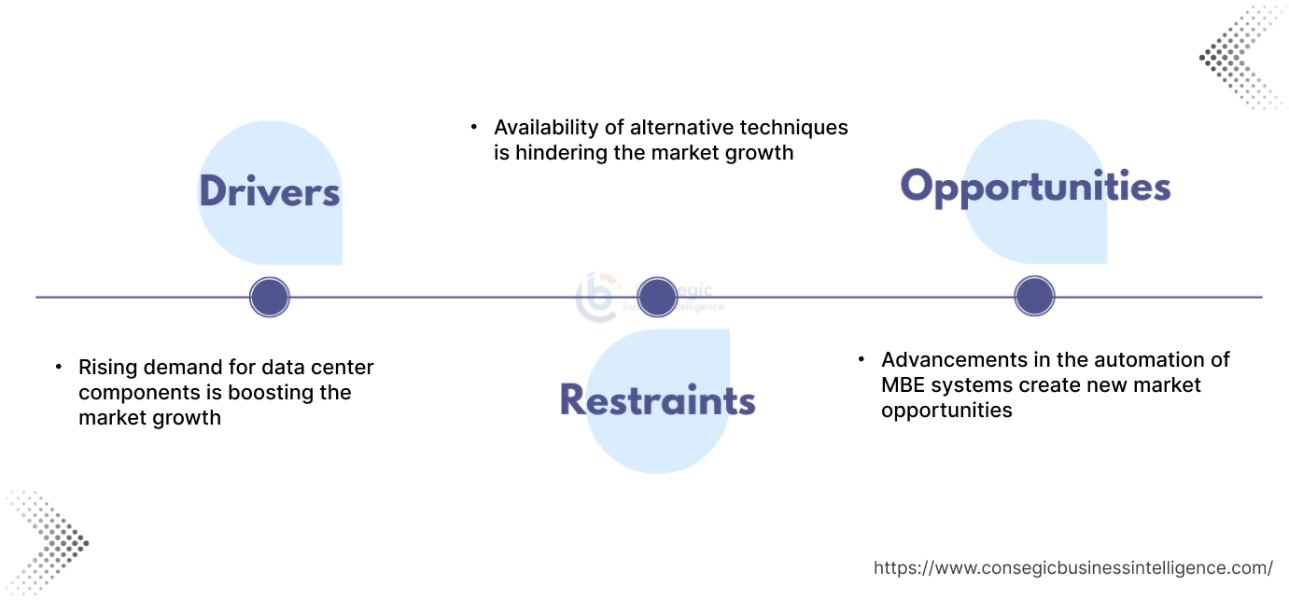
Rising demand for data center components is boosting the market growth
MBE systems play a crucial role in the development of components that power data centers. MBE is essential for creating the semiconductor materials that are the foundation of microchips, lasers, and other photonic components used in data center networking and computing. MBE is used to grow the thin films that form the transistors and other components on microchips, which are the heart of data center servers. MBE is used to fabricate the semiconductor lasers that transmit data across optical fibers, a key part of data center networks. MBE is also used to create other photonic components like waveguides and photodetectors, which are essential for high-speed data transfer within data centers.
- For instance, in February 2025, Dominari Holdings launched an HPC data center unit in the U.S. This denotes the rising demand for data center components, leading to the adoption of MBE systems.
Thus, the aforementioned factors are driving the molecular beam epitaxy system market growth.
Key Restraints:
Availability of alternative techniques is hindering the market growth
There are several alternative techniques including metal-organic chemical vapor deposition (MOCVD), pulsed laser deposition (PLD), and others, which are scalable and affordable as compared to MBE systems. MOCVD uses gaseous precursors to deposit thin films on a substrate. It offers high throughput and cost-effectiveness, and it is suitable for large-scale production. Moreover, PLD uses a laser pulse to ablate a target material and deposit it onto a substrate. It is versatile in material deposition, precise control, and suitable for oxide thin films. Thus, the molecular beam epitaxy system market analysis shows that the aforementioned factors are restraining the molecular beam epitaxy system market demand.
Future Opportunities :
Advancements in the automation of MBE systems create new market opportunities
Automated MBE systems enhance processes by providing precise control and repeatability for complex materials and structures. These systems are often used in the research and development of microelectronics and optoelectronics. Automation allows precise control over the deposition parameters, such as substrate temperature, source cell temperatures, and shutter timings, ensuring repeatable and reliable growth of high-quality thin films. Automated systems handle complex growth recipes, allowing the fabrication of multi-layered structures, quantum wells, and other advanced nanostructures with sub-nanometer precision.
- For instance, Veeco Instruments Inc. offers automated MBE systems that allow automated wafer transfer. This enables high system utilization, allowing multiple researchers to use the system simultaneously.
Thus, the ongoing advancements in automation are projected to drive molecular beam epitaxy system market opportunities during the forecast period.
Molecular Beam Epitaxy System Market Segmental Analysis :
By Product Type:
Based on the product type, the market is segmented into laser MBE and normal MBE.
Trends in the Product Type:
- Rising adoption of MBE systems in semiconductor manufacturing processes for the creation of complex structures is boosting the molecular beam epitaxy system market size.
- Increasing trend in the adoption of laser MBE systems for research of oxide electronics is boosting the market trends.
The normal MBE segment accounted for the largest revenue share in the molecular beam epitaxy system market share in 2024.
- Normal MBE systems utilize effusion cells and electron beam evaporators to heat and evaporate materials in a high vacuum or ultra-high vacuum environment.
- Molecular beams of the evaporated materials are directed onto a heated substrate, where they condense and form a thin film.
- Precise control of the flux and composition of the molecular beams is achieved using shutters and temperature control, enabling the growth of single-crystal multilayers.
- Normal MBE systems are primarily used in semiconductor research and manufacturing of semiconductor devices like transistors, due to their ability to produce high-quality thin films with sharp interfaces.
- Therefore, the molecular beam epitaxy system market analysis shows that the aforementioned factors are boosting the molecular beam epitaxy system market growth.
The laser MBE segment is expected to register the fastest CAGR during the forecast period.
- A laser MBE system combines the advantages of pulsed laser deposition and MBE to achieve controlled, layer-by-layer growth of thin films, particularly useful for ceramic materials like oxides.
- It operates in an ultrahigh vacuum environment, allowing in-situ monitoring of surface reactions using reflection high-energy electron diffraction (RHEED).
- This system enables the creation of atomically smooth surfaces and perfect lattice structures, making it valuable for research and development in fields like oxide electronics.
- Thus, the market analysis depicts that the aforementioned factors are expected to boost the market trends during the forecast period.
By End User:
Based on the end use, the market is segmented into research & development and industrial production.
Trends in the End Use:
- Rising adoption of MBE systems in research and development for emerging technologies like 5G/6G communications, biosensors, and environmental monitoring is boosting the molecular beam epitaxy system market size.
- Increasing trend in the adoption of MBE systems in industrial production for utilization in various industries including semiconductors, data centers, electronics, and others, is driving the molecular beam epitaxy system market trends.
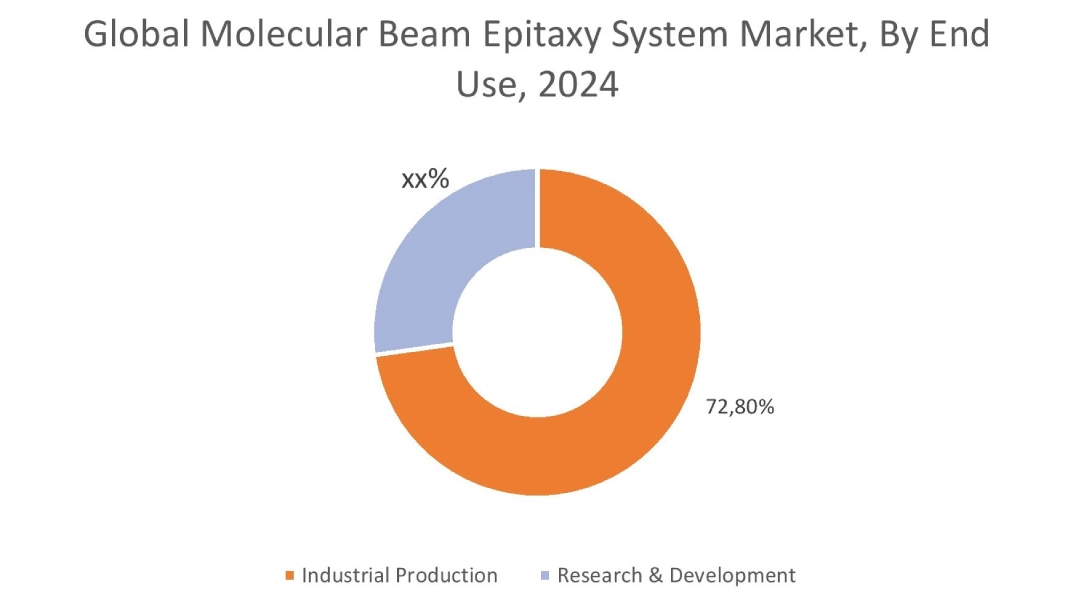
The industrial production segment accounted for the largest revenue share of 72.80% in the molecular beam epitaxy system market share in 2024 and is also expected to register the fastest CAGR during the forecast period.
- MBE systems are particularly valuable in semiconductor manufacturing for devices like transistors and optoelectronic components.
- MBE is used to grow various materials, including semiconductors, metals, and oxides.
- MBE is used in the production of various semiconductor devices, including transistors, diodes, and optoelectronic components.
- MBE is used in the fabrication of optical devices like LEDs, laser diodes, and photodetectors.
- Therefore, the market analysis states that the aforementioned factors are boosting the molecular beam epitaxy system market expansion.
Regional Analysis:
The regions covered are North America, Europe, Asia Pacific, the Middle East and Africa, and Latin America.
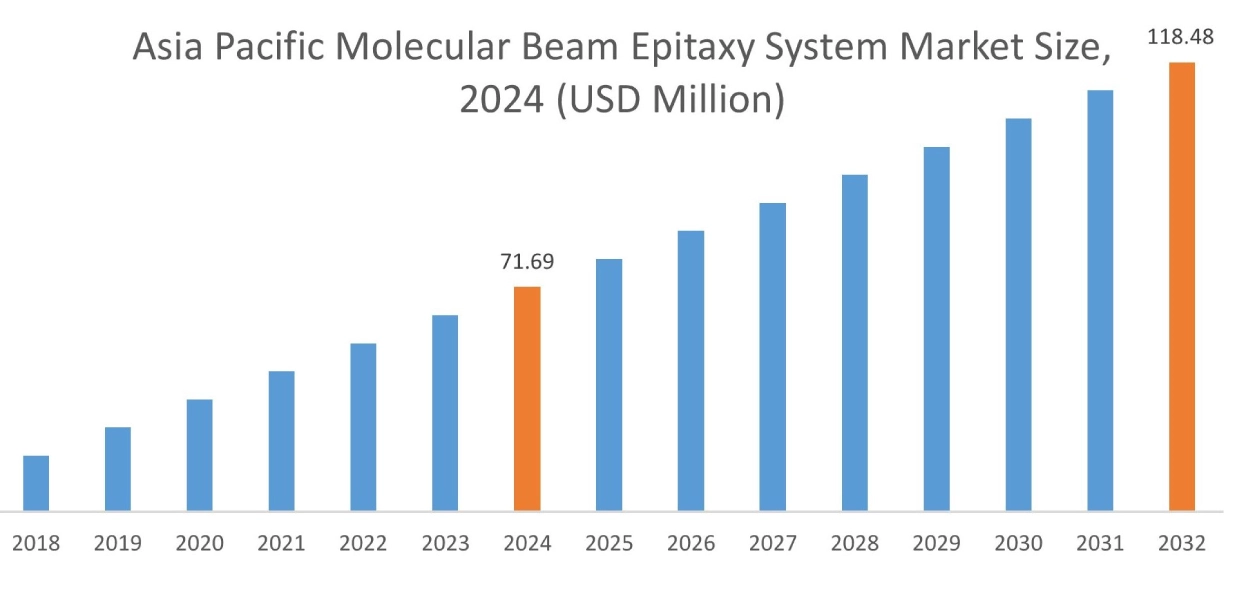
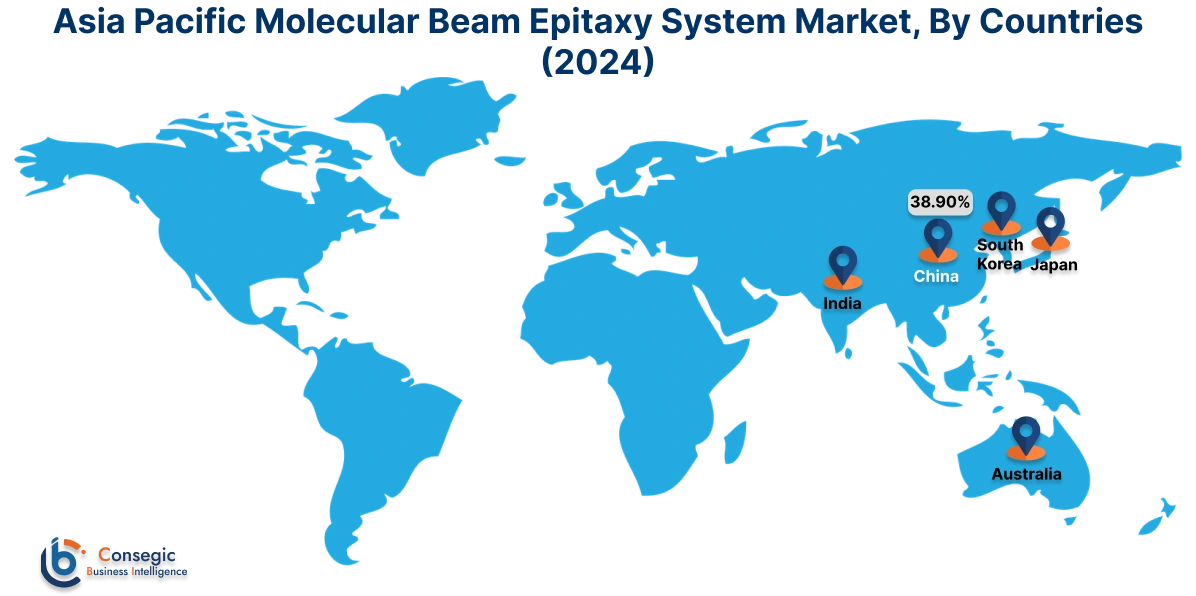
Asia Pacific region was valued at USD 71.69 Million in 2024. Moreover, it is projected to grow by USD 75.12 Million in 2025 and reach over USD 118.48 Million by 2032. Out of this, China accounted for the maximum revenue share of 38.90%. The market analysis shows that the expanding semiconductor and electronics industry leads to rising demand for molecular beam epitaxy systems for semiconductor manufacturing.
- For instance, in February 2025, the Semiconductor Industry Association stated that there is an 18.3% increase in yearly semiconductor sales. Thus, the aforementioned factors are driving the molecular beam epitaxy system market trends in the Asia-Pacific region.
North America is estimated to reach over USD 95.34 Million by 2032 from a value of USD 56.02 Million in 2024 and is projected to grow by USD 58.84 Million in 2025. The market in the region is growing primarily due to the rising number of data centers in the region and the increasing need for advanced data center components among others.
- For instance, the Data Center Map states that there are 3,736 data centers in the U.S. This indicates the rising demand for molecular beam epitaxy systems in the region, resulting in molecular beam epitaxy system market expansion.
In Europe, the market is primarily driven by the widespread adoption of molecular beam epitaxy systems in research and development of advanced semiconductor manufacturing methodologies, thereby boosting the molecular beam epitaxy system market opportunities. In Latin America, the Middle East, and Africa, the market is primarily driven by the rising penetration of smartphones and electronic devices, leading to the adoption of MBE systems for manufacturing mobile chips, processors, and other components, thereby driving the molecular beam epitaxy system market demand.
Top Key Players and Market Share Insights:
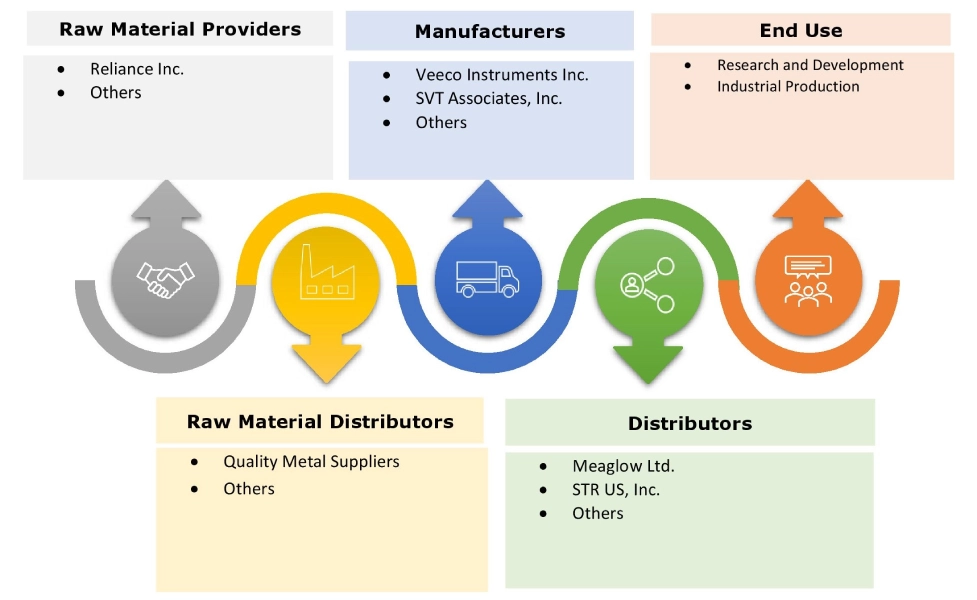
The molecular beam epitaxy system industry is highly competitive with major players providing solutions and services to the national and international markets. Key players are adopting several strategies in research and development (R&D), product innovation, and end-user launches to hold a strong position in the global molecular beam epitaxy system market. Key players in the molecular beam epitaxy system industry include -
- Veeco Instruments Inc. (United States)
- SVT Associates, Inc. (United States)
- Prevac (Poland)
- United Mineral and Chemical Corp. (United States)
- Scienta Omicron (Sweden)
- CreaTec Fischer & Co. GmbH (Germany)
- Riber (France)
- Scanwel (United Kingdom)
- k-Space Associates, Inc. (United States)
- Howard J. Moore Company, Inc. (United States)
Molecular Beam Epitaxy System Market Report Insights :
| Report Attributes | Report Details |
| Study Timeline | 2019-2032 |
| Market Size in 2032 | USD 327.30 Million |
| CAGR (2025-2032) | 7.2% |
| By Product Type |
|
| By End Use |
|
| By Region |
|
| Key Players |
|
| North America | U.S. Canada Mexico |
| Europe | U.K. Germany France Spain Italy Russia Benelux Rest of Europe |
| APAC | China South Korea Japan India Australia ASEAN Rest of Asia-Pacific |
| Middle East and Africa | GCC Turkey South Africa Rest of MEA |
| LATAM | Brazil Argentina Chile Rest of LATAM |
| Report Coverage |
|
Key Questions Answered in the Report
Quelle est la taille du marché des systèmes d'épitaxie par jets moléculaires ? −
Le marché des systèmes d'épitaxie par jets moléculaires devrait atteindre plus de 327,30 millions de dollars américains d'ici 2032, contre 196,50 millions de dollars américains en 2024, et devrait croître de 206,02 millions de dollars américains en 2025, avec un TCAC de 7,2 % entre 2025 et 2032.
Quels sont les principaux segments abordés dans le rapport sur le marché des systèmes d'épitaxie par jets moléculaires ? +
Les segments couverts par le rapport sont le type de produit, l'utilisation finale et la région.
Quelle région détiendra la plus grande part de revenus en 2024 sur le marché des systèmes d'épitaxie par jets moléculaires ? +
La région Asie-Pacifique détenait la plus grande part de revenus sur le marché des systèmes d'épitaxie par jets moléculaires en 2024.
Qui sont les principaux acteurs du marché des systèmes d'épitaxie par jets moléculaires ? +
Les principaux acteurs du marché sont Veeco Instruments Inc. (États-Unis), SVT Associates, Inc. (États-Unis), CreaTec Fischer & Co. GmbH (Allemagne), Riber (France), Scanwel (Royaume-Uni), k-Space Associates, Inc. (États-Unis), Howard J. Moore Company, Inc. (États-Unis), Prevac (Pologne), United Mineral and Chemical Corp. (États-Unis) et Scienta Omicron (Suède).