Jump to Content
Functional Fitness Equipment Market - Size, Share, Industry Trends, and Forecasts (2025-2032)
Functional Fitness Equipment Market Size:
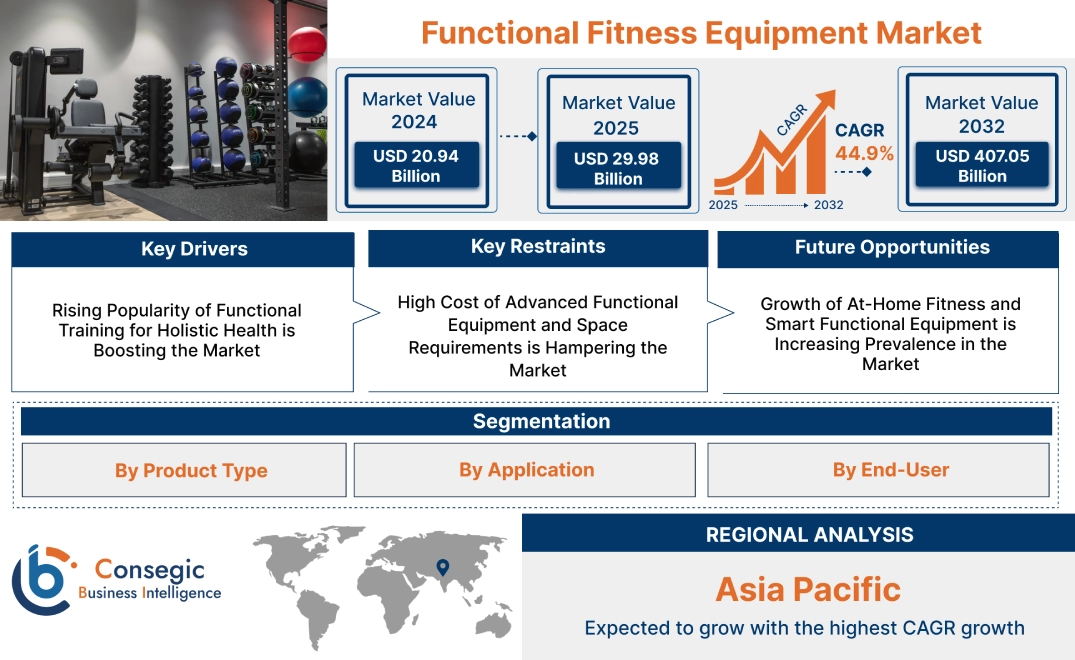
Functional Fitness Equipment Market size is estimated to reach over USD 407.05 Billion by 2032 from a value of USD 20.94 Billion in 2024 and is projected to grow by USD 29.98 Billion in 2025, growing at a CAGR of 44.9% from 2025 to 2032.
Functional Fitness Equipment Market Scope & Overview:
The functional fitness equipment is designed to improve strength, flexibility, endurance, and overall physical performance by mimicking natural body movements. This market includes a wide range of products such as kettlebells, medicine balls, resistance bands, battle ropes, suspension trainers, and multi-functional rigs. These tools are widely used in gyms, rehabilitation centers, and home fitness setups to support diverse training programs, including high-intensity interval training (HIIT), CrossFit, and rehabilitation exercises.
Key characteristics of functional fitness equipment include versatility, compact designs, and durability to accommodate dynamic and high-intensity movements. The benefits include improved workout efficiency, enhanced muscle coordination, injury prevention, and support for a wide range of fitness goals.
Applications span personal fitness training, rehabilitation programs, and professional athletic conditioning. End-users include fitness enthusiasts, professional athletes, gym owners, and physical therapists, driven by increasing awareness of functional training benefits, rising adoption of fitness routines focusing on holistic health, and growing demand for compact and cost-effective home fitness solutions.
Functional Fitness Equipment Market Dynamics - (DRO) :
Key Drivers:
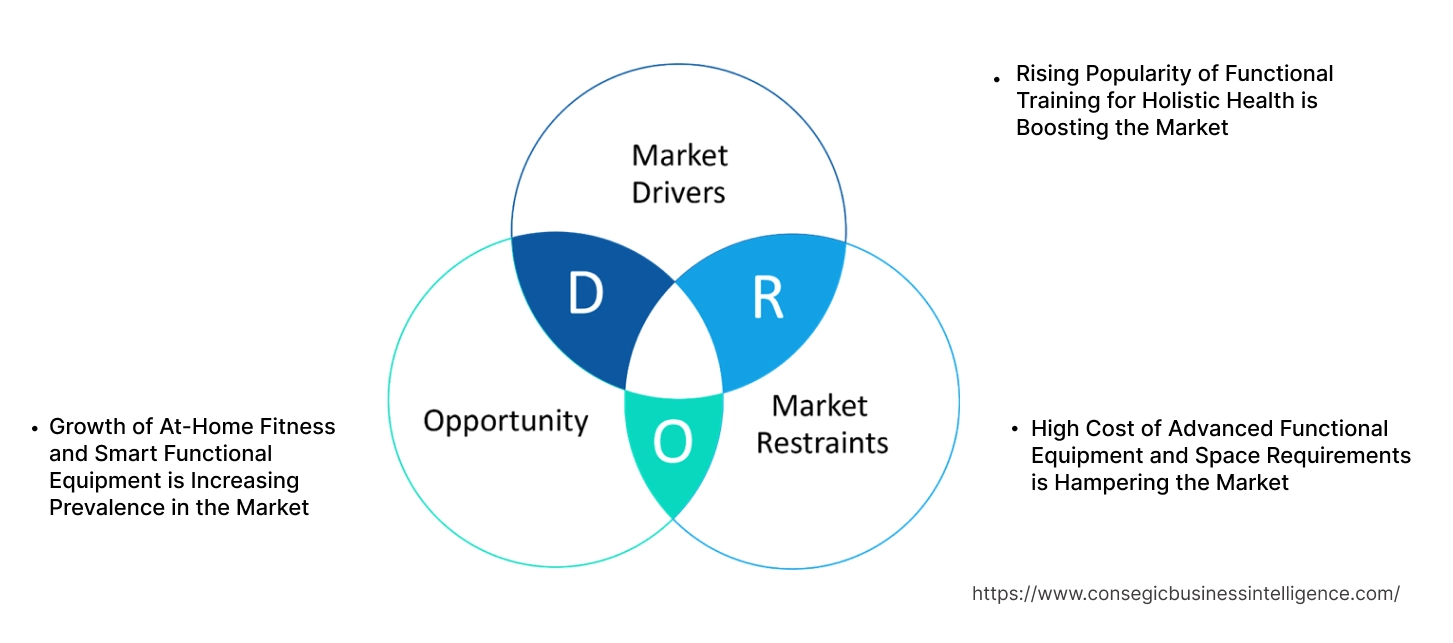
Rising Popularity of Functional Training for Holistic Health is Boosting the Market
The growing adoption of functional training, which focuses on improving strength, balance, flexibility, and coordination for daily activities, is a significant driver for the market. With increasing awareness about the benefits of functional fitness in managing chronic conditions, enhancing athletic performance, and preventing injuries, both individuals and fitness facilities are investing in equipment such as kettlebells, resistance bands, medicine balls, and suspension trainers. The functional fitness equipment market demand is particularly strong among millennials and fitness enthusiasts prioritizing holistic health and well-rounded physical capabilities. Additionally, the integration of functional training programs in corporate wellness initiatives and rehabilitation centers has further boosted the market.
Key Restraints:
High Cost of Advanced Functional Equipment and Space Requirements is Hampering the Market
A major restraint in the market is the high cost of advanced equipment, such as multifunctional training rigs and smart fitness devices, which can be prohibitively expensive for smaller gyms and home users. Furthermore, some functional fitness setups require substantial space, which limits their adoption in compact home environments or smaller fitness centers. Maintenance costs and the need for specialized training to use advanced equipment effectively also deter some potential buyers, particularly in cost-sensitive regions.
Future Opportunities :
Growth of At-Home Fitness and Smart Functional Equipment is Increasing Prevalence in the Market
The rising trend of at-home fitness presents a significant surge in the functional fitness equipment market opportunities. With the convenience of working out at home gaining traction, compact, portable, and versatile equipment such as resistance bands, adjustable kettlebells, and suspension trainers are becoming increasingly popular. Additionally, the integration of smart technologies into functional equipment, such as connected apps, real-time performance tracking, and virtual coaching, is driving consumer interest. These innovations cater to tech-savvy users seeking personalized fitness experiences, enabling manufacturers to tap into the growing demand for smart and space-efficient fitness solutions.
These dynamics highlight the increasing popularity of functional fitness as a versatile and effective training approach. While cost and space constraints remain challenges, advancements in smart technologies and the rise of home fitness solutions provide ample opportunities for functional fitness equipment market growth and innovation.
Functional Fitness Equipment Market Segmental Analysis :
By Product Type:
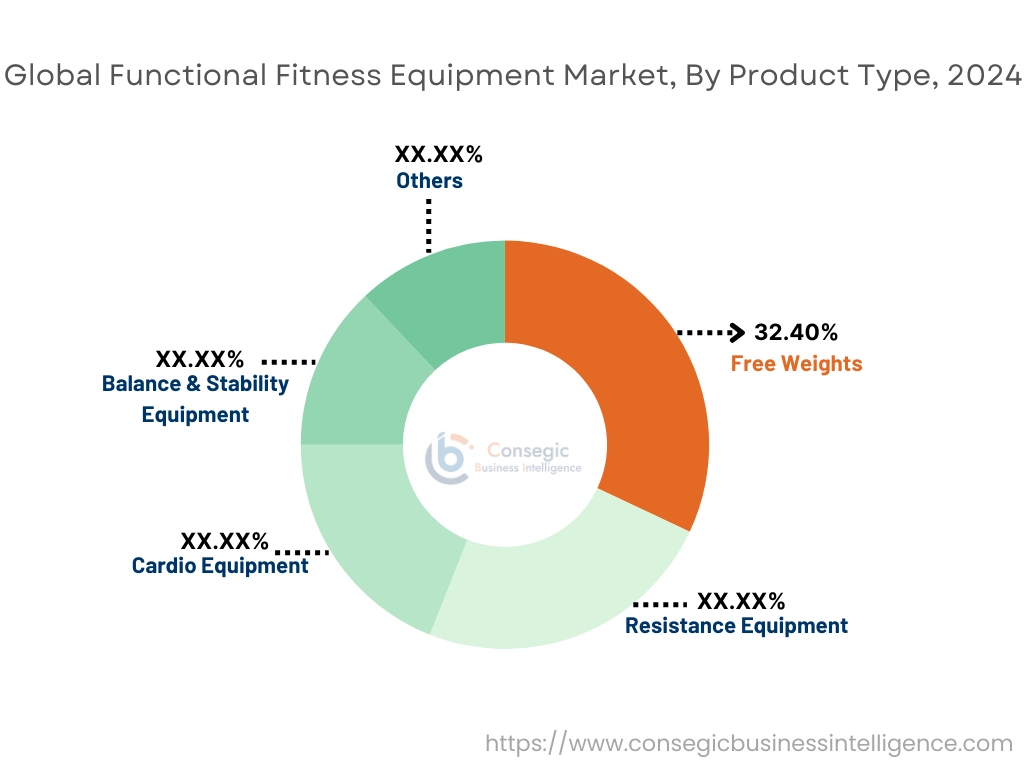
Based on product type, the market is segmented into free weights, resistance equipment, cardio equipment, balance & stability equipment, and others.
The free weights segment accounted for the largest revenue of functional fitness equipment market share of 32.40% in 2024.
- Free weights, including dumbbells, barbells, and kettlebells, are widely used for strength training and functional workouts.
- Their versatility in targeting multiple muscle groups supports their widespread adoption in gyms, sports facilities, and home setups.
- Increasing consumer focus on strength and resistance training drives functional fitness equipment market trends for compact and affordable free weights.
- Expanding product innovation, such as adjustable dumbbells and ergonomic designs, boosts demand.
The cardio equipment segment is anticipated to register the fastest CAGR during the forecast period.
- Cardio equipment, such as treadmills, rowing machines, and elliptical trainers, are increasingly used for functional and endurance training.
- Rising functional fitness equipment market trends for multifunctional cardio equipment integrated with performance tracking and virtual training features support trends in this segmental analysis.
- Expanding adoption of compact cardio machines for home use aligns with the growing preference for at-home fitness solutions.
- Advancements in eco-friendly and energy-efficient cardio equipment contribute to the segment's rapid growth.
By Application:
Based on application, the market is segmented into strength training, cardio training, balance training, rehabilitation, and endurance training.
The strength training segment accounted for the largest revenue share in 2024.
- Strength training remains a cornerstone of functional fitness, driving rapid functional fitness equipment market opportunities for resistance and free weight equipment.
- Increasing awareness of strength training benefits for overall health and injury prevention supports market trends.
- The rising trends in weightlifting and resistance-based fitness programs across commercial gyms and sports training facilities contribute to the segment.
- Technological advancements, including smart weight systems with data tracking, enhance user engagement.
The rehabilitation segment is anticipated to register the fastest CAGR during the forecast period.
- Functional fitness equipment is widely used in rehabilitation programs to aid recovery and improve mobility after injuries or surgeries.
- Increasing adoption of balance and stability equipment in physical therapy centers drives trends in this segment.
- Rising prevalence of musculoskeletal disorders and aging populations requiring rehabilitation support functional fitness equipment market demand.
- Expanding healthcare investments in advanced rehabilitation facilities globally further enhances rising potential.
By End-User:
Based on end-user, the market is segmented into commercial gyms, home users, rehabilitation centers, sports training facilities, and corporate wellness programs.
The commercial gyms segment accounted for the largest revenue of functional fitness equipment market share in 2024.
- Commercial gyms are the primary buyers of functional fitness equipment, offering diverse options for group and individual workouts.
- Increasing memberships in gyms globally, driven by health awareness and fitness trends, supports this segment’s dominance.
- Investments by gym operators in advanced functional fitness zones and equipment to attract customers enhance growth.
- Rising advancement for multifunctional and space-efficient fitness solutions in gyms boosts the adoption of functional fitness equipment.
The home users segment is anticipated to register the fastest CAGR during the forecast period.
- Growing consumer preference for home-based fitness setups, particularly post-pandemic, drives functional fitness equipment market growth.
- Increasing availability of compact, affordable, and multifunctional equipment tailored for home users supports functional fitness equipment market expansion.
- Advancements in connected fitness technology and virtual training platforms enhance the appeal of at-home functional fitness.
- The rising adoption of fitness as part of everyday lifestyles among busy professionals supports the segment’s growth.
Regional Analysis:
The regions covered are North America, Europe, Asia Pacific, the Middle East and Africa, and Latin America.
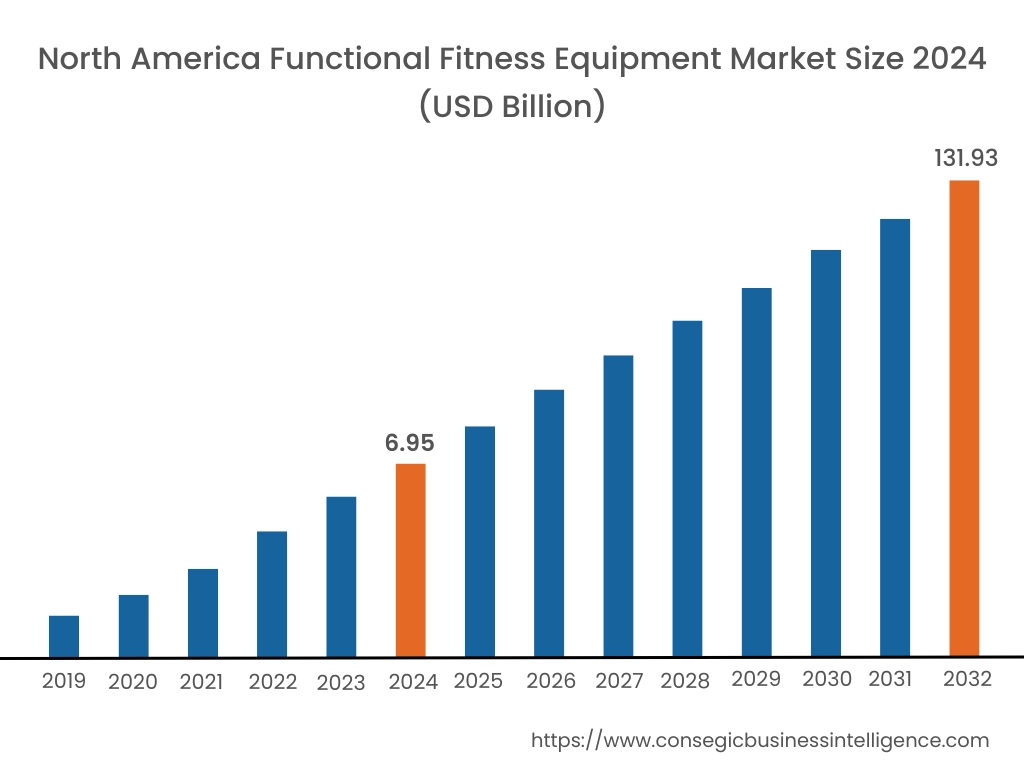
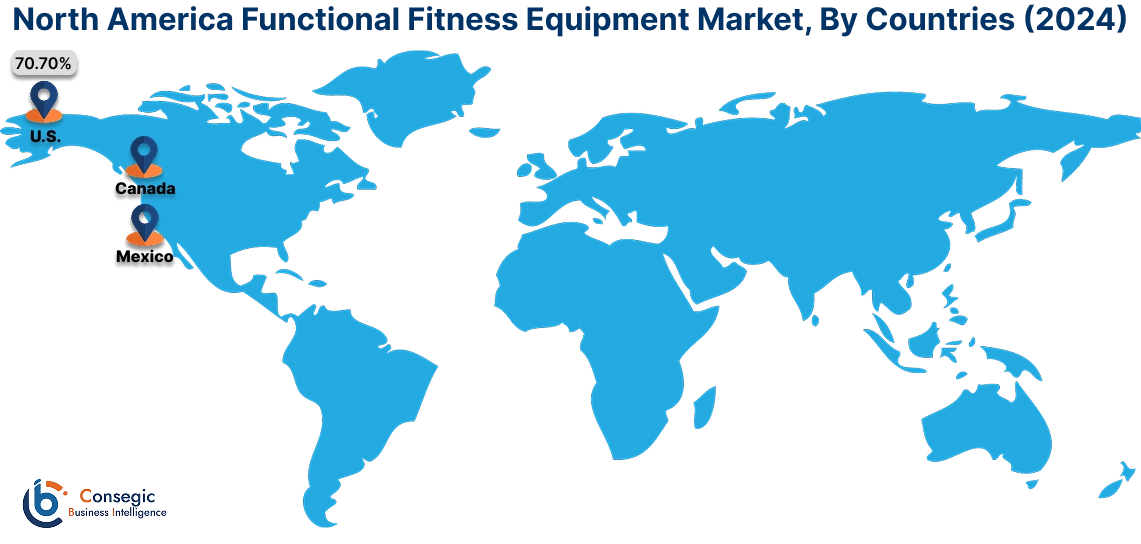
In 2024, North America was valued at USD 6.95 Billion and is expected to reach USD 131.93 Billion in 2032. In North America, the U.S. accounted for the highest share of 70.70% during the base year of 2024. North America holds a substantial share of the global functional fitness equipment market due to the growing emphasis on health and wellness and the increasing popularity of high-intensity interval training (HIIT) and functional fitness routines. The U.S. leads the region, with a significant number of gyms and fitness centers adopting versatile equipment like kettlebells, resistance bands, and suspension trainers to cater to diverse fitness programs. Canada contributes to the market through the rising adoption of functional fitness in community gyms and home setups. Analysis of the region indicates that technological advancements in smart fitness equipment are enhancing user engagement and training efficiency.
In Asia Pacific, the market is experiencing the fastest growth with a CAGR of 45.5% over the forecast period. Asia-Pacific region is fueled by urbanization, rising disposable incomes, and increasing awareness of fitness and healthy lifestyles in China, India, and Japan. China dominates the region with its growing adoption of functional fitness equipment in boutique gyms and fitness studios. India’s expanding middle-class population is driving the demand for cost-effective, durable equipment in urban areas. Japan emphasizes advanced fitness solutions, incorporating innovative and compact functional equipment to cater to space-conscious consumers. The functional fitness equipment market analysis suggests that the proliferation of fitness apps and virtual training platforms is further encouraging the adoption of functional fitness equipment.
Europe is a key market for functional fitness equipment, supported by increasing participation in group training and outdoor fitness activities. Countries like Germany, the UK, and France are major contributors. Germany drives demand with its focus on integrating multifunctional equipment in gym chains and sports training facilities. The UK emphasizes portable and home-friendly fitness equipment to cater to the growing trend of at-home workouts. France sees rising interest in rehabilitation-focused functional fitness, promoting equipment tailored for physiotherapy and injury recovery. Analysis highlights that regulatory policies encouraging physical activity in workplaces are boosting the regional market.
The Middle East & Africa region is witnessing steady growth, driven by rising investments in fitness industry and the popularity of fitness challenges and community events. Countries like Saudi Arabia and the UAE are integrating functional fitness equipment into luxury fitness centers and sports clubs as part of initiatives to promote healthy living. South Africa is emerging as a key market, with a focus on making functional fitness accessible in community gyms and wellness programs. Regional functional fitness equipment market analysis points out that limited local manufacturing of fitness equipment increases reliance on imports, which can impact pricing and availability.
Latin America is an emerging market for functional fitness equipment, with Brazil and Mexico leading the region. Brazil’s strong fitness culture and the increasing number of boutique fitness studios drive demand for multifunctional equipment. Mexico focuses on promoting fitness among younger demographics, encouraging the use of compact and affordable fitness equipment in home setups. Analysis of the region highlights the role of social media in influencing consumer behavior and preferences for functional fitness. However, economic instability in certain countries may pose challenges to functional fitness equipment market expansion.
Top Key Players & Market Share Insights:
The functional fitness equipment market is highly competitive with major players providing products and services to the national and international markets. Key players are adopting several strategies in research and development (R&D), product innovation, and end-user launches to hold a strong position in the global functional fitness equipment market. Key players in the functional fitness equipment industry include -
- Peloton Interactive, Inc. (United States)
- Technogym S.p.A. (Italy)
- Torque Fitness (United States)
- TRX Training (United States)
- Escape Fitness Ltd. (United Kingdom)
- Life Fitness (United States)
- Nautilus, Inc. (United States)
- Johnson Health Tech Co., Ltd. (Taiwan)
- ICON Health & Fitness, Inc. (United States)
- Precor Incorporated (United States)
Recent Industry Developments :
Research and Development:
- In January 2025, The piece emphasizes the importance of incorporating versatile tools that mimic real-life movements to enhance strength, flexibility, and coordination. Key equipment discussed includes suspension trainers, medicine balls, battle ropes, kettlebells, and resistance bands. These tools are designed to engage multiple muscle groups simultaneously, promoting core stability and balance. The article underscores the growing popularity of functional training due to its adaptability and effectiveness across various fitness levels.
Collaborations:
- In May 2024, Escape Fitness collaborated with the Rockwell Group to design a state-of-the-art fitness facility at the Fontainebleau Las Vegas resort and casino. This facility redefines luxury and wellness, offering guests an unparalleled fitness experience. The partnership highlights Escape Fitness's commitment to integrating innovative design with high-quality functional fitness equipment, catering to the evolving demands of the hospitality industry.
- In May 2024, Matrix Fitness introduced the Performance Plus Treadmill, featuring five customizable consoles that enable facility owners to tailor user experiences ranging from basic functionality to fully digital, entertainment-rich interactions.
Functional Fitness Equipment Market Report Insights:
| Report Attributes | Report Details |
| Study Timeline | 2019-2032 |
| Market Size in 2032 | USD 407.05 Billion |
| CAGR (2025-2032) | 44.9% |
| By Product Type |
|
| By Application |
|
| By End-User |
|
| By Region |
|
| Key Players |
|
| North America | U.S. Canada Mexico |
| Europe | U.K. Germany France Spain Italy Russia Benelux Rest of Europe |
| APAC | China South Korea Japan India Australia ASEAN Rest of Asia-Pacific |
| Middle East and Africa | GCC Turkey South Africa Rest of MEA |
| LATAM | Brazil Argentina Chile Rest of LATAM |
| Report Coverage |
|
Key Questions Answered in the Report
What is the projected size of the Functional Fitness Equipment Market? −
Functional Fitness Equipment Market size is estimated to reach over USD 407.05 Billion by 2032 from a value of USD 20.94 Billion in 2024 and is projected to grow by USD 29.98 Billion in 2025, growing at a CAGR of 44.9% from 2025 to 2032.
What are the key product segments in the market? +
The market is segmented into Free Weights, Resistance Equipment, Cardio Equipment, Balance & Stability Equipment, and Others, with Free Weights accounting for the largest revenue share in 2024.
Which product segment is expected to grow the fastest? +
The Cardio Equipment segment is anticipated to register the fastest CAGR, driven by the rising demand for multifunctional and compact cardio machines for home use and gyms.
What applications drive the demand for functional fitness equipment? +
The key applications include Strength Training, Cardio Training, Balance Training, Rehabilitation, and Endurance Training, with Strength Training leading due to its prominence in fitness programs. Rehabilitation is expected to grow the fastest.
Overview
Reputation & Certifications

Our Services
- Market Intelligence & Forecasting
- Custom Research Solutions
- Market Entry Strategy
- Competitive Intelligence
- Customer Insights
- Industry Innovation Analysis
- Investment Advisory