Jump to Content
Home Theater Market - Size, Share, Industry Trends, and Forecasts (2024 - 2031)
Home Theater Market Size:
Home Theater Market size is estimated to reach over USD 26,619.47 Million by 2031 from a value of USD 13,460.42 Million in 2023 and is projected to grow by USD 14,418.26 Million in 2024, growing at a CAGR of 8.90% from 2024 to 2031.
Home Theater Market Scope & Overview:
A home theater is a combination of audio and video equipment designed to replicate the experience of a commercial cinema within a residential setting. These systems typically include components such as high-definition projectors or televisions, surround sound speakers, subwoofers, AV receivers, and media playback devices. They are engineered to deliver high-quality audio and visual performance, providing an immersive entertainment experience.
The systems are available in various configurations, ranging from compact soundbars paired with TVs to elaborate setups with multiple speakers and projection systems. Modern systems often integrate smart technologies, enabling wireless connectivity, voice control, and compatibility with streaming services. This allows users to enjoy seamless access to digital content while maintaining a high level of customization and ease of use.
End-users of these systems include individual consumers and custom installation service providers, catering to residential properties and entertainment-focused spaces. These systems play a crucial role in enhancing home entertainment experiences, offering a blend of functionality, style, and cutting-edge technology.

Home Theater Market Dynamics - (DRO) :

Key Drivers:
Rising Demand for Immersive Entertainment Experiences Fuels the Market Progress
The increasing preference for immersive entertainment at home is significantly driving the market. Consumers are investing in advanced audio-visual systems that replicate the cinematic experience, prioritizing high-quality sound and visuals. Technologies such as Dolby Atmos, 4K resolution, and surround sound systems are at the forefront of this demand, offering an unparalleled level of detail and depth in entertainment. These features not only enhance the experience of watching movies but also elevate gaming, live sports, and music streaming.
With the availability of content optimized for advanced technologies on platforms like Netflix and Amazon Prime, consumers are more inclined toward upgrading their home entertainment setups. This trend is further supported by the growing accessibility of premium equipment at competitive prices, enabling a broader demographic to adopt immersive systems. As personalized entertainment becomes a priority, the need for feature-rich and user-friendly systems is expected to continue its upward trajectory, boosting the home theater market growth.
Key Restraints :
Space Constraints in Urban Homes Restrain the Market Development
The growing urbanization and limited living spaces in metropolitan areas present significant challenges for adopting full-fledged home theater setups. Traditional systems, which often require multiple speakers, amplifiers, and large displays, are difficult to accommodate in compact apartments. These setups also demand careful consideration of room acoustics and speaker placement, further complicating their installation in smaller homes.
To address this issue, manufacturers are increasingly offering compact and modular solutions, such as soundbars with built-in subwoofers, wireless speakers, and ultra-thin displays. While these innovations cater to urban consumers, they do not fully replicate the immersive experience of larger setups, limiting their appeal among high-end users. Despite advancements, the lack of sufficient space remains a key restraint, particularly in densely populated regions like Asia-Pacific and Europe, limiting the home theater market demand.
Future Opportunities :
Advancements in 8K and 3D Audio Technologies Opens New Doors
The advent of 8K resolution displays and 3D audio technologies is redefining home entertainment, offering an unmatched level of visual and auditory immersion. 8K displays deliver exceptional picture quality with enhanced clarity, vivid colors, and intricate details, transforming the viewing experience for movies, gaming, and sports. Complementing this, 3D audio technologies such as Dolby Atmos and DTS:X create spatial soundscapes that replicate real-world acoustics, enveloping users in a fully immersive audio environment.
These advancements are particularly appealing to consumers seeking premium home entertainment systems that rival cinematic experiences. The increasing availability of 8K content and audio formats optimized for 3D sound further drives demand in this segment. Additionally, as prices for high-end technologies gradually decline, they are becoming accessible to a broader audience. These innovations are expected to fuel growth in the premium product segment, aligning with trends in cutting-edge, personalized home entertainment. Thus, the aforementioned factors create significant home theater market opportunities.
Home Theater Market Segmental Analysis :
By Component:
Based on components, the market is segmented into display systems, sound systems, storage devices, media players, and others.
The sound system segment held the largest revenue of the total home theater market share in 2023.
- Sound systems are the core of home theater setups, offering immersive audio experiences for both cinematic and musical applications.
- Advancements in sound system technology, such as Dolby Atmos and DTS:X, are driving adoption among residential users seeking high-quality sound performance.
- The integration of smart features, including voice control and wireless connectivity, enhances user convenience and functionality in sound systems.
- Therefore, the dominance of this segment reflects its essential role in delivering an authentic experience, contributing to the home theater market expansion.
The display system segment is expected to grow at the fastest CAGR during the forecast period.
- Increasing consumer preference for large-screen displays, including 4K and 8K televisions and projectors, is propelling need in this segment.
- Enhanced visual technologies, such as HDR (High Dynamic Range) and OLED panels, are further improving the viewing experience in home theaters.
- Rising availability of compact and affordable projector solutions for home use is boosting the segment’s growth.
- As per home theater market analysis, expanding access to streaming platforms and high-definition content supports the rapid adoption of advanced display systems.
By System Type:
Based on deployment mode, the market is segmented into on-premise, cloud-based, and hybrid.
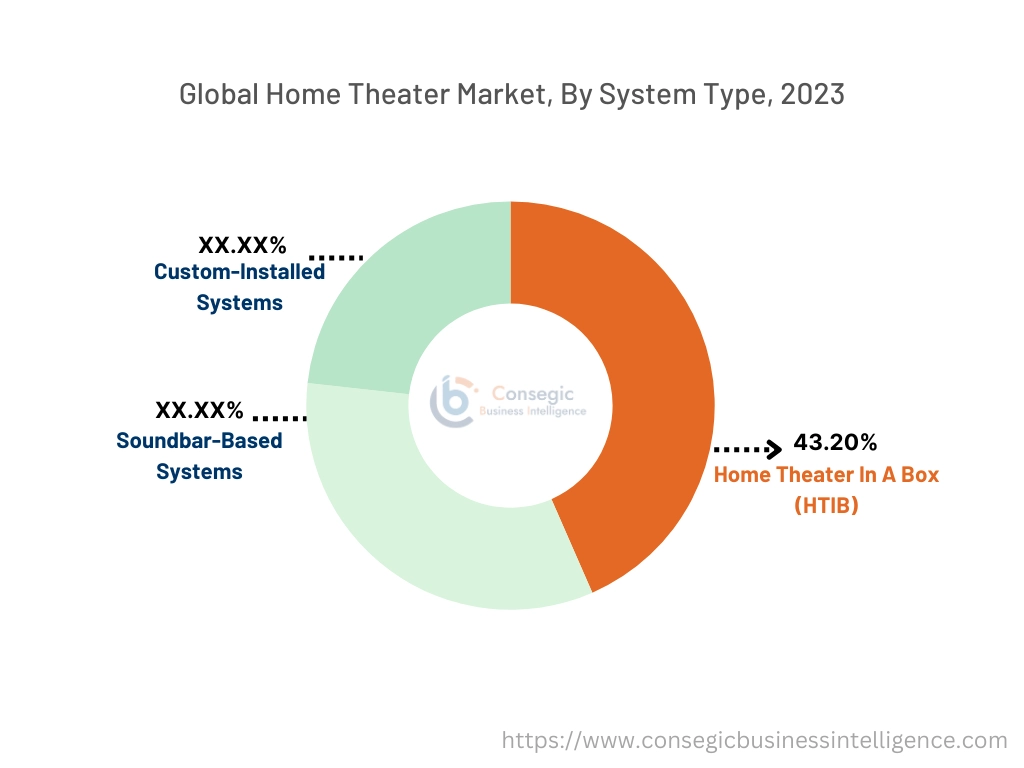
Based on system type, the market is segmented into home theater in a box (HTIB), soundbar-based systems, and custom-installed systems.
The home theater in a box (HTIB) segment accounted for the largest revenue of 43.20% in 2023.
- HTIB systems provide an all-in-one solution, including speakers, receivers, and media players, simplifying the setup process for consumers.
- These systems are popular among budget-conscious buyers due to their affordability and compatibility with various room sizes.
- Widespread availability across online and offline retail channels supports the segment’s significant market portion.
- As per home theater market trends, consumer preference for plug-and-play systems, particularly in urban areas, contributes to the segment's dominance.
The custom installed systems segment is expected to grow at the fastest CAGR during the forecast period.
- Custom systems cater to personalized needs, offering tailored solutions for premium home theater experiences.
- Growing adoption of luxury and high-end entertainment setups in affluent households is a driving requirement for this segment.
- Integration of advanced technologies, such as smart home connectivity and automated control systems, enhances the appeal of custom installations.
- The segment's growth is further supported by professional installation services and rising consumer expenditure on home improvement, fueling the home theater market demand.
By Connectivity:
Based on connectivity, the market is segmented into wired systems and wireless systems.
The wireless systems segment held the largest revenue share of the home theater market share in 2023.
- Wireless systems eliminate the need for complex cabling, offering convenience and aesthetic appeal to home theater setups.
- Increasing adoption of Wi-Fi and Bluetooth-enabled audio and video devices supports the segment’s significant market share.
- Compatibility with smart devices and voice assistants enhances the usability of wireless systems, driving consumer preference.
- Therefore, as per the market analysis, manufacturers are focusing on innovative wireless solutions, such as multi-room audio systems, to cater to the evolving needs of modern households, boosting the home theater market growth.
The wired systems segment is expected to grow at the fastest CAGR during the forecast period.
- Wired systems are preferred by audiophiles and cinema enthusiasts for their superior audio and video quality without latency or signal interference.
- Continued demand for high-performance wired systems in custom installations contributes to this segment's consistent market performance.
- The segment benefits from ongoing advancements in high-speed HDMI and optical cable technologies, ensuring seamless connectivity for large setups.
- Therefore, the market analysis shows that the segment’s rapid growth reflects the balance between reliability and performance for professional-grade home theaters, driving the home theater market expansion.
By Distribution Channel:
Based on distribution channels, the market is segmented into online retail and offline retail, including specialty stores, supermarkets, hypermarkets, and others.
The offline retail segment held the largest revenue share in 2023.
- Specialty stores and showrooms provide personalized recommendations and hands-on demonstrations, enhancing the buying experience for customers.
- Supermarkets and hypermarkets offer competitive pricing and bundled offers, attracting a diverse customer base for home theater products.
- The dominance of offline retail reflects its ability to cater to immediate purchase needs and provide expert consultation for complex setups.
- As per home theater market analysis, brand partnerships with large retail chains ensure widespread availability of premium and mid-range home theater systems.
The online retail segment is expected to grow at the fastest CAGR during the forecast period.
- Increasing consumer preference for e-commerce platforms, driven by competitive pricing and convenience, supports this segment's growth.
- Online channels enable easy access to a wide range of products, supported by customer reviews and detailed specifications.
- The adoption of virtual try-ons and augmented reality tools enhances the shopping experience for home theater buyers online.
- As per home theater market trends, the segment benefits from increasing internet penetration and rising adoption of digital payment solutions globally.
Regional Analysis:
The regions covered are North America, Europe, Asia Pacific, the Middle East and Africa, and Latin America.
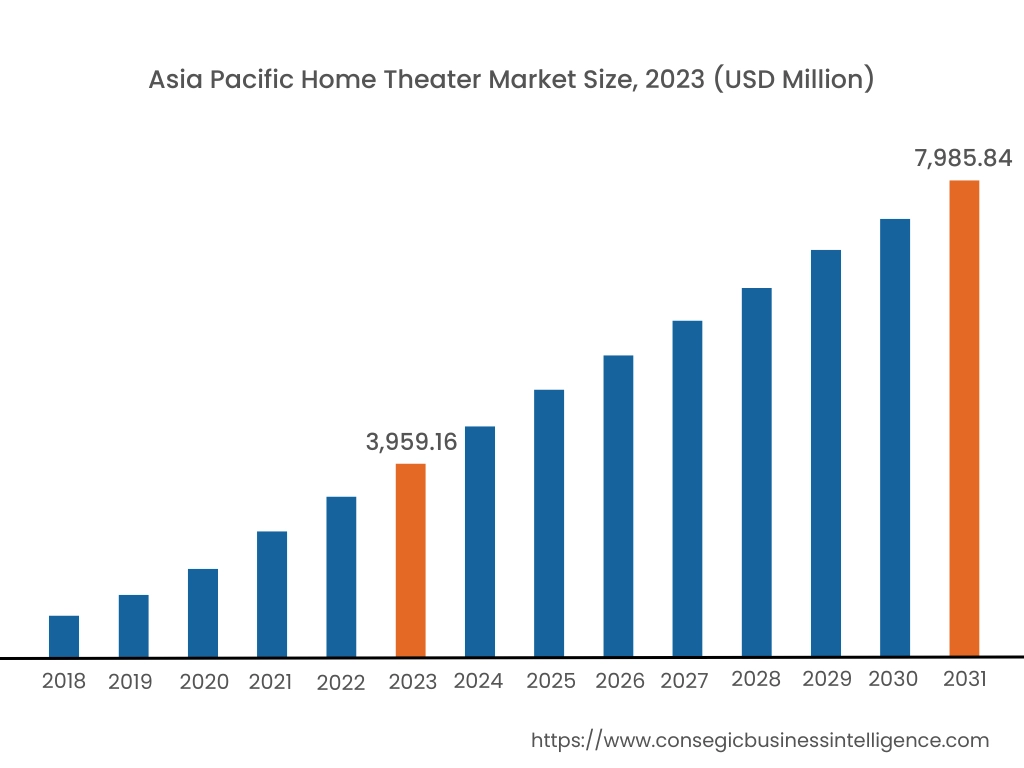
Asia Pacific region was valued at USD 3,959.16 Million in 2023. Moreover, it is projected to grow by USD 4,247.94 Million in 2024 and reach over USD 7,985.84 Million by 2031. Out of these, China accounted for the largest share of 27.6% in 2023. The Asia-Pacific region is experiencing rapid growth in the home theater market, fueled by rising disposable incomes and increasing urbanization in countries such as China, India, and Japan. Consumers in this region are increasingly adopting advanced home entertainment systems, with a notable trend towards affordable yet feature-rich products. Industry analysis indicates that local manufacturers are playing a crucial role in catering to regional preferences and price sensitivities.

North America is estimated to reach over USD 8,757.81 Million by 2031 from a value of USD 4,474.13 Million in 2023 and is projected to grow by USD 4,788.44 Million in 2024. This region holds a significant share of the home theater market, driven by high disposable incomes and a strong inclination towards advanced home entertainment systems. The United States, in particular, has seen widespread adoption of home theater systems, with consumers favoring integrated solutions that offer seamless connectivity with smart home devices. The trend toward streaming services has further propelled the market pull for high-quality audio-visual setups, creating significant home theater market opportunities.
Europe represents a substantial portion of the global home theater market, with countries like Germany, the United Kingdom, and France leading in terms of adoption. The region's emphasis on technological innovation and design aesthetics has led to a preference for sleek, high-performance home theater systems. The analysis reveals a growing trend towards soundbars and compact systems that complement modern living spaces.
The Middle East & Africa region shows a growing interest in home theater systems, particularly in urban centers where there is a rising need for luxury home entertainment solutions. Countries like the United Arab Emirates and South Africa are witnessing increased adoption, driven by a trend towards premium audio-visual experiences.
Latin America is an emerging market for home theater systems, with Brazil and Mexico being key contributors. The region's growing middle class and increasing interest in home entertainment have spurred requirements for home theater systems. A notable trend is the preference for cost-effective solutions that offer good quality and align with the region's economic conditions.
Top Key Players & Market Share Insights:
The home theater market is highly competitive with major players providing products and services to the national and international markets. Key players are adopting several strategies in research and development (R&D), product innovation, and end-user launches to hold a strong position in the global home theater market. Key players in the home theater industry include –
- Sony Corporation (Japan)
- Samsung Electronics (South Korea)
- Pioneer Corporation (Japan)
- Denon Electronics (USA)
- Klipsch Audio Technologies (USA)
- LG Electronics (South Korea)
- Bose Corporation (USA)
- Sonos, Inc. (USA)
- Vizio Inc. (USA)
- Yamaha Corporation (Japan)
Recent Industry Developments:
Product Launches:
- In November 2024, Leica unveiled the Cine Play 1, a portable 4K smart mini projector featuring triple RGB laser technology and a Leica Summicron lens. It delivers vibrant colors and up to 3,000 ANSI lumens brightness, ensuring clear images even in well-lit environments. The device offers plug-and-play functionality with built-in apps and supports Apple AirPlay, Bluetooth, Wi-Fi, HDMI, USB, and LAN connections.
- In September 2024, Sony India launched the BRAVIA Theatre U, a wearable neckband speaker designed to deliver an immersive cinematic audio experience without disturbing others. Priced at ₹24,990, it supports Dolby Atmos and 360 Spatial Sound when paired with compatible BRAVIA TVs. Features include AI-based noise reduction, multipoint connectivity, up to 12 hours of battery life with quick charging, and a splash-proof design.
- In September 2024, Sony India introduced the SA-D40M2, a 4.1-channel home theatre speaker system featuring four compact satellite speakers and a powerful subwoofer, delivering a combined 100W output for an immersive audio experience. It supports Bluetooth and USB connectivity for versatile playback options.
- In May 2023, BenQ unveiled new home projectors featuring HDR-PRO technology, delivering enhanced contrast and accurate colors for a cinematic viewing experience. These projectors support 4K resolution and incorporate CinematicColor technology to reproduce authentic colors. The lineup includes models like the W5800, HT4550i, and HT3560, each designed to cater to various home theater setups. Additionally, select models come equipped with Android TV for seamless streaming.
Product Enhancements:
- In September 2024, KEF launched the updated Q Series speakers, now featuring Metamaterial Absorption Technology (MAT™) to absorb 99% of unwanted sound for purer audio. The series includes eight models, such as the 3-way Q Concerto Meta bookshelf speaker and the Q11 Meta floorstanding speaker, both equipped with the 12th generation Uni-Q driver array for enhanced clarity.
Home Theater Market Report Insights :
| Report Attributes | Report Details |
| Study Timeline | 2018-2031 |
| Market Size in 2031 | USD 26,619.47 Million |
| CAGR (2024-2031) | 8.90% |
| By Component |
|
| By System Type |
|
| By Connectivity |
|
| By Distribution Channel |
|
| By Region |
|
| Key Players |
|
| North America | U.S. Canada Mexico |
| Europe | U.K. Germany France Spain Italy Russia Benelux Rest of Europe |
| APAC | China South Korea Japan India Australia ASEAN Rest of Asia-Pacific |
| Middle East and Africa | GCC Turkey South Africa Rest of MEA |
| LATAM | Brazil Argentina Chile Rest of LATAM |
| Report Coverage |
|
Key Questions Answered in the Report
What is the size of the Home Theater Market? −
Home Theater Market size is estimated to reach over USD 26,619.47 Million by 2031 from a value of USD 13,460.42 Million in 2023 and is projected to grow by USD 14,418.26 Million in 2024, growing at a CAGR of 8.90% from 2024 to 2031.
What are the key segments in the Home Theater Market? +
The Home Theater Market is segmented by component (Display Systems, Sound Systems, Storage Devices, Media Players, Others), system type (Home Theater in a Box (HTIB), Soundbar-Based Systems, Custom Installed Systems), connectivity (Wired Systems, Wireless Systems), distribution channel (Online Retail, Offline Retail), and region (Asia-Pacific, Europe, North America, Latin America, Middle East & Africa).
Which segment is expected to grow the fastest in the Home Theater Market? +
The Display Systems segment is expected to grow at the fastest CAGR during the forecast period. This is due to the increasing consumer preference for large-screen displays such as 4K and 8K televisions and projectors, and the demand for enhanced visual technologies like HDR and OLED panels.
Who are the major players in the Home Theater Market? +
Key players in the Home Theater Market include Sony Corporation (Japan), Samsung Electronics (South Korea), LG Electronics (South Korea), Bose Corporation (USA), Sonos, Inc. (USA), Vizio Inc. (USA), Yamaha Corporation (Japan), Pioneer Corporation (Japan), Denon Electronics (USA), and Klipsch Audio Technologies (USA).
Overview
Reputation & Certifications


Our Services
- Market Intelligence & Forecasting
- Custom Research Solutions
- Market Entry Strategy
- Competitive Intelligence
- Customer Insights
- Industry Innovation Analysis
- Investment Advisory