Jump to Content
Atmospheric Water Generator Market - Size, Share, Industry Trends, and Forecasts (2025-2032)
Atmospheric Water Generator Market Size:
Atmospheric Water Generator Market Size is estimated to reach over USD 6.15 Billion by 2032 from a value of USD 2.79 Billion in 2024 and is projected to grow by USD 3.03 Billion in 2025, growing at a CAGR of 11.6% from 2025 to 2032.
Atmospheric Water Generator Market Scope & Overview:
An atmospheric water generator (AWG) is a device that extracts water from the ambient air. It replicates the natural process of condensation, where water vapor in the air is converted into liquid water. These devices work by cooling the air to its dew point, causing the water vapor to condense, or by using desiccants to absorb moisture from the air. The resulting water is then collected and filtered to ensure it's potable. Additionally, AWGs offer a potential solution for providing clean drinking water in areas with limited access to traditional water sources.
How is AI Impacting the Atmospheric Water Generator Market?
AI is impacting the atmospheric water generator (AWG) market by enabling greater efficiency and intelligence in device operation. Through machine learning, AWG systems can analyze real-time data on temperature, humidity, and air pressure to automatically adjust their settings, maximizing water production and minimizing energy consumption. Predictive analytics help anticipate future weather conditions, allowing for optimized scheduling of water generation cycles. This not only makes AWG devices more reliable and cost-effective but also extends their viability to a wider range of climates, including those with lower humidity levels. The integration of AI and IoT also allows for remote monitoring and control, streamlining maintenance and operational management.

Atmospheric Water Generator Market Dynamics - (DRO):
Key Drivers:
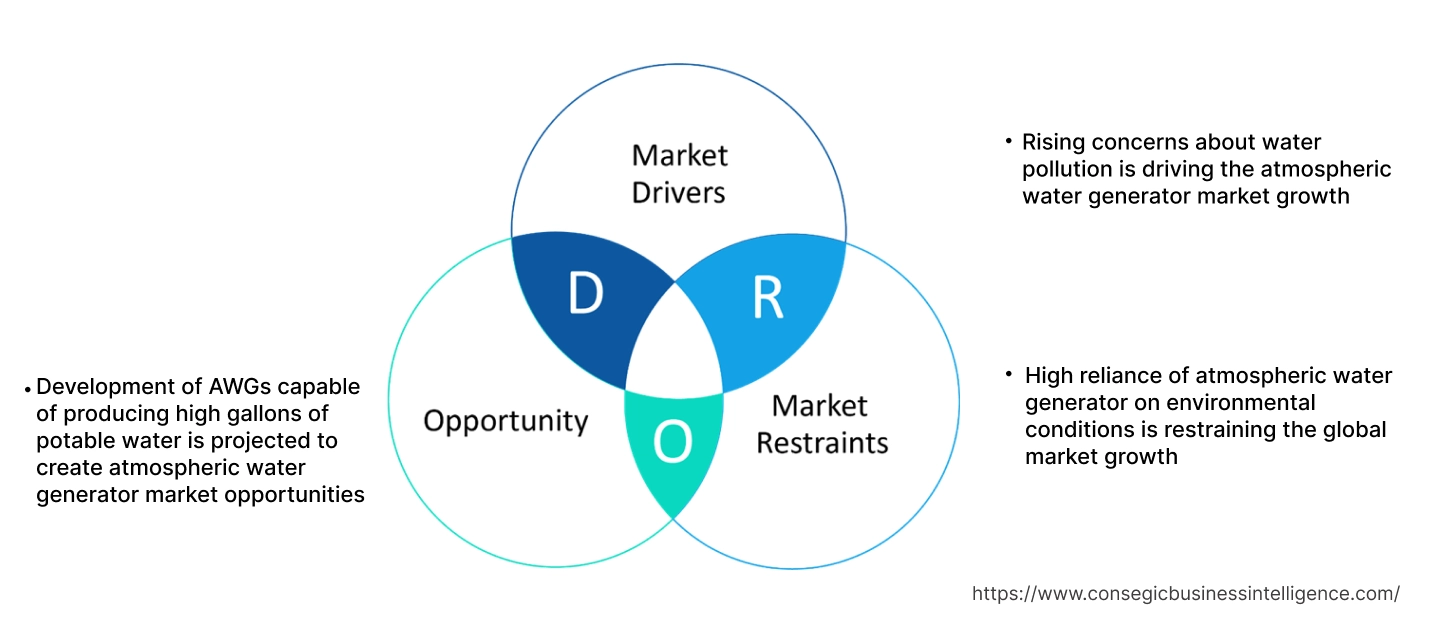
Rising concerns about water pollution is driving the atmospheric water generator market growth
Surface and groundwater sources are contaminated by industrial waste, agricultural runoff, and sewage. This pollution renders these traditional water sources unsafe for consumption, creating a demand for alternative, clean water sources. Additionally, consuming polluted water led to various health problems, including infectious diseases and chronic illnesses. This growing awareness of the health risks associated with contaminated water is compelling consumers and governments to seek safer water solutions, hence driving the atmospheric water generator market size.
- For instance, in September 2023, according to World Health Organization, in 2021, over 2 billion people lived in water-stressed countries, a situation projected to worsen due to climate change and population growth. In addition, in 2022, approximately 1.7 billion people worldwide relied on drinking water sources contaminated with feces, posing a significant health risk due to microbial contamination.
Consequently, rising concerns about water pollution are driving the atmospheric water generator market expansion.
Key Restraints:
High reliance of atmospheric water generator on environmental conditions is restraining the global market growth
AWG efficiency is directly related to the relative humidity of the surrounding air. In arid or semi-arid regions with low humidity, these generators produce significantly less water or do not function effectively, hindering the global market. Additionally, temperature also plays a role in AWG performance. Optimal performance occurs within specific temperature ranges and extreme temperatures, whether hot or cold, reduce water production. Moreover, extracting water from the atmosphere requires energy, and the amount of energy needed is influenced by environmental conditions. Atmospheric water generators experience reduced efficiency in low humidity conditions, resulting in increased energy consumption, higher operating expenses, and diminished sustainability.
Therefore, these combined factors are significantly hindering atmospheric water generator market expansion.
Future Opportunities:
Development of AWGs capable of producing high gallons of potable water is projected to create atmospheric water generator market opportunities
High-capacity atmospheric water generators (AWGs) hold the potential to revolutionize water management by providing substantial clean water directly from the air. This technology offers solutions for commercial, industrial, disaster relief, and municipal needs, lessening dependence on traditional infrastructure. The capacity to produce significant amounts of pure water directly from the atmosphere has the potential to reshape water management and expand accessibility, further boosting the atmospheric water generator market demand.
- For instance, in August 2023, Spout launched a new atmospheric water generator, developed with Bould, which produce 2.5 gallons of clean drinking water daily. This device offers consistent daily output, and importantly, is viable for approximately 80% of global households, as they live in climates with adequate humidity.
Hence, based on the analysis, development of AWGs capable of producing high gallons of potable water is creating atmospheric water generator market opportunities.
Atmospheric Water Generator Market Segmental Analysis :
By Product:
Based on the product, the market is classified into cooling condensation and wet desiccation.
Trends in the Product:
- Growing trend towards adoption of wet desiccation in industrial applications that consume less power and utilize renewable energy sources are driving the atmospheric water generator market demand.
- Ongoing research and development are leading to advancements in filtration systems, water harvesting techniques, and materials used in desiccation processes.
Cooling Condensation accounted for the largest revenue share in 2024.
- Cooling condensation is a simpler process compared to wet desiccation as it involves cooling air to its dew point, causing water vapor to condense, thus fueling the atmospheric water generator market share.
- Due to its longer history, this technology has undergone significant development and refinement. Its ability to efficiently extract atmospheric water, even in conditions of relatively low humidity, is well-proven.
- Cooling condensation systems exhibit remarkable adaptability, allowing them to be deployed across a wide range of environments and applications, from homes to industrial facilities, thus boosting the atmospheric water generator market size.
- Thus, as per the analysis, the aforementioned factors are driving the cooling condensation atmospheric water generator market share.
Wet Desiccation is predicted to register the fastest progress during the forecast period.
- Wet desiccation systems excel in environments with high humidity, particularly suitable in tropical and coastal regions where traditional cooling condensation methods are less efficient.
- Many industrial processes require consistent and large volumes of water. Wet desiccation AWGs are well-suited for these applications due to their ability to produce significant amounts of water, accelerating the market size.
- Additionally, ongoing research and development are leading to improvements in desiccant materials and regeneration processes. These advancements are increasing the energy efficiency and overall performance of wet desiccation systems.
- In conclusion, as per the analysis, the above-mentioned factors are contributing notably in accelerating the atmospheric water generator market trend.
By Application:
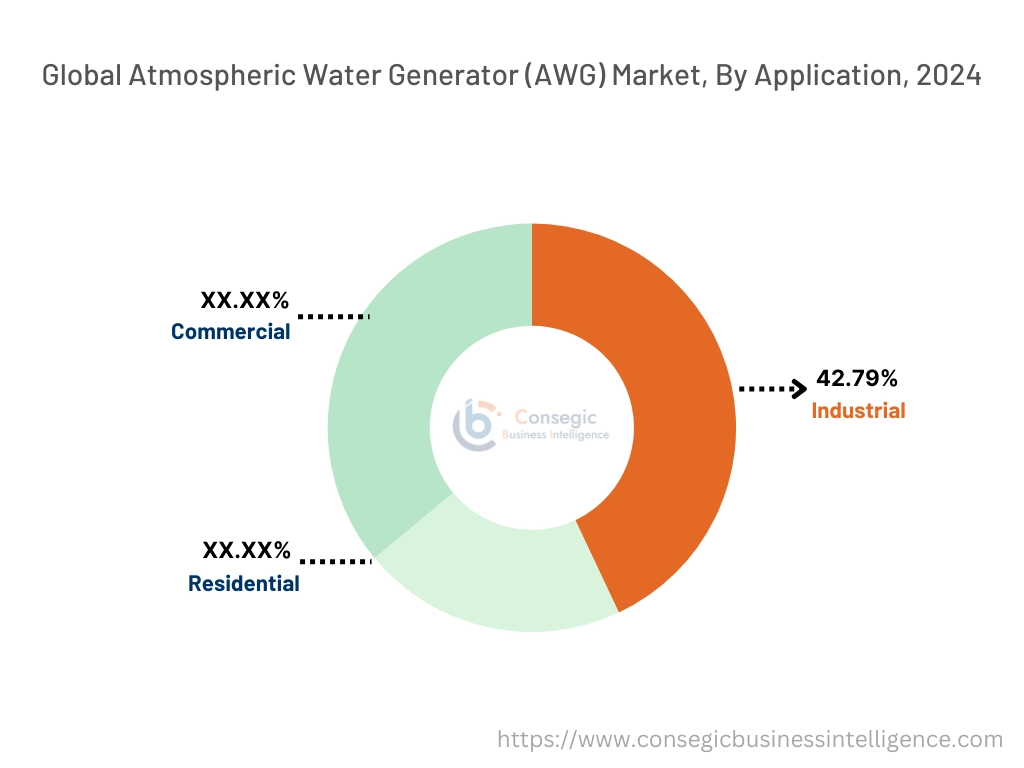
Based on the application, the market is classified into residential, commercial, and industrial.
Trends in Application:
- Increasing trend for home-based AWG units, especially in areas with unreliable water supplies or concerns about water quality.
- Growing trend towards adopting AWGs by businesses including hotels, offices, and restaurants to ensure a consistent supply of clean water for customers and employees.
Industrial accounted for the largest revenue share of 42.79% in 2024.
- Many industries, such as manufacturing, mining, and energy production, require significant amounts of water. AWGs are being adopted to mitigate the risks associated with water scarcity and unreliable water supplies.
- Industries are increasingly seeking on-site water production solutions to reduce their reliance on external water sources and transportation. AWGs offer the ability to generate water directly, hence minimizing infrastructure requirements and transportation costs.
- Industrial processes require high-quality water that meets specific standards. AWGs equipped with advanced filtration systems can produce water that meets these requirements.
- Therefore, the aforementioned benefits are bolstering the atmospheric water generator market trend.
Commercial is predicted to register the fastest growth during the forecast period.
- Businesses are increasingly seeking reliable and sustainable water sources, particularly in regions facing water scarcity or unreliable municipal water supplies.
- Many businesses are prioritizing sustainability initiatives, and AWGs align with these goals by providing an on-site, renewable water source.
- Specific sectors such as the hospitality industry, and remote work sites, and also disaster relief operations, have a growing need for independent water sources.
- In conclusion, as per the atmospheric water generator market analysis, the above-mentioned factors are collectively responsible in driving the commercial segment.
Regional Analysis:
The global atmospheric water generator market has been classified by region into North America, Europe, Asia-Pacific, MEA, and Latin America.
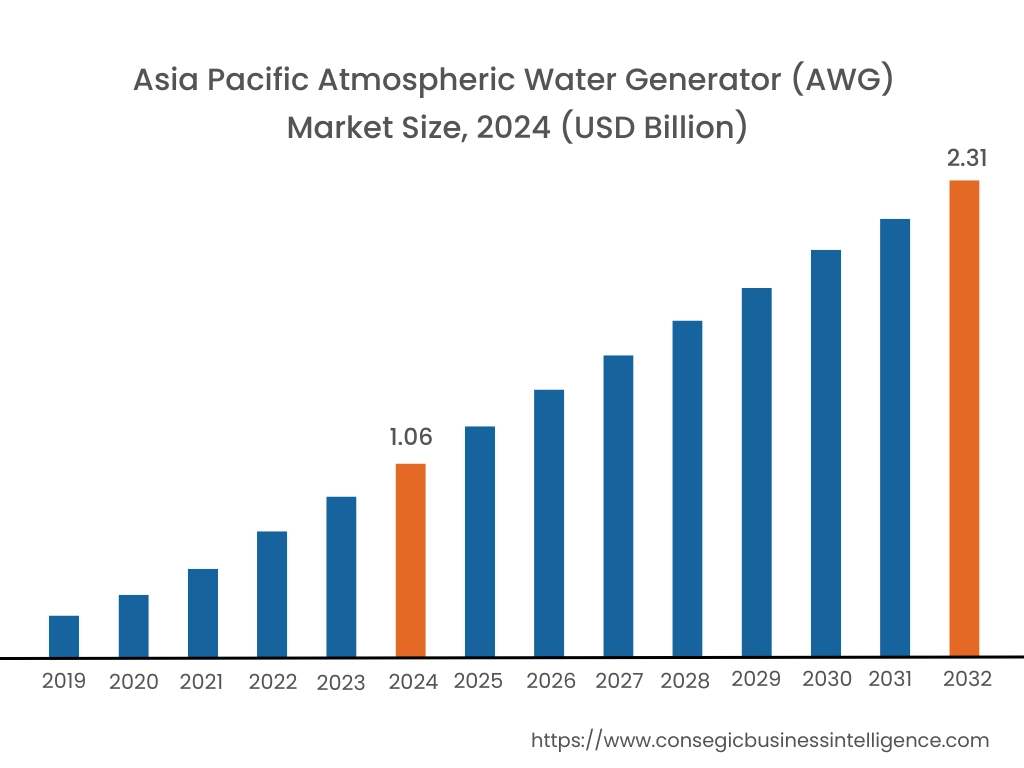
Asia Pacific region was valued at USD 1.06 Billion in 2024. Moreover, it is projected to grow by USD 1.15 Billion in 2025 and reach over USD 2.31 Billion by 2032. Out of these, China accounted for the largest revenue share of 37.52% in 2024. The region's booming industrial sector requires substantial water resources and AWGs are being adopted by industries to supplement or replace traditional water sources. Also, the rising awareness of waterborne diseases and the importance of safe drinking water is driving demand for purification solutions. Moreover, as per the analysis, the improvements in existing infrastructure in Asia Pacific countries are further contributing significantly in fueling atmospheric water generator market growth.
- For instance, in June 2022, Chennai Metro Rail Limited (CMRL) implemented atmospheric water generators at its 41 metro stations to provide clean drinking water for passengers. These systems, combined with reverse osmosis equipment, extract moisture from the air and purify it for consumption, addressing the need for accessible drinking water within the metro network.

North America was valued at USD 0.74 Billion in 2024. Moreover, it is projected to grow by USD 0.81 Billion in 2025 and reach over USD 1.69 Billion by 2032. North America is a hub for technological innovation, and there's significant investment in developing and improving AWG technology, leading to more efficient and reliable systems. Additionally, Mexico is expected to experience very strong growth in AWG usage, due to its climate conditions, and increasing needs for clean water in industrial and agricultural applications. Furthermore, the presence of key players in the region is also contributing notably in spurring the market share.
- For instance, in March 2024, GE Vernova and Montana Technologies LLC have formed a 50/50 joint venture to combine GE Vernova's advanced sorbent materials with Montana's AirJoule technology. This partnership aims to develop and commercialize atmospheric water harvesting, leveraging both companies' expertise in their respective fields.
As per the atmospheric water generator market analysis, Europe's atmospheric water generator (AWG) market is gaining traction, driven by increasing awareness of water scarcity in Southern European countries due to climate change and tourism. Additionally, a growing focus on sustainable technologies and a demand for off-grid water solutions, particularly in remote areas and for emergency preparedness, are contributing to market trends. Further, Latin America presents a significant growth opportunity for AWGs, primarily due to widespread water stress in arid and semi-arid regions. Moreover, ME&A region is experiencing substantial growth in the market, driven by severe water scarcity and arid climates.
Top Key Players & Market Share Insights:
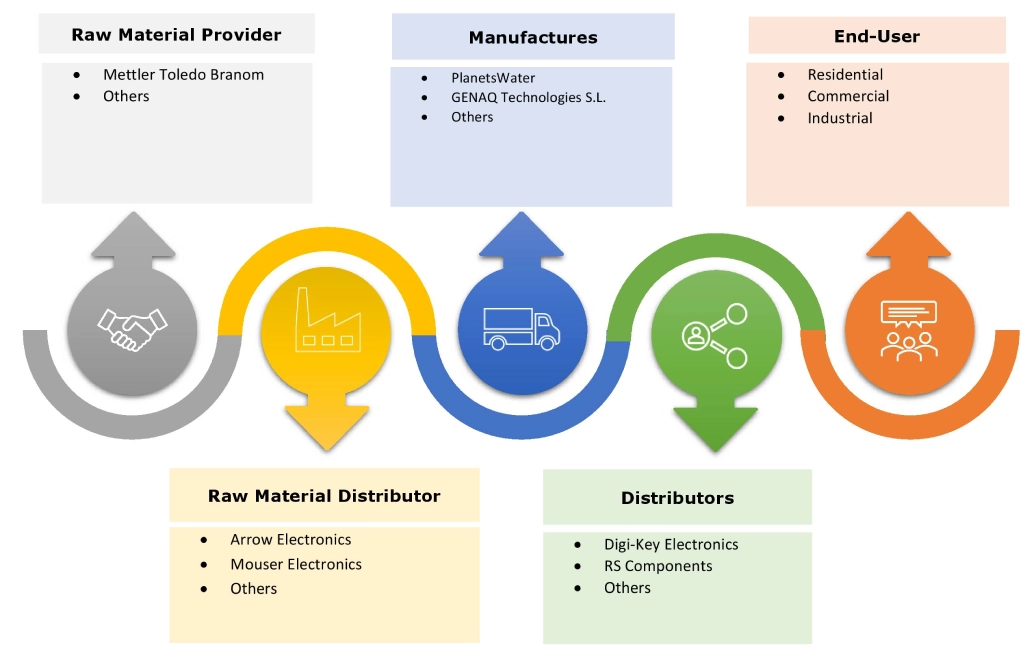
The market is highly competitive with major players providing atmospheric water generator to the national and international markets. Key players are adopting several strategies in research and development (R&D), product innovation, and end-user launches to hold a strong position in the market. Key players in the atmospheric water generator industry include-
- Akvo Atmospheric Water Systems Pvt. Ltd. (India)
- Ray Agua (USA)
- WaterMaker India Pvt. Ltd. (India)
- Atlantis Solar (USA)
- GENAQ Technologies S.L. (Spain)
- Air 2 Water Solutions (USA)
- EcoloBlue, Inc. (USA)
- PlanetsWater (USA)
- Water Technologies International, Inc. (USA)
- SkyWater Air Water Machines (USA)
- Drinkable Air (USA)
- Hendrx Water (USA)
- Watergen (Israel)
- Energy and Water Development Corp. (EAWC) (USA)
Recent Industry Developments :
- In March 2025, the S. Army awarded Genesis Systems a USD 2 million contract to develop a mobile, self-sufficient water generation system. This system, designed to be mounted on vehicles, will extract moisture from the air to produce 650 gallons of drinkable water daily, ensuring soldiers have a reliable water source in remote or challenging environments.
- In January 2023, Airiver launched consumer-grade atmospheric water generators, providing a sustainable water solution. These devices extract moisture from the air, using minimal energy, and purify it through a multi-stage filtration system. The generators produce up to 30 liters of pure, alkaline water daily, offering a convenient and eco-friendly alternative to traditional water sources.
Atmospheric Water Generator Market Report Insights:
| Report Attributes | Report Details |
| Study Timeline | 2019-2032 |
| Market Size in 2032 | USD 6.15 Billion |
| CAGR (2025-2032) | 11.6% |
| By Product |
|
| By Application |
|
| By Region |
|
| Key Players |
|
| North America | U.S. Canada Mexico |
| Europe | U.K. Germany France Spain Italy Russia Benelux Rest of Europe |
| APAC | China South Korea Japan India Australia ASEAN Rest of Asia-Pacific |
| Middle East and Africa | GCC Turkey South Africa Rest of MEA |
| LATAM | Brazil Argentina Chile Rest of LATAM |
| Report Coverage |
|
Key Questions Answered in the Report
How big is the atmospheric water generator market? −
The atmospheric water generator market size is estimated to reach over USD 6.15 Billion by 2032 from a value of USD 2.79 Billion in 2024 and is projected to grow by USD 3.03 Billion in 2025, growing at a CAGR of 11.6% from 2025 to 2032.
What specific segmentation details are covered in the atmospheric water generator report? +
The atmospheric water generator report includes specific segmentation details for product, application, and regions.
Which is the fastest segment anticipated to impact the market growth? +
In the atmospheric water generator market, commercial is the fastest-growing segment during the forecast period.
Who are the major players in the atmospheric water generator market? +
The key participants in the atmospheric water generator market are Akvo Atmospheric Water Systems Pvt. Ltd. (India), Ray Agua (USA), WaterMaker India Pvt. Ltd. (India), PlanetsWater (USA), Water Technologies International, Inc. (USA), SkyWater Air Water Machines (USA), Drinkable Air (USA), Hendrx Water (USA), Energy and Water Development Corp. (EAWC) (USA), Atlantis Solar (USA), GENAQ Technologies S.L. (Spain), Air 2 Water Solutions (USA), EcoloBlue, Inc. (USA), Watergen (Israel) and Others.
Overview
Reputation & Certifications


Our Services
- Market Intelligence & Forecasting
- Custom Research Solutions
- Market Entry Strategy
- Competitive Intelligence
- Customer Insights
- Industry Innovation Analysis
- Investment Advisory