Jump to Content
Hydronic Pumps Market - Size, Share, Industry Trends, and Forecasts (2025-2032)
Hydronic Pumps Market Size:
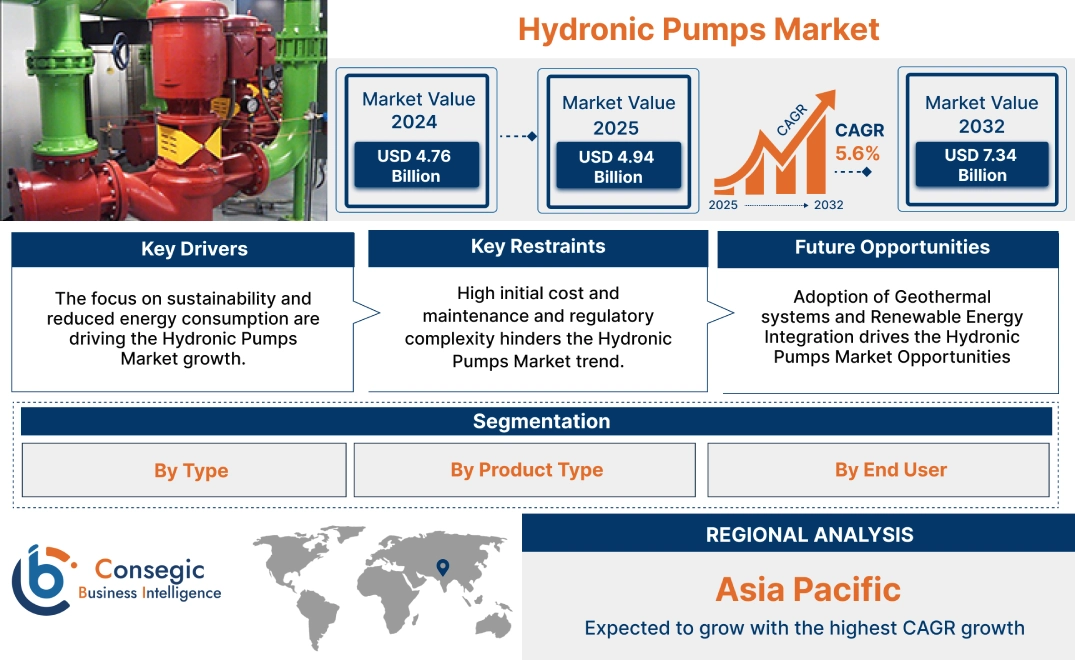
Hydronic Pumps Market size is estimated to reach over USD 7.34 Billion by 2032 from a value of USD 4.76 Billion in 2024 and is projected to grow by USD 4.94 Billion in 2025, growing at a CAGR of 5.6% from 2025 to 2032.
Hydronic Pumps Market Scope & Overview:
Hydronic pumps, also known as circulating pumps, are used in hydronic systems (heating and cooling systems using water as a heat transfer medium) to circulate water through a network of pipes, which heats or cools various parts of a building. The most common types are circulation pumps, pressure pumps, jet pumps, and evaporative pumps. They are typically centrifugal pumps, meaning they use a rotating impeller to create a pressure difference that forces water through the system. In hydronic heating systems, the pump circulates heated water from a boiler or heat pump to radiators, underfloor heating, or other heat exchangers. In hydronic cooling systems, the pump circulates chilled water from a chiller to cooling units like chilled water fans or chilled water radiators. They offer benefits like energy efficiency, reduced maintenance, and improved comfort by circulating water for heating and cooling, while also minimizing dust and allergens. They find end-user applications in industrial, residential, and commercial HVAC systems.
Hydronic Pumps Market Dynamics - (DRO):
Key Drivers:
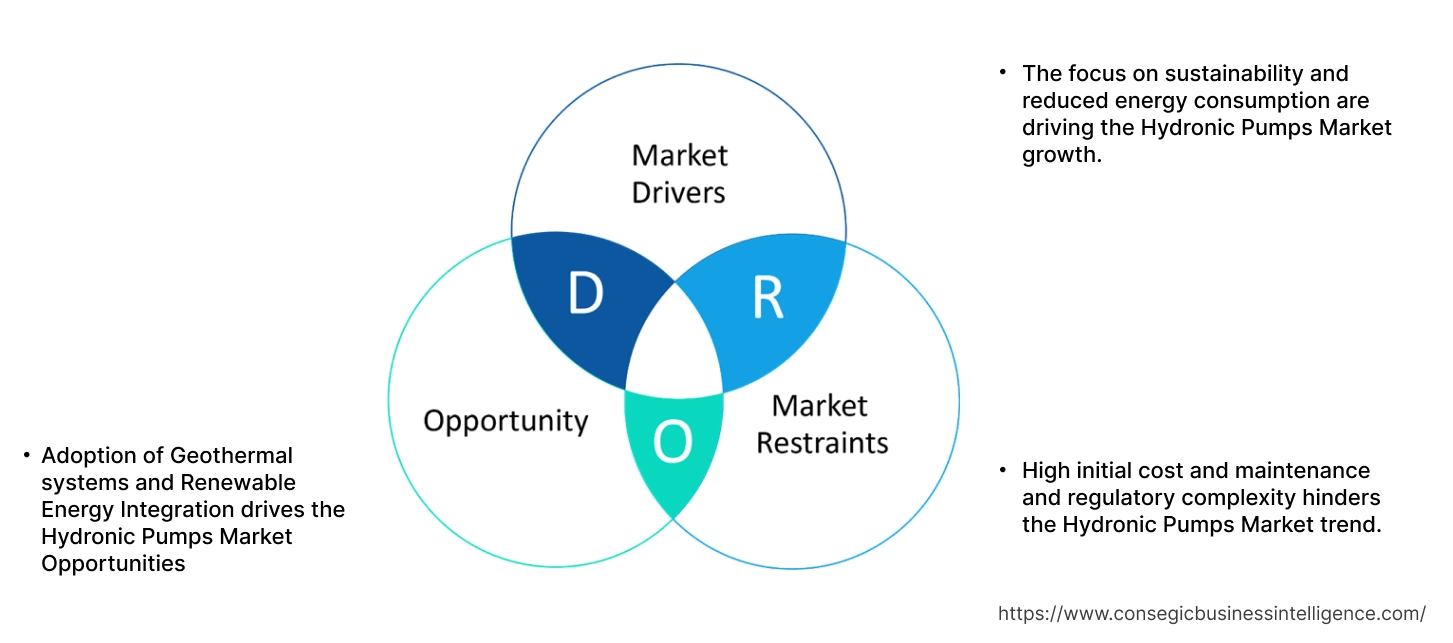
The focus on sustainability and reduced energy consumption are driving the Hydronic Pumps Market growth.
They contribute to sustainability by enabling efficient and energy-saving heating and cooling systems, promoting cleaner indoor air, and reducing the need for ductwork, ultimately lowering carbon emissions.
Hydronic systems use pumps to circulate water, rather than fans or blowers to move air, which prevents the circulation of dust, allergens, and odors. They generally have a lower carbon footprint compared to traditional heating systems like electric resistance heating. They are known for their long lifespan and low maintenance requirements, which further contributes to their sustainability.
- For instance, in February 2025, Trane – by Trane Technologies, a global climate innovator, announced the new Trane Hydronic Branch Conductor that helps retrofit and new buildings achieve higher energy efficiency and zone comfort from decarbonized, electrified heating and cooling without major structural disruptions. The Hydronic Branch Conductor supports simultaneous heating and cooling capabilities, and in certain applications improves heating efficiency by more than 35%.
Hydronic systems use water, which is a better conductor of heat than air, requiring less energy to heat and cool. These systems allow for reducing energy consumption by only heating or cooling occupied spaces. They are designed for low heat loss and high heat transfer rates, further minimizing energy usage.
Thus, the utilization of these pumps increases sustainability and reduces energy consumption further, driving the Hydronic Pumps Market.
Key Restraints:
High initial cost and maintenance and regulatory complexity hinders the Hydronic Pumps Market trend.
Hydronic systems, which use water as a heat transfer medium, involve more components than traditional heating systems, such as boilers, pumps, and a network of pipes, increasing the overall cost. When heat pumps are used in conjunction with hydronic systems, the cost of the heat pump unit itself, along with any necessary modifications to the existing HVAC system and the installation of an outdoor unit, contributes significantly to the initial investment. They also require regular maintenance, including inspections, lubrication, and seal/gasket checks, to prevent costly breakdowns and ensure optimal performance.
The global pumps market, including hydronic pumps, faces increasing regulatory complexity and higher compliance costs. Regulations related to energy efficiency, emissions, and safety standards, particularly in North America and Europe, require frequent upgrades of designs, materials, and processes, which significantly increases production costs.
Thus, the high initial setup cost and the requirement of regular maintenance and various regulatory complexities restrains the Hydronic Pumps Market expansion.
Future Opportunities:
Adoption of Geothermal systems and Renewable Energy Integration drives the Hydronic Pumps Market Opportunities
Geothermal systems are increasingly being adopted with hydronic pumps, leveraging the earth's stable temperature for efficient heating and cooling, offering advantages like reduced energy consumption and lower emissions. Geothermal heat pumps (GHPs) utilize the earth's relatively constant temperature, which is warmer than the air in winter and cooler in summer, to heat and cool buildings. These systems use water or a water-glycol mixture to circulate heat, making them suitable for integration with geothermal heat pumps. GHPs are known for their reliability, lower maintenance needs, and longer lifespans compared to air-source systems.
- For instance, in November 2024, Honeywell and Como Park Zoo & Conservatory broke ground on an expansive automation and energy efficiency project that helped advance the City of Saint Paul’s goal of achieving carbon neutrality for city operations. The project focused primarily on deploying more sustainable equipment and new control strategies in the Primates, Polar Bear and Administration buildings at the zoo and conservatory to support enhanced comfort for animals, visitors and staff. Geothermal source heat pump systems provides heating and cooling to the building hydronic systems. These systems replaced an aging central low-pressure steam plant.
Integrating renewable energy with these pumps, such as solar thermal or geothermal systems, offers a sustainable and efficient heating and cooling solution, reducing reliance on fossil fuels and lowering energy costs. Solar thermal systems use solar collectors to heat water, which is then circulated by these pumps to heat homes or buildings. Geothermal systems tap into the Earth's heat to provide heating and cooling, with these pumps circulating the heated or cooled fluid.
Thus, the adoption of geothermal systems and integration of renewable energy boosts Hydronic Pumps Market opportunities.
Hydronic Pumps Market Segmental Analysis :
By Type:
Based on type, the market is segmented into vertical and horizontal.
The vertical segment accounted for the largest revenue in the Hydronic Pumps Market share in 2024 and is anticipated to register the highest CAGR growth during the forecast period.
- Vertical hydronic pumps, also known as vertical turbine pumps or vertical centrifugal pumps, are specifically designed to move fluids, particularly water, from deep wells or reservoirs to the surface.
- These pumps are designed with their shaft and motor in a vertical orientation, allowing them to be submerged in the fluid being pumped.
- They are a type of centrifugal pump, meaning they use a rotating impeller to create a centrifugal force that moves the fluid.
- Vertical turbine pumps are known for their high efficiency in moving large volumes of water from great depths. They are designed for reliable performance and durability, making them a popular choice for demanding applications.
- They are particularly well-suited for applications where fluids need to be lifted from deep wells or reservoirs, as the vertical design allows for efficient pumping from significant depths.
- Thus, the market analysis shows the prominent trend of vertical segment bolsters the Hydronic Pumps Market growth.
By Product Type:
Based on product type, the market is segmented into heat pumps, boilers, and chillers.
The boilers segment accounted for the largest revenue in the Hydronic Pumps Market share in 2024.
- Hydronic heating systems use water as a heat transfer medium, unlike forced-air systems that use air. The boiler's primary function is to heat the water, typically using fuel combustion (natural gas, oil, etc.) or electricity.
- In this hydronic heating system, boilers heat water, which is then circulated by pumps through pipes to radiators, underfloor heating, or other heat distributors, providing warmth to the building.
- Boilers are often less expensive to install than heat pumps, especially if the existing radiators and pipes are in good condition.
- Modern hydronic systems are highly efficient, with features like condensing boilers and variable-speed pumps.
- For instance, in October 2024, Miura America introduced its latest innovation, the LXN-300SG-A, an ultra-low NOx steam boiler designed to significantly reduce emissions. This new model emits less than 5 ppm NOx, making it a standout in the industry for its environmental performance. What sets the LXN-300SG-A apart is its ability to achieve these reductions without relying on Flue Gas Recirculation (FGR) or Selective Catalytic Reduction (SCR) systems, maintaining both efficiency and sustainability.
- Thus, boilers are an essential part of the hydronic systems, heating the water which is later circulated by pumps and are driving the Hydronic Pumps market trend.
The Heat pumps segment is anticipated to register the highest CAGR growth during the forecast period.
- In hydronic systems, heat pumps function as air-to-water heat pumps, extracting heat from the air and transferring it to the water, which is then circulated through the system for heating or cooling.
- These hydronic systems use water as the heat transfer medium, circulating heated or cooled water through a network of pipes to radiators, underfloor heating, or other heat emitters.
- Heat Pumps are known for their high efficiency, meaning they use less energy to produce heat or cooling compared to traditional heating
- They typically have lower operational costs than gas boilers, as they rely on natural energy sources to provide heat.
- For instance, in October 2024, Copeland, a global provider of sustainable climate solutions, announced the launch of the Vilter VQ95 industrial heat pump to help customers reduce their carbon footprints. Copeland’s innovative Vilter VQ95 heat pump is a single-stage heat pump designed to decarbonize district heating and industrial process heating applications, including food and beverage production.
- Thus, the heat pump segment is expected to show the fastest growing Hydronic Pumps market demand.
By End User:
Based on end-user, the Hydronic Pumps market is segmented into commercial, residential and industrial.
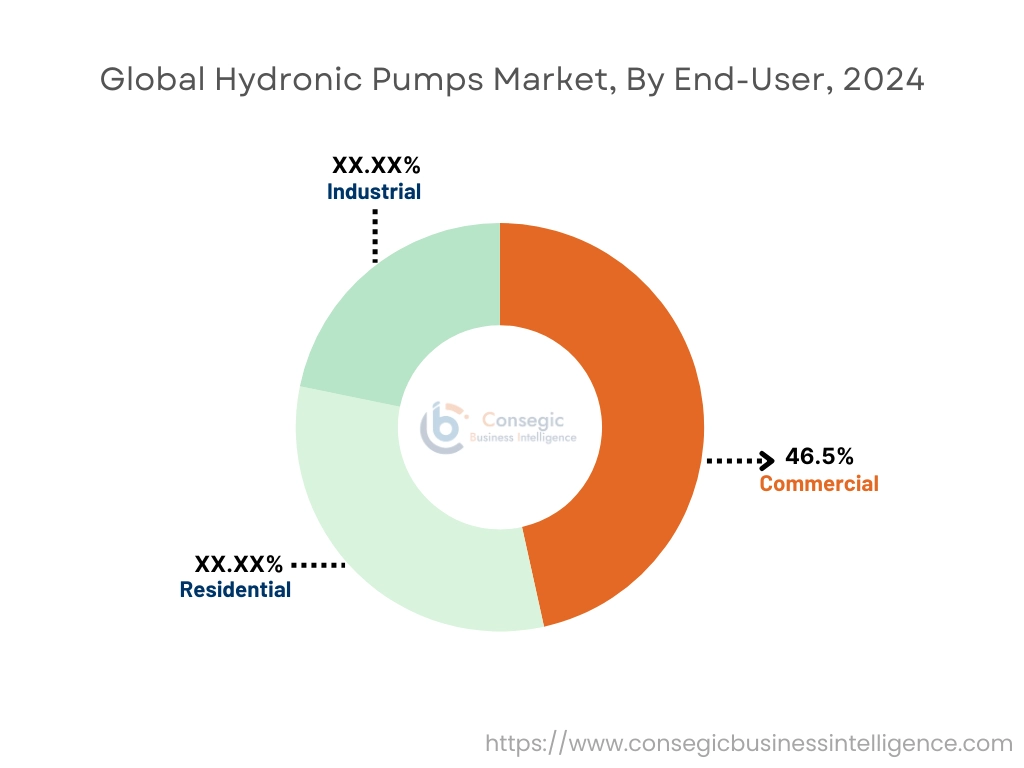
The commercial segment accounted for the largest revenue share of 46.5% in 2024.
- Hydronic pumps are widely utilized in commercial spaces including office buildings, shopping complexes, educational institutions, and healthcare facilities, where demand for efficient heating and cooling systems is substantial.
- These systems are integrated into centralized HVAC infrastructures, supporting zone-wise temperature control while ensuring energy-efficient fluid circulation.
- Continuous retrofitting of aging commercial buildings with sustainable hydronic solutions is boosting demand across developed and emerging markets alike.
- For instance, in October 2023, Panasonic Heating & Cooling Solutions expanded its portfolio of high-quality HVAC solutions to offer a wide choice to suit a variety of residential, commercial and industrial applications. The portfolio includes air-cooled and water-cooled chillers and heat pumps, fan coil units, water source heat pumps, and rooftop units.
- According to market analysis, government-backed energy efficiency programs and green building certifications are among the key trends strengthening commercial segment adoption.
The residential segment is projected to exhibit the fastest CAGR during the forecast period.
- Growing awareness regarding home energy efficiency and the rising trend of radiant floor heating are encouraging homeowners to invest in hydronic pump systems.
- The integration of smart home technologies and demand for silent, low-maintenance heating solutions further enhances product preference in the residential sector.
- Increase in residential construction activities, particularly in colder regions of Europe and North America, contributes to sustained growth.
- The increasing focus on decarbonized heating solutions in residential buildings will drive strong adoption throughout the forecast period, bolstering the Hydronic Pumps Market expansion.
Regional Analysis:
The regions covered are North America, Europe, Asia Pacific, the Middle East and Africa, and Latin America.
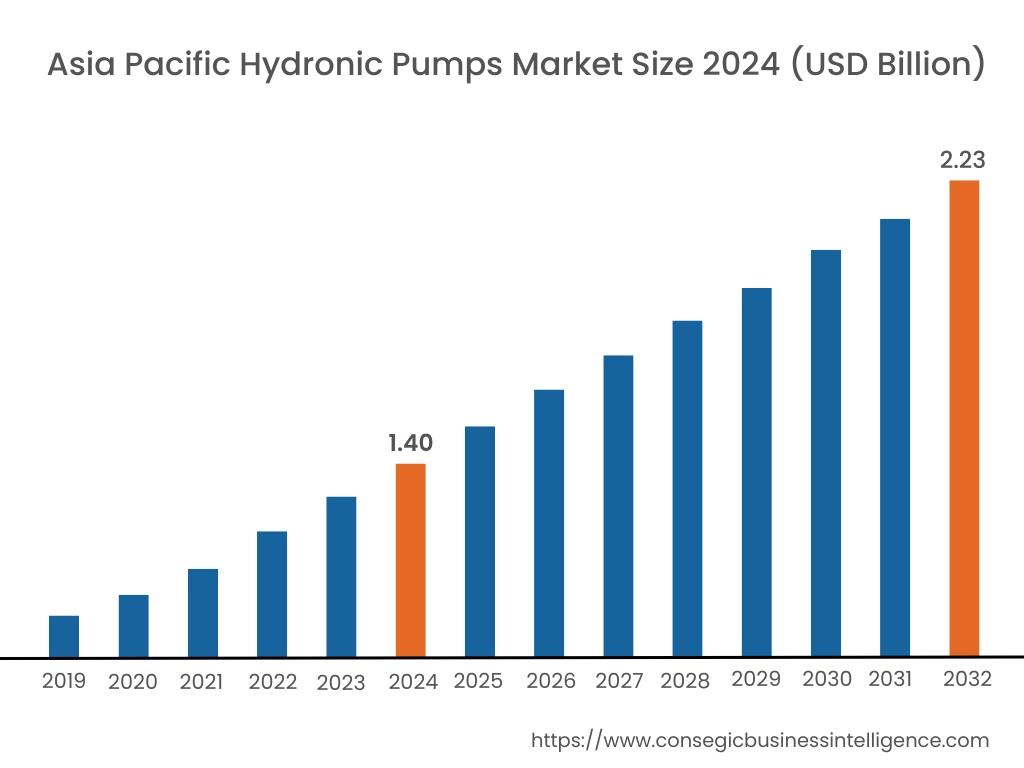
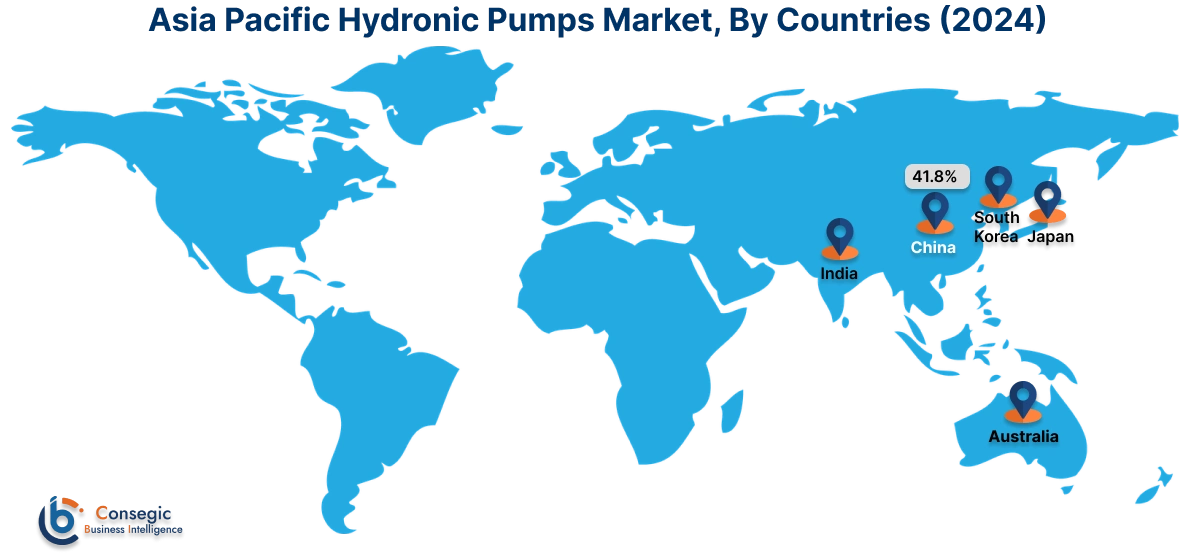
Asia Pacific region was valued at USD 1.40 Billion in 2024. Moreover, it is projected to grow by USD 1.46 Billion in 2025 and reach over USD 2.23 Billion by 2032. Out of this, China accounted for the maximum revenue share of 41.8%.
The demand for hydronic heat pumps in Asia-Pacific region is rising due to the need for energy-efficient and environmentally friendly heating and cooling solutions, particularly in the context of meeting net-zero targets. Manufacturers are focusing on developing cost-effective and energy-efficient hydronic heat pump solutions, with innovations like EVI (Evaporator-based Inverter) technology. These pumps, used in heating and cooling systems, see growth driven by factors like urbanization, increasing mechanization in agriculture, and the push for energy-efficient solutions. As Asian cities grow, the demand for efficient heating and cooling systems in buildings, including commercial and residential spaces, rises. Governments and businesses in Asia are increasingly focused on reducing carbon emissions and promoting energy-efficient technologies, making heat pumps a key solution. The adoption of hydraulic pumps in farming has increased this due to the increased mechanization of agricultural activities.
- For instance, in June 2023, RMIT University launched a new Co2 Training Facility that is the most advanced refrigeration and air conditioning training system in the Asia-Pacific region. Components including frequency inverters, parallel compression and heat reclaim, along with adiabatic cooling and hydronic systems, are part of the new Co2 Training Facility.
Thus, the Hydronic Pumps Market analysis highlights their growing trend in the APAC region due to rapid urbanization, increased mechanization and push for energy-efficient solutions.
North America is estimated to reach over USD 2.38 Billion by 2032 from a value of USD 1.58 Billion in 2024 and is projected to grow by USD 1.64 Billion in 2025.
Hydronic pumps and systems, including air-to-water heat pumps, are in trend in North America and are the largest revenue share holder in the global Hydronic Pumps Market due to growing energy efficiency and sustainability concerns, government incentives, and increasing demand for reliable heating and cooling solutions.
They are primarily used in hydronic heating and cooling systems, circulating water or other fluids to transfer heat from a source (like a boiler or heat pump) to heat emitters (radiators, baseboards, radiant floors) or to a cooling system. They circulate heated water from a boiler or heat pump through a network of pipes to radiators, baseboard convectors, or radiant heating systems, providing efficient and comfortable heating. Both residential and commercial buildings are increasingly adopting hydronic systems for heating and cooling, and hot water heating. Modern hydronic systems often use variable-speed pumps (using variable frequency drives or VFDs) to optimize energy efficiency by adjusting pump speed to match the system's needs.
- For instance, in June 2023, HTS Eng. Ltd announced its agreement with the owners of Arlington, Texas-based Oslin Nation to acquire the 80-year-old hydronics company. The strategic move enhances HTS’ HVAC and Building Automation Controls offerings and strengthens the fast-growing independent manufacturers rep firm’s Texas footprint with sought-after pump and plumbing capabilities. This acquisition significantly grows their business with leading suppliers of hydronic products and systems to the commercial and industrial building space.
Thus, the Hydronic Pumps market analysis highlights the global dominance of the North American region in Hydronic Pumps Market.
Hydronics have started being used extensively in Europe, where the high cost and scarce fuel availability made homeowners look for the most economical and effective heating options, given how cost-efficient they are. A well-designed and installed hydronic system are very practical in terms of energy use. Many European governments are implementing policies and providing incentives to promote the use of heat pumps, further fueling their popularity. The push to decarbonize the heating sector, which contributes significantly to CO2 emissions, is a major driver for the adoption of heat pumps. The hydronic central heating is one of the most efficient and economical alternatives of heating your home. It has become one of the primary choices for house heating in the UK.
Thus, the market analysis highlights the increased use of these pumps in the European region due to their cost efficiency and government policies.
Hydronic pumps and HVAC systems are gaining traction in the Middle East and Africa (MEA) due to growing demand for energy-efficient cooling and heating solutions, particularly in regions with extreme temperatures and increasing urbanization. They are increasingly used for energy-efficient heating and cooling in both residential and commercial sectors, driven by extreme temperatures and a focus on sustainability, particularly in countries like Saudi Arabia. The region's hot climate and increasing awareness of energy efficiency are driving the adoption of hydronic HVAC systems, which utilize water for heat transfer, making them a suitable solution for cooling and heating.
Thus, the market analysis shows that the region is experiencing a growth in utilization of these pumps due to the requirement of energy-efficient cooling and heating solutions in high temperature areas driving the market.
Hydronic pumps and systems, including heat pumps, are experiencing growth and increased trend in Latin America, driven by the region's focus on energy efficiency and sustainable building practices. Latin American countries are increasingly prioritizing energy-efficient solutions for both residential and commercial buildings, leading to a rise in the adoption of hydronic HVAC systems. The surge in construction investments across Latin America, including projects for bioclimatic homes and water infrastructure, is further fueling the demand for pumps.
Thus, according to the market analysis, Latin American countries are focusing of building energy efficient solutions resulting in the rise of hydronic pumps industry.
Top Key Players & Market Share Insights:
The Hydronic Pumps market is highly competitive with major players providing products and services to the national and international markets. Key players are adopting several strategies in research and development (R&D), product innovation, and end-user launches to hold a strong position in the global Hydronic Pumps market. Key players in the Hydronic Pumps industry include–
- Armstrong Fluid Technology (Canada)
- Grundfos (Denmark)
- Ruhrpumpen Group (Germany)
- KSB (Germany)
- EBARA (Japan)
- Wilo (Germany)
- Xylem (US)
- Sulzer (Switzerland)
- Flowserve (US)
- ITT (US)
Recent Industry Developments :
Acquisitions:
- In April 2024, Mitsubishi Electric Corporationannounced its wholly owned subsidiaries Mitsubishi Electric Hydronics & IT Cooling Systems S.p.A. and Mitsubishi Electric Europe B.V. wholly acquired AIRCALO, an air-conditioning company in France. Going forward, Mitsubishi Electric expects to leverage AIRCALO’s broad product line and strong customization capabilities to expand and upgrade its hydronic HVAC systems business in the diversifying European market, including by meeting strong demand for made-to-order products and environmental awareness.
Hydronic Pumps Market Report Insights:
| Report Attributes | Report Details |
| Study Timeline | 2019-2032 |
| Market Size in 2032 | USD 7.34 Billion |
| CAGR (2025-2032) | 5.6% |
| By Type |
|
| By Product Type |
|
| By End User |
|
| By Region |
|
| Key Players |
|
| North America | U.S. Canada Mexico |
| Europe | U.K. Germany France Spain Italy Russia Benelux Rest of Europe |
| APAC | China South Korea Japan India Australia ASEAN Rest of Asia-Pacific |
| Middle East and Africa | GCC Turkey South Africa Rest of MEA |
| LATAM | Brazil Argentina Chile Rest of LATAM |
| Report Coverage |
|
Key Questions Answered in the Report
What are Hydronic Pumps? −
Hydronic Pumps, also known as circulating pumps, are used in hydronic systems to circulate water through a network of pipes, transferring heat or cooling. They are basically centrifugal pumps, using a rotating impeller to create a pressure difference forcing water through the system.
What are the key drivers of the Hydronic Pumps Market? +
The increasing focus on sustainability and reduced energy consumption is the major driver of the hydronic pumps market. They contribute to a sustainable environment by providing efficient and energy saving heating and cooling systems. This results in cleaner indoor air, reducing carbon emissions. Hydronic systems use water, which requires less energy to heat and cool, thus reducing energy consumption.
What specific segmentation details are covered in the Hydronic Pumps market report and how is the dominating segment impacting market growth? +
The market is segmented on the basis of type, product type, and end-user. In which, the vertical segment is dominating as vertical hydronic pumps are designed specifically to move fluids, particularly water, from deep wells or reservoirs to the surface. These pumps allow themselves to be submerged in the fluid being pumped. They are used in applications requiring fluids lifting from deep wells and their vertical designs allows for efficient pumping.
Who are the major key players in the Hydronic Pumps Market? +
Armstrong Fluid Technology (Canada), Grundfos (Denmark), Wilo (Germany), Xylem (US), Sulzer (Switzerland), Flowserve (US), ITT (US), Ruhrpumpen Group (Germany), KSB (Germany), EBARA (Japan).
Overview
Reputation & Certifications


Our Services
- Market Intelligence & Forecasting
- Custom Research Solutions
- Market Entry Strategy
- Competitive Intelligence
- Customer Insights
- Industry Innovation Analysis
- Investment Advisory