Jump to Content
Hypersonic Weapons Market - Size, Share, Industry Trends, and Forecasts (2025 - 2032)
Hypersonic Weapons Market Size:
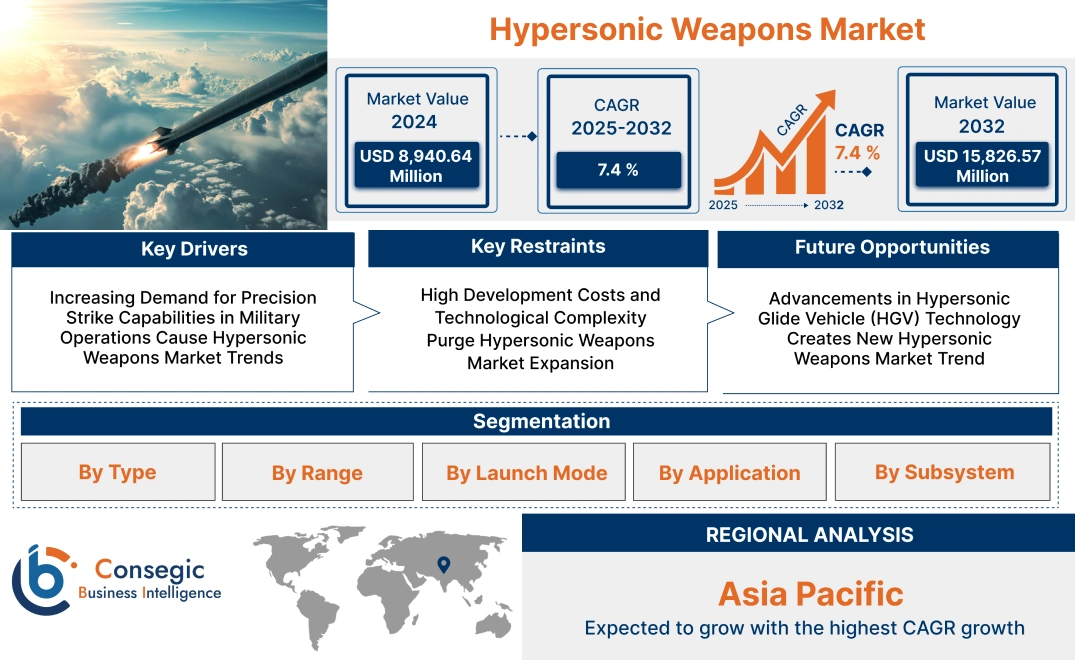
Hypersonic Weapons Market size is estimated to reach over USD 15,826.57 Million by 2032 from a value of USD 8,940.64 Million in 2024 and is projected to grow by USD 9,442.94 Million in 2025, growing at a CAGR of 7.4 % from 2025 to 2032.
Hypersonic Weapons Market Scope & Overview:
Hypersonic weapons are advanced military systems designed to travel at speeds exceeding Mach 5, or five times the speed of sound. These weapons combine precision, maneuverability, and rapid response capabilities, making them a critical component of modern defense strategies. Their aerodynamic designs and high-speed propulsion systems enable them to evade traditional missile defense systems. Key properties of hypersonic weapons include exceptional speed, enhanced accuracy, and the ability to penetrate heavily fortified defenses. These features provide significant tactical advantages in neutralizing high-value targets and delivering strategic impact. Their benefits also include reduced reaction times, increased survivability, and precision in both offensive and defensive military operations.
Applications of hypersonic weapons span missile systems, surveillance operations, and counter-defense mechanisms. End-use industries include defense forces, aerospace agencies, and security organizations, underscoring their importance in national security and global defense advancements.
Hypersonic Weapons Market Dynamics - (DRO) :
Key Drivers:
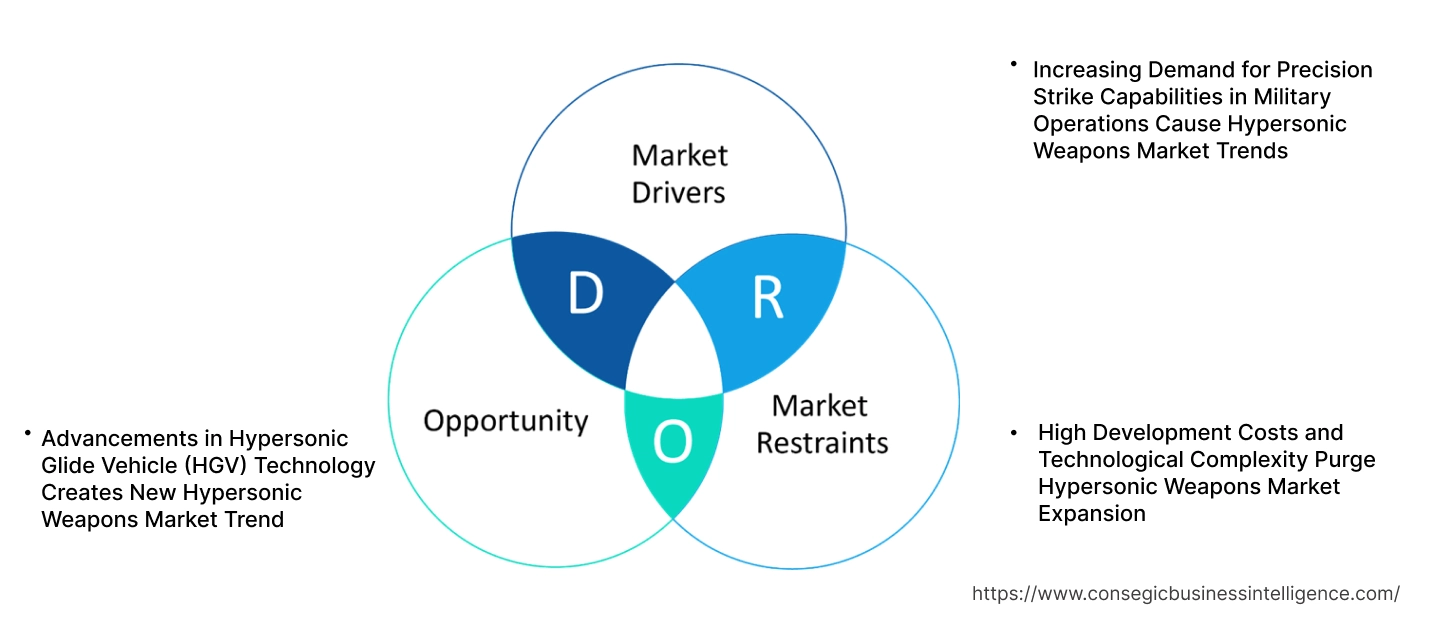
Increasing Demand for Precision Strike Capabilities in Military Operations Cause Hypersonic Weapons Market Trends
The need for precision strike capabilities is a key factor propelling the hypersonic weapons market. Hypersonic weapons, with their ability to travel at speeds exceeding Mach 5, allow for precise targeting with minimal response time, enhancing military effectiveness. This capability is crucial in modern warfare, where swift neutralization of threats is essential to maintain strategic advantage. For instance, the United States has been actively developing hypersonic missiles to strengthen its defense capabilities against adversaries.
As nations continue to invest in advanced weaponry to improve military precision, the demand for hypersonic weapons is expected to intensify.
Key Restraints:
High Development Costs and Technological Complexity Purge Hypersonic Weapons Market Expansion
The development of hypersonic weapons requires significant financial investment and advanced technological expertise. This includes research in materials capable of withstanding extreme temperatures and integration of cutting-edge propulsion systems. These challenges increase the overall cost of production, making hypersonic weapons inaccessible for nations with limited defense budgets. For instance, the high costs associated with scramjet engine development and thermal protection systems can deter investment.
These financial and technical barriers limit the widespread adoption of hypersonic weapons, restraining hypersonic weapons market growth.
Future Opportunities :
Advancements in Hypersonic Glide Vehicle (HGV) Technology Creates New Hypersonic Weapons Market Trend
The ongoing advancements in hypersonic glide vehicle technology are anticipated to create significant hypersonic weapons market opportunities. HGVs enhance maneuverability and accuracy, making them a preferred choice for next-generation missile systems. Countries like China and Russia are investing heavily in this technology to achieve a strategic edge. For example, the successful testing of the Russian Avangard system showcases the potential of HGVs in redefining modern warfare.
These advancements are expected to expand the application scope of hypersonic weapons, driving future hypersonic weapons market growth.
Hypersonic Weapons Market Segmental Analysis :
By Type:
Based on type, the hypersonic weapons market is segmented into hypersonic glide vehicles (HGV) and hypersonic cruise missiles.
The hypersonic glide vehicles (HGV) sector accounted for the largest revenue in hypersonic weapons market share in 2024.
- Hypersonic glide vehicles are launched from a rocket and then glide to their target at hypersonic speeds.
- They are designed to maneuver and evade missile defenses, making them a strategic asset in military applications.
- The development and deployment of HGVs are driven by advancements in materials, propulsion technologies, and defense requirements.
- Major defense agencies and contractors are heavily investing in HGV research and development to enhance their capabilities.
- Therefore, according to hypersonic weapons market analysis, the strategic importance and advanced technology of HGVs contribute significantly to their revenue share.
The hypersonic cruise missiles sector is anticipated to register the fastest CAGR during the forecast period.
- Hypersonic cruise missiles are powered by high-speed engines, such as scramjets, and travel at sustained hypersonic speeds.
- These missiles are capable of rapid response and precision targeting, making them a critical component of modern military arsenals.
- The growing emphasis on precision strike capabilities and the need for rapid response systems drive the development of hypersonic cruise missiles.
- Ongoing research and advancements in propulsion and guidance technologies are expected to enhance their performance.
- Thus, according to hypersonic weapons market analysis, increasing focus on defense modernization and strategic deterrence is fueling the rapid demand for hypersonic cruise missiles.
By Range:
Based on range, the hypersonic weapons market is segmented into short-range (up to 500 km), medium-range (500 km-2,000 km), and long-range (more than 2,000 km).
The medium range (500 km–2,000 km) sector accounted for the largest revenue in hypersonic weapons market share in 2024.
- Medium-range hypersonic weapons are designed to engage targets at intermediate distances, making them versatile for various military applications.
- They offer a balance between range, speed, and payload capacity, making them suitable for regional conflicts and strategic missions.
- The development of medium-range hypersonic weapons is driven by the need for flexible and adaptable defense systems.
- Defense agencies are prioritizing medium-range hypersonic capabilities to enhance their operational reach and strategic options.
- Therefore, according to market analysis, the adaptability and strategic relevance of medium-range hypersonic weapons contribute significantly to their revenue share.
The long-range (more than 2,000 km) sector is anticipated to register the fastest CAGR during the forecast period.
- Long-range hypersonic weapons are designed to strike targets at extended distances, providing a strategic advantage in global conflict scenarios.
- These weapons can bypass traditional missile defenses due to their high speeds and maneuverability.
- The development of long-range hypersonic weapons is driven by the need for global strike capabilities and strategic deterrence.
- Ongoing advancements in propulsion, guidance, and materials technologies are expected to enhance the performance of long-range hypersonic weapons.
- Thus, according to market analysis, the strategic importance and extended reach of long-range hypersonic weapons are fueling their rapid hypersonic weapons market
By Launch Mode:
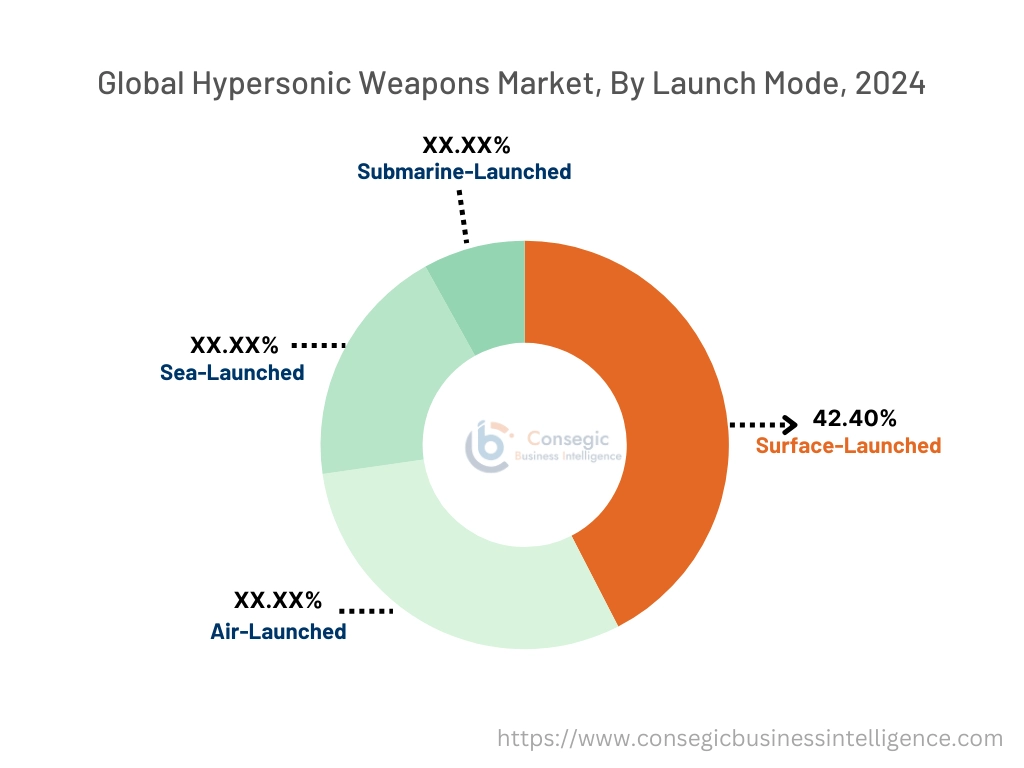
Based on launch mode, the hypersonic weapons market is segmented into surface-launched, air-launched, sea-launched, and submarine-launched.
The surface-launched sector accounted for the largest revenue share of 42.40% in 2024.
- Surface-launched hypersonic weapons are deployed from ground-based platforms, offering a stable and flexible launch option.
- These weapons can be integrated into existing defense infrastructure, making them a cost-effective solution for enhancing military capabilities.
- The development of surface-launched hypersonic weapons is driven by the need for rapid and reliable strike options.
- Defense agencies are investing in surface-launched hypersonic systems to bolster their strategic and tactical capabilities.
- Therefore, according to market analysis, the stability and integration potential of surface-launched hypersonic weapons contribute significantly to their revenue share.
The air-launched sector is anticipated to register the fastest CAGR during the forecast period.
- Air-launched hypersonic weapons are deployed from aircraft, providing a flexible and rapid response option.
- These weapons can be launched from various platforms, including fighter jets and bombers, enhancing their operational versatility.
- The development of air-launched hypersonic weapons is driven by the need for rapid deployment and precision strike capabilities.
- Ongoing advancements in aircraft integration and propulsion technologies are expected to enhance the performance of air-launched hypersonic weapons.
- Thus, according to market analysis, the flexibility and rapid response potential of air-launched hypersonic weapons are fueling their rapid hypersonic weapons market
By Application:
Based on application, the hypersonic weapons market is segmented into military and defense and homeland security.
The military and defense sector accounted for the largest revenue share in 2024.
- Hypersonic weapons are primarily developed for military and defense applications due to their strategic and tactical advantages.
- These weapons provide a significant enhancement in strike capabilities, deterrence, and defense penetration.
- The development of hypersonic weapons for military use is driven by the need to maintain strategic superiority and counter emerging threats.
- Defense agencies and contractors are heavily investing in hypersonic weapon programs to enhance their military capabilities.
- Therefore, according to market analysis, the strategic importance and tactical advantages of hypersonic weapons in military applications contribute significantly to their revenue share.
The homeland security sector is anticipated to register the fastest CAGR during the forecast period.
- Hypersonic weapons are also being developed for homeland security applications, providing rapid response and precision targeting capabilities.
- These weapons can be used to counter threats such as ballistic missiles, high-speed aircraft, and unmanned systems.
- The development of hypersonic weapons for homeland security is driven by the need for advanced defense solutions to protect critical infrastructure and national security.
- Ongoing advancements in detection, tracking, and interception technologies are expected to enhance the effectiveness of hypersonic weapons in homeland security.
- Thus, according to market analysis, growing emphasis on national security and critical infrastructure protection is fueling the rapid trend of hypersonic weapons in homeland security applications.
By Subsystem:
Based on subsystem, the hypersonic weapons market is segmented into guidance systems, propulsion systems, boost-glide, and warheads.
The propulsion systems sector accounted for the largest revenue share in 2024.
- Propulsion systems are critical components of hypersonic weapons, providing the necessary thrust to achieve hypersonic speeds.
- These systems include advanced engines such as scramjets and rocket boosters, which enable sustained high-speed flight.
- The development of propulsion systems for hypersonic weapons is driven by the need for efficient and reliable thrust technologies.
- Defense agencies and contractors are investing in the research and development of advanced propulsion systems to enhance the performance of hypersonic weapons.
- Therefore, according to market analysis, the critical role and technological advancements of propulsion systems contribute significantly to their revenue share.
The guidance system sector is anticipated to register the fastest CAGR during the forecast period.
- Guidance systems are essential for the precise navigation and targeting of hypersonic weapons, ensuring they reach their intended targets.
- These systems include advanced sensors, navigation algorithms, and control mechanisms that enable accurate flight and impact.
- The development of guidance systems for hypersonic weapons is driven by the need for precision strike capabilities and reliable navigation.
- Ongoing advancements in sensor technologies, artificial intelligence, and control algorithms are expected to enhance the performance of guidance systems.
- Thus, according to market analysis, the importance of precision targeting and navigation is fueling the rapid trend of guidance systems in hypersonic weapons.
Regional Analysis:
The regional segment includes North America, Europe, Asia Pacific, the Middle East and Africa, and Latin America.
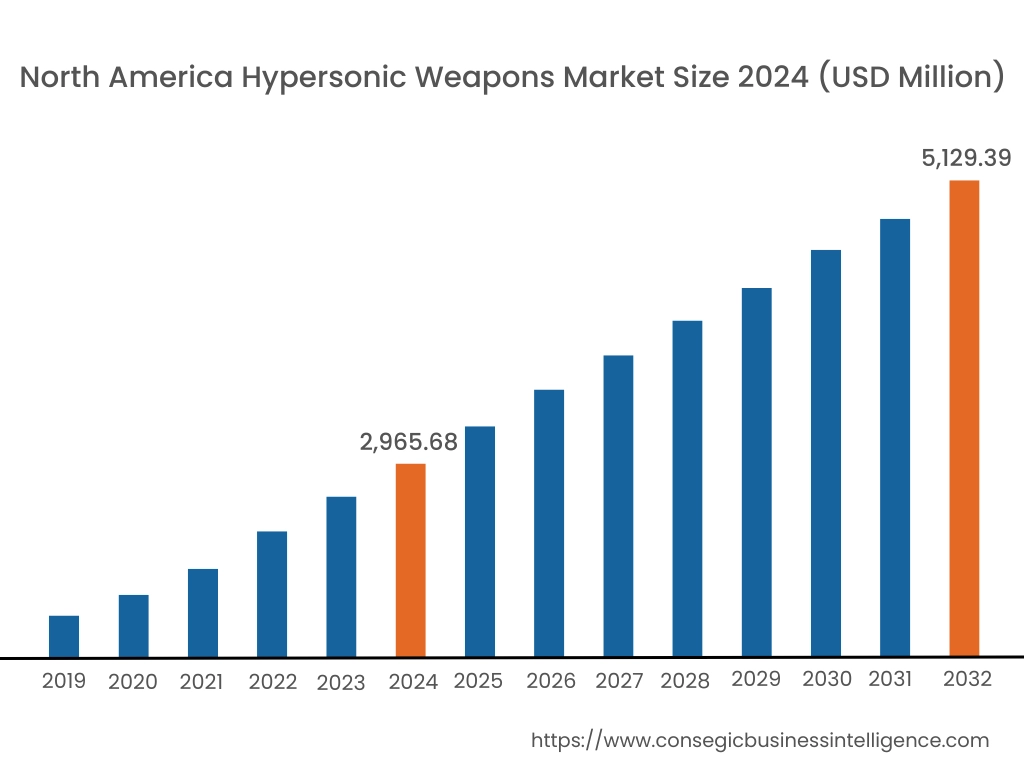
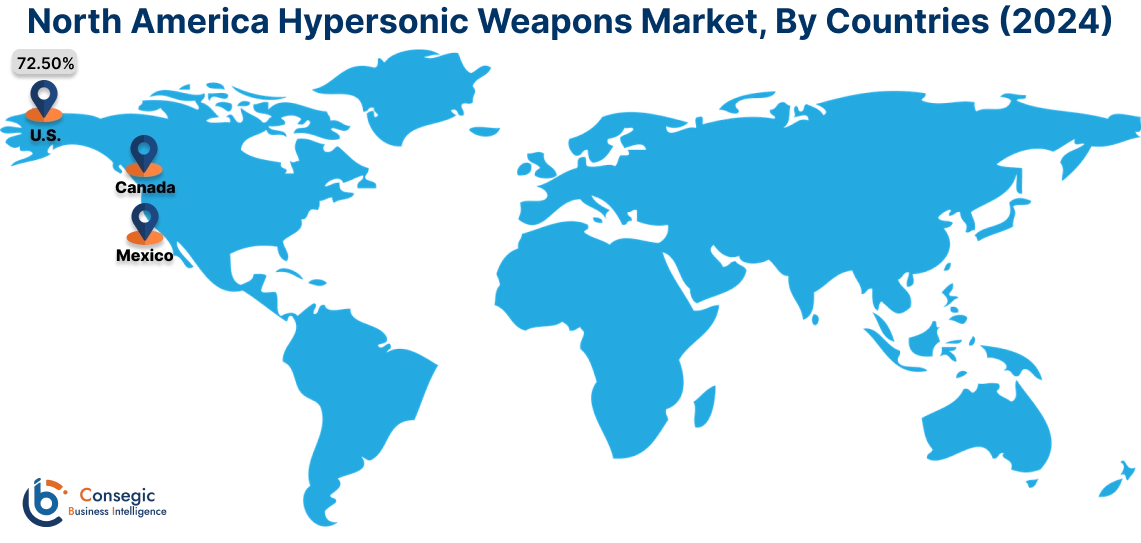
In 2024, North was valued at USD 2,965.68 Million and is expected to reach USD 5,129.39 Million in 2032. In North America, the U.S. accounted for the highest share of 72.50% during the base year of 2024. The United States has heavily invested in hypersonic technology, driven by the need for strategic deterrence and modernizing its defense capabilities. Programs like the Conventional Prompt Strike (CPS) and Hypersonic and Ballistic Tracking Space Sensor (HBTSS) demonstrate the region's commitment to advancing hypersonic capabilities. The presence of leading defense contractors and substantial defense budgets further support the hypersonic weapons market trend.
In Asia Pacific, the market is experiencing the fastest growth with a CAGR of 7.8% over the forecast period. Countries like China and India are actively developing hypersonic weapons to enhance their military capabilities. China's advancements in hypersonic glide vehicles and India's Hypersonic Technology Demonstrator Vehicle (HSTDV) project highlight the region's focus on hypersonic technology. Geopolitical tensions and the need for strategic superiority drive significant investments in hypersonic weapons in this region.
Europe has shown steady growth in the hypersonic weapons market. Nations like France and Germany are investing in hypersonic research and development to strengthen their defense capabilities. Collaborative projects within the European Union, such as the Future Hypersonic Technology Demonstrator Platform (FHTDP), contribute to the region's advancements in hypersonic technology. The focus on defense modernization and technological innovation supports market growth.
The Middle East and Africa region has experienced moderate growth in the hypersonic weapons market. Countries like Saudi Arabia and the United Arab Emirates are investing in advanced defense systems, including hypersonic weapons, to enhance their military capabilities. The region's strategic importance and the need for advanced weaponry drive the adoption of hypersonic technology. However, economic challenges and geopolitical instability pose barriers to market expansion.
Latin America has shown potential for growth in the hypersonic weapons market. Countries like Brazil and Argentina are exploring hypersonic technology to strengthen their defense capabilities. The region's focus on modernizing military forces and enhancing national security drives investments in hypersonic weapons. Collaborations with global defense contractors and advancements in defense research support market growth.
Top Key Players and Market Share Insights:
The Global Hypersonic Weapons Market is highly competitive with major players providing products to the national and international markets. Key players are adopting several strategies in research and development (R&D), product innovation, and end-user launches to hold a strong position in the Global Hypersonic Weapons Market. Key players in the Hypersonic Weapons industry include-
- Lockheed Martin Corporation (United States)
- Raytheon Technologies Corporation (United States)
- Kongsberg Defence & Aerospace AS (Norway)
- Tactical Missiles Corporation JSC (KTRV) (Russia)
- Aerojet Rocketdyne Holdings, Inc. (United States)
- Northrop Grumman Corporation (United States)
- The Boeing Company (United States)
- General Dynamics Corporation (United States)
- BAE Systems plc (United Kingdom)
- Thales Group (France)
Hypersonic Weapons Market Report Insights :
| Report Attributes | Report Details |
| Study Timeline | 2019-2032 |
| Market Size in 2032 | USD 15,826.57 million |
| CAGR (2025-2032) | 7.4 % |
| By Type |
|
| By Range |
|
| By Launch Mode |
|
| By Application |
|
| By Subsystem |
|
| By Region |
|
| Key Players |
|
| North America | U.S. Canada Mexico |
| Europe | U.K. Germany France Spain Italy Russia Benelux Rest of Europe |
| APAC | China South Korea Japan India Australia ASEAN Rest of Asia-Pacific |
| Middle East and Africa | GCC Turkey South Africa Rest of MEA |
| LATAM | Brazil Argentina Chile Rest of LATAM |
| Report Coverage |
|
Key Questions Answered in the Report
How big is the Hypersonic Weapons Market? −
In 2024, the Hypersonic Weapons Market was USD 8,940.64 million.
What will be the potential market valuation for the Hypersonic Weapons Market by 2032? +
In 2032, the market size of Hypersonic Weapons Market is expected to reach USD 15,826.57 million.
What are the segments covered in the Hypersonic Weapons Market report? +
The type, range, launch mode, application, and subsystem are the segments covered in this report.
Who are the major players in the Hypersonic Weapons Market? +
Lockheed Martin Corporation (United States), Raytheon Technologies Corporation (United States), Northrop Grumman Corporation (United States), The Boeing Company (United States), General Dynamics Corporation (United States), BAE Systems plc (United Kingdom), Thales Group (France), Kongsberg Defence & Aerospace AS (Norway), Tactical Missiles Corporation JSC (KTRV) (Russia), Aerojet Rocketdyne Holdings, Inc. (United States) are the major players in the Hypersonic Weapons market.
Overview
Reputation & Certifications


Our Services
- Market Intelligence & Forecasting
- Custom Research Solutions
- Market Entry Strategy
- Competitive Intelligence
- Customer Insights
- Industry Innovation Analysis
- Investment Advisory