Jump to Content
Maritime Patrol Aircraft Market - Size, Share, Industry Trends, and Forecasts (2025 - 2032)
Maritime Patrol Aircraft Market Size:
Maritime Patrol Aircraft Market size is estimated to reach over USD 25,113.17 Million by 2032 from a value of USD 17,850.55 Million in 2024 and is projected to grow by USD 18,310.77 Million in 2025, growing at a CAGR of 4.4% from 2025 to 2032.
Maritime Patrol Aircraft Market Scope & Overview:
Maritime patrol aircraft are specialized aircraft designed for surveillance, reconnaissance, and anti-submarine warfare in maritime environments. These aircraft are equipped with advanced sensors, radar systems, and communication tools to monitor activities across vast oceanic regions, ensuring the security and operational efficiency of maritime domains. They are widely used by naval forces, coast guards, and border protection agencies for tasks such as search and rescue, anti-piracy operations, and environmental monitoring.
These aircraft are tailored to meet diverse mission requirements, featuring capabilities like long-range endurance, real-time data transmission, and integration with naval fleets. They are equipped with systems for detecting and tracking surface and underwater targets, enhancing situational awareness in critical operations. Designed for reliability, they perform efficiently in various weather conditions and operational scenarios.
End-users include defense organizations, government agencies, and international bodies focused on safeguarding maritime interests. Maritime patrol aircraft play a critical role in modernizing maritime surveillance and ensuring the security of territorial waters and trade routes.
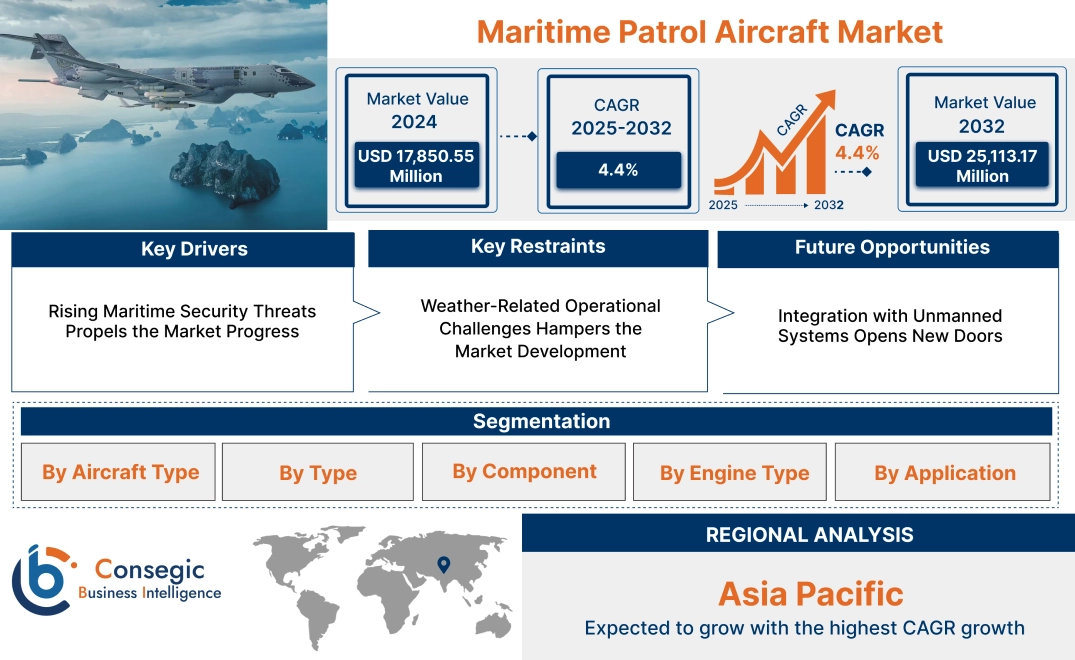
Maritime Patrol Aircraft Market Dynamics - (DRO) :
Key Drivers:
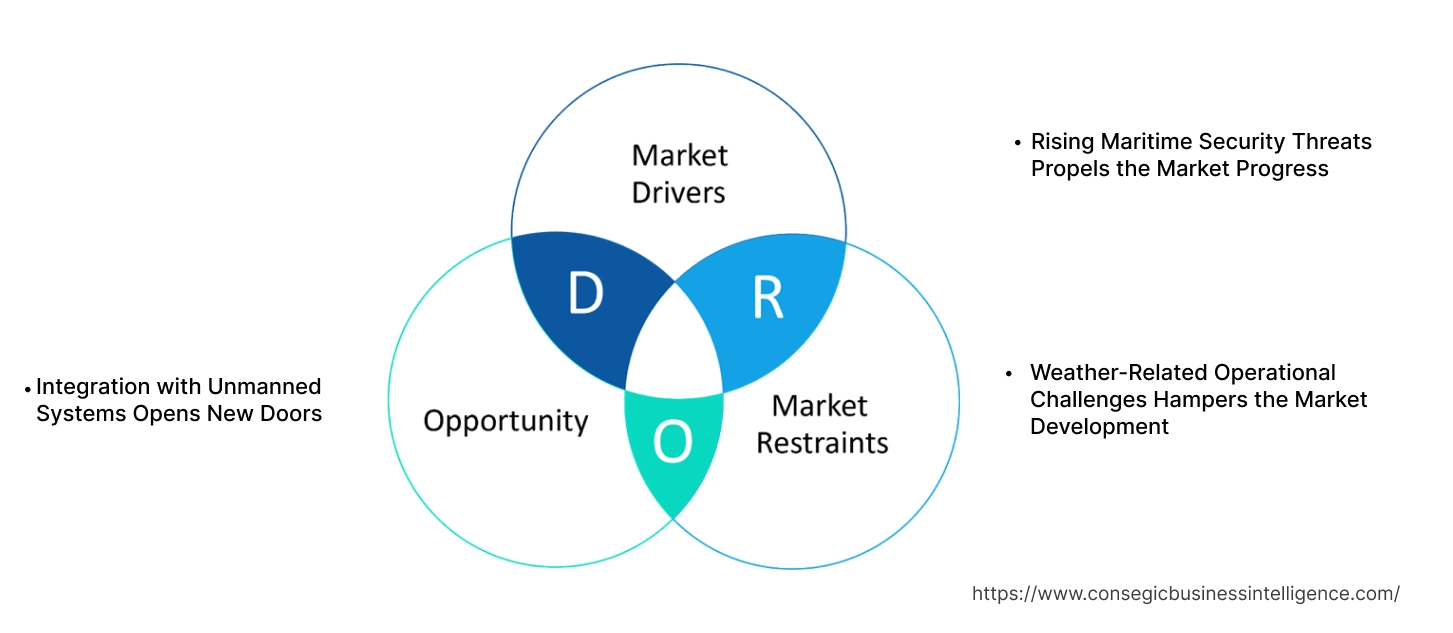
Rising Maritime Security Threats Propels the Market Progress
The escalation of maritime security threats, including piracy, illegal fishing, smuggling, and territorial disputes, has intensified the need for advanced surveillance solutions. Coastal regions and exclusive economic zones (EEZs) are particularly vulnerable to these challenges, necessitating robust monitoring systems. Maritime patrol aircraft equipped with cutting-edge sensors, radar systems, and electro-optical devices offer real-time situational awareness, enabling rapid response to emerging threats. These aircraft play a pivotal role in detecting unauthorized activities, ensuring safer shipping routes, and protecting national resources.
Governments worldwide are prioritizing investments in patrol aircraft to strengthen their naval capabilities, enforce maritime laws, and safeguard national sovereignty. The growing emphasis on securing critical sea lanes and territorial waters underscores the importance of such aerial platforms in modern naval defense strategies. This rising demand is driving advancements in maritime patrol technologies, ensuring improved safety and operational efficiency. Thus, the aforementioned factors are driving the maritime patrol aircraft market growth.
Key Restraints:
Weather-Related Operational Challenges Hampers the Market Development
Maritime patrol aircraft face significant issues in harsh weather conditions, including severe storms, strong winds, and turbulence. Such environments affect aircraft stability, limit maneuverability, and reduce the effectiveness of onboard sensors, particularly during long-endurance missions. Adverse weather disrupts radar and electro-optical systems, leading to inaccurate or incomplete data collection, which is critical for effective surveillance and response operations.
Additionally, extreme conditions increase wear and tear on aircraft components, leading to higher maintenance requirements and operational costs. These constraints are particularly pronounced in regions prone to tropical storms or polar extremes, where consistent surveillance is essential. The reliability of maritime patrol missions depends on overcoming these weather-related obstacles, which remain a key concern for operators and governments relying on these aircraft for security and monitoring purposes. In conclusion, the above mentioned factors limit the maritime patrol aircraft market demand.
Future Opportunities :
Integration with Unmanned Systems Opens New Doors
The integration of unmanned aerial systems (UAS) with manned patrol aircraft is revolutionizing maritime surveillance by providing enhanced coverage and operational efficiency. This hybrid approach allows unmanned systems to operate in high-risk or remote zones, collecting critical data without jeopardizing human safety. UAS complements manned aircraft by performing tasks such as extended monitoring, data relay, and reconnaissance in areas with limited accessibility or harsh conditions. The synergy between these platforms enables real-time data sharing and comprehensive situational awareness, crucial for addressing maritime security threats such as piracy and illegal activities.
Furthermore, adopting hybrid fleet solutions reduces operational costs while increasing the overall effectiveness of patrol missions. This advancement aligns with the growing trend of leveraging automation and robotics in defense operations, creating significant maritime patrol aircraft market opportunities for manufacturers and operators to develop and deploy integrated systems tailored to modern surveillance needs.
Maritime Patrol Aircraft Market Segmental Analysis :
By Aircraft Type:
Based on aircraft type, the market is segmented into armoured and unarmoured aircraft.
The unarmoured segment held the largest revenue of the total maritime patrol aircraft market share in 2024.
- These aircraft are widely used for surveillance and reconnaissance missions due to their lightweight structure and operational efficiency.
- The lack of heavy armor reduces fuel consumption, enabling extended operational hours for patrol missions.
- The dominance of this segment is driven by the increasing adoption of environmental monitoring and border patrol activities.
- The unarmoured segment benefits from advancements in materials and design, enhancing its versatility across military and commercial industry applications and contributing to the maritime patrol aircraft market expansion.
The armoured segment is expected to register the fastest CAGR during the forecast period.
- Armoured aircraft are critical for anti-submarine warfare and high-risk missions, offering enhanced protection for crew and equipment.
- The segment is witnessing increasing demand from military forces due to growing geopolitical tensions and maritime security threats.
- Technological advancements in lightweight armor are enabling the development of armoured aircraft with improved performance and fuel efficiency.
- As per the maritime patrol aircraft market analysis, the rising need for combat-ready aircraft capable of withstanding hostile environments drives the adoption of armoured maritime patrol aircraft.
By Type:
Based on type, the market is segmented into fixed-wing aircraft and rotary-wing aircraft.
The fixed-wing aircraft segment accounted for the largest revenue of the total maritime patrol aircraft market share in 2024.
- Fixed-wing aircraft are ideal for long-range missions, including surveillance, reconnaissance, and search and rescue operations.
- Their larger payload capacity enables the integration of advanced equipment such as radars, cameras, and sensors.
- The dominance of this segment is attributed to their extensive use in military and commercial industry applications, including fisheries management and coastal monitoring.
- As per the maritime patrol aircraft market trends, fixed-wing aircraft benefit from superior speed and operational range, making them a preferred choice for maritime patrol activities.
The rotary-wing aircraft segment is expected to grow at the fastest CAGR during the forecast period.
- Rotary-wing aircraft are extensively used for short-range missions, including anti-submarine warfare and search and rescue operations.
- Their vertical take-off and landing capabilities make them suitable for operations in restricted areas, such as offshore platforms and ships.
- Increasing demand for multipurpose aircraft capable of operating in dynamic environments supports the growth of this segment.
- Thus, technological advancements in rotary-wing aircraft, such as enhanced maneuverability and fuel efficiency, drive their adoption in maritime applications, further driving the maritime patrol aircraft market growth.
By Sales Component:
Based on components, the market is segmented into radar, cameras, and sensors.
The radar segment held the largest revenue share in 2024.
- Radars are essential for detecting and tracking surface and underwater targets, enabling effective maritime surveillance.
- The increasing use of advanced radar systems for real-time data processing and target identification drives their adoption.
- The dominance of this segment is supported by rising investments in modernizing naval fleets and improving maritime security.
- Thus, radars benefit from continuous advancements in technology, including enhanced range, resolution, and accuracy, fueling the maritime patrol aircraft market demand.
The sensor segment is expected to register the fastest CAGR during the forecast period.
- Sensors are integral to maritime patrol aircraft for collecting critical environmental and target data.
- The growing adoption of sensors for anti-submarine warfare, weather monitoring, and pollution tracking fuels their market growth.
- Technological innovations in sensors, such as miniaturization and increased sensitivity, enhance their operational capabilities.
- Therefore, as per the maritime patrol aircraft market analysis, the rising need for advanced sensor technologies in both military and commercial applications contributes to their rapid adoption.
By Engine Type:
Based on engine type, the market is segmented into turboprop engines and jet engines.
The turboprop engine segment accounted for the largest share in 2024.
- Turboprop engines are widely used in maritime patrol aircraft due to their fuel efficiency and cost-effectiveness.
- These engines are ideal for low-speed and low-altitude missions, including surveillance and search and rescue operations.
- The dominance of this segment is driven by their reliability and suitability for short and medium-range applications.
- As per the maritime patrol aircraft market trends, turboprop engines benefit from advancements in design, offering reduced noise levels and improved performance.
The jet engine segment is expected to grow at the fastest CAGR during the forecast period.
- Jet engines are preferred for high-speed and long-range missions, including reconnaissance and anti-submarine warfare.
- The rising demand for modern military aircraft with enhanced speed and maneuverability supports the growth of this segment.
- Technological advancements in jet engine design, such as increased fuel efficiency and reduced emissions, drive their adoption.
- The segment's growth is further fueled by increasing investments in next-generation aircraft for military and defense industry applications, creating new maritime patrol aircraft market opportunities.
By Application:
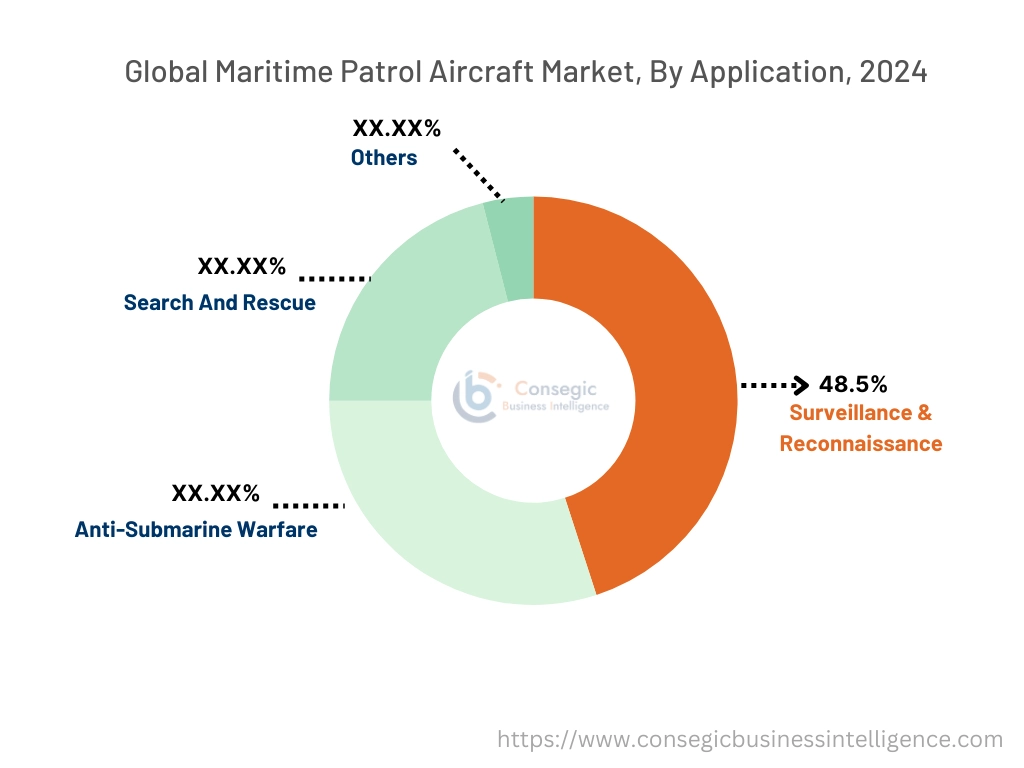
Based on application, the market is segmented into surveillance & reconnaissance, anti-submarine warfare, search and rescue (SAR), and others.
The surveillance & reconnaissance segment held the largest revenue of 44.6% share in 2024.
- This application is critical for monitoring maritime activities, ensuring border security, and preventing illegal activities such as smuggling and piracy.
- The increasing deployment of advanced aircraft equipped with high-resolution cameras and sensors drives the dominance of this segment.
- Surveillance and reconnaissance benefit from rising government investments in enhancing maritime situational awareness.
- Thus, the growing need for real-time data collection and analysis to support decision-making further fuels this segment's prominence, contributing to the maritime patrol aircraft market expansion.
The search and rescue segment is expected to grow at the fastest CAGR during the forecast period.
- The rising frequency of natural disasters and maritime emergencies drives the demand for aircraft equipped for search and rescue operations.
- Technological advancements, such as improved navigation systems and thermal imaging cameras, enhance the effectiveness of search and rescue missions.
- The increasing focus on safety and preparedness in both military and commercial sectors supports the growth of this segment.
- As per the market trends, the rapid adoption of SAR aircraft in regions with extensive coastlines and high maritime traffic further boosts this segment's growth.
Regional Analysis:
The regions covered are North America, Europe, Asia Pacific, the Middle East and Africa, and Latin America.
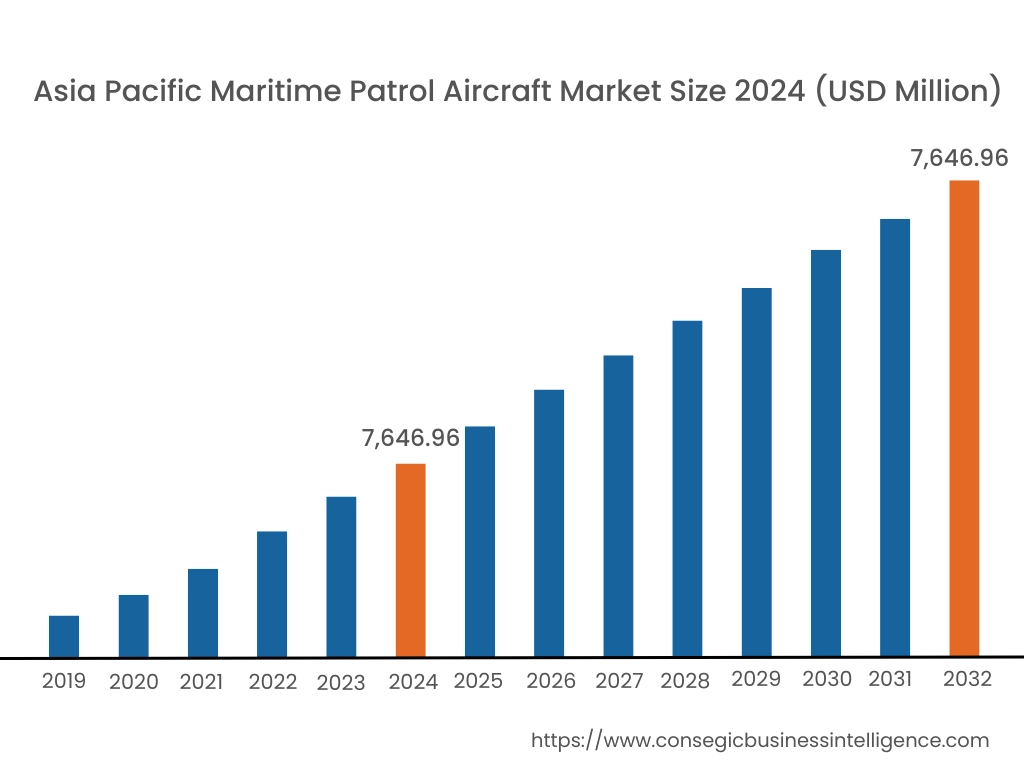
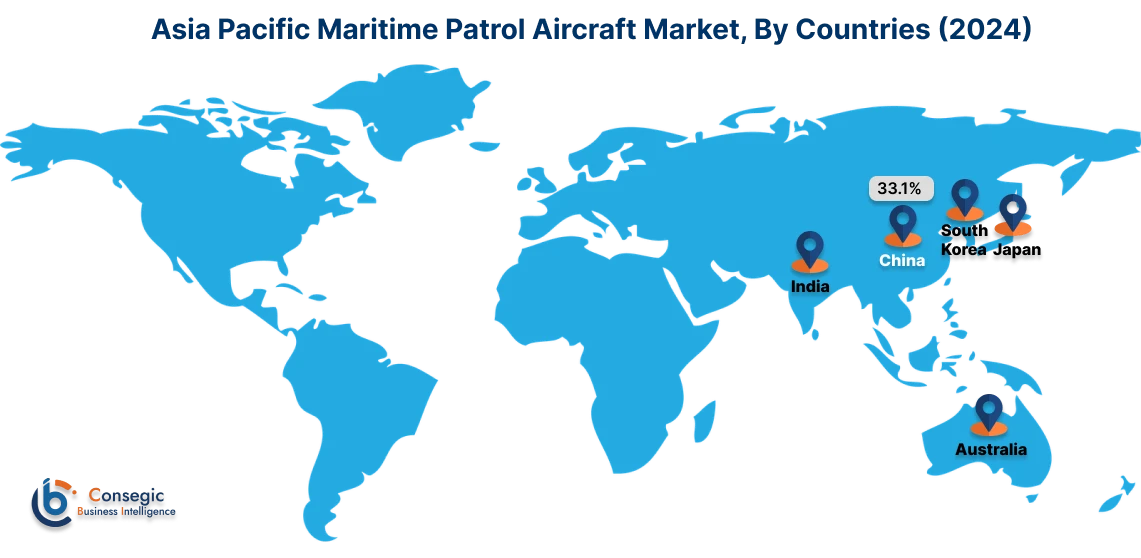
Asia Pacific region was valued at USD 5,257.14 Million in 2024. Moreover, it is projected to grow by USD 5,407.92 Million in 2025 and reach over USD 7,646.96 Million by 2032. Out of this, China accounted for the maximum revenue share of 33.1%. The Asia-Pacific region is witnessing a surge in the need for maritime patrol aircraft, driven by territorial disputes and the need for enhanced maritime domain awareness. Countries such as India, China, and Japan are investing in modern MPAs to bolster their naval capabilities. A significant trend is the development of indigenous platforms to reduce reliance on foreign suppliers. Analysis indicates that regional security dynamics and economic progress will continue to drive the MPA market in Asia-Pacific.
North America is estimated to reach over USD 8,139.18 Million by 2032 from a value of USD 5,921.18 Million in 2024 and is projected to grow by USD 6,062.22 Million in 2025. This region maintains a substantial portion of the MPA market, driven by the United States' emphasis on enhancing maritime surveillance and defense capabilities. The U.S. Navy's investment in advanced MPAs, such as the P-8A Poseidon, underscores a commitment to maintaining maritime security. A notable trend is the integration of cutting-edge technologies, including artificial intelligence and unmanned systems, to augment operational efficiency. Analysis indicates that ongoing modernization efforts and defense spending will continue to influence market dynamics in North America.
European nations, including the United Kingdom, France, and Germany, are actively investing in modernizing their maritime patrol fleets to address emerging security challenges. The collaboration among European defense manufacturers to develop advanced MPA solutions reflects a trend toward enhancing regional security capabilities. However, economic constraints and varying defense budgets across countries may impact procurement strategies. Analysis suggests that Europe's focus on joint defense initiatives and technological innovation will play a crucial role in shaping the MPA market.
In the Middle East, nations are focusing on strengthening their maritime surveillance to protect vital sea lanes and offshore resources. Investments in advanced MPAs are part of broader defense modernization programs. However, economic diversification efforts and regional conflicts may influence defense spending patterns. In Africa, the MPA market is in a nascent stage, with limited procurement due to budgetary constraints. Analysis suggests that as economic conditions improve, there may be increased interest in enhancing maritime security capabilities.
Latin American countries are gradually recognizing the importance of maritime patrol aircraft in combating challenges such as illegal fishing, smuggling, and drug trafficking. Brazil and Chile have initiated steps to modernize their maritime patrol fleets. A notable trend is the procurement of cost-effective platforms that offer multi-mission capabilities. However, economic instability and competing budget priorities may affect the pace of acquisitions. Analysis indicates that regional cooperation and external assistance could play a role in the development of the MPA market in Latin America.
Top Key Players and Market Share Insights:
The Maritime Patrol Aircraft market is highly competitive with major players providing products and services to the national and international markets. Key players are adopting several strategies in research and development (R&D), product innovation, and end-user launches to hold a strong position in the global Maritime Patrol Aircraft market. Key players in the Maritime Patrol Aircraft industry include -
- Boeing (USA)
- Lockheed Martin Corporation (USA)
- Airbus SE (Netherlands)
- Northrop Grumman Corporation (USA)
- Dassault Aviation (France)
- Embraer S.A. (Brazil)
- Saab AB (Sweden)
- Leonardo S.p.A. (Italy)
- Kawasaki Heavy Industries (Japan)
- Israel Aerospace Industries (IAI) (Israel)
Maritime Patrol Aircraft Market Report Insights :
| Report Attributes | Report Details |
| Study Timeline | 2018-2032 |
| Market Size in 2032 | USD 25,113.17 Million |
| CAGR (2025-2032) | 4.4% |
| By Aircraft Type |
|
| By Type |
|
| By Component |
|
| By Engine Type |
|
| By Application |
|
| By Region |
|
| Key Players |
|
| North America | U.S. Canada Mexico |
| Europe | U.K. Germany France Spain Italy Russia Benelux Rest of Europe |
| APAC | China South Korea Japan India Australia ASEAN Rest of Asia-Pacific |
| Middle East and Africa | GCC Turkey South Africa Rest of MEA |
| LATAM | Brazil Argentina Chile Rest of LATAM |
| Report Coverage |
|
Key Questions Answered in the Report
What is the size of the Maritime Patrol Aircraft Market? −
The Maritime Patrol Aircraft Market size is estimated to reach over USD 25,113.17 Million by 2032 from a value of USD 17,850.55 Million in 2024 and is projected to grow by USD 18,310.77 Million in 2025, growing at a CAGR of 4.4% from 2025 to 2032.
What are the key segments in the Maritime Patrol Aircraft Market? +
The market is segmented by aircraft type (armoured and unarmoured), type (fixed-wing aircraft and rotary-wing aircraft), component (radar, camera, sensors), engine type (turboprop engine, jet engine), and application (surveillance & reconnaissance, anti-submarine warfare, search and rescue (SAR), and others).
Which segment is expected to grow the fastest in the Maritime Patrol Aircraft Market? +
The search and rescue (SAR) segment is expected to grow at the fastest CAGR during the forecast period, driven by the increasing frequency of natural disasters and maritime emergencies, as well as technological advancements in navigation systems and thermal imaging cameras.
Who are the major players in the Maritime Patrol Aircraft Market? +
Key players in the Maritime Patrol Aircraft market include Boeing (USA), Lockheed Martin Corporation (USA), Airbus SE (Netherlands), Northrop Grumman Corporation (USA), Dassault Aviation (France), Embraer S.A. (Brazil), Saab AB (Sweden), Leonardo S.p.A. (Italy), Kawasaki Heavy Industries (Japan), and Israel Aerospace Industries (IAI) (Israel).
Overview
Reputation & Certifications


Our Services
- Market Intelligence & Forecasting
- Custom Research Solutions
- Market Entry Strategy
- Competitive Intelligence
- Customer Insights
- Industry Innovation Analysis
- Investment Advisory