Jump to Content
Immortalized Cell Line Market - Size, Share, Industry Trends, and Forecasts (2025-2032)
Immortalized Cell Line Market Size:
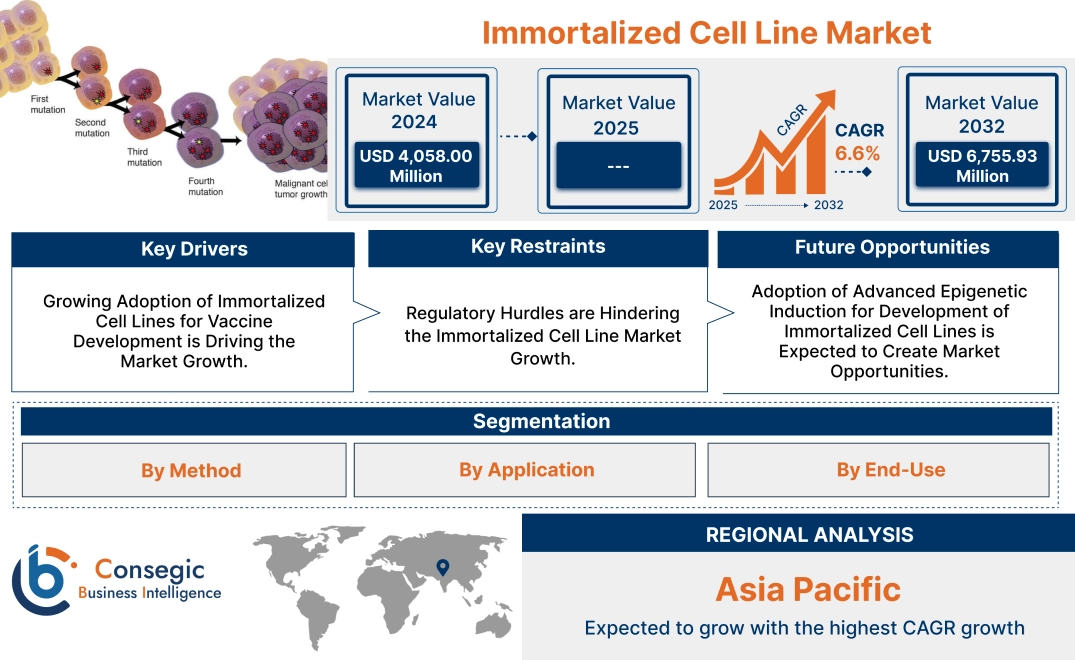
Immortalized Cell Line Market size is growing with a CAGR of 6.6% during the forecast period (2025-2032), and the market is projected to be valued at USD 6,755.93 Million by 2032 from USD 4,058.00 Million in 2024.
Immortalized Cell Line Market Scope & Overview:
An immortalized cell line refers to cells that have been altered to proliferate indefinitely. This allows them to be cultured for extended periods of time. Immortalization cell lines are developed through several methods including spontaneous mutations, viral transformation, and deliberate genetic engineering among others. This indefinite proliferation provides a consistent and readily available cell source, reducing research costs and enhancing experimental reproducibility. Furthermore, these cell lines often exhibit a high degree of homogeneity, facilitating the study of specific cellular processes. Examples of widely used immortalized cell lines include HeLa cells, HEK293 cells, and CHO cells. These cell lines find range of applications in various research areas such as drug development and testing, cancer research, virology research, 3D cell culture, and others.
Immortalized Cell Line Market Dynamics - (DRO) :
Key Drivers:
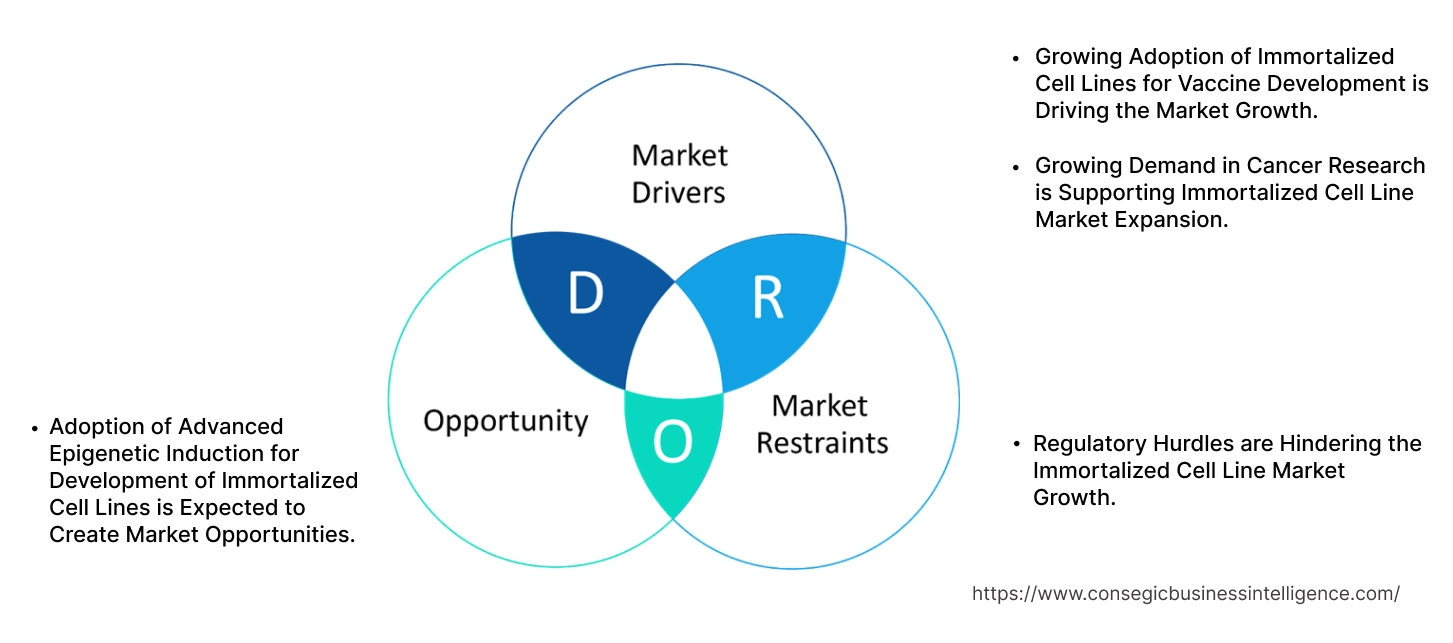
Growing Adoption of Immortalized Cell Lines for Vaccine Development is Driving the Market Growth.
Immortalized cell lines are capable of replicating indefinitely. Indefinite replication offers a constant source of cells for vaccine production. High replication enables large-scale manufacturing of vaccines. It ensures consistent, quality and sufficient supply of vaccines across the globe. Additionally, these cells streamline vaccine production processes further resulting in increased efficiency and reduced production costs. Hence, these cells are being increasingly utilized for vaccine development.
- For instance, in November 2024, Transgene, an immunotherapy biotech company and ProBioGen, a contract development and manufacturing organization, signed a license agreement for ProBioGen’s AGE1.CR.pIX immortalized suspension cell line which will combine ProBioGen’s specific production technology with the manufacturing capabilities of Transgene’s individualized cancer vaccine program.
As a result, the ability of these cell lines to consistently produce high-quality vaccines efficiently drives the immortalized cell line market growth.
Growing Demand in Cancer Research is Supporting Immortalized Cell Line Market Expansion.
Immortalized cancer cell lines are used to investigate tumor growth and cancer metastasis. These cells are widely employed for anticancer drugs screening to assess their efficacy and toxicity. Cell lines derived from patient tumors play a vital role in personalized medicine. These cells support the study of unique characteristics of individual tumors. Hence, there is growing focus on the development of tumor derived immortalized cell lines.
- For instance, in March 2024, The Rare Cancer Research Foundation announced the launch of first publicly available desmoid tumor immortalized cell line, HCM-BROD-0762-C49.
Thus, as per analysis, growing demand in cancer research, driven by the need to study tumor biology and develop personalized therapies, supporting market trajectory.
Key Restraints:
Regulatory Hurdles are Hindering the Immortalized Cell Line Market Growth.
The development and use of immortalized cell lines are subject to stringent regulations. These regulations are imposed by from various regulatory bodies, including government agencies and international organizations. Complying with regulations is complex and time-consuming. This involves lengthy documentation, rigorous quality control procedures, and approvals from regulatory authorities. These aspects increase the time and cost associated with research and development.
Additionally, regulatory authorities and regulatory standards differ by country and region. This creates barriers for researchers and companies operating in multiple jurisdictions. The stringent regulatory requirements stifle innovation in the field of cell line development. As a result, owing to aforementioned factors stringent regulatory requirements are restraining the market growth.
Future Opportunities :
Adoption of Advanced Epigenetic Induction for Development of Immortalized Cell Lines is Expected to Create Market Opportunities.
Advanced epigenetic induction involves targeting epigenetic enzymes to rewrite the epigenetic landscape of a genomic site. Epigenetic induction presents a potential to generate more physiologically relevant immortalized cell lines. This approach is offers more safer development of these cell lines it minimizes the risk of unwanted genetic alterations. Epigenetic Induction also enables the immortalization of a wider range of cell types. Hence, there is growing focus on the adoption of advanced epigenetic induction.
- For instance, in September 2024, Creative Bioarray, announced the launch of its new epigenetic induction service aimed at the immortalization of various cell types, including chicken, monkey, dog, and human cells.
Thus, being safer and more physiologically relevant alternative to traditional methods, the adoption of advanced epigenetic induction is expected to create significant immortalized cell line market opportunities.
Immortalized Cell Line Market Segmental Analysis :
By Method:
Based on this method, the market is categorized into spontaneous mutation, virus induction, hTERT expression, and others.
Trends in the Method:
- Shift towards HTERT-based methods is a trend driven by more physiologically relevant cell lines with minimal alterations to their phenotype.
- There's a growing trend in immortalizing patient-derived cells for personalized medicine applications.
The hTERT expression segment accounted for the largest immortalized cell line market share in 2023 and is expected to grow at the fastest CAGR over the forecast period.
- Telomerase is an enzyme that extends the ends of chromosomes. It is often inactive in most somatic cells and results in cellular aging and senescence.
- Introduction of human telomerase reverse transcriptase (hTERT) into somatic cells counteract this process.
- hTERT maintains telomere length and allows cells to divide indefinitely. Thus, it effectively immortalizes them.
- Immortalized cells produced through this method allow them to be cultured for extended periods. hTERT-immortalized cells maintain a more stable karyotype and retain the physiological characteristics of their parent cell type.
- For instance, according to the research study published on NCBI, it is stated that derivation of the immortalized cell line UM51-PrePodo-hTERT exhibited a much faster proliferation capacity compared with the original primary cells UM51-PrePodo, and kept proliferating for more than six months, while showing a similar morphology.
- Hence, as per analysis, hTERT-immortalization offers a crucial approach to generating stable and physiologically relevant cell lines for several applications creating immortalized cell line market opportunities in the upcoming years.
By Application:
Based on application, the market is categorized into drug development and testing, cancer research, virology research, 3D cell culture, and others.
Trends in Application:
- The rise of personalized medicine trend is fueling the need for these cell lines.
- The growing field of immuno-oncology is driving adoption of immortalized cell lines to study immune responses to cancer.
The drug development and testing segment accounted for the largest market share in the year 2024.
- Applications of immortalized cell lines in drug development and testing are high-throughput screening (HTS), lead optimization and target validation.
- One of the prominent applications is vaccine development. Capability of these cells to replicate indefinitely allows for the large-scale production of viruses or viral components required for vaccine manufacturing.
- For instance, in January 2023, ProBioGen announced clinical milestone for its viral vector and vaccine production cell line AGE1.CRpIX. ProBioGen's customer, Nouscom, has initiated Phase 1 clinical trials for VAC85135, an oncologic cancer vaccine utilizing this cell line. The AGE1.CRpIX cell line offers streamlined manufacturing and product release processes.
- Moreover, advancements in drug discovery technologies, such as high-content screening are expanding the applications of immortalized cell lines in drug development
- Hence, as per analysis, applications like HTS, lead optimization along with the vaccine production drives the drug development and testing segment.
The 3D cell culture segment is expected to grow at the fastest CAGR over the forecast period.
- Immortalized cell lines ensure a consistent and readily available source of cells for 3D experiments.
- The use of these cell lines enhances the reproducibility of 3D culture experiments
- 3D cell culture models accurately mimic the vivo environment. They offer more physiologically relevant data compared to traditional cells cultures.
- This increased relevance drives adoption of 3D cell culture models across various research areas, such as tissue engineering, cancer research, and drug discovery among other further supporting immortalized cell line market trend.
By End Use:
Based on end use, the market is categorized into pharmaceutical and biotechnology companies, academic and research institutions, and contract research organizations, and others.
Trends in the End Use:
- Regenerative medicine companies and companies developing cell-based diagnostics are emerging as significant consumers of immortalized cell lines.
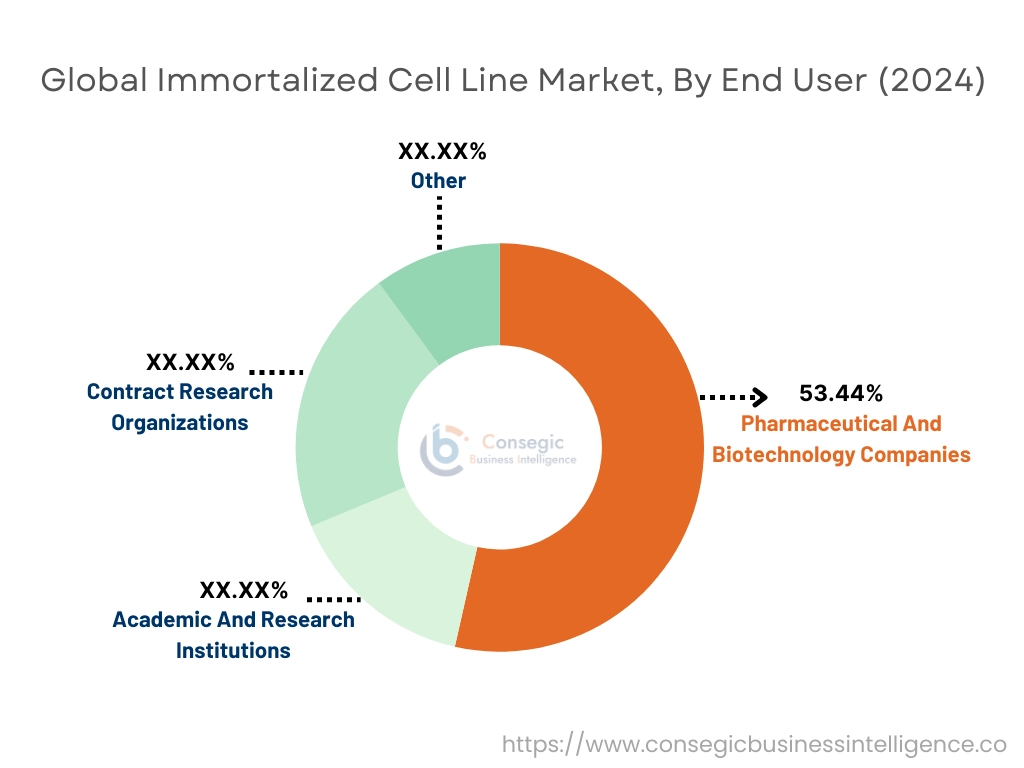
The pharmaceutical and biotechnology companies segment accounted for the largest market share of 53.44% in the year 2024.
- Pharmaceutical and biotechnology companies are the key end user of immortalized cell lines.
- These cell lines are widely utilized by such companies for various applications including drug discovery and development, vaccine production, and therapeutic protein production.
- Additionally, these cell lines are also utilized by pharmaceutical and biotechnology companies for the development of a range of biotherapeutics, including cell therapies, gene therapies, and other advanced therapies.
- Pharmaceutical and biotechnology companies invest heavily in research and development activities. These companies are also exploring the innovative applications of these cell lines. This fuels the need for reliable and cost-effective cell-based research tools, including immortalized cell lines.
- For instance, in October 2024, Evercyte, a pioneer in developing novel cell lines, has expanded its focus on organ-on-a-chip (OOC) technology through a new collaboration with AIM Biotech, a leading Singaporean company in this field. This collaboration involves the provision of Evercyte's human umbilical vein endothelial cells and human lung fibroblast cell lines for integration into AIM's innovative microfluidic chips.
- Henceforth, as per analysis, R&D investments coupled with exploration of innovative applications is creating the immortalized cell line market demand.
The academic and research institutions segment is expected to grow at the fastest CAGR over the forecast period.
- Academic and research institutions are involved in fundamental and translational research.
- These institutions utilize cell lines for fundamental research, investigating cellular processes and for discovering the complex mechanisms of diseases such as cancer and others.
- Additionally, research conducted in such centers boosts advancements in cancer research, virology, and genetic engineering.
- Increased research funding by government bodies coupled with adoption of advanced technologies such as CRISPR-Cas support the segment trajectory.
- Furthermore, novel research areas such as personalized medicine drive the market demand within this segment.
Regional Analysis:
The regional segment includes North America, Europe, Asia Pacific, the Middle East and Africa, and Latin America.
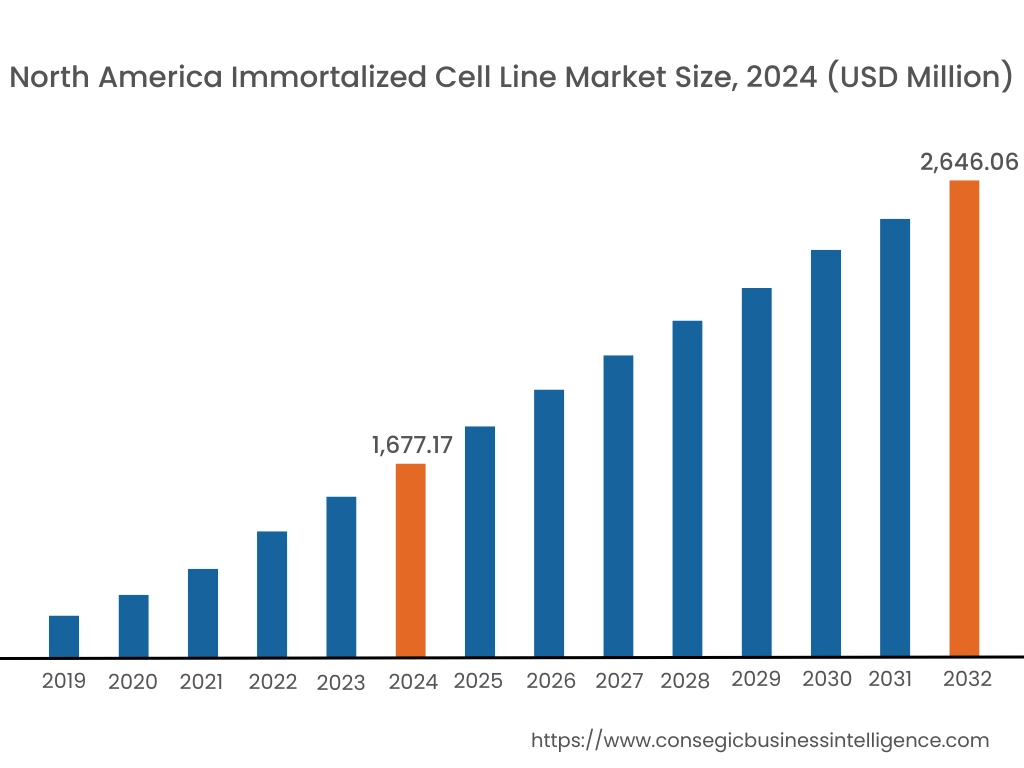
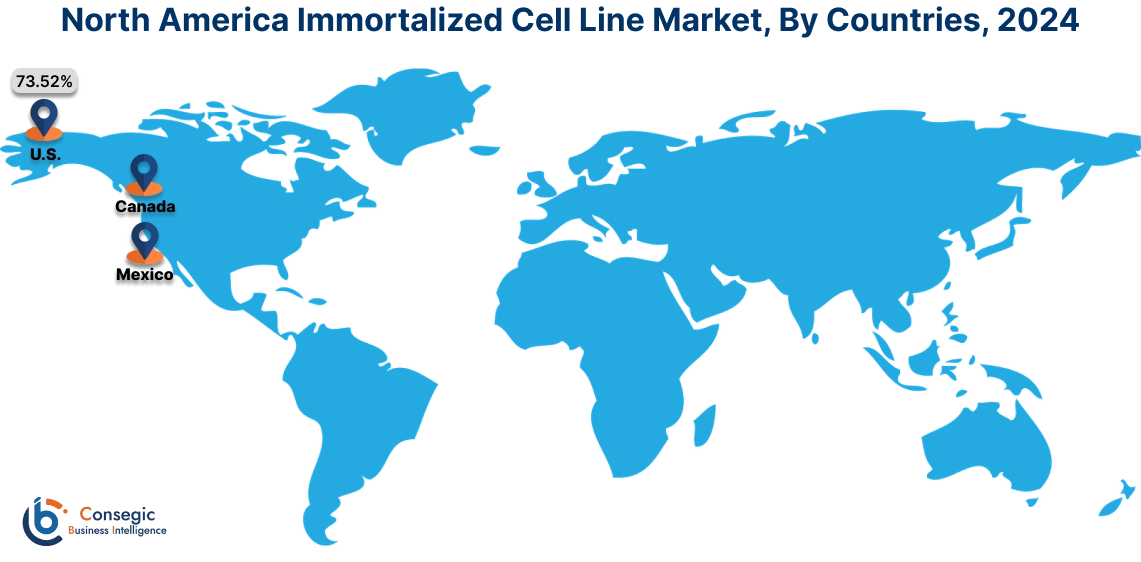
In 2024, North America accounted for the highest market share at 41.33% and was valued at USD 1,677.17 Million and is expected to reach USD 2,646.06 Million in 2032. In North America, the U.S. accounted for the highest market share of 73.52% during the base year of 2024.
North America dominates the global immortalized cell line market, primarily due to the large pharmaceutical and biotechnology industry. The region presents various pharmaceutical and biotechnology giants. This well-established pharmaceutical and biotechnology sector creates the adoption of immortalized cells lines for several applications. Additionally, advanced research infrastructure and research funding trajectory growth of the market.
- For instance, in September 2022, the White House announced the federal funding of more than USD 2 billion for biotechnology and biomanufacturing. The funding aims at reducing U.S. reliance on foreign materials and bioproduction, while directing federal agencies to identify priority R&D needs to translate bioscience and biotech discoveries into medical breakthroughs and to strengthen domestic supply chains.
Henceforth, the combination of the aforementioned factors is driving a substantial trajectory in the North America immortalized cell line market trend.
Asia Pacific is experiencing the fastest growth with a CAGR of 7.8% over the forecast period. Key factors driving the Asia Pacific market include increasing rising prevalence of chronic diseases such as cancer, increasing healthcare research and development activities, and rapidly expanding pharmaceutical and biotechnology industry. Increasing cancer, diabetes, and cardiovascular diseases research and drug development investments in emerging economies create high demand for these cell lines. Additionally, government bodies across the region are supporting research and development through various programs, funding, and policies supporting immortalized cell line market expansion.
Europe presents a significant contribution to the immortalized cell line market analysis. The European pharmaceutical and biotechnology sector is mature, creating constant requirements for these cell lines. Additionally, a well-established network of renowned research institutions is driving the market across the region. These institutions actively utilize these cell lines for a wide range of research activities. Additionally, Europe is home to several leading pharmaceutical and biotechnology companies, which are major consumers of these cell lines for vaccine development activities. The rigorous vaccine development across the region is supporting immortalized cell line market.
The Middle East and Africa (MEA) region is witnessing notable immortalized cell line market demand characterized by significant potential. The region is increasingly focusing on research and development activities for various diseases such as cancer and cardiovascular disorders. The region is witnessing increasing healthcare infrastructure development. This creates the requirement of these cell lines for range of diagnostic applications. Government initiatives and funding programs in the MEA support research and development activities, supporting the immortalized cell line market share.
Latin America is an emerging region in the immortalized cell line market, with significant potential for innovation. There is a growing focus on improving healthcare infrastructure and research capabilities across many Latin American countries. This increasing emphasis on healthcare is expected to drive demand for research tools. Thus, as per immortalized cell line market analysis, the growing focus on healthcare, the emergence of a stronger biotechnology sector, and increasing collaborations with international partners are expected to drive market expansion in this region.
Top Key Players and Market Share Insights:
The Immortalized Cell Line market is highly competitive with major players providing precise products to the national and international markets. Key players are adopting several strategies in research and development (R&D) and product innovation to hold a strong position in the global Immortalized Cell Line market. Key players in the Immortalized Cell Line industry include-
- Creative Bioarray (U.S.)
- Charles River Laboratories (U.S.)
- FUJIFILM Wako Pure Chemical Corporation (Japan)
- Merck KGaA (Germany)
- HiMedia Laboratories (India)
- AcceGen (U.S.)
- Applied Biological Materials Inc (Canada)
- Thermo Fisher Scientific Inc. (U.S.)
- Stellixir Biotech Pvt. Ltd. (India)
Recent Industry Developments :
Agreement:
- In November 2024, Transgene, an immunotherapy biotech company and ProBioGen, a contract development and manufacturing organization, signed a license agreement for ProBioGen’s AGE1.CR.pIX immortalized suspension cell line which will combine ProBioGen’s specific production technology with the manufacturing capabilities of Transgene’s individualized cancer vaccine program.
Product Launch:
- In March 2024, The Rare Cancer Research Foundation announced the launch of first publicly available desmoid tumor immortalized cell line, HCM-BROD-0762-C49.
Collaboration:
- In October 2024, Evercyte, a pioneer in developing novel cell lines, has expanded its focus on organ-on-a-chip (OOC) technology through a new collaboration with AIM Biotech, a leading Singaporean company in this field. This collaboration involves the provision of Evercyte's human umbilical vein endothelial cells and human lung fibroblast cell lines for integration into AIM's innovative microfluidic chips.
Immortalized Cell Line Market Report Insights :
| Report Attributes | Report Details |
| Study Timeline | 2019-2032 |
| Market Size in 2032 | USD 6,755.93 Million |
| CAGR (2025-2032) | 6.6% |
| By Method |
|
| By Application |
|
| By End-Use |
|
| By Region |
|
| Key Players |
|
| North America | U.S. Canada Mexico |
| Europe | U.K. Germany France Spain Italy Russia Benelux Rest of Europe |
| APAC | China South Korea Japan India Australia ASEAN Rest of Asia-Pacific |
| Middle East and Africa | GCC Turkey South Africa Rest of MEA |
| LATAM | Brazil Argentina Chile Rest of LATAM |
| Report Coverage |
|
Key Questions Answered in the Report
How big is the Immortalized Cell Line market? −
In 2024, the Immortalized Cell Line market is USD 4,058.00 Million.
Which is the fastest-growing region in the Immortalized Cell Line market? +
Asia Pacific is the fastest-growing region in the Immortalized Cell Line market.
What specific segmentation details are covered in the Immortalized Cell Line market? +
Method, Application, and End Use segmentation details are covered in the Immortalized Cell Line market.
Who are the major players in the Immortalized Cell Line market? +
Creative Bioarray (U.S.),AcceGen (U.S.), and Applied Biological Materials Inc (Canada) are some of the major players in the market.
Overview
Reputation & Certifications


Our Services
- Market Intelligence & Forecasting
- Custom Research Solutions
- Market Entry Strategy
- Competitive Intelligence
- Customer Insights
- Industry Innovation Analysis
- Investment Advisory