Jump to Content
Indoor Robots Market - Size, Share, Industry Trends, and Forecasts (2025 - 2032)
Indoor Robots Market Size:
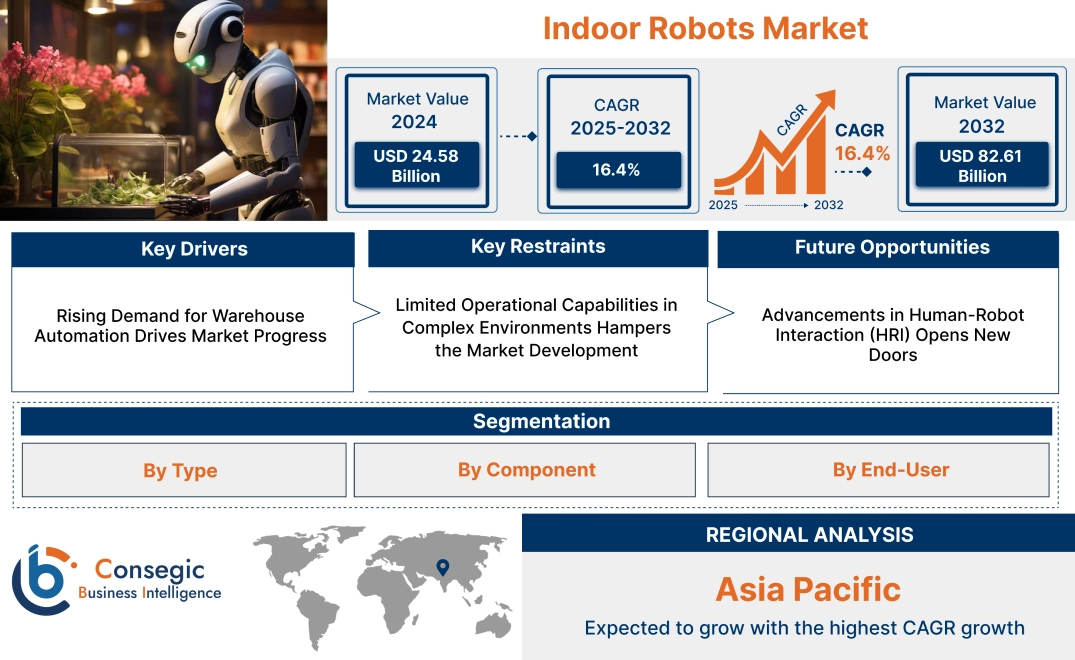
Indoor Robots Market size is estimated to reach over USD 82.61 Billion by 2032 from a value of USD 24.58 Billion in 2024 and is projected to grow by USD 28.16 Billion in 2025, growing at a CAGR of 16.4% from 2025 to 2032.
Indoor Robots Market Scope & Overview:
Indoor robots are automated systems designed to perform tasks within indoor environments, catering to applications in residential, commercial, and industrial settings. These robots are equipped with sensors, cameras, and advanced software to navigate spaces, interact with objects, and execute specific functions efficiently. Their tasks range from cleaning and surveillance to inventory management and customer service, offering versatility across various sectors.
These robots are available in diverse forms, including robotic vacuum cleaners, security robots, and service robots, each tailored to specific operational requirements. They feature technologies such as real-time mapping, obstacle avoidance, and wireless connectivity, ensuring seamless and reliable performance. Indoor robots are built for durability and adaptability, capable of functioning effectively in confined or complex environments.
End-users of these systems include households, retail businesses, warehouses, and healthcare facilities, where automation helps streamline operations and improve overall efficiency. These robots play a crucial role in modernizing workflows and enhancing productivity in indoor settings.
Indoor Robots Market Dynamics - (DRO) :
Key Drivers:
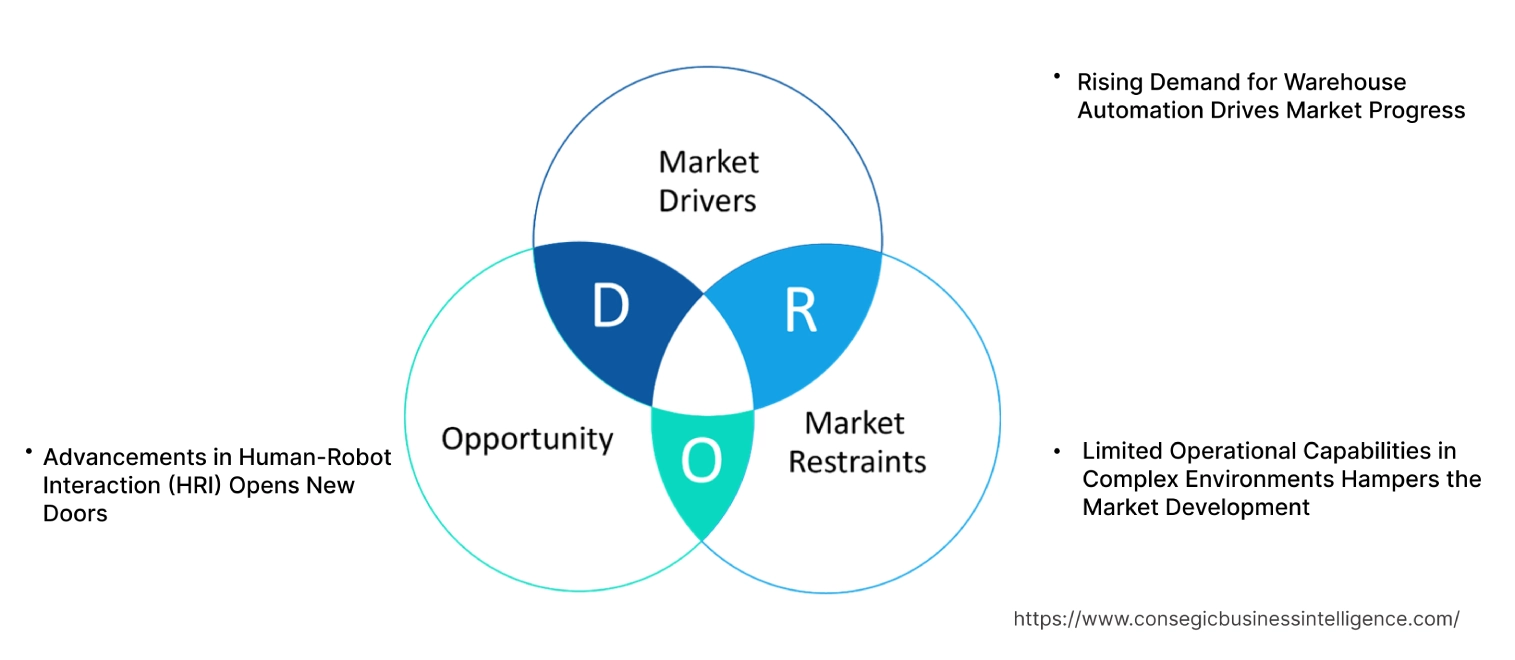
Rising Demand for Warehouse Automation Drives Market Progress
The rapid expansion of e-commerce and logistics sectors is driving the adoption of warehouse automation to enhance operational efficiency. Indoor robots, including automated guided vehicles (AGVs) and robotic arms, play a crucial role in streamlining processes such as inventory tracking, order picking, and sorting. These robots ensure faster, more accurate handling of goods, reducing human errors and optimizing storage space utilization. By enabling seamless coordination in large-scale warehouses, robotic solutions meet the growing demand for quick and reliable order fulfillment, aligning with consumer expectations for faster deliveries. Furthermore, advancements in robotics and AI are making these systems more accessible and adaptable, encouraging their integration into modern warehouses. This trend reflects the industry's emphasis on achieving error-free and efficient operations in increasingly competitive markets, cementing the role of indoor robots in next-generation supply chain management. Thus, the aforementioned factors are fueling the indoor robots market growth.
Key Restraints:
Limited Operational Capabilities in Complex Environments Hampers the Market Development
Robots designed for indoor environments often encounter limitations when operating in complex or unstructured settings. Issues such as difficulty detecting transparent or reflective objects, navigating poorly lit areas, or managing uneven and irregular surfaces hinder their performance. These operational inefficiencies slow down processes, particularly in industries requiring high adaptability, such as healthcare or retail, where environments are dynamic and unpredictable. Moreover, the inability of some robots to seamlessly adjust to rapidly changing surroundings reduces their reliability and effectiveness in such settings. These constraints limit the broader adoption of robotic solutions in applications demanding advanced situational awareness and adaptability, highlighting the need for further innovation to enhance their capabilities in complex indoor environments. In conclusion, limited operational capabilities limit the indoor robots market demand.
Future Opportunities :
Advancements in Human-Robot Interaction (HRI) Opens New Doors
Advancements in human-robot interaction (HRI) technologies are transforming how robots engage with users, enhancing their usability and acceptance across various applications. Innovations such as natural language processing (NLP) and gesture recognition enable robots to understand and respond to verbal commands, gestures, and even facial expressions, creating more intuitive and seamless communication. These capabilities are particularly beneficial in sectors like education, where robots serve as interactive teaching assistants, and entertainment, where they enhance user experiences through lifelike interactions. By providing a more human-centered approach to communication, HRI advancements are broadening the adoption of robots in environments that require engagement, empathy, and adaptability, aligning with growing trends in personalized and interactive technologies. Therefore, this underlines the importance of HRI in influencing indoor robots market opportunities.
Indoor Robots Market Segmental Analysis :
By Type:
Based on type, the market is segmented into medical robots, drones, cleaning robots, entertainment robots, education robots, personal/handicap assistant robots, public relations robots, and security and surveillance robots.
The medical robots segment held the largest revenue of the total indoor robots market share in 2023.
- Medical robots are widely used in healthcare settings for tasks like surgery, rehabilitation, and patient assistance, ensuring precision and improving healthcare outcomes.
- The growing adoption of robotic-assisted surgeries, particularly in minimally invasive procedures, enhances operational efficiency and reduces patient recovery time.
- Technological advancements in telemedicine and robotic rehabilitation systems drive demand in this segment across developed and developing regions.
- As per indoor robots market trends, the rising focus on healthcare automation and the increasing need for patient-centric solutions continue to support this segment’s prominence.
The security and surveillance robots segment is projected to grow at the fastest CAGR during the forecast period.
- Security robots, equipped with AI-powered cameras and sensors, are increasingly adopted for monitoring and safeguarding residential and commercial spaces.
- The integration of advanced features like real-time threat detection and facial recognition technology further enhances their adoption in high-security environments.
- Rising concerns about public safety and the increasing need for automated surveillance solutions contribute to the growth of this segment.
- The analysis of segmental trends depicts that continuous innovation in autonomous navigation and AI-based threat analytics boosts the adoption of security and surveillance robots across various industries, driving the indoor robots market expansion.
By Component:
Based on components, the market is segmented into hardware (sensors, cameras, actuators, power systems) and software (AI algorithms, control systems).
The hardware segment accounted for the largest revenue of the total indoor robots market share in 2023.
- Sensors and cameras are critical components for enhancing navigation, obstacle detection, and interaction capabilities in indoor robots.
- Actuators and power systems ensure precise movements and efficient energy management, driving operational effectiveness.
- The rising focus on integrating advanced hardware components, such as LIDAR and depth sensors, boosts their adoption across various robot types.
- As per indoor robots market analysis, the need for reliable and durable hardware solutions continues to drive this segment’s growth trajectory.
The software segment is expected to register the fastest CAGR during the forecast period.
- AI algorithms and control systems are pivotal in enabling advanced functionalities like autonomous navigation, decision-making, and interactive responses.
- The increasing reliance on machine learning and data analytics for improving robot efficiency and adaptability accelerates growth in this segment.
- Customizable software solutions tailored to specific end-user needs, such as healthcare and education, contribute to its rapid adoption.
- The segment’s growth is supported by ongoing advancements in AI and the rising need for integrated robot management systems, contributing to the indoor robots market growth.
By End-User:
Based on end-users, the market is segmented into residential, commercial, and industrial sectors.
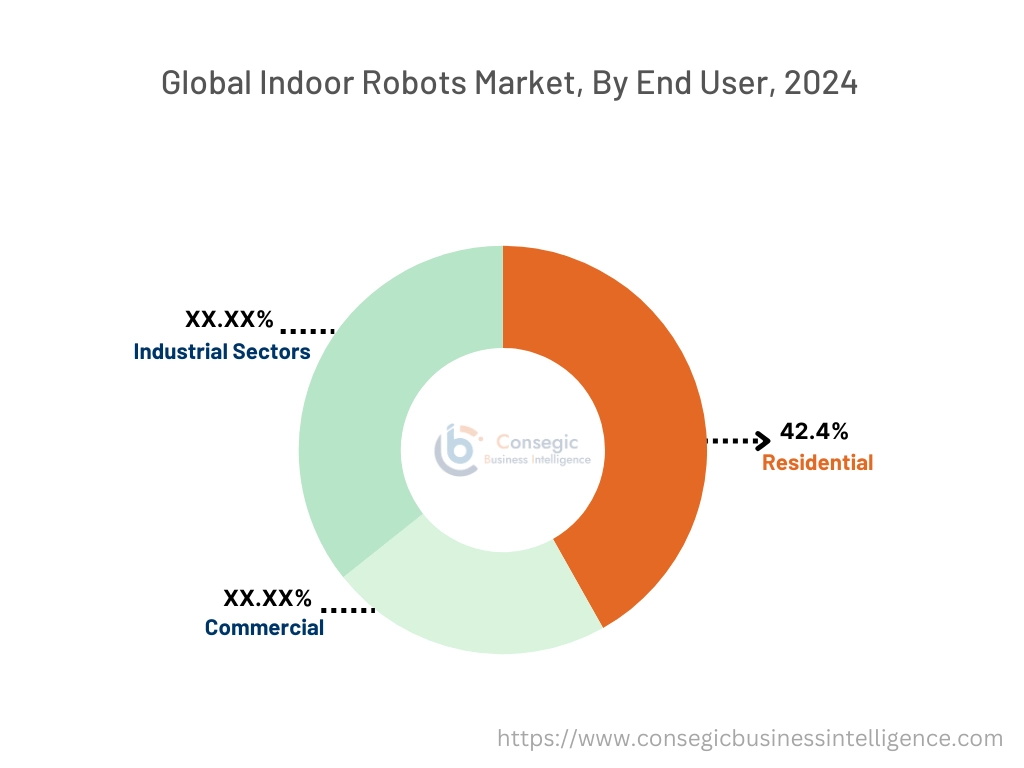
The residential segment held the largest revenue of 42.4% share in 2023.
- Residential robots, including cleaning and entertainment robots, are gaining popularity due to their convenience and time-saving capabilities.
- Increasing consumer awareness about smart home technologies and the benefits of automation fuels the adoption of residential robots.
- The rising preference for personal assistant robots, particularly among the elderly and individuals with disabilities, supports this segment’s growth.
- As per indoor robots market trends, affordability and ease of use further enhance the penetration of residential robots in households globally.
The commercial segment is expected to grow at the fastest CAGR during the forecast period.
- Commercial robots are extensively used in sectors like retail, hospitality, and healthcare for tasks like inventory management, customer assistance, and patient care.
- The adoption of public relations robots in retail spaces and drones for security surveillance drives growth in this segment.
- Increasing investments in automation for enhancing operational efficiency and customer experience contribute to the segment’s prominence.
- Therefore, as per the market analysis, continuous advancements in robotics technology and the integration of AI further expand the applications of commercial robots across diverse industries, fueling the indoor robots market demand.
Regional Analysis:
The regions covered are North America, Europe, Asia Pacific, the Middle East and Africa, and Latin America.
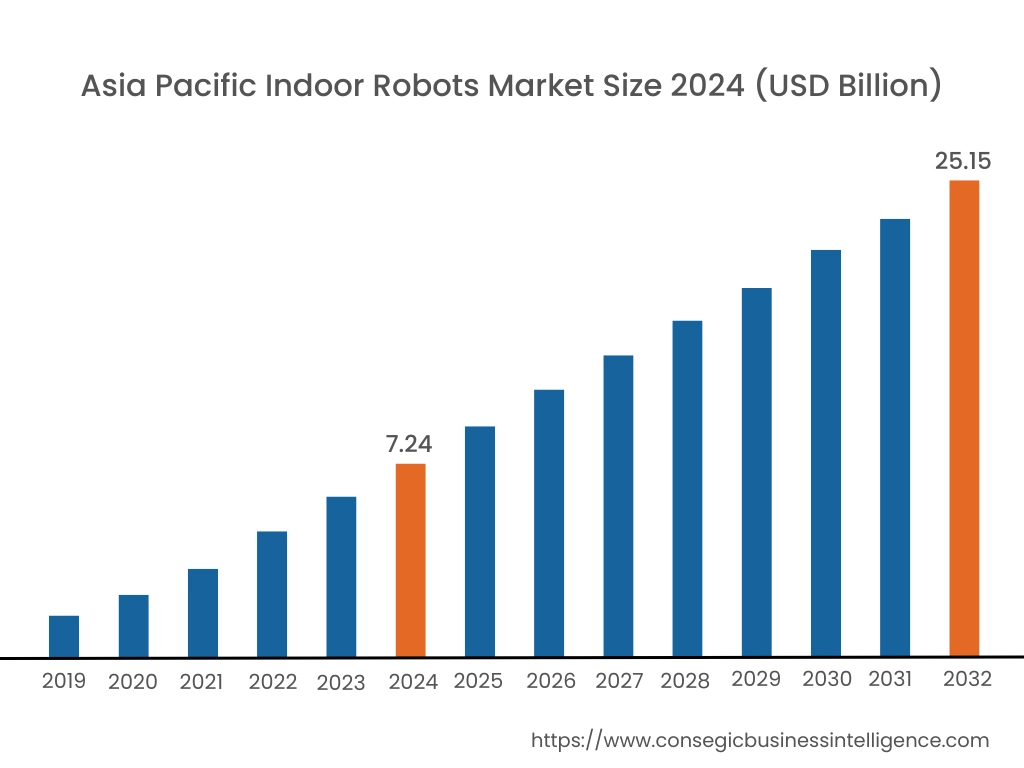
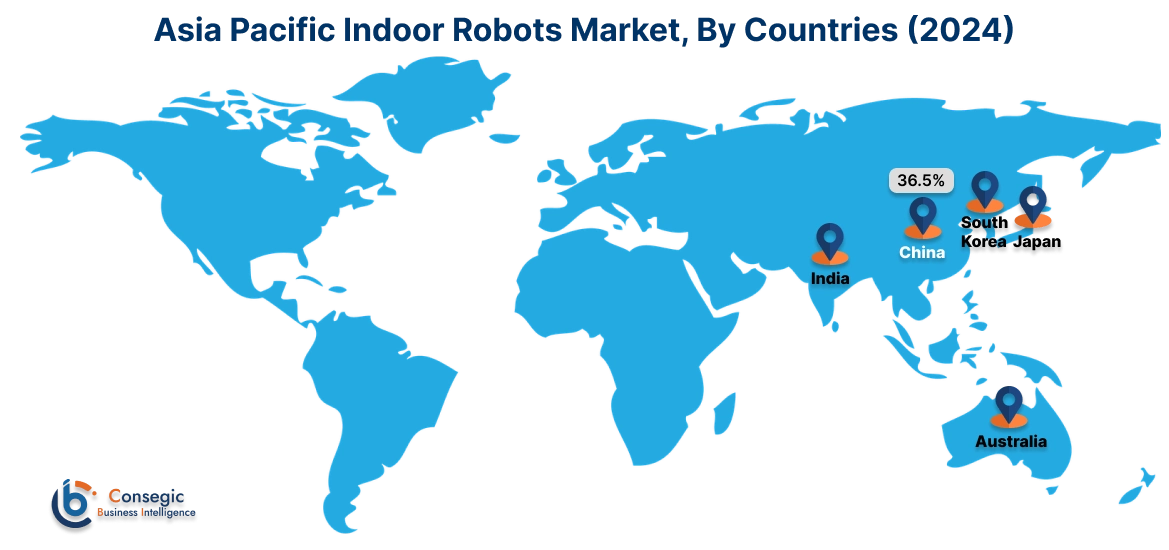
Asia Pacific region was valued at USD 7.24 Billion in 2024. Moreover, it is projected to grow by USD 8.32 Billion in 2025 and reach over USD 25.15 Billion by 2032. Out of this, China accounted for the maximum revenue share of 36.5%. The Asia-Pacific region is experiencing rapid development in the indoor robots market, driven by industrialization and technological advancements in countries such as China, Japan, and South Korea. The expansion of the e-commerce industry and the rising demand for automation have intensified the need for indoor robots in logistics and warehousing. Government initiatives promoting industrial efficiency further influence indoor robots market opportunities.
North America is estimated to reach over USD 26.77 Billion by 2032 from a value of USD 8.15 Billion in 2024 and is projected to grow by USD 9.32 Billion in 2025. This region holds a substantial share of the indoor robots market, driven by the increasing adoption of advanced robotics in sectors such as healthcare, logistics, and residential applications. The United States, in particular, has seen a rise in the implementation of indoor robots for tasks ranging from cleaning to security. A notable trend is the integration of artificial intelligence (AI) and machine learning (ML) to enhance robot autonomy and efficiency. The indoor robots market analysis indicates that the presence of key market players and continuous technological advancements contribute to the region's market dominance.
Europe represents a substantial portion of the global indoor robots market, with countries like Germany, France, and the United Kingdom leading in adoption and innovation. The region's emphasis on sustainability and energy efficiency has propelled the utilization of eco-friendly robotic solutions. Analysis indicates a growing trend towards the deployment of collaborative robots (cobots) in industrial settings, offering flexibility across various applications.
The Middle East & Africa region shows a growing interest in advanced robotic solutions, particularly in the construction and industrial sectors. Countries like Saudi Arabia and the United Arab Emirates are investing in modern technologies to enhance production efficiency. Analysis suggests an increasing trend towards adopting indoor robots for tasks such as cleaning and security in commercial establishments.
Latin America is an emerging market for indoor robots, with Brazil and Mexico being key contributors. The region's growing focus on industrial modernization and the automotive industry has spurred the adoption of advanced robotic solutions. Government policies aimed at enhancing manufacturing capabilities influence indoor robots market expansion.
Top Key Players and Market Share Insights:
The Indoor Robots market is highly competitive with major players providing products and services to the national and international markets. Key players are adopting several strategies in research and development (R&D), product innovation, and end-user launches to hold a strong position in the global Indoor Robots market. Key players in the Indoor Robots industry include -
- iRobot Corporation (USA)
- Neato Robotics (USA)
- Samsung Electronics Co., Ltd. (South Korea)
- SharkNinja Operating LLC (USA)
- Panasonic Corporation (Japan)
- Ecovacs Robotics (China)
- Roborock (China)
- Dyson Ltd. (UK)
- LG Electronics Inc. (South Korea)
Recent Industry Developments :
Partnerships & Collaborations:
- In September 2024, Kakao Mobility, Hoban Construction, and Bear Robotics signed an MOU to standardize indoor robot service environments. This collaboration aims to develop tailored robot delivery services for diverse spaces such as hotels, apartments, and commercial buildings. Kakao Mobility’s ‘Bring’ service uses the BRING-ON open API platform for optimized robot dispatch and has been successfully deployed at Jecheon Restri Resort. The service is set to expand across Hoban Construction’s properties, ensuring stable, versatile, and user-focused delivery solutions.
Product Launches:
- In November 2023, Matic unveiled its fully autonomous indoor cleaning robot, capable of advanced 3D mapping, precise navigation, and AI-driven cleaning. The robot features edge-device processing for privacy, toggles between vacuuming and mopping based on surface detection, and responds to voice or gesture commands. Backed by $30M in funding, including a $24M Series A led by prominent tech leaders, Matic aims to redefine home robotics.
Indoor Robots Market Report Insights :
| Report Attributes | Report Details |
| Study Timeline | 2019-2032 |
| Market Size in 2032 | USD 82.61 Billion |
| CAGR (2025-2032) | 16.4% |
| By Type |
|
| By Component |
|
| By End-User |
|
| By Region |
|
| Key Players |
|
| North America | U.S. Canada Mexico |
| Europe | U.K. Germany France Spain Italy Russia Benelux Rest of Europe |
| APAC | China South Korea Japan India Australia ASEAN Rest of Asia-Pacific |
| Middle East and Africa | GCC Turkey South Africa Rest of MEA |
| LATAM | Brazil Argentina Chile Rest of LATAM |
| Report Coverage |
|
Key Questions Answered in the Report
What is the size of the Indoor Robots Market? −
Indoor Robots Market size is estimated to reach over USD 82.61 Billion by 2032 from a value of USD 24.58 Billion in 2024 and is projected to grow by USD 28.16 Billion in 2025, growing at a CAGR of 16.4% from 2025 to 2032.
What are the key drivers of the Indoor Robots Market? +
Key drivers of the market include the rising demand for warehouse automation, particularly within the e-commerce and logistics sectors. Indoor robots, such as automated guided vehicles (AGVs) and robotic arms, enhance inventory tracking, order picking, and sorting, making them vital for operational efficiency.
What are the key segments of the Indoor Robots Market? +
The market is segmented by type (e.g., medical robots, drones, cleaning robots, security, and surveillance robots), by component (e.g., hardware like sensors, cameras, and actuators, and software like AI algorithms and control systems), and by end-user (residential, commercial, and industrial sectors).
Who are the leading players in the Indoor Robots Market? +
Leading players in the Indoor Robots Market include iRobot Corporation (USA), Neato Robotics (USA), Ecovacs Robotics (China), Roborock (China), Dyson Ltd. (UK), LG Electronics Inc. (South Korea), Samsung Electronics Co., Ltd. (South Korea), SharkNinja Operating LLC (USA), and Panasonic Corporation (Japan).
Overview
Reputation & Certifications


Our Services
- Market Intelligence & Forecasting
- Custom Research Solutions
- Market Entry Strategy
- Competitive Intelligence
- Customer Insights
- Industry Innovation Analysis
- Investment Advisory