Jump to Content
Intracranial Pressure Monitor Market - Size, Share, Industry Trends, and Forecasts (2025-2032)
Intracranial Pressure Monitor Market Size:
Intracranial Pressure Monitor Market size is estimated to reach over USD 3,217.14 Million by 2032 from a value of USD 1,832.90 Million in 2024 and is projected to grow by USD 1,934.55 Million in 2025, growing at a CAGR of 8.0% from 2025 to 2032.
Intracranial Pressure Monitor Market Scope & Overview:
An intracranial pressure (ICP) monitor is a medical device used to measure pressure inside the skull, providing critical data for managing neurological conditions such as traumatic brain injuries, hydrocephalus, and strokes. It enables continuous monitoring of cerebrospinal fluid dynamics, helping healthcare professionals make timely interventions to prevent complications related to abnormal brain pressure.
Key features include real-time pressure tracking, minimally invasive sensor technology, and compatibility with advanced patient monitoring systems. These monitors offer precise measurements, improving diagnostic accuracy and treatment decisions. Some models integrate wireless data transmission and automated alerts to enhance clinical efficiency and patient safety.
Hospitals, neurology centers, and intensive care units rely on these devices for monitoring patients with severe brain injuries or post-surgical recovery needs. Advancements in sensor technology and device miniaturization continue to improve monitoring accuracy, ensuring better management of neurological disorders and critical care outcomes.

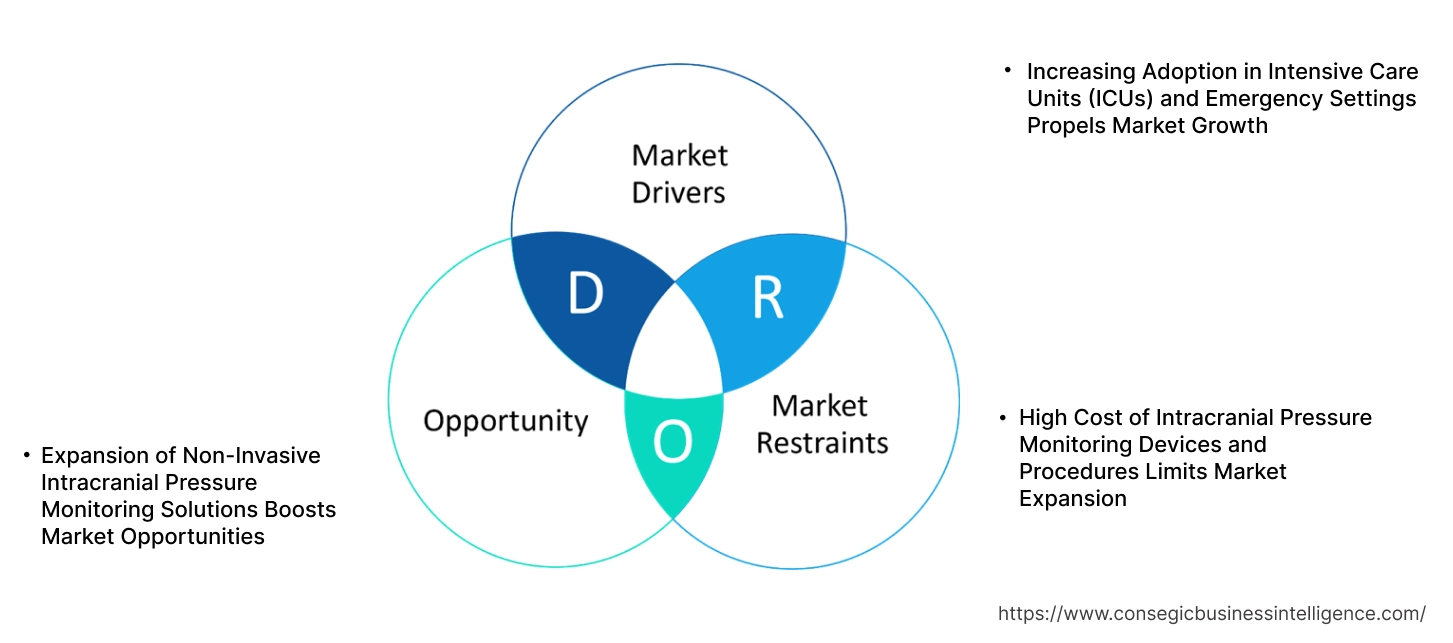
Intracranial Pressure Monitor Market Dynamics - (DRO):
Key Drivers:
Increasing Adoption in Intensive Care Units (ICUs) and Emergency Settings Propels Market Growth
Intracranial pressure (ICP) monitors are essential for managing patients with traumatic brain injuries, stroke, hydrocephalus, and post-surgical neurological complications. As critical care facilities expand and improve their capabilities, hospitals are incorporating continuous ICP monitoring systems to ensure early detection of intracranial hypertension and cerebral edema. The use of real-time ICP monitoring in emergency settings allows medical teams to make faster, data-driven decisions, reducing the risk of brain herniation and permanent neurological damage. Additionally, government and private investments in critical care infrastructure, tele-neurology, and emergency medical response systems are supporting wider adoption. As healthcare institutions prioritize efficient patient management and outcome-driven care, these trends will continue fueling intracranial pressure monitor market expansion, reinforcing the importance of ICP monitoring in neurocritical care.
Key Restraints:
High Cost of Intracranial Pressure Monitoring Devices and Procedures Limits Market Expansion
Advanced monitoring systems require surgical implantation, disposable probes, calibration, and specialized neurosurgical expertise, making them expensive for healthcare facilities, particularly in developing regions. Hospitals face financial challenges in procuring high-end monitoring systems due to budget constraints and insurance reimbursement limitations. Additionally, ongoing maintenance, sterilization protocols, and training requirements add to operational costs. The preference for more affordable neuro-monitoring alternatives, such as clinical examinations and non-invasive imaging, is further slowing adoption in cost-sensitive markets. To expand accessibility, manufacturers and healthcare providers must focus on cost reduction strategies, reimbursement approvals, and scalable technology solutions. Overcoming these financial challenges will be essential for ensuring intracranial pressure monitor market growth, making these critical monitoring systems more accessible across global healthcare settings.
Future Opportunities:
Expansion of Non-Invasive Intracranial Pressure Monitoring Solutions Boosts Market Opportunities
Traditional invasive methods, such as ventricular catheters and intraparenchymal probes, pose risks of infection, bleeding, and procedural complications. Emerging non-invasive techniques, including transcranial Doppler ultrasound, optic nerve sheath diameter (ONSD) measurement, and MRI-based ICP estimation, offer promising alternatives for early detection and continuous brain pressure assessment. These advancements enhance patient comfort, reduce hospital stays, and lower procedure-related costs, making them highly desirable in outpatient, emergency, and telemedicine settings. The growth of AI-powered remote monitoring platforms is further expanding the reach of non-invasive technologies, allowing for real-time ICP analysis and predictive neurological assessments. As the healthcare industry focuses on minimally invasive, accessible monitoring solutions, these innovations are expected to drive significant intracranial pressure monitor market opportunities, improving outcomes for neurological patients worldwide.
Intracranial Pressure Monitor Market Segmental Analysis :
By Technology:
By technology, the market is segmented into fiber optic monitoring, microelectromechanical systems (MEMS) sensors, and air-pouch technology.
The fiber optic monitoring segment held the largest intracranial pressure monitor market share in 2024.
- Fiber optic-based monitors offer real-time and highly accurate pressure readings, making them the preferred choice in critical neurosurgical cases.
- The demand for minimally invasive and high-precision monitoring solutions is driving adoption in hospitals and specialty neurology clinics.
- Intracranial pressure monitor market analysis indicates that fiber optic technology is increasingly replacing conventional monitoring systems due to its durability and reduced risk of infections.
- Segmental trends suggest continuous advancements in fiber optic sensor technology, improving sensitivity and reliability in neurological monitoring.
The MEMS sensors segment is expected to experience the fastest CAGR during the forecast period.
- MEMS-based ICP sensors offer a compact, cost-effective, and minimally invasive solution for long-term monitoring.
- The demand for wireless, implantable monitoring devices is increasing in neurocritical care and traumatic brain injury management.
- Intracranial pressure monitor market trends indicate that MEMS technology is gaining traction, particularly due to its high sensitivity and real-time data transmission capabilities.
- With advancements in nanotechnology and biomedical engineering, the MEMS sensors segment is contributing significantly to market growth.
By End-User:
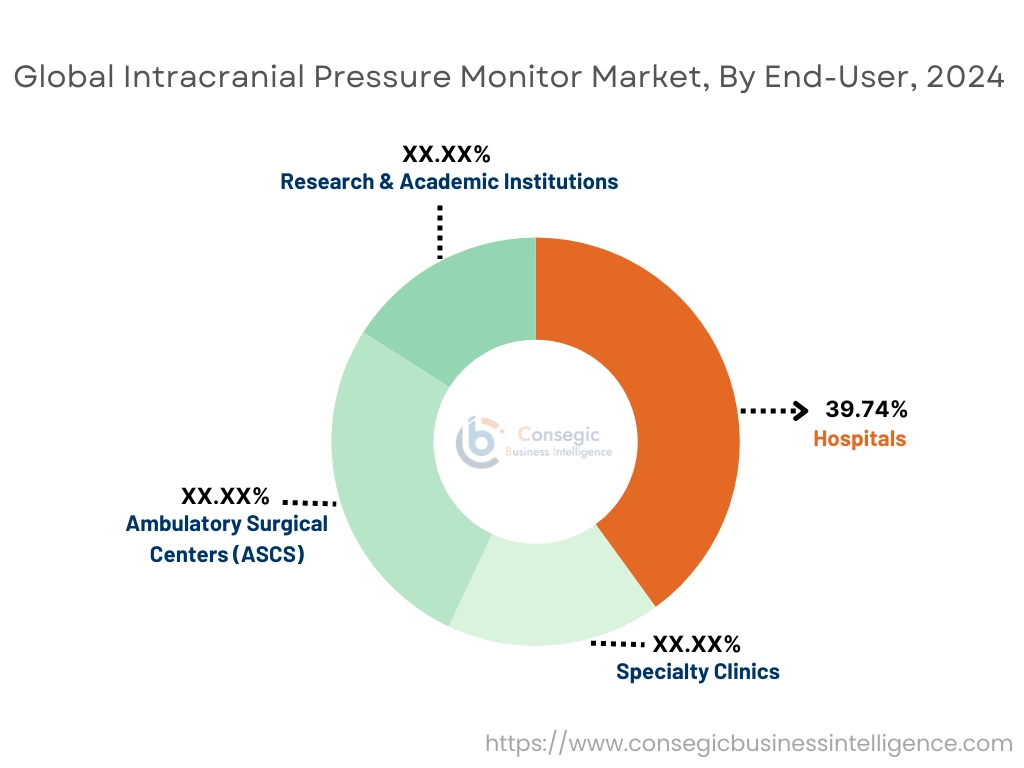
Based on end-user, the market is categorized into hospitals, specialty clinics, ambulatory surgical centers (ASCS), and research & academic institutions.
The hospitals segment held the largest market share of 39.74% in 2024.
- Hospitals serve as the primary centers for monitoring, particularly for traumatic brain injuries, hydrocephalus, and neurosurgical procedures.
- The demand for advanced ICP monitoring solutions is growing as hospitals integrate AI-based patient monitoring systems for real-time neurocritical care.
- Intracranial pressure monitor market analysis highlights that hospitals are investing in state-of-the-art ICP monitoring technologies, ensuring enhanced patient outcomes.
- Market trends suggest that government healthcare initiatives and increased funding for neurotrauma research are strengthening hospital-based ICP monitoring solutions.
The ambulatory surgical centers (ASCs) segment is anticipated to experience the fastest CAGR during the forecast period.
- ASCs are increasingly adopting non-invasive ICP monitoring techniques, providing cost-effective alternatives to inpatient hospital stays.
- The need for portable, real-time ICP monitoring devices is rising as outpatient neurology services expand globally.
- Market trends analysis indicates a shift toward minimally invasive and remote monitoring technologies, making ASCs a key growth driver.
- With the increasing prevalence of neurological disorders and improved accessibility to outpatient care, ASCs are contributing to intracranial pressure monitor market expansion.
By Product Type:
By product type, the market is segmented into invasive and non-invasive intracranial pressure monitors.
The invasive segment held the largest intracranial pressure monitor market share in 2024.
- Invasive monitoring methods, such as external ventricular drainage (EVD) and microtransducer ICP monitors, remain the gold standard for accurate pressure measurement in neurocritical patients.
- The need for high-precision monitoring systems in emergency neurotrauma and post-surgical care is fueling the adoption of invasive ICP monitors.
- Market analysis highlights the importance of invasive techniques in high-risk neurosurgical interventions, ensuring real-time cerebrospinal fluid (CSF) drainage.
- In July 2024, researchers at NTU, Singapore, developed a minimally invasive, injectable, biodegradable wireless sensor capable of monitoring multiple brain parameters. Furthermore, it harmlessly dissolves within 18 weeks after implantation, minimizing the need for another surgery.
- Intracranial pressure monitor market trends suggest that new sensor-based invasive monitors are improving infection control and data accuracy.
The non-invasive segment is expected to have the fastest CAGR during the forecast period.
- Non-invasive monitoring techniques, such as transcranial Doppler ultrasonography (TCD), optic nerve sheath diameter (ONSD) monitoring, and MRI/CT-based techniques, are gaining popularity due to their reduced risk of infection and ease of use.
- The need for non-invasive ICP monitors is rising in outpatient settings, where rapid assessment of intracranial hypertension is required.
- Segmental trends indicate a growing preference for handheld, portable monitoring solutions, enhancing accessibility to neurological diagnostics.
- In September 2024, researchers at the Icahn School of Medicine at Mount Sinai developed and published a groundbreaking artificial intelligence (AI)-driven noninvasive technique to monitor intracranial pressure, offering a safer and faster alternative to patients.
- With continuous advancements in AI-driven imaging and wearable ICP monitoring technologies, non-invasive methods are expected to drive intracranial pressure monitor market growth.
Regional Analysis:
The regions covered are North America, Europe, Asia Pacific, the Middle East and Africa, and Latin America.
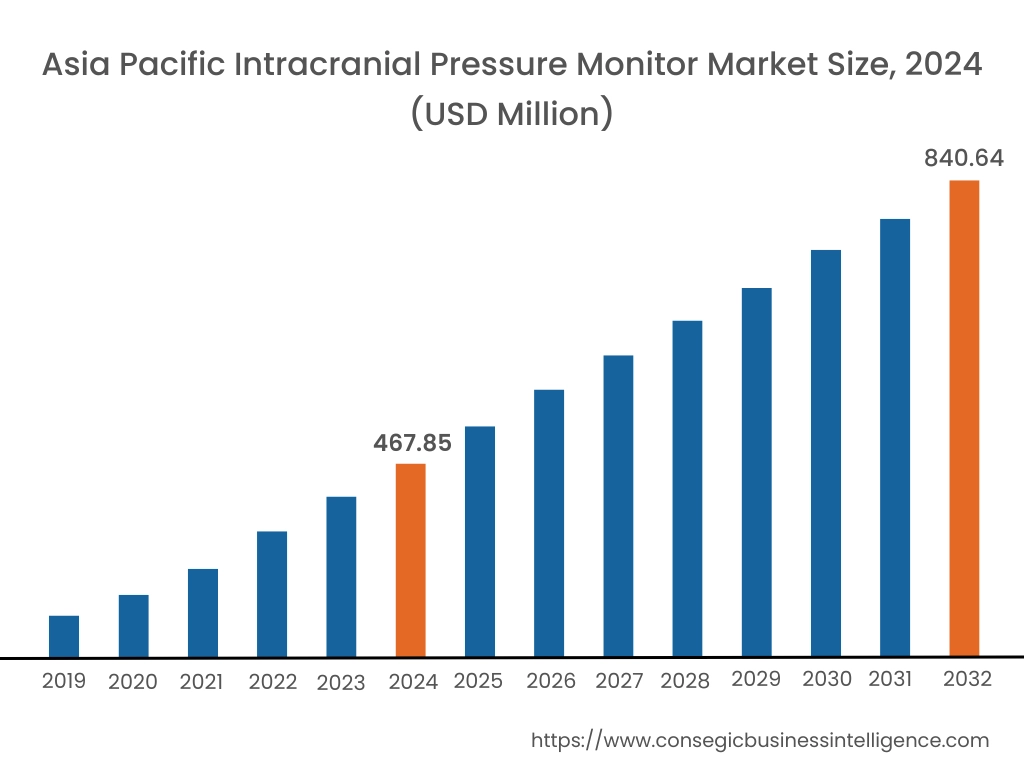
Asia Pacific region was valued at USD 467.85 Million in 2024. Moreover, it is projected to grow by USD 494.77 Million in 2025 and reach over USD 840.64 Million by 2032. Out of this, China accounted for the maximum revenue share of 34.74%. The Asia Pacific region is witnessing rapid growth in the intracranial pressure monitor market, propelled by increasing healthcare investments and a rising number of traumatic brain injury cases. Countries like China, Japan, and India are investing heavily in healthcare infrastructure, leading to increased demand for advanced monitoring devices. The region's focus on improving patient outcomes and adopting minimally invasive procedures further drives the intracranial pressure monitor market demand.

North America is estimated to reach over USD 1,161.07 Million by 2032 from a value of USD 665.96 Million in 2024 and is projected to grow by USD 702.50 Million in 2025. North America stands as a dominant force in the intracranial pressure monitor industry, primarily due to the high incidence of traumatic brain injuries and well-established healthcare infrastructure. The United States, in particular, has seen substantial adoption of advanced monitoring devices, attributed to the increasing volume of intracranial pressure monitoring procedures and improved healthcare facilities. The presence of key industry players and continuous technological advancements further bolster the intracranial pressure monitor market demand in this region.
Europe exhibits a robust market for intracranial pressure monitors, driven by stringent healthcare regulations and a strong emphasis on patient safety. Countries such as Germany, France, and the United Kingdom are at the forefront, utilizing these devices to manage neurological conditions effectively. The region's focus on reducing the burden of neurological disorders presents a significant intracranial pressure monitor market opportunity for innovative solutions and product development.
Latin America's intracranial pressure monitor market is gradually gaining traction, influenced by a growing emphasis on improving healthcare services and increasing awareness of neurological conditions. Countries such as Brazil and Mexico are exploring the use of advanced monitoring technologies to enhance patient care. As awareness of the benefits of early diagnosis and intervention spreads, the market is poised to experience steady growth, offering opportunities for both local and international stakeholders.
The Middle East and Africa are emerging markets for intracranial pressure monitors, with growth potential linked to increasing healthcare investments and the demand for advanced medical devices. The region's focus on modernizing healthcare infrastructure and addressing the rising incidence of neurological disorders necessitates the adoption of effective monitoring solutions. While challenges such as limited access to advanced technologies persist, the region offers a promising landscape for the expansion of the intracranial pressure monitor market as part of broader healthcare development initiatives.
Top Key Players & Market Share Insights:
The intracranial pressure monitor market is highly competitive with major players providing products and services to the national and international markets. Key players are adopting several strategies in research and development (R&D), product innovation, and end-user launches to hold a strong position in the global intracranial pressure monitor market. Key players in the intracranial pressure monitor industry include -
- Medtronic (Ireland)
- Raumedic AG (Germany)
- Elekta AB (Sweden)
- Natus Medical Incorporated (USA)
- Integra LifeSciences Corporation (USA)
- Sophysa (France)
- Spiegelberg GmbH & Co. KG (Germany)
- Gaeltec Devices Ltd. (UK)
- Headsense Medical Ltd. (Israel)
- Linet (Netherlands)
Recent Industry Developments :
Partnerships:
- In February 2025, Children’s National Hospital and Compremium AG partnered to develop and commercialize cutting-edge medical technologies for the pediatric population. The novel technology will aim to diagnose venous, intracranial and tissue pressure conditions in children before being scale-up for adult populations.
- In August 2024, Aesculap, Inc. (Aesculap), in partnership with Christoph Miethke GmbH & Co. KG (MIETHKE), announced that the U.S. Food and Drug Administration (FDA) granted Breakthrough Device Designation for the M.scio® System. This unique, non-invasive, telemetric pressure measurement system is designed to provide continuous access to long-term, intracranial pressure (ICP) monitoring of cerebrospinal fluid (CSF) for the management of hydrocephalus via a permanent, fully implantable sensor.
Intracranial Pressure Monitor Market Report Insights:
| Report Attributes | Report Details |
| Study Timeline | 2019-2032 |
| Market Size in 2032 | USD 3,217.14 Million |
| CAGR (2025-2032) | 8.0% |
| By Technology |
|
| By End-User |
|
| By Product Type |
|
| By Region |
|
| Key Players |
|
| North America | U.S. Canada Mexico |
| Europe | U.K. Germany France Spain Italy Russia Benelux Rest of Europe |
| APAC | China South Korea Japan India Australia ASEAN Rest of Asia-Pacific |
| Middle East and Africa | GCC Turkey South Africa Rest of MEA |
| LATAM | Brazil Argentina Chile Rest of LATAM |
| Report Coverage |
|
Key Questions Answered in the Report
How big is the Intracranial Pressure Monitor Market? −
Intracranial Pressure Monitor Market size is estimated to reach over USD 3,217.14 Million by 2032 from a value of USD 1,832.90 Million in 2024 and is projected to grow by USD 1,934.55 Million in 2025, growing at a CAGR of 8.0% from 2025 to 2032.
What specific segmentation details are covered in the Intracranial Pressure Monitor Market report? +
The Intracranial Pressure Monitor market report includes specific segmentation details for technology, end-user and product type.
Which is the fastest-growing region in the Intracranial Pressure Monitor Market? +
Asia Pacific is the fastest-growing region in the Intracranial Pressure Monitor market. These trends are encouraged by increasing healthcare investments and a rising number of traumatic brain injury cases.
Who are the major players in the Intracranial Pressure Monitor Market? +
The key participants in the Intracranial Pressure Monitor market are Medtronic (Ireland), Raumedic AG (Germany), Sophysa (France), Spiegelberg GmbH & Co. KG (Germany), Gaeltec Devices Ltd. (UK), Headsense Medical Ltd. (Israel), Linet (Netherlands), Elekta AB (Sweden), Natus Medical Incorporated (USA) and Integra LifeSciences Corporation (USA).
Overview
Reputation & Certifications


Our Services
- Market Intelligence & Forecasting
- Custom Research Solutions
- Market Entry Strategy
- Competitive Intelligence
- Customer Insights
- Industry Innovation Analysis
- Investment Advisory