Jump to Content
Iot Operating Systems Market Size & Industry Share - Growth Trends & Forecasts (2026 - 2034)
IoT Operating Systems Market Size:
The IoT Operating Systems Market is expected to expand from 2,501.71 (US$M) in 2025 to 3,109.62 (US$M) in 2026, and is forecast to surpass 17,720.51 (US$M) by 2034, growing at a CAGR of 24.3% between 2026 and 2034, according to a recent report from Consegic Business Intelligence.
IoT Operating Systems Market Scope & Overview:
IoT operating systems are specialized platforms designed to manage and control connected devices within the Internet of Things ecosystem. These systems provide the necessary framework for resource management, real-time data processing, and seamless communication between devices, ensuring efficient operation across various IoT applications. They are tailored to support devices with limited computational power, storage, and energy resources while ensuring security and reliability.
IoT operating systems come in various configurations, including lightweight, real-time, and embedded systems, each designed to meet the unique requirements of applications such as smart homes, industrial automation, healthcare monitoring, and connected vehicles. These platforms are equipped with features like multi-threading, low-latency processing, and compatibility with diverse hardware architectures, enabling smooth integration into complex IoT networks.
End-users of these systems include industries such as manufacturing, transportation, energy, and consumer electronics, where connected devices play a critical role in enhancing operational efficiency and enabling data-driven decision-making. IoT operating systems serve as the backbone for managing connected environments, ensuring seamless interaction and optimized performance across a wide range of IoT deployments.
How is AI Impacting the IoT Operating Systems Market?
AI is having a profound impact on the IoT operating systems market by enabling a fundamental shift from simple data collection to intelligent, real-time decision-making. AI-powered IoT operating systems are analyzing the vast amounts of data generated by connected devices. This integration allows for predictive maintenance, optimized resource allocation, and autonomous operations in smart cities, manufacturing, and healthcare. The market is moving towards lightweight, secure, and modular operating systems that can support embedded AI, which is crucial for reducing latency, enhancing security, and enabling more sophisticated and responsive IoT applications

IoT Operating Systems MarketDynamics - (DRO) :
Key Drivers:
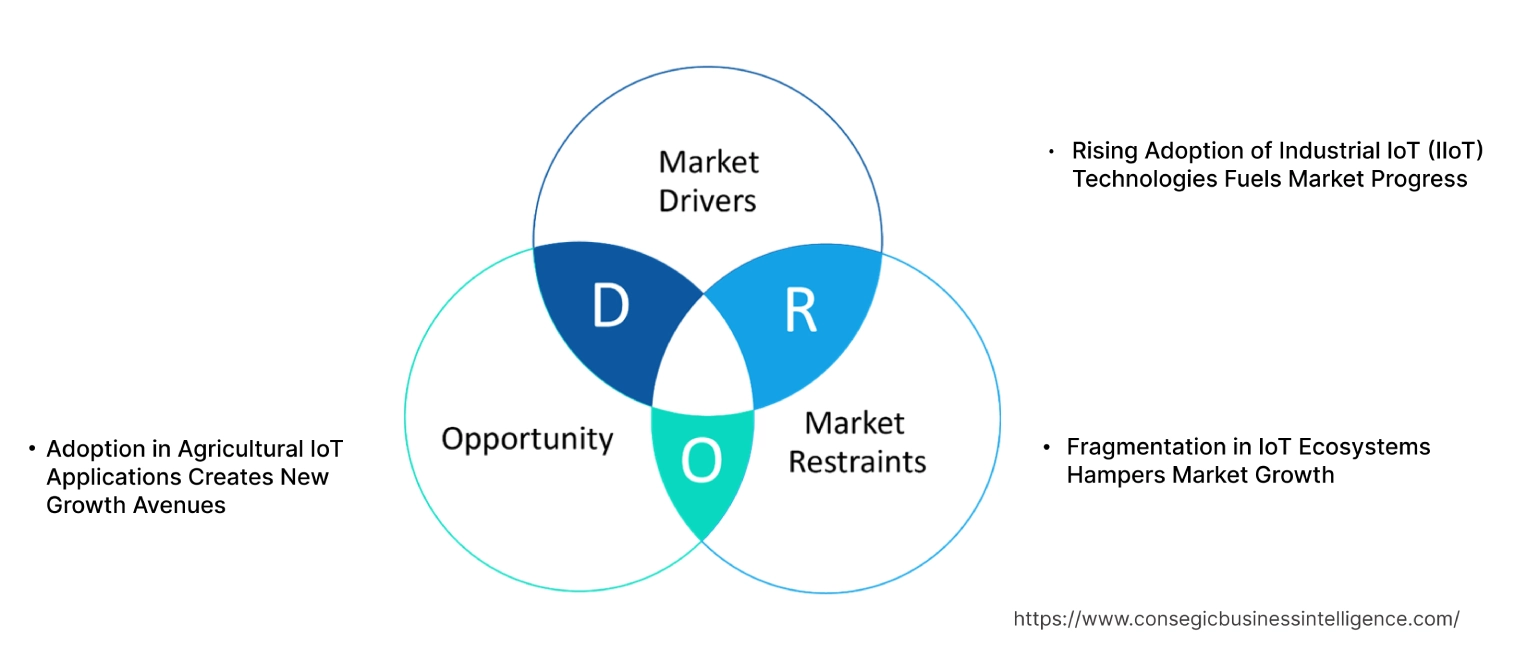
Rising Adoption of Industrial IoT (IIoT) Technologies Fuels Market Progress
The increasing adoption of Industrial IoT (IIoT) technologies is a major driver for IoT operating systems, enabling industries to achieve greater efficiency, automation, and connectivity. IIoT integrates smart sensors, connected devices, and advanced analytics into industrial processes, allowing real-time monitoring, predictive maintenance, and seamless control. This has become critical for industries such as manufacturing, energy, and logistics, which require highly reliable and scalable systems to manage vast amounts of operational data. IoT operating systems play a key role by facilitating device interoperability, secure data exchange, and efficient resource management in IIoT environments. Trends such as smart factories, digital twins, and edge computing are further accelerating the demand for operating systems that handle complex industrial workflows. As industries prioritize productivity, cost reduction, and sustainability, the adoption of IIoT technologies continues to expand, driving IoT operating systems market demand for robust and specialized IoT operating platforms.
Key Restraints :
Fragmentation in IoT Ecosystems Hampers Market Growth
The highly fragmented IoT ecosystem presents a significant restraint due to the vast diversity of devices, communication protocols, and hardware configurations. Each IoT application, whether in healthcare, manufacturing, or smart cities, has unique requirements, making it difficult to create universally compatible operating systems. This fragmentation forces manufacturers to develop customized operating systems for specific use cases, which increases development complexity, costs, and time-to-market. Moreover, the lack of standardization across IoT devices and protocols complicates seamless interoperability, hindering large-scale deployments. For example, ensuring that IoT sensors, gateways, and cloud platforms communicate effectively often requires extensive customization and middleware integration. This constraint is particularly pronounced in industries with legacy systems, where compatibility issues further limit adoption. As a result, the scalability of IoT solutions across diverse applications is restricted, slowing down the IoT operating systems market growth.
Future Opportunities :
Adoption in Agricultural IoT Applications Creates New Growth Avenues
The agriculture sector is increasingly adopting IoT technologies to enable precision farming practices, optimize resource usage, and improve crop yields. IoT devices, such as soil moisture sensors, weather stations, and crop health monitors, provide real-time data, helping farmers make informed decisions about irrigation, fertilization, and pest control. These applications require operating systems tailored for agricultural environments, offering long-term reliability, low-power consumption, and ruggedness to withstand harsh outdoor conditions. In remote areas with limited connectivity, IoT operating systems designed for intermittent or low-bandwidth networks facilitate seamless data collection and transmission. They also support integration with satellite and edge computing systems to enhance decision-making. As smart farming practices expand to address challenges like climate change, water scarcity, and food security, the demand for specialized operating systems in agriculture continues to grow, creating significant IoT operating systems market opportunities.
IoT Operating Systems Market Segmental Analysis :
By Component:
Based on the component, the market is segmented into Device Type (Server Side, Client Side) and Services (Consulting, Integration & Deployment, Support & Maintenance).
The Server Side segment held the largest revenue of the total IoT Operating systems market share in 2023.
- Server-side IoT operating systems are essential for managing large-scale device networks and enabling data processing, storage, and analytics.
- These systems are widely adopted in industrial IoT (IIoT) applications to manage critical operations such as predictive maintenance and supply chain optimization.
- Server-side solutions ensure seamless integration with cloud platforms, supporting scalability and efficient resource utilization.
- Therefore, the trends indicate the increasing reliance on server-side systems for real-time data processing and decision-making in smart cities and connected vehicle networks are driving IoT operating systems market expansion.
The Services segment is expected to grow at the fastest CAGR during the forecast period.
- Consulting services are vital for organizations planning IoT deployments, providing expertise in selecting and implementing suitable operating systems.
- Integration and deployment services streamline the adoption of IoT systems, ensuring compatibility with existing infrastructure and devices.
- Support and maintenance services enhance system reliability, offering regular updates, troubleshooting, and performance optimization.
- Therefore, the market analysis highlights the growing importance of service offerings in simplifying the complexities of IoT implementations across industries, fueling IoT operating systems market growth.
By Application:
Based on application, the market is segmented into Smart Home Automation, Industrial IoT (IIoT), Healthcare IoT, Smart Cities, Retail IoT, and Connected Vehicles.
The Industrial IoT (IIoT) segment accounted for the largest revenue of the total IoT Operating systems market share in 2023.
- IoT operating systems enable real-time monitoring and control of industrial processes, improving efficiency and reducing downtime.
- Applications in IIoT include robotics, predictive maintenance, and asset tracking in manufacturing and logistics.
- These systems support the integration of AI and machine learning for advanced analytics and decision-making in industrial environments.
- As per IoT operating systems market analysis, the dominance of this segment reflects its critical role in transforming traditional industries into smart factories.
The Healthcare IoT segment is expected to grow at the fastest CAGR during the forecast period.
- IoT operating systems in healthcare facilitate remote patient monitoring, wearable devices, and smart medical equipment, improving healthcare delivery and outcomes.
- These systems ensure secure data transmission and compliance with regulatory standards, such as HIPAA, for patient data protection.
- The adoption of IoT in telemedicine and diagnostics is driving the rapid expansion of this segment.
- Thus, the market analysis emphasizes the rising importance of IoT solutions in enhancing operational efficiency and patient care in healthcare institutions, which boosts the IoT operating systems market demand.
By Operating Environment:
Based on the operating environment, the market is segmented into Real-Time Operating Systems (RTOS), Embedded Operating Systems, General-Purpose Operating Systems (GPOS), and Network Operating Systems.
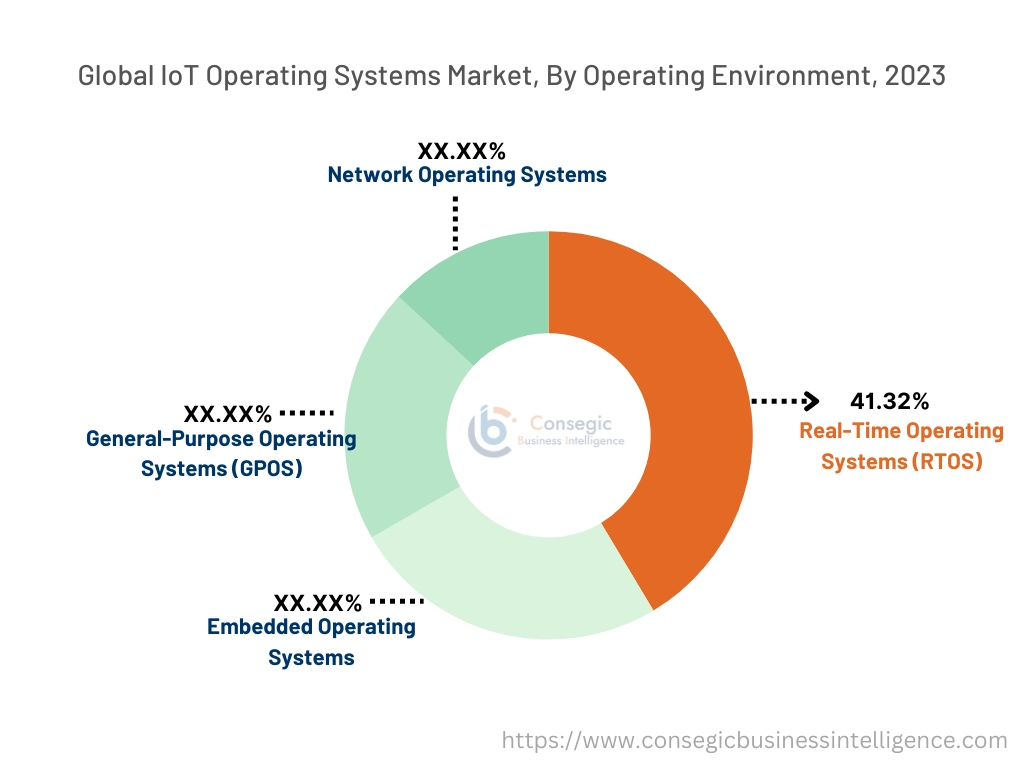
The Real-Time Operating Systems (RTOS) segment held the largest revenue of 41.32% share in 2023.
- RTOS is designed for time-critical applications, ensuring precise and predictable execution of tasks in IoT systems.
- These systems are widely used in applications such as autonomous vehicles, industrial automation, and aerospace systems.
- RTOS offers features like low latency and deterministic behavior, making them ideal for mission-critical operations.
- As per IoT operating systems market trends, the dominance of this segment is attributed to its suitability for high-reliability and safety-critical applications across industries.
The Embedded Operating Systems segment is expected to grow at the fastest CAGR during the forecast period.
- Embedded operating systems are integral to IoT devices, enabling efficient control and operation of hardware components.
- These systems are widely deployed in consumer electronics, automotive infotainment systems, and healthcare devices.
- The segment’s steady growth is supported by advancements in microcontrollers and embedded technologies, enhancing device performance.
- Therefore, the market trends highlight the increasing integration of embedded systems in smart devices, driven by the growing popularity of IoT applications further contributing to the IoT operating systems market expansion.
By End-User Industry:
Based on end-user industry, the market is segmented into Manufacturing, Healthcare, Automotive, Energy & Utilities, Retail, Government, and Others.
The Manufacturing segment held the largest revenue share in 2023.
- IoT operating systems are crucial for enabling automation, robotics, and real-time monitoring in smart manufacturing facilities.
- Applications include inventory management, quality control, and predictive maintenance, ensuring operational efficiency.
- Manufacturers are increasingly adopting IoT systems to reduce costs, improve productivity, and enhance supply chain transparency.
- As per IoT operating systems market analysis, the dominance of this segment is driven by Industry 4.0 initiatives and the increasing adoption of IoT in factory operations.
The Automotive segment is expected to grow at the fastest CAGR during the forecast period.
- IoT operating systems in the automotive sector support connected vehicle technologies, autonomous driving, and in-car infotainment systems.
- These systems enable real-time communication between vehicles and infrastructure, enhancing safety and traffic management.
- The segment’s steady growth is attributed to advancements in connected vehicle ecosystems and rising investments in smart mobility solutions.
- Thus, the market analysis highlights the critical role of IoT systems in shaping the future of the automotive sector, creating significant IoT operating systems market opportunities.
Regional Analysis:
The regions covered are North America, Europe, Asia Pacific, the Middle East and Africa, and Latin America.
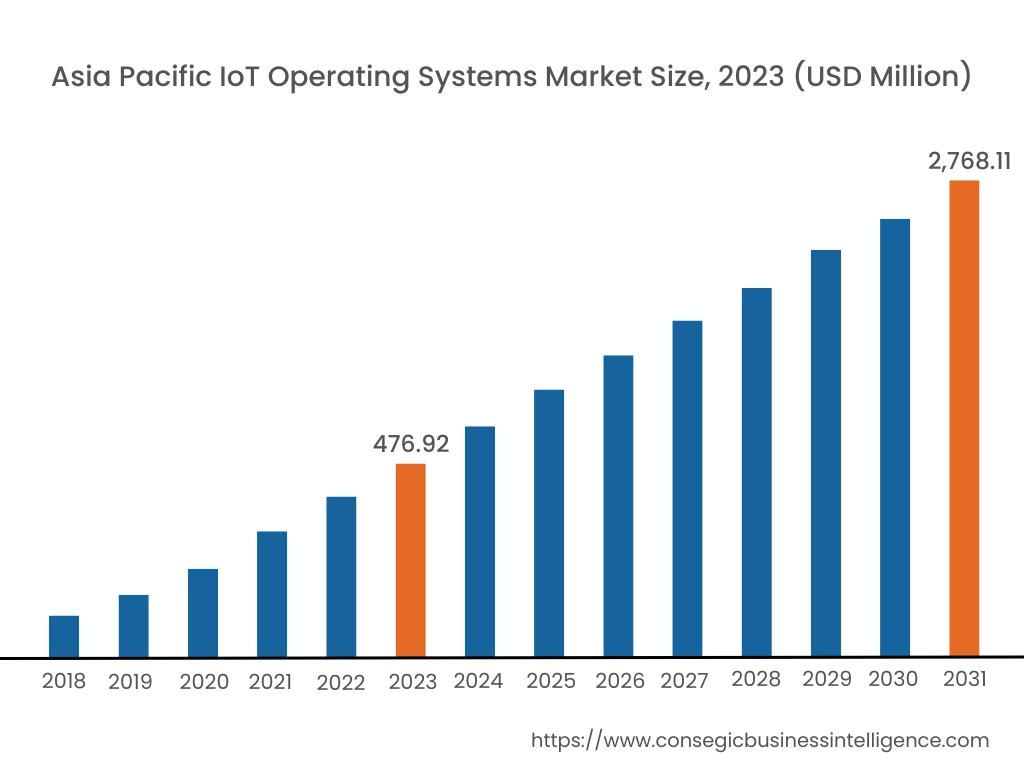
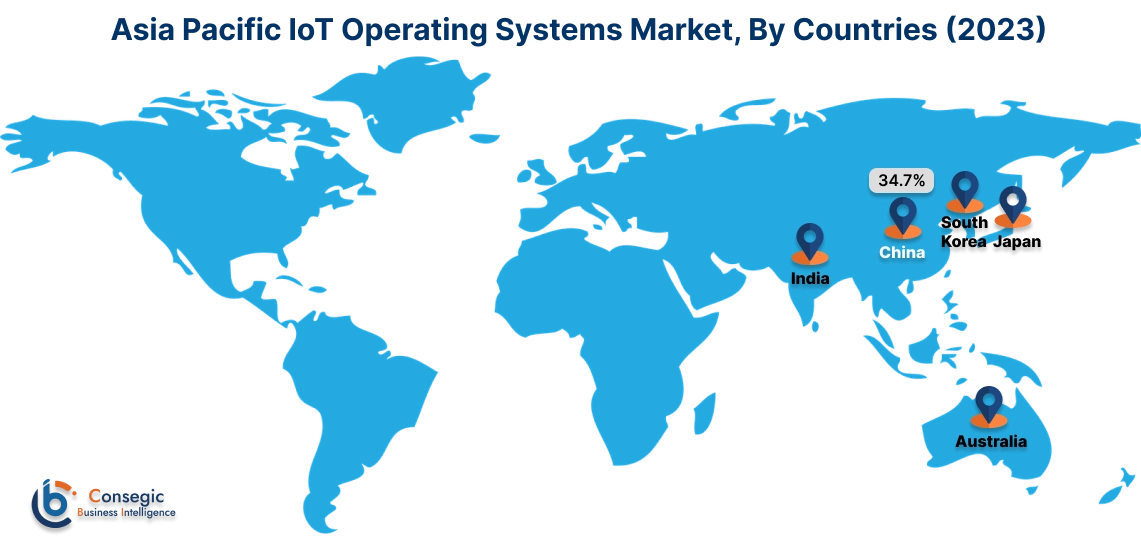
Asia Pacific region was valued at USD 476.92 Million in 2023. Moreover, it is projected to grow by USD 585.15 Million in 2024 and reach over USD 2,768.11 Million by 2031. Out of these, China accounted for the largest share of 34.7% in 2023. The Asia-Pacific region is experiencing rapid growth in the IoT operating systems market, propelled by industrialization and a burgeoning consumer electronics market in countries like China, India, and Japan. The proliferation of smart devices and the expansion of telecommunications infrastructure have intensified the demand for efficient IoT operating systems. As per IoT operating systems market trends, technological advancements, and government initiatives promoting smart city projects further influence market growth.
North America is estimated to reach over USD 3,035.70 Million by 2031 from a value of USD 538.96 Million in 2023 and is projected to grow by USD 659.64 Million in 2024. This region maintains a significant position in the IoT operating systems market, driven by the early adoption of IoT technologies across sectors such as manufacturing, healthcare, and automotive. The United States, in particular, has seen substantial integration of IoT devices, necessitating robust operating systems to manage complex networks. The trend towards smart manufacturing and connected healthcare systems has further propelled the utilization of specialized IoT operating systems.
Europe represents a substantial share of the global IoT operating systems market, with countries like Germany, France, and the United Kingdom leading in technological advancements. The region's strong emphasis on sustainability and the development of smart cities has accelerated the adoption of IoT solutions. The analysis indicates a growing trend towards integrating IoT operating systems in energy management and transportation sectors, aligning with the European Union's digitalization initiatives.
The Middle East & Africa region shows a growing interest in IoT operating systems, particularly in the oil & gas and utility sectors. Countries like the United Arab Emirates and Saudi Arabia are investing in IoT technologies to enhance operational efficiency and resource management. The analysis suggests an increasing trend towards adopting IoT operating systems to support digital transformation initiatives.
Latin America is an emerging market for IoT operating systems, with Brazil and Mexico being key contributors. The region's growing industrial sector and initiatives to promote digitalization have spurred the adoption of IoT solutions. Government policies aimed at modernizing infrastructure and enhancing connectivity influence market trends.
Top Key Players & Market Share Insights:
The IoT Operating Systems market is highly competitive with major players providing products and services to the national and international markets. Key players are adopting several strategies in research and development (R&D), product innovation, and end-user launches to hold a strong position in the global IoT Operating Systems market. Key players in the IoT Operating Systems industry include –
- Microsoft Corporation (USA)
- Google LLC (USA)
- Amazon Web Services, Inc. (USA)
- IBM Corporation (USA)
- Oracle Corporation (USA)
- Siemens AG (Germany)
- PTC Inc. (USA)
- MongoDB, Inc. (USA)
- Cisco Systems, Inc. (USA)
- SAP SE (Germany)
Recent Industry Developments :
- In September 2024, SECO announced the release of Clea OS, an advanced embedded Linux operating system designed to support the development of IoT solutions. This new addition to the Clea software stack is optimized for industrial applications, offering high reliability, security, and seamless integration with Clea's cloud components for device management and remote access. It aims to simplify the development process for IoT edge devices and streamline DevOps workflows.
- In May 2023, BlackBerry QNX introduced an ultra-scalable, high-performance compute-ready operating system aimed at advancing software development for next-generation vehicles and IoT systems. The new QNX OS is designed to support complex, mission-critical embedded systems, offering scalability and reliability for automotive and industrial IoT applications. This system ensures real-time computing performance while simplifying software development, reducing costs, and accelerating time-to-market for autonomous vehicles and IoT-based innovations.
IoT Operating Systems Market Report Insights :
| Report Attributes | Report Details |
| Study Timeline | 2021-2034 |
| Market Size in 2034 | USD 17,720.51 Million |
| CAGR (2026-2034) | 24.30% |
| Base Year | 2025 |
| By Component |
|
| By Application |
|
| By Operating Environment |
|
| By End-User Industry |
|
| By Region |
|
| Key Players |
|
| North America | U.S. Canada Mexico |
| Europe | U.K. Germany France Spain Italy Russia Benelux Rest of Europe |
| APAC | China South Korea Japan India Australia ASEAN Rest of Asia-Pacific |
| Middle East and Africa | GCC Turkey South Africa Rest of MEA |
| LATAM | Brazil Argentina Chile Rest of LATAM |
| Report Coverage |
|
Key Questions Answered in the Report
How big is the IoT Operating Systems Market? −
IoT Operating Systems Market size is estimated to reach over USD 9,227.05 Million by 2031 from a value of USD 1,621.45 Million in 2023 and is projected to grow by USD 1,986.21 Million in 2024, growing at a CAGR of 24.3% from 2024 to 2031.
What specific segmentation details are covered in the IoT Operating Systems Market report? +
The IoT Operating Systems Market report includes segmentation details by component (Device Type: Server Side, Client Side; Services: Consulting, Integration & Deployment, Support & Maintenance), application (Smart Home Automation, Industrial IoT (IIoT), Healthcare IoT, Smart Cities, Retail IoT, Connected Vehicles), operating environment (Real-Time Operating Systems (RTOS), Embedded Operating Systems, General-Purpose Operating Systems (GPOS), Network Operating Systems), end-user industry (Manufacturing, Healthcare, Automotive, Energy & Utilities, Retail, Government, Others), and region (Asia-Pacific, Europe, North America, Latin America, Middle East & Africa).
Which is the fastest-growing segment in the IoT Operating Systems Market? +
The Healthcare IoT segment is expected to grow at the fastest CAGR during the forecast period. IoT operating systems are increasingly adopted for real-time patient monitoring, wearable devices, and connected medical equipment, enhancing healthcare delivery and outcomes.
Who are the major players in the IoT Operating Systems Market? +
The major players in the IoT Operating Systems Market include Microsoft Corporation (USA), Google LLC (USA), Amazon Web Services, Inc. (USA), IBM Corporation (USA), Oracle Corporation (USA), Siemens AG (Germany), PTC Inc. (USA), MongoDB, Inc. (USA), Cisco Systems, Inc. (USA), and SAP SE (Germany).
Overview
Reputation & Certifications


Our Services
- Market Intelligence & Forecasting
- Custom Research Solutions
- Market Entry Strategy
- Competitive Intelligence
- Customer Insights
- Industry Innovation Analysis
- Investment Advisory