Jump to Content
Luxury & Sports Cars Market - Size, Share, Industry Trends, and Forecasts (2025-2032)
Luxury & Sports Cars Market Size:
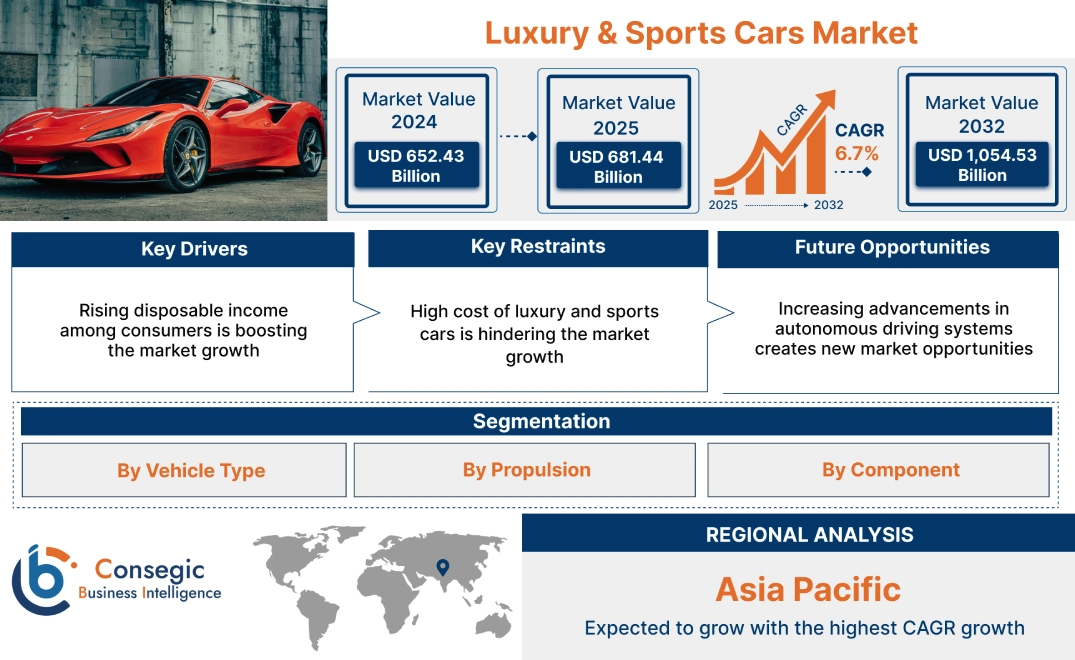
Luxury & Sports Cars Market size is estimated to reach over USD 1,054.53 Billion by 2032 from a value of USD 652.43 Billion in 2024 and is projected to grow by USD 681.44 Billion in 2025, growing at a CAGR of 6.7% from 2025 to 2032.
Luxury & Sports Cars Market Scope & Overview:
Luxury & sports cars are known for their design, riding experience, and performance. These cars provide comfort, luxury, advanced technology, safety, exclusivity, status, ride quality, high-performance, and other benefits. Moreover, luxury cars focus more on comfort, and high-end features, while the sports cars usually focus on performance and handling, which offers a thrilling driving experience. In addition, luxury cars are designed for a smooth and comfortable ride, with features like heated/massaging seats, sufficient legroom, and advanced technology. Furthermore, the cars require regular maintenance for efficient driving.
Luxury & Sports Cars Market Dynamics - (DRO):
Key Drivers:
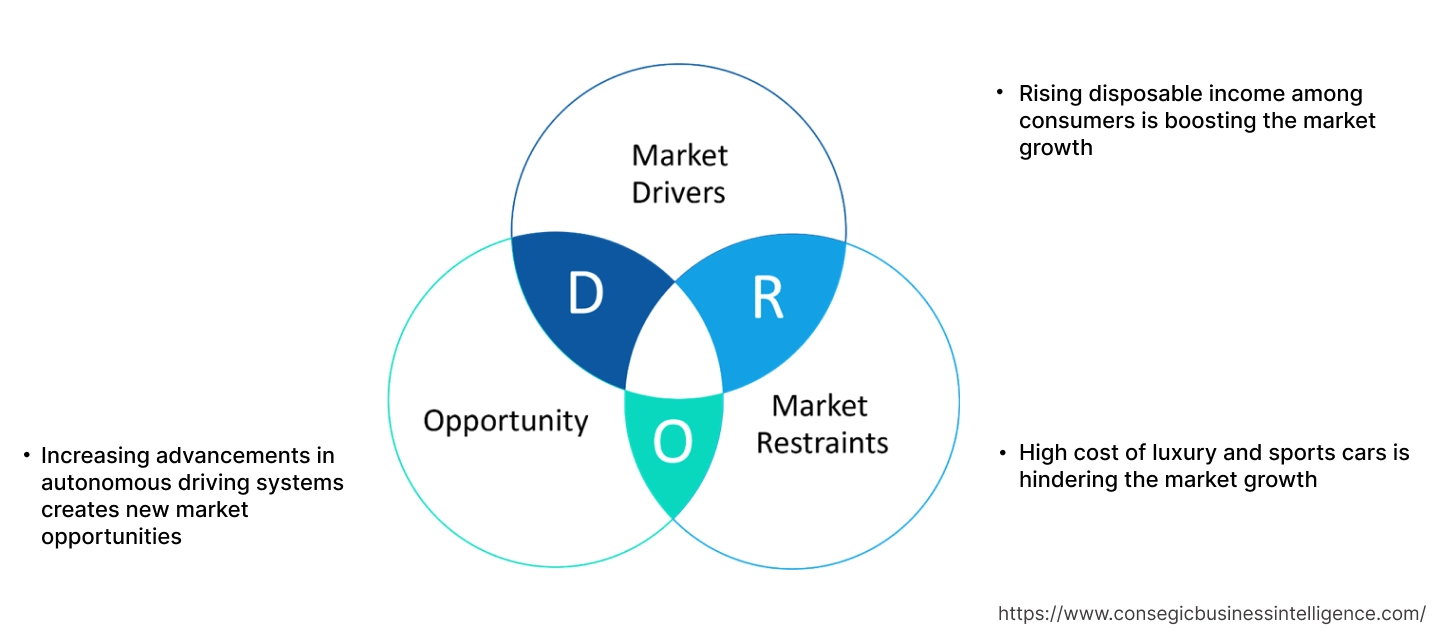
Rising disposable income among consumers is boosting the market growth
Rising disposable income fuels the demand as consumers with more purchasing power buy premium vehicles including sports and luxury cars. Moreover, these vehicles are often associated with advanced technology, high performance, and exclusive features, further driving the adoption of these cars. Furthermore, car manufacturers are focusing on offering personalized and customized experiences, catering to the unique needs and preferences of customers, in turn, driving the market growth.
- For instance, according to Organization for Economic Co-operation and Development (OECD), the gross disposable income per capita of households and NPISH was USD 63,084 in United States in the year 2023.
Thus, the aforementioned factors are boosting the sales of sports and luxury cars, in turn, driving the luxury & sports cars market growth.
Key Restraints:
High cost of luxury and sports cars is hindering the market growth
High production and maintenance costs significantly hinder the sales of luxury & sports cars globally. These cars are expensive due to the use of advanced technologies, high-quality materials, and specialized manufacturing processes. Moreover, these vehicles require specialized parts and skilled technicians, leading to high maintenance and repair costs.
Furthermore, these cars depreciate faster than standard vehicles, adding to the overall cost of ownership. Thus, the market analysis shows that the aforementioned factors are restraining the luxury & sports cars market demand.
Future Opportunities:
Increasing advancements in autonomous driving systems creates new market opportunities
Integrating advanced autonomous driving systems in luxury & sports cars using AI, sensors, and connectivity enhances safety, convenience, and the overall driving experience. AI algorithms allow vehicles to perceive, reason, and maneuver in complex road situations. LiDAR, radar systems, and cameras provide vehicles with enhanced situational awareness that allows the systems to interpret signals, identify objects, and respond to traffic conditions. Moreover, luxury automakers are developing systems that handle most driving tasks independently, with minimal driver intervention.
- For instance, in March 2025, Zeekr, a Chinese luxury EV maker, launched an autonomous driving system. The new Zeeker 9X SUV is integrated with a new G-Pilot system that uses artificial intelligence to locate empty parking spots and avoid obstacles.
Thus, the ongoing advancements in autonomous driving systems are projected to drive luxury & sports cars market opportunities during the forecast period.
Luxury & Sports Cars Market Segmental Analysis :
By Vehicle Type:
Based on the vehicle type, the market is segmented into SUV, sedan/hatchback, and sports/super luxury cars.
Trends in the Vehicle Type:
- Rising trend in adoption of hatchback vehicles for better fuel efficiency and affordability is driving the luxury & sports cars market size.
- Increasing adoption of sports cars due to factors including quick acceleration and enhanced handling and performance.
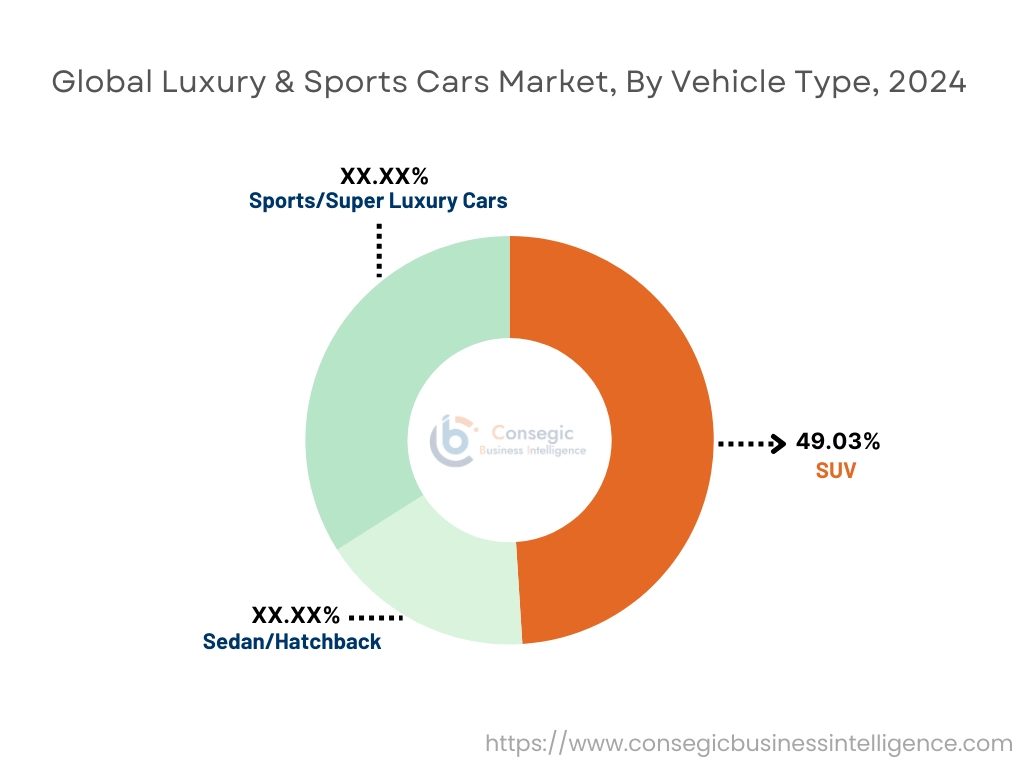
The SUV segment accounted for the largest revenue share of 49.03% in the market in 2024.
- SUVs offer benefits including spacious interiors, enhanced visibility, and versatility for various terrains while providing both comfort and safety.
- SUVs offer comfortable seating and advanced technology, enhancing the overall passenger experience.
- For instance, in March 2025, Martial Volvo Cars launched a luxury SUV, Volvo XC90. It has 2.0-liter mild-hybrid turbo-petrol engine that produces 360Nm of maximum torque and 250hp.
- Therefore, the wide spread adoption of SUVs is driving the luxury & sports cars market growth.
The sedan/hatchback segment is expected to register fastest CAGR during the forecast period.
- Sedans offer a more comfortable and stable ride even at higher speeds, while hatchbacks are more fuel-efficient and easier to move in compact city spaces.
- Sedans have a separate trunk that offers dedicated and secure space for luggage while hatchbacks offer cargo space by folding down the rear seats that creates a larger, more usable space.
- For instance, in July 2024, BMW launched 5 Series luxury sedan featuring luxurious comfort and unparalleled space. It comes with BMW operating system 8.5 and intelligent personal assistant.
- Thus, the rising demand for sedan/hatchback cars is expected to boost the luxury & sports cars market trends during the forecast period.
By Propulsion:
Based on the propulsion, the market is segmented into electric/hybrid and ICE.
Trends in the Propulsion:
- Rising demand for electric/hybrid cars due to government incentives, tax benefits, and subsidies is driving the luxury & sports cars market size.
- Increasing trend in adoption of ICE cars due to factors such as greater range, improved power, and quick refueling, among others.
The ICE segment accounted for the largest revenue share in the luxury & sports cars market share in 2024.
- ICE cars are available in various models, offer personalized customizations, and require lower purchasing costs, which are further driving their demand.
- Moreover, ICE offers longer range, advanced combustion techniques, and improved aerodynamics.
- For instance, in June 2023, Toyota Motor Corporation commenced sales of all-new Vellfire and Alphard gasoline models. The models have 2.5-liter gasoline engine with super CVT-I transmission.
- Therefore, the luxury & sports cars market analysis depicts that the aforementioned factors are driving the luxury & sports cars market demand.
The electric/hybrid segment is expected to register the fastest CAGR during the forecast period.
- Electric and hybrid cars offer multiple benefits including lower emissions, reduced fuel costs and environmental advantages, which makes them suitable for sustainable and efficient transportation options.
- For instance, in March 2025, BYD Denza launched new SUV Denza N9 with CLTC battery range of more than 200 kilometers.
- Thus, the market analysis concludes that the advantages provided by electric/hybrid cars is anticipated to drive the luxury & sports cars market trends during the forecast period.
By Component:
Based on the component, the market is segmented into drivetrain, interior, body, electronics, and chassis.
Trends in the Component:
- Rising adoption of chassis for facilitating improved vehicle stability, rigidity, durability, comfort, and safety.
- Increasing trend in adoption of electronics systems in cars such as advanced driver assistance systems, infotainment and navigation system, and others.
The drivetrain segment accounted for the largest revenue share in the luxury & sports cars market share in 2024.
- Drivetrain, a subset of powertrain, refer to components that transfer power from the engine to the wheels. It includes the transmission, driveshaft, axles, differential, and CV joints.
- There are four different types of drivetrains including front-wheel drive (FWD), rear-wheel drive (RWD), all-wheel drive (AWD), and four-wheel drive (4WD) that affects the traction, handling, and fuel efficiency.
- For instance, BMW offers BMW xDrive electric all-wheel 523 hp with two powerful electric motors. The drive propels from 0 to 100 km/h in 4.6 seconds.
- Therefore, the market analysis depicts that the aforementioned factors are driving the luxury & sports cars market expansion.
The interior segment is expected to register the fastest CAGR during the forecast period.
- A car interior offers benefits including improved resale value, enhanced comfort, and a more immersive driving experience.
- Moreover, interior systems also include ergonomic designs, AI-powered features, and eco-friendly materials.
- For instance, in September 2024, Lotus launched Eletre Carbon, an ultra-luxury variant of its electric hyper-SUV Eletre. Eletre Carbon features three new leather interior colorways including light grey, black, and dark brown.
- Thus, the market analysis concludes that the rising demand for improved interior in cars is expected to boost the luxury & sports cars market opportunities during the forecast period.
Regional Analysis:
The regions covered are North America, Europe, Asia Pacific, the Middle East and Africa, and Latin America.
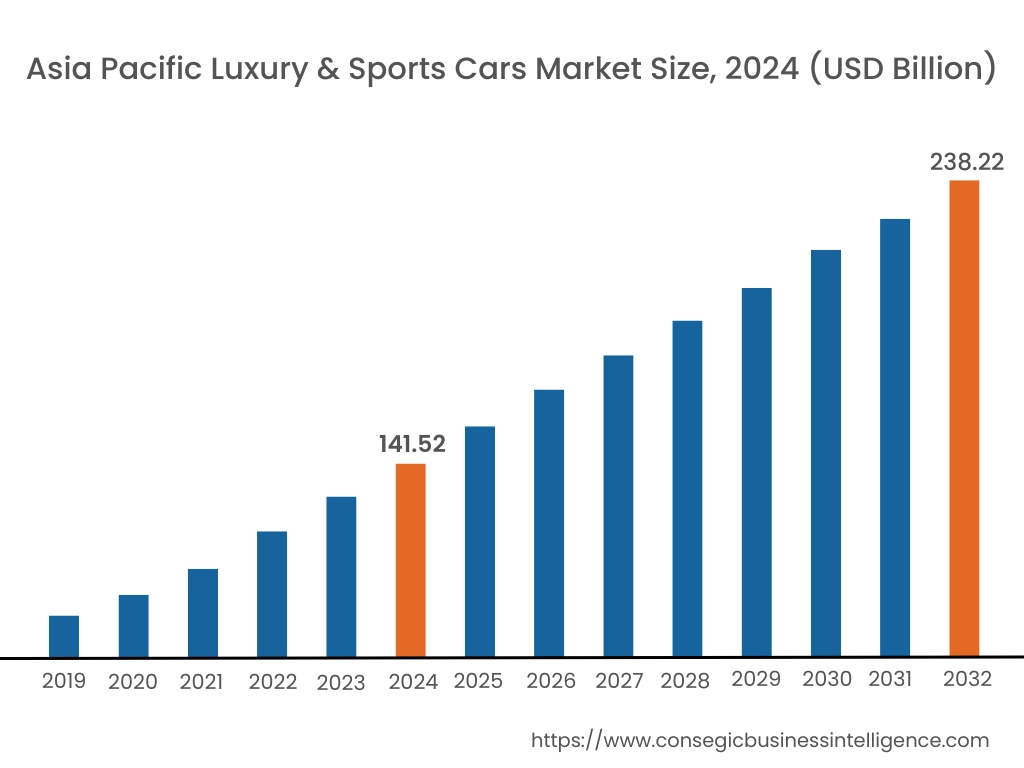
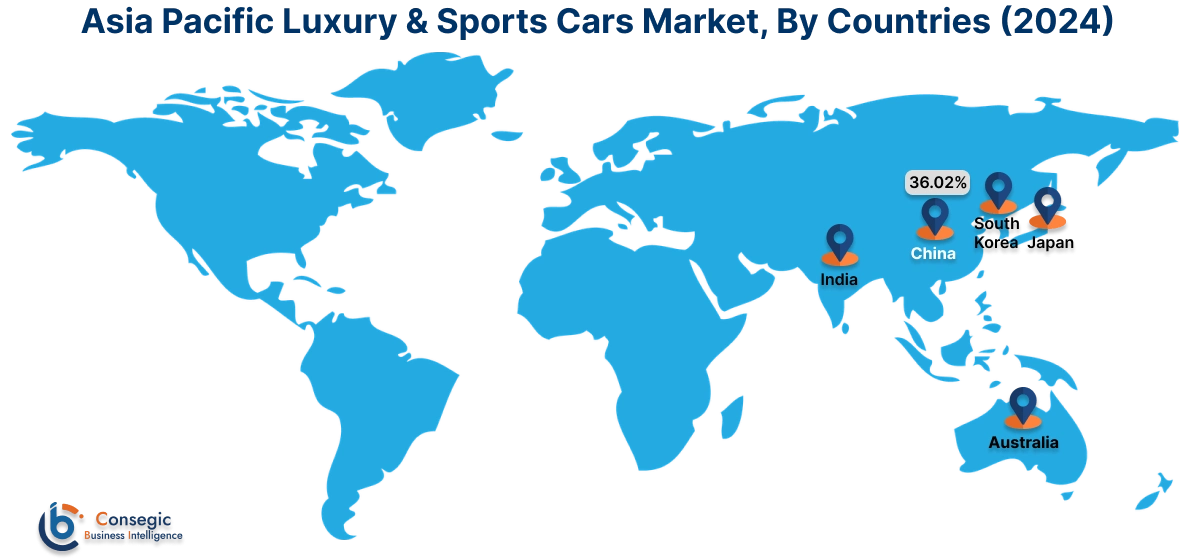
Asia Pacific region was valued at USD 141.52 Billion in 2024. Moreover, it is projected to grow by USD 148.32 Billion in 2025 and reach over USD 238.22 Billion by 2032. Out of this, China accounted for the maximum revenue share of 36.02%. The market is expanding as manufacturers are locally producing cars, leading to slightly lower prices, in turn, driving the market. Moreover, urbanization, rising living standard, and consumer preference for expensive vehicles, are further boosting the market growth.
- For instance, in January 2025, Lotus Emeya and Lotus Emira launched in India. The Lotus Emeya series is the electric hyper-GT while Lotus Emira serries is the ICE-powered sports car.
North America is estimated to reach over USD 313.72 Billion by 2032 from a value of USD 195.63 Billion in 2024 and is projected to grow by USD 204.20 Billion in 2025. In the region, the market is driven by factors including rising consumer preference for premium features and technology in cars along with increasing disposable incomes, which is further leading to market growth.
- For instance, in December 2024, Honda announced return of Honda Prelude in US markets. The vehicle will use two-motor hybrid system of Honda with 200 horsepower engines.
Additionally, in Europe, the market is driven by rising disposable income, economic stability, and a robust automotive industry. Moreover, the luxury & sports cars market analysis suggests that in Latin America and Middle East and Africa, the market is rising due to rising incomes, consumer preferences for high-end vehicles, and an expanding motorsports sector, which is further contributing to luxury & sports cars market expansion.
Top Key Players & Market Share Insights:
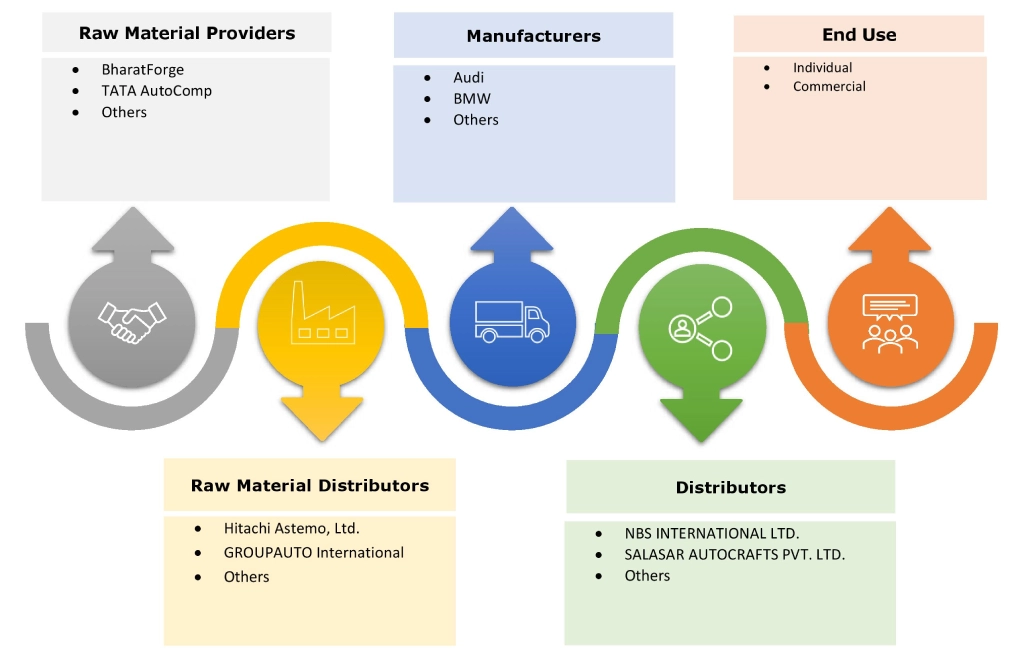
The luxury & sports cars industry is highly competitive with major players providing products to the national and international markets. Key players are adopting several strategies in research and development (R&D), product innovation, and end-user launches to hold a strong position in the global luxury & sports cars market. Key players in the luxury & sports cars industry include -
Recent Industry Developments :
Business Expansions:
- In February 2025, Arnold Clark launched its Luxe branch in Glasgow, UK. It offers high-value and high-end used cars including Audi, Lamborghini, Bentley, BMW, Porsche, and Maserati.
Luxury & Sports Cars Market Report Insights:
| Report Attributes | Report Details |
| Study Timeline | 2019-2032 |
| Market Size in 2032 | USD 1,054.53 Billion |
| CAGR (2025-2032) | 6.7% |
| By Vehicle Type |
|
| By Propulsion |
|
| By Component |
|
| By Region |
|
| Key Players |
|
| North America | U.S. Canada Mexico |
| Europe | U.K. Germany France Spain Italy Russia Benelux Rest of Europe |
| APAC | China South Korea Japan India Australia ASEAN Rest of Asia-Pacific |
| Middle East and Africa | GCC Turkey South Africa Rest of MEA |
| LATAM | Brazil Argentina Chile Rest of LATAM |
| Report Coverage |
|
Key Questions Answered in the Report
How big is the luxury & sports cars market? −
Luxury & Sports Cars Market size is estimated to reach over USD 1,054.53 Billion by 2032 from a value of USD 652.43 Billion in 2024 and is projected to grow by USD 681.44 Billion in 2025, growing at a CAGR of 6.7% from 2025 to 2032.
What are the major segments covered in the luxury & sports cars market report? +
The segments covered in the report are vehicle type, propulsion, component, and region.
Which region holds the largest revenue share in 2024 in the luxury & sports cars market? +
Europe holds the largest revenue share in the luxury & sports cars market in 2024.
Who are the major key players in the luxury & sports cars market? +
The major key players in the market are Audi (Germany), BMW (Germany), Cadillac (U.S.), Genesis (South Korea), Jaguar Land Rover (U.K.), Lexus (Japan), Maserati (Italy), Mercedes-Benz (Germany), Porsche (Germany), and Volvo (Germany).
Overview
Reputation & Certifications


Our Services
- Market Intelligence & Forecasting
- Custom Research Solutions
- Market Entry Strategy
- Competitive Intelligence
- Customer Insights
- Industry Innovation Analysis
- Investment Advisory