Jump to Content
Marine Electric Vehicle Market - Size, Share, Industry Trends, and Forecasts (2025-2032)
Marine Electric Vehicle Market Size:
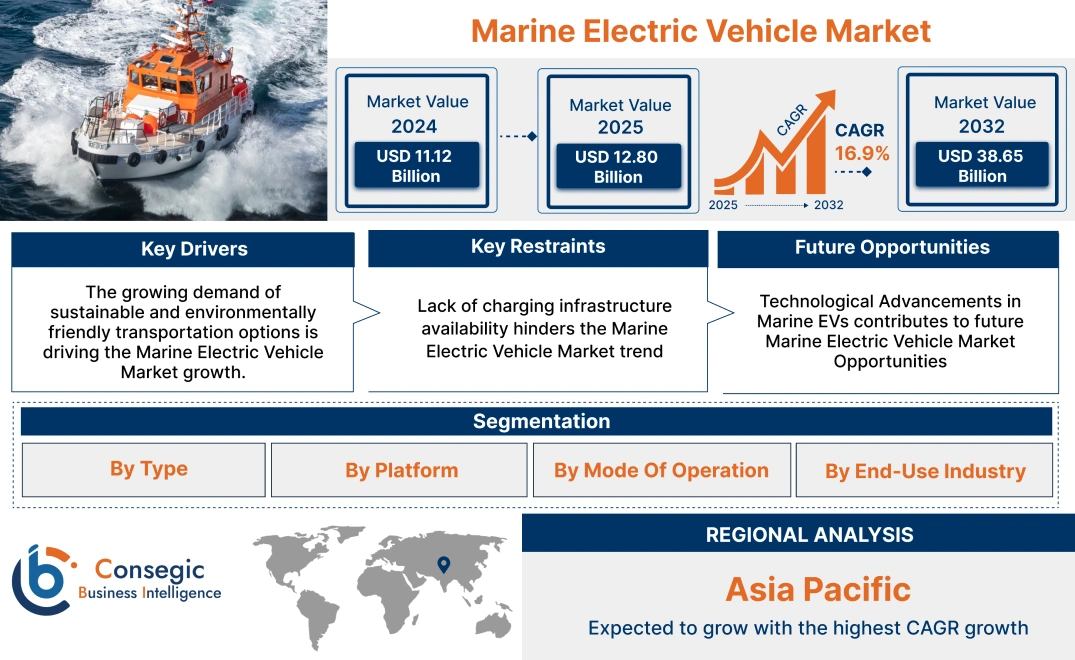
Marine Electric Vehicle Market size is estimated to reach over USD 38.65 Billion by 2032 from a value of USD 11.12 Billion in 2024 and is projected to grow by USD 12.80 Billion in 2025, growing at a CAGR of 16.9% from 2025 to 2032.
Marine Electric Vehicle Market Scope & Overview:
Marine electric vehicles (MEVs), or electric boats, are watercraft powered by electric motors, drawing energy from batteries or fuel cells. They encompasses various types, including battery electric boats (BEVs), hybrid electric boats (HEVs), and plug-in hybrid electric boats (PHEVs), offering environmentally friendly alternatives to traditional combustion-powered vessels. These electric vehicles are powered by electric motors instead of internal combustion engines. These motors draw electricity from onboard batteries or fuel cells, which are then charged from an external source. MEVs offer a cleaner and more sustainable alternative to traditional fossil fuel-powered vessels, reducing emissions and noise pollution. Some examples of MEVs include electric ferries, electric yachts, and electric workboats. Their end-user industry consists of defense, research, oil and gas exploration, passenger transport, fishing, and environmental monitoring.
How is AI Impacting the Marine Electric Vehicle Market?
AI is accelerating the marine electric vehicle market by tackling its core challenges which include battery management and energy optimization. AI-powered battery management systems (BMS) use machine learning to predict battery health, extend lifespan, and optimize charging cycles, which is crucial for the reliability and range of electric vessels. Further, AI enhances route optimization by analyzing real-time data like weather conditions, ocean currents, and cargo weight to calculate the most energy-efficient paths. It also enables predictive maintenance by analyzing sensor data to anticipate equipment failures, minimizing downtime and maintenance costs. This integration is making MEVs more viable, efficient, and reliable, thereby accelerating their adoption and market growth.
Marine Electric Vehicle Market Dynamics - (DRO):
Key Drivers:
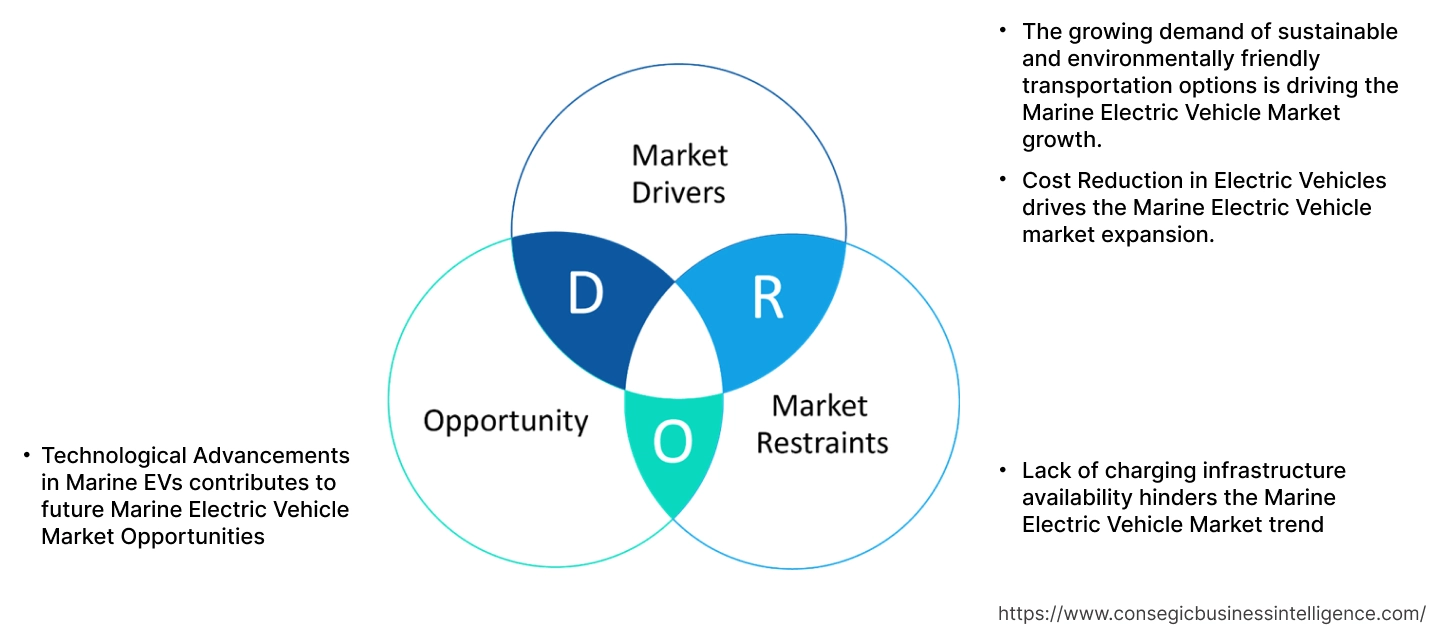
The growing demand of sustainable and environmentally friendly transportation options is driving the Marine Electric Vehicle Market growth.
Marine Electric Vehicles (MEVs) offer a promising path towards a cleaner maritime sector, but their environmental impact extends beyond just the vessel itself, encompassing the entire lifecycle, from resource extraction to battery disposal. MEVs produce zero direct emissions during operation, unlike traditional fossil fuel-powered vessels, significantly reducing air and water pollution. Electric motors are highly energy efficient, converting a larger portion of energy into motion compared to internal combustion engines. Electric boats rely on electricity, which is generated from renewable sources like solar, wind, and hydro power, reducing dependence on fossil fuels and their associated environmental impacts. They have lower lifetime greenhouse gas emissions than gasoline-powered equivalents, especially when charged using renewable energy sources. They require less maintenance than gasoline-powered boats, as they have fewer moving parts and do not require oil changes or fuel filters.
- In February 2025, The Connecticut Department of Energy and Environmental Protection (DEEP) announced the availability of more than $1 Billion in federal funds for grants to local and state governments, as well as businesses and organizations who want to replace large, older diesel engines and equipment with electric vehicle equivalents or newer, cleaner-burning engines.
Thus, the environmental benefits offered by EVs such as reducing emissions, noise pollution, and reliance on fossil fuels, contributing to cleaner water and air quality results in their increased trend leading to Marine Electric Vehicle Market expansion.
Cost Reduction in Electric Vehicles drives the Marine Electric Vehicle market expansion.
The cost savings when owning an electric boat compared to petrol and diesel-powered outboards is significant. Compared to petrol and diesel-powered boats, electric boats have lower maintenance requirements, saving owners significant time and effort including no engine or foot oils to be changed, no oil filters, transmission, fuel systems, drive-belt, spark plug, petrol lines or distributor caps to check and service and also no need to carry spare fuel on board. Electric boats still require some care as they operate in harsh marine environments, but this is significantly less than for petrol or diesel outboards. They are more reliable and provide a longer average lifetime compared to petrol and diesel-powered outboards, as a result of far fewer moving parts.
- For instance, in October 2024, SOLiTHOR made significant progress in the development of its next-generation Lithium metal solid-state batteries (SSBs) designed to meet the rigorous demands of the aviation and maritime industries and accelerate their electric transition. These advancements include major improvements in cyclability, energy density, industrialization readiness, and cost reduction making SOLiTHOR one of the world’s leaders in the solid-state battery sector.
Thus, the cost reduction of MEVs boosts their demand driving the market.
Key Restraints:
Lack of charging infrastructure availability hinders the Marine Electric Vehicle Market trend
The lack of readily available and reliable charging infrastructure is a significant hurdle for the widespread adoption of these EVs as it limits their operational range and convenience compared to traditional, fuel-powered boats. The current infrastructure for charging MEVs is sparse, making it difficult and inconvenient to find charging stations, especially for longer trips. MEVs have a shorter travel range than their fossil fuel-powered counterparts, and the lack of charging infrastructure exacerbates "range anxiety" for potential users. Charging electric boats takes longer than refueling traditional boats, which is a deterrent for some users. The upfront costs of building and maintaining charging infrastructure is high, which may discourage investment. There are technical challenges associated with developing and deploying charging infrastructure for marine environments, such as ensuring it is waterproof and its ability to withstand harsh conditions.
Thus, the lack of charging infrastructure for MEVs results to be unfavorable for the market.
Future Opportunities:
Technological Advancements in Marine EVs contributes to future Marine Electric Vehicle Market Opportunities
Technological advancements in MEVs are focused on improving battery technology, developing efficient propulsion systems, and integrating smart technologies for autonomous operation and enhanced safety, all while aiming for sustainability and reduced emissions. Batteries with higher energy density provides longer operational ranges and heavier payloads. Fast charging infrastructure and technologies makes EVs more useful for practical applications. The integration of autonomous navigation and control systems into electric vessels further enhances safety, efficiency, and operational flexibility. The development of a robust and reliable charging infrastructure for electric vessels, both in ports and along waterways, will be essential for supporting the growth of the electric marine sector. The development of submersibles and remotely operated vehicles (ROVs) opens up new possibilities for deep-sea exploration and research. Emerging technologies such as autonomous underwater vehicles (AUVs), unmanned surface vessels (USVs), and underwater drones are transforming the way we explore and exploit the ocean.
- For instance, HaiSea Marine Limited Partnership (HaiSea Marine LP), majority owned by the Haisla Nation in partnership with Seaspan ULC, recently announced the start of an innovative idea leading new battery-powered and low emissions tugboat build program. The new fleet is among the greenest tugboat fleets in the world and provides ship-assist and escort towing services to LNG carriers calling at LNG Canada’s new export facility in Kitimat in the unceded traditional territory of the Haisla Nation.
Thus, the technological advancements in Marine EVs provides massive scope of demand in the market.
Marine Electric Vehicle Market Segmental Analysis :
By Type:
Based on type, the market is segmented into Battery Electric, Plug-in Hybrid Electric, and Hybrid.
Battery Electric segment accounted for the largest revenue in the Marine Electric Vehicle Market share in 2024.
- Marine battery electric vehicles (BEVs), also known as all-electric vessels, are in trend for marine transportation. They include boats and ships that operate solely on electricity stored in batteries, eliminating the need for internal combustion engines.
- Battery type Marine EVs are fully electric vehicles with rechargeable batteries and no gasoline engine. All energy to run the vehicle comes from the battery pack which is recharged from the grid.
- BEVs are zero emissions vehicles, as they do not generate any harmful tailpipe emissions or air pollution hazards caused by traditional gasoline-powered vehicles.
- They use batteries to power electric propulsion systems, offering silent and emission-free operation, particularly suitable for shorter-distance vessels like ferries, tugs, and inland waterway boats, while larger vessels may benefit from hybrid solutions.
- They are used for various applications, including propulsion for boats, ferries, and even cargo ships, offering silent operation and reduced emissions.
- For instance, in February 2025, Seavolt and RAD Propulsion announced new partnership to deliver complete electric propulsion solutions to boat manufacturers, marinas, ports, sporting organisations, and governments across Australia and the Pacific region which offers a total engine, battery and charging solution.
- Thus, the zero emission property of Battery electric marine vehicles drives the market.
Plug-in Hybrid Electric segment is anticipated to have the fastest CAGR during the forecast period.
- A plug-in hybrid marine EV (PHEV) is a vessel that combines a conventional engine with a rechargeable battery pack, allowing it to be charged via shore power and operate on electric power for certain periods.
- It consists of a hybrid system meaning it has both an internal combustion engine (like diesel) and an electric motor powered by batteries.
- It use batteries to power an electric motor, as well as another fuel, such as gasoline or diesel, to power an internal combustion engine or other propulsion source.
- The vessel operates on electric power alone for certain parts of the journey, such as when maneuvering in port or during standby operations. When electric power is insufficient or for longer journeys, the internal combustion engine kicks in, providing additional power.
- In March 2025, AET, a leading global owner and operator of maritime transportation assets and specialised services, and Fleetzero, a developer and manufacturer of modular marine batteries for hybrid and electric ships, have recently signed an agreement for the development of the world’s longest-range plug-in hybrid-electric vessel.
- Thus, the plug-in hybrid segment is an emerging trend in the market providing a dual powering facility for marine vehicles.
By Platform:
Based on platform, the market is segmented into on-water and underwater marine EV.
The On-Water Marine EV segment accounted for the largest revenue in the Marine Electric Vehicle Market in 2024.
- On-water marine EV refers to electric boats or ships, also known as electric marine vessels (EMVs), that use electric motors and batteries for propulsion, which traverses on the water surface, offering a cleaner and quieter alternative to traditional fuel-powered boats.
- They are the electric boats and ships that operate on the surface. These vessels utilize electric motors powered by onboard batteries, solar panels, or generators, eliminating emissions and reducing noise pollution.
- They include ferries, leisure boats, and even some types of tugboats, with electric drives also available as auxiliary propulsion for sailing yachts.
- Electric boats are a key part of the movement towards sustainable marine transportation, contributing to cleaner oceans and waterways.
- They are used for various purposes, such as recreational boating, commercial applications, and even passenger transport, particularly in inland waterways.
- For instance, in December 2024, Vision Marine Technologies Inc., a pioneer in electric marine propulsion, entered into a milestone partnership with Massimo Marine, the marine division of Massimo Group. This collaboration aims to produce a fully integrated 30-foot electric pontoon platform designed for commercial and recreational markets. As part of Vision Marine’s strategic shift to offer complete electric boats directly to consumers, this partnership represents a key step in rapidly delivering high-quality electric marine products to market.
- Thus, the On-water Marine market accounts for the largest revenue share in the market.
The Underwater Marine EV segment is anticipated to have the fastest CAGR during the forecast period.
- Underwater marine EVs, including autonomous underwater vehicles (AUVs) and remotely operated vehicles (ROVs) are unmanned, self-propelled vehicles that explores the ocean floor and perform various tasks, such as mapping, inspection, and data collection.
- These are remotely controlled vehicles that allow operators to perform tasks in underwater environments, often used for maintenance, inspection, and intervention.
- They are gaining traction for various applications, from ocean exploration to underwater work and defense
- AUVs and ROVs are used to explore the deep ocean, study marine life, and map the ocean floor. ROVs are used for underwater construction, maintenance, and inspection of pipelines, cables, and other infrastructure.
- For instance, in November 2024, A team of British engineers based in Portsmouth successfully demonstrated a new type of autonomous submarine, called Herne, also known as an extra-large autonomous underwater vehicle (XLAUV) and has been configured by BAE Systems to enable militaries to monitor and help protect underwater infrastructure across the vast expanses of the seabed, support anti-submarine warfare and provide another means for them to undertake covert surveillance missions.
- Thus, the Underwater marine EV segment is expected to show the fastest marine electric vehicle market growth.
By Mode Of Operation:
Based on mode of operation, the market is segmented into Manned, Remotely Operated, and Autonomous.
The Manned segment accounted for the largest revenue share in the Marine Electric Vehicle Market in 2024.
- Human-operated MEVs, or human-occupied vehicles (HOVs), are submersible vehicles that allow humans to explore and conduct research in deep-sea environments.
- HOVs allow humans to directly observe and interact with the underwater environment, including collecting samples and conducting experiments.
- Manned MEVs are boats or ships that are powered by electric motors and operated by humans.
- They use electric motors, which are powered by batteries, solar panels, or hydrogen fuel cells, to propel the vessel.
- For instance, in November 2024, Voltari announced it has built another kind of electric boat which is a patrol vessel. The VOLTARI Patrol 26 RIB is built to stand out in speed, performance, and environmental impact. Unlike traditional gas or diesel boats, this all-electric vessel operates without any noise or emissions, making it not only more eco-friendly but also stealthier in harsh water conditions or intense security operations.
- They include small electric boats for recreational use, ferries, or even larger vessels that are being developed for commercial applications.
The Autonomous segment is anticipated to have the fastest CAGR during the forecast period.
- Autonomous marine electric vehicles (AMEVs), also known as autonomous underwater vehicles (AUVs) or unmanned surface vehicles (USVs) are an emerging trend in the marine sector. They are vessels that can navigate, avoid obstacles, and perform tasks without human intervention, powered by electric propulsion systems.
- These autonomous underwater vehicles are robots that operate on or under the water, utilizing sensors, AI, and advanced propulsion to navigate and perform tasks autonomously.
- They use a variety of sensors, including cameras, lidar, radar, ultrasonic sensors, thermal cameras, and acoustic sensors, to perceive their environment.
- Artificial intelligence algorithms allow these vehicles to process sensor data, make decisions, and navigate complex situations.
- They are used for research and exploration, surveying and inspection, logistics and delivery, and military operations.
- For instance, in April 2024, L3Harris Technologies collaborates with Performance Marine to showcase Unmanned Surface Vehicle (USV) capabilities during the eighth edition of the Doha International Maritime Defense Exhibition and Conference (DIMDEX). Suhail is a 39-foot USV that integrates L3Harris’ ASView control system technology. ASView, an open architecture software with artificial intelligence and machine learning embedded, enables unmanned or remote operations from ashore or sea-based control stations to execute pre-planned missions or autonomously adapt to dynamic conditions.
- Thus, the Autonomous segment is expected to boost the Marine Electric Vehicle Market opportunities.
By End-User Industry:
Based on end-user industry, the market is segmented into military and defense, logistics and transportation, oil and gas, and tourism.
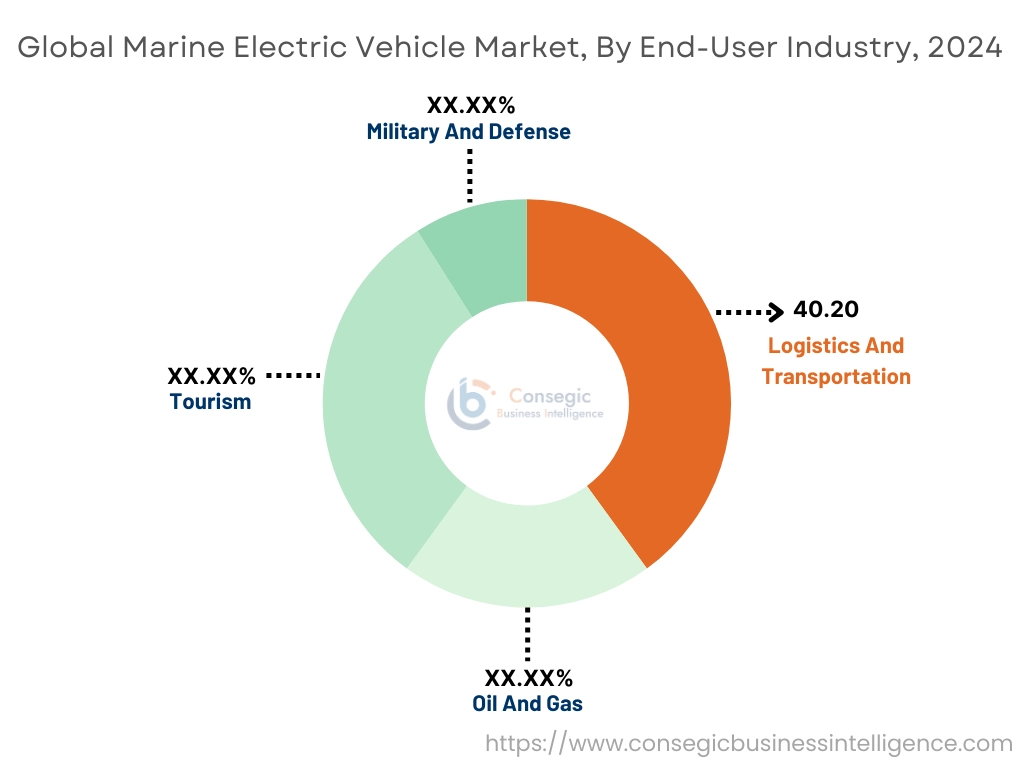
The Logistics and Transportation segment accounted for the largest revenue in the Marine Electric Vehicle Market share of 40.20% in 2024.
- Marine EVs, including ferries and tugboats, are increasingly used in logistics and transportation to reduce emissions and noise pollution, particularly in port areas and waterways.
- Electric marine vessels produce zero tailpipe emissions and significantly reduce noise pollution compared to traditional diesel-powered vessels, making them ideal for use in urban and environmentally sensitive areas.
- Electric propulsion systems offer high efficiency, allowing for faster acceleration and maneuverability, which improves logistics operations.
- Electric ferries and tugboats facilitates the efficient and environmentally friendly movement of goods within ports and along waterways.
- Electric tugboats are used to assist in maneuvering large ships in ports, reducing fuel consumption and emissions.
- For instance, in November 2023, Yinson GreenTech, a leading green technology solutions provider, together with Goal Zero Consortium led by SeaTech Solutions officially launched the Hydromover, marking a critical milestone in the decarbonisation of Singapore’s maritime sector. The lightweight Hydromover is Singapore’s first fully electric cargo vessel.
- Thus, the segmental analysis shows that the logistics and transportation segment is the largest user of marine EVs bolstering the marine electric vehicle market trend.
The Military segment is anticipated to have the highest CAGR growth during the forecast period.
- They are used in the military sector for their quieter operation, reduced emissions, and enhanced stealth capabilities, allowing for covert operations and tactical advantages in various scenarios.
- Electric motors offer superior acceleration and instantaneous torque, allowing for quick maneuvers and rapid deployment in dynamic environments.
- Military sector use electric light reconnaissance vehicles for scouting and surveillance missions and use of hybrid and fully electric platforms for tactical and logistical missions.
- EVs provide immediate torque from a standstill, leading to quick acceleration. This feature can be key for rapid deployment and maneuvering in combat or emergency situations.
- For instance, in October 2024, The Defense Innovation Unit (DIU), together with the Department of the Navy, Department of the Air Force, U.S. Marine Corps, and the Army Reserve, delivered a new dual use commercial electric vehicle (EV) charging process with integrated physical and digital infrastructure to enable fast and cost-effective EV charging. The Service Based Charging process optimizes the accelerated deployment of advanced EV technology solutions, including nearly 120 new EV Charging Facilities (EVCF) at 10 locations across the country.
- Thus, the military sector is expected to be the fastest growing user of Marine EVs, driving the Marine Electric Vehicle Market demand.
Regional Analysis:
The regions covered are North America, Europe, Asia Pacific, the Middle East and Africa, and Latin America.
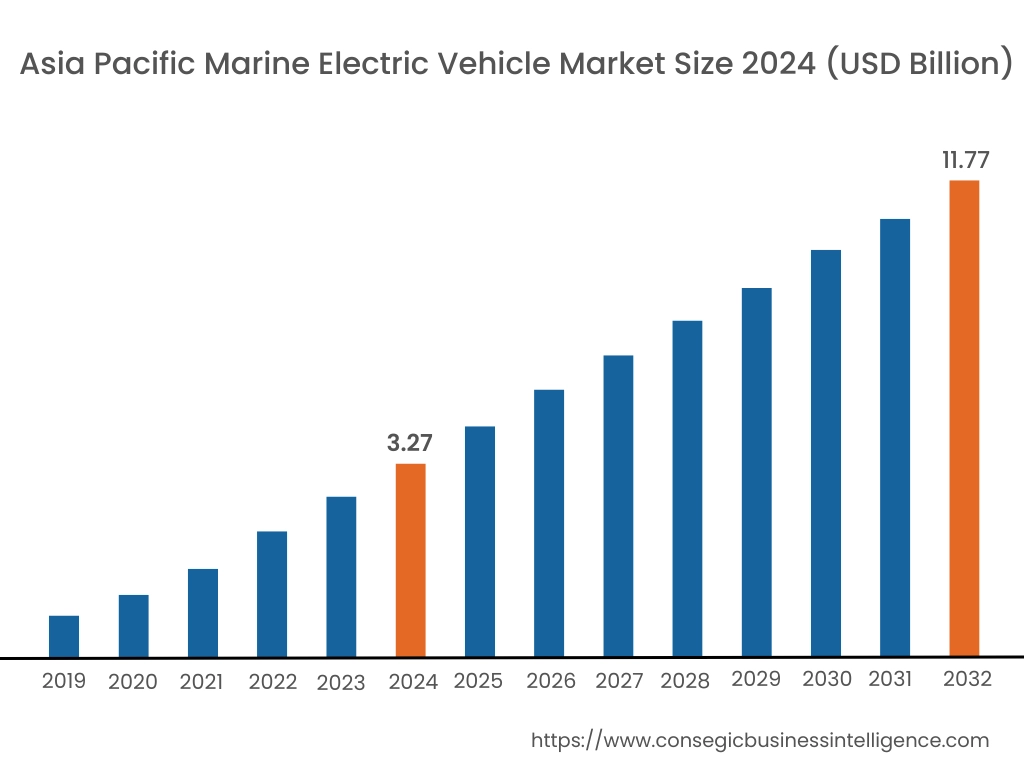
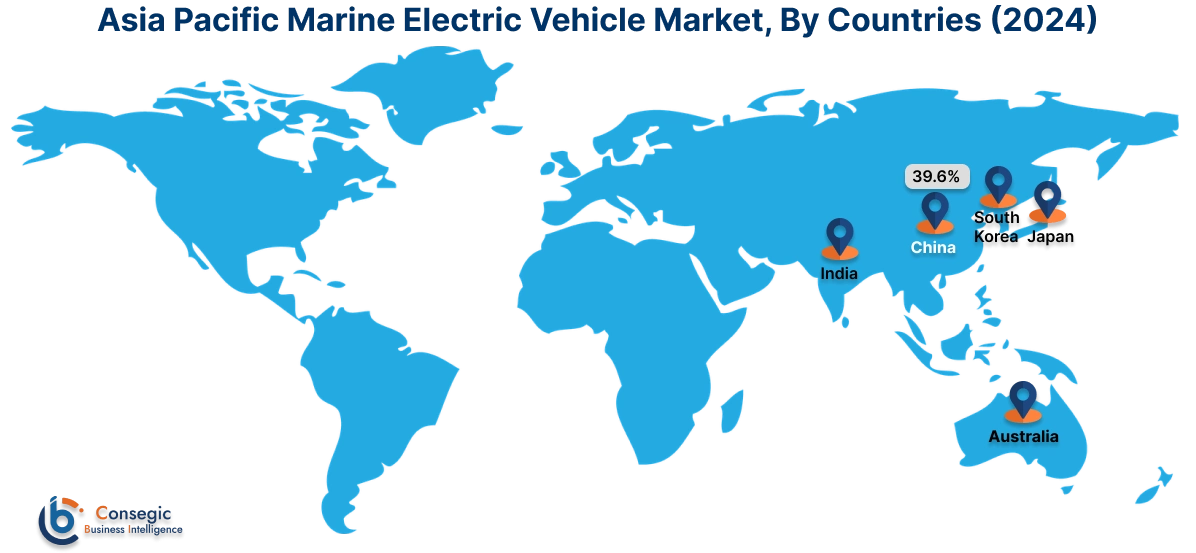
Asia Pacific region was valued at USD 3.27 Billion in 2024. Moreover, it is projected to grow by USD 3.78 Billion in 2025 and reach over USD 11.77 Billion by 2032. Out of this, China accounted for the maximum revenue share of 39.6%.
The Asia-Pacific region, particularly China, is a major player in the global marine electric vehicle (MEV) market, with significant growth expected due to increasing demand for robotic underwater vehicles and other applications. Governments in Asia are increasingly implementing policies and providing incentives to promote the development and adoption of electric and hybrid marine vehicles.
China is a leading manufacturer of electric vehicle batteries and is rapidly becoming a dominant force in the EV market, including MEVs. China is increasingly investing in and deploying marine EVs, including container ships and car carriers, to reduce emissions and support its growing EV export sector. The Chinese government has played a pivotal role in driving the maritime revolution towards electric propulsion, with policies and incentives encouraging the development and deployment of MEVs. China's booming EV industrial sector is leading to a surge in EV exports, which necessitates efficient and sustainable transportation solutions. Improvements in battery technology, including increased energy density and reduced costs, are making electric propulsion systems more viable for marine applications.
Countries like Thailand, Indonesia, and others in Southeast Asia are emerging as leaders in the adoption of electric vehicles, including MEVs. India is also seeing growth in the EV sector, including marine applications, and is expected to be a significant market for MEVs in the future.
- For instance, in November 2024, Yinson GreenTech unveiled the region’s first fully electric hydrofoil vessel, the Hydroglyder, at Offshore Energy Week (OSEA) 2024. Designed for crew transfer, the Hydroglyder marks a significant notch towards sustainable marine innovation, empowering more environmentally friendly journeys in Singapore’s waters. Singapore’s first fully electric light cargo vessel, offer the region future-ready green transport solutions for passenger and cargo transportation across ASEAN waters and beyond.
Thus, the market analysis highlights that the Asia-Pacific region is the largest revenue share holder of the market.
North America is estimated to reach over USD 12.53 Billion by 2032 from a value of USD 3.69 Billion in 2024 and is projected to grow by USD 4.24 Billion in 2025.
The marine electric vehicle market in North America, particularly in the US and Canada, is growing due to stricter pollution rules, technological advancements, and government incentives, with a focus on electric ferries, leisure boats, and research vessels.
Electric vehicles in North America are an emerging trend that reflects the growing demand for sustainable, eco-friendly alternatives to traditional gasoline-powered vessels. This shift toward electric propulsion in recreational boating, as well as boating for commercial and government uses, has been driven by environmental concerns, technological advances, declines in price, and an increasing awareness of the impact of fossil fuel emissions on waterways.
Electric boats use battery-powered motors instead of internal combustion engines. Technology has improved in recent years, with impressive advancements in battery capacity, efficiency, and charging infrastructure. The electric motors used in boats are quieter, require less maintenance, are cheaper to own overtime, and produce zero emissions, making them ideal for eco-conscious and cost-conscious boaters.
In the United States, the Marine EV market is growing, with companies like Candela offering hydrofoiling technology for efficient electric boats, and Tesla and Rivian leading in electric car sales, with other manufacturers catching up. They are used for commercial and recreational purposes, including passenger ferries, cargo vessels, research, and leisure activities, driven by environmental concerns and the shift towards zero-emission vessels. Electric ferries are gaining popularity for short-distance routes, offering a quieter and cleaner alternative to traditional diesel-powered ferries.
- For instance, in June 2024, Crowley christened the eWolf, America’s first all-electric ship assist harbor tugboat. Operating with zero emissions and other sustainable technology, the tugboat delivers the high-power capability, safety, and efficiency that Crowley has made its reputation. The all-electric tugboat is the most technologically advanced vessel of its kind, and eWolf will help customers and communities reach their decarbonization goals while delivering capabilities.
Marine EVs are still in their early stages in North America but holds great promise for the future. With the environmental benefits, decreasing costs, and increasing range, electric vehicles are poised to become a more common sight on waterways across the continent. As more manufacturers enter the market and consumers embrace eco-friendly alternatives, electric vehicles will continue to grow as a mainstream option in the marine electric vehicle industry.
Thus, the market analysis shows that the North American region holds great potential for the Marine Electric Vehicle Market.
In the European region, marine electric vehicles are used in various sectors, including recreational boating, ferries, and short sea/inland vessels, with increasing adoption driven by regulations targeting carbon and GHG emissions, and the need for decarbonization in the maritime sector. Electric propulsion systems are gaining traction in smaller recreational vessels, offering quiet and emission-free operation. There is a growing trend of transporting electric vehicles as cargo on ships, with increased scrutiny on safety measures and guidelines for their carriage.
The International Maritime Organization (IMO) and the EU are increasingly focusing on reducing carbon and greenhouse gas emissions from the maritime sector. The EU is promoting the use of electric vehicles and alternative fuels, including in the maritime sector, through various policies and investments.
Thus, the Marine Electric Vehicle Market analysis shows the significant dominance of EV market in the European region.
In the Middle East, marine electric vehicles are finding use in sectors like tourism, shipping, offshore services, and potentially naval defense, driven by environmental regulations, advancements in battery technology, and investments in sustainable maritime practices. Improvements in battery technology, electric motor efficiency, and charging infrastructure are making electric marine vehicles more practical and cost-effective. Many Middle Eastern countries are investing in green technologies and sustainable infrastructure, which includes electric marine transportation.
While the usage of marine electric vehicles in Africa is still in its early stages, there's growing interest and some initiatives underway, particularly in areas like passenger ferries, cargo transportation, and potentially for fishing and research purposes.
Thus, the Marine Electric Vehicle market analysis shows that marine EVs are an emerging trend in the MEA region with a lot of growth potential.
The Latin American manufacturing sector has undergone a significant shift in recent decades. In Latin America, marine electric vehicles are increasingly used for various purposes, including hybrid electric vessels, ferries, workboats, and leisure boats, driven by environmental concerns, rising discretionary incomes, and the expanding travel and tourism sector. The use of electric ferries and workboats is increasing in Latin America, offering a cleaner and more sustainable alternative to traditional diesel-powered vessels. Governments in Latin America are increasingly providing economic and non-economic incentives to promote the adoption of electric vehicles, including hybrid electric vehicles, to reduce energy consumption and emissions in the transportation sector.
Thus, the market analysis highlights the emergence of electric vehicles in the Latin American region leading to the market boost.
Top Key Players & Market Share Insights:
The Marine Electric Vehicle market is highly competitive with major players providing products and services to the national and international markets. Key players are adopting several strategies in research and development (R&D), product innovation, and end-user launches to hold a strong position in the global Marine Electric Vehicle market. Key players in the Marine Electric Vehicle industry include –
- Pure Watercraft (US)
- Twin Vee (US)
- ABB (Switzerland)
- Wartsila (Finland)
- Corvus Energy (Norway)
Recent Industry Developments :
- In November 2024, Yamaha U.S. Marine Business Unit joined forces with Roush and Regulator Marine to reveal the world’s first hydrogen-powered outboard for recreational boats, to car manufacturers, automotive component suppliers and aftermarket equipment manufactures from around the globe during the 2024 Specialty Equipment Marketing Association (SEMA) Show.
Marine Electric Vehicle Market Report Insights:
| Report Attributes | Report Details |
| Study Timeline | 2019-2032 |
| Market Size in 2032 | USD 38.65 Billion |
| CAGR (2025-2032) | 16.9% |
| By Type |
|
| By Platform |
|
| By Mode Of Operation |
|
| By End-User Industry |
|
| By Region |
|
| Key Players |
|
| North America | U.S. Canada Mexico |
| Europe | U.K. Germany France Spain Italy Russia Benelux Rest of Europe |
| APAC | China South Korea Japan India Australia ASEAN Rest of Asia-Pacific |
| Middle East and Africa | GCC Turkey South Africa Rest of MEA |
| LATAM | Brazil Argentina Chile Rest of LATAM |
| Report Coverage |
|
Key Questions Answered in the Report
What are Marine Electric Vehicles? −
Marine Electric Vehicles (MEVs) are vessels powered by electric motors, drawing energy from batteries or fuel cells, offering a more sustainable alternative to fossil fuel-powered vessels. They are powered by electric motors, which draw electricity from onboard batteries.
What are the major drivers of market growth? +
The growing demand of sustainable and environmentally friendly transportation options, promising towards a cleaner maritime sector and the cost difference in these electric vehicles as compared to the traditional petrol- and diesel-powered boats are the two major drivers of the Marine Electric Vehicle Market.
What are the major segments covered in the Marine Electric Vehicle Market report, and how is the dominating segment affecting the market? +
The market is segmented on the basis of type, platform, mode of operation, and end-user industry, and are further categorized into sub-segments. For instance, the Battery Electric sub segment accounts for the largest revenue in the ‘By Type’ segment, due to their widespread use in the maritime industry.
Who are the major key players in the Marine Electric Market? +
Candela (Sweden), Duffy (US), Pure Watercraft (US), Twin Vee (US), ABB (Switzerland), Wartsila (Finland), Corvus Energy (Norway), BAE Systems (UK), Kongsberg Gruppen (Norway), Siemens AG (Germany).
Overview
Reputation & Certifications


Our Services
- Market Intelligence & Forecasting
- Custom Research Solutions
- Market Entry Strategy
- Competitive Intelligence
- Customer Insights
- Industry Innovation Analysis
- Investment Advisory