Jump to Content
Marine Radar Market - Size, Share, Industry Trends, and Forecasts (2025 - 2032)
Marine Radar Market Size:
Marine Radar Market size is estimated to reach over USD 5,582.31 Million by 2032 from a value of USD 3,460.55 Million in 2024 and is projected to grow by USD 3,612.06 Million in 2025, growing at a CAGR of 6.2% from 2025 to 2032.
Marine Radar Market Scope & Overview:
The marine radar focuses on radar systems designed for navigation, collision avoidance, and monitoring in marine environments. These systems are essential for detecting and tracking objects such as ships, buoys, and landmasses, providing critical data to enhance situational awareness and safety during maritime operations. They are widely used in commercial shipping, fishing vessels, and naval applications.
These systems are available in different configurations, including X-band and S-band radars, each tailored for specific operational requirements. These systems are equipped with advanced features like automatic tracking, high-resolution imaging, and real-time data processing to ensure accurate and reliable performance in varying weather and sea conditions. They are designed to be robust and adaptable, catering to both small vessels and large ships.
End-users include shipping companies, coast guards, fishing operators, and naval forces, where efficient and dependable radar systems are essential for navigation and operational efficiency. These systems play a vital role in ensuring safety and optimizing maritime activities.

Marine Radar Market Dynamics - (DRO) :
Key Drivers:
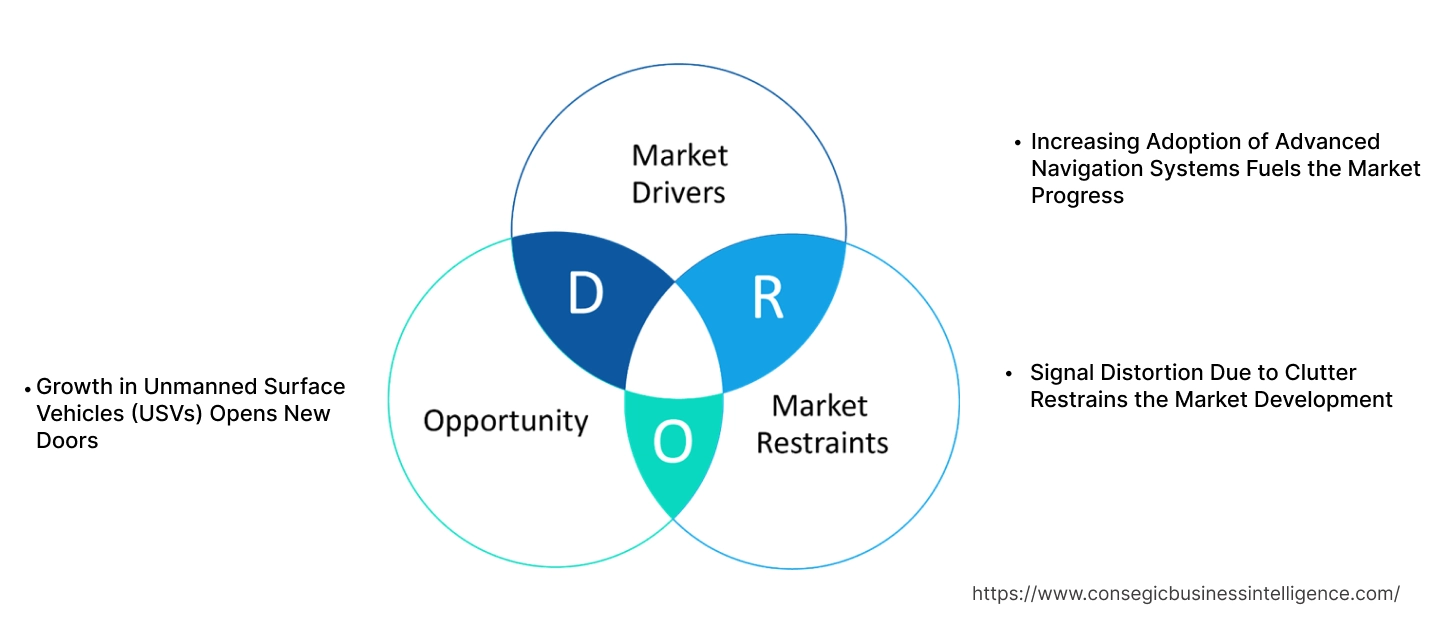
Increasing Adoption of Advanced Navigation Systems Fuels the Market Progress
The increasing focus on maritime safety is driving the adoption of advanced radar systems designed for real-time navigation. These systems provide critical data on obstacles, weather patterns, and vessel traffic, enabling precise decision-making and reducing the risk of accidents. Equipped with features like target tracking, collision avoidance, and high-resolution imaging, modern radar systems are essential for safe operations in congested waterways and adverse weather conditions. With the continuous expansion of global maritime trade, shipping companies, and vessel operators are prioritizing investment in navigation technologies to improve operational efficiency and ensure compliance with international safety standards. This trend is further supported by advancements in radar technology, such as the integration of AI for predictive analytics and the use of IoT for enhanced connectivity, making these systems indispensable for the evolving needs of the maritime industry. As a result, the demand for sophisticated navigation tools continues to drive the marine radar market growth.
Key Restraints:
Signal Distortion Due to Clutter Restrains the Market Development
Marine radar systems often face constraints from unwanted echoes caused by sea surface reflections and precipitation. These interferences, known as clutter, distort radar signals, reducing the accuracy of navigation and obstacle detection. Clutter creates confusion for vessel operators, particularly in high-traffic areas or during adverse weather conditions, where precise data is critical for safe navigation. Although modern radar systems include clutter control features, their effectiveness varies depending on the environment and system capabilities. This limitation hinders the reliability of radar systems in ensuring maritime safety, especially for less-experienced operators or in extreme weather scenarios. As per the market analysis, the aforementioned factors limit the marine radar market demand.
Future Opportunities :
Growth in Unmanned Surface Vehicles (USVs) Opens New Doors
The rising deployment of unmanned surface vehicles (USVs) across defense, research, and commercial sectors is driving demand for compact and high-precision radar systems. USVs rely heavily on advanced radar technology for real-time navigation, obstacle detection, and environmental monitoring, ensuring operational accuracy in challenging marine conditions. In defense, radar-equipped USVs enhance surveillance and reconnaissance capabilities, while in commercial applications, they support tasks such as harbor management and cargo monitoring. Additionally, research-focused USVs benefit from radar systems for mapping and data collection in remote or hazardous marine environments. As the use of USVs expands globally, the need for specialized radar solutions tailored to their unique operational requirements is presenting significant marine radar market opportunities for manufacturers.
Marine Radar Market Segmental Analysis :
By Type:
Based on type, the market is segmented into X-Band Radar and S-Band Radar.
The X-Band Radar segment held the largest revenue of the total marine radar market share in 2024.
- X-Band radars are widely adopted for navigation and collision avoidance in both commercial and naval vessels due to their high-frequency capabilities.
- The segment’s dominance is attributed to the radar's ability to provide detailed imaging, making it suitable for operations in coastal areas and high-traffic zones.
- Increasing adoption of advanced navigation systems in fishing vessels and recreational boats supports the segment’s market presence.
- As per marine radar market analysis, the growth of this segment is further driven by the integration of modern technologies like AI-enhanced radar systems.
The S-Band Radar segment is expected to register the fastest CAGR during the forecast period.
- S-Band radars are preferred for long-range surveillance and weather monitoring due to their lower frequency, providing better penetration through heavy rain and fog.
- Growing demand for enhanced radar capabilities in naval operations and commercial shipping is driving the adoption of S-Band radars.
- The segment benefits from its capability to ensure reliable performance in adverse weather conditions, improving vessel safety.
- As maritime safety regulations tighten globally, S-Band radar adoption is set to accelerate across various applications, contributing to the marine radar market expansion.
By Component:
Based on components, the market is segmented into antennas, transmitters, receivers, displays, processors, and others.
The antennas segment accounted for the largest revenue of the total marine radar market share in 2024.
- Antennas play a crucial role in transmitting and receiving radar signals, making them indispensable in radar systems.
- Increasing advancements in phased-array antennas contribute to their adoption in naval and commercial vessels.
- The segment benefits from the rising need for high-resolution imaging and long-range capabilities in modern radar systems.
- As per industry trends, the requirement for compact and lightweight antennas further fuels the segment’s growth, creating significant marine radar market opportunities.
The processor's segment is expected to register the fastest CAGR during the forecast period.
- Advanced processors enable real-time data analysis and imaging, enhancing decision-making for vessel navigation and surveillance.
- Integration of AI and machine learning technologies in processors is driving innovation in radar systems.
- The rising need for multi-functional radar systems with enhanced computing capabilities supports the rapid growth of this segment.
- As per the marine radar market trends, as vessels increasingly rely on automated navigation and monitoring systems, the demand for high-performance processors continues to grow.
By Application:
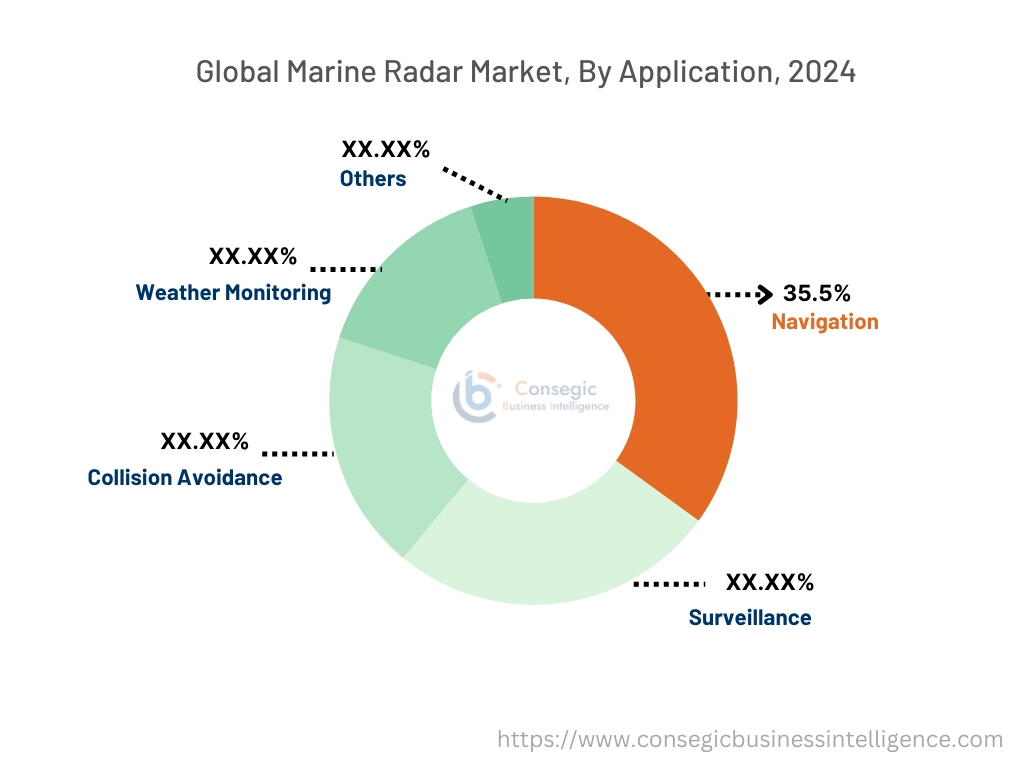
Based on application, the market is segmented into navigation, surveillance, collision avoidance, weather monitoring, and others.
The navigation segment held the largest revenue of 35.5% share in 2024.
- Navigation systems equipped with marine radars are essential for ensuring safe and efficient vessel operations in congested waters.
- High adoption of radars in commercial vessels and naval ships for precise route mapping drives the dominance of this segment.
- The integration of radar systems with GPS and other navigation tools enhances operational efficiency, supporting segment growth.
- As per the marine radar market analysis, growing trade activities and the expansion of global shipping routes further contribute to the widespread adoption of navigation radars.
The weather monitoring segment is expected to register the fastest CAGR during the forecast period.
- Weather monitoring radars are vital for detecting and predicting adverse weather conditions, ensuring vessel safety at sea.
- Increasing demand for accurate weather data in real-time has driven investments in advanced radar systems.
- The segment benefits from the growing adoption of radars with dual-frequency capabilities for enhanced weather prediction.
- As per the marine radar market trends, rising awareness about maritime safety and increasing use of weather monitoring radars in fishing vessels and recreational boats contribute to the segment’s rapid growth.
Regional Analysis:
The regions covered are North America, Europe, Asia Pacific, the Middle East and Africa, and Latin America.
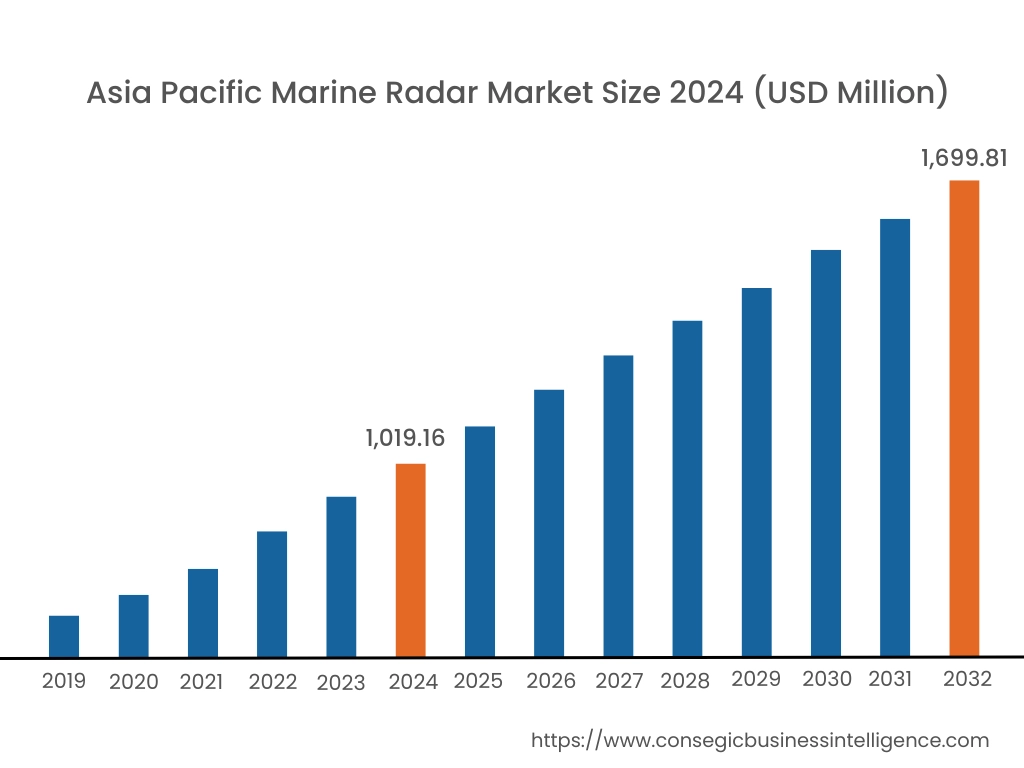
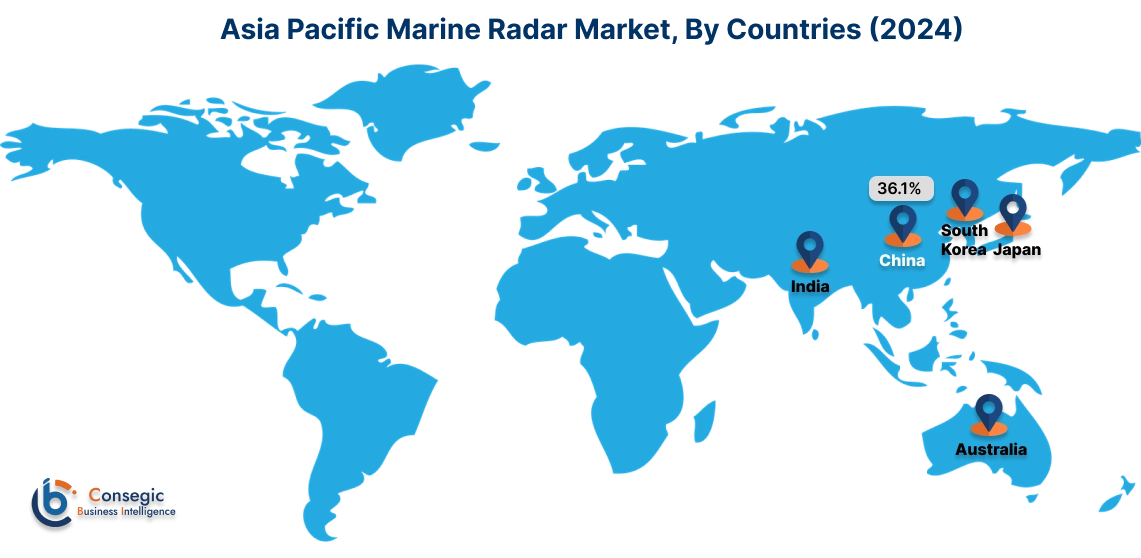
Asia Pacific region was valued at USD 1,019.16 Million in 2024. Moreover, it is projected to grow by USD 1,066.79 Million in 2025 and reach over USD 1,699.81 Million by 2032. Out of this, China accounted for the maximum revenue share of 36.1%. The Asia-Pacific region is witnessing rapid advancements in the marine radar market, driven by the expanding maritime sector in countries like China, Japan, and India. The increasing number of fishing vessels and merchant marine activities necessitates comprehensive radar systems to ensure safety and efficiency. Technological improvements and government initiatives supporting the maritime industry are projected to generate profitable prospects for the radar sector, fueling the marine radar market growth.
North America is estimated to reach over USD 1,809.23 Million by 2032 from a value of USD 1,147.89 Million in 2024 and is projected to grow by USD 1,195.86 Million in 2025. This region holds a substantial share of the marine radar market, driven by well-established maritime infrastructure and a strong emphasis on safety. The adoption of advanced radar technologies for navigation and collision avoidance is prevalent. A notable trend is the integration of cutting-edge radar systems in both commercial and recreational vessels to enhance situational awareness. Analysis indicates that continuous investment in maritime safety and technological innovation sustains the marine radar market demand.
European countries, including the United Kingdom, France, and Germany, are significant players in the marine radar market. The region's focus on maintaining robust maritime operations has led to substantial investments in radar technologies. A significant trend is the collaboration among European manufacturers to develop advanced radar systems that comply with stringent safety standards.
The Middle East serves as a key hub for international maritime trade, contributing to the need for marine radar systems. Nations like the United Arab Emirates are investing in innovative radar solutions to enhance service delivery and comply with international standards. Analysis suggests an emerging trend towards adopting advanced radar technologies to improve operational efficiency is boosting the marine radar market expansion in this region.
Latin America is an emerging market for marine radar systems, with countries such as Brazil and Mexico contributing to its development. The region's focus on modernizing maritime infrastructure and improving operational efficiency has spurred interest in radar solutions. Government policies aimed at enhancing technological capabilities influence market trends.
Top Key Players and Market Share Insights:
The Marine Radar market is highly competitive with major players providing products and services to the national and international markets. Key players are adopting several strategies in research and development (R&D), product innovation, and end-user launches to hold a strong position in the global Marine Radar market. Key players in the Marine Radar industry include -
- Raytheon Technologies (USA)
- Northrop Grumman Corporation (USA)
- SAAB AB (Sweden)
- Furuno Electric Co., Ltd. (Japan)
- Thales Group (France)
- Leonardo S.p.A. (Italy)
- Lockheed Martin Corporation (USA)
- JRC (Japan Radio Co., Ltd.) (Japan)
- Bharat Electronics Limited (India)
- Kongsberg Gruppen (Norway)
Recent Industry Developments :
Product Launches:
- In April 2024, Wärtsilä ANCS launched the NACOS Platinum Solid State X-Band Radar, advancing maritime safety with solid-state technology, eliminating magnetrons. Key features include adaptive pulse transmission, advanced signal processing, and improved hazard detection, ensuring low maintenance and cost efficiency. Compatible with NACOS Platinum systems, it allows easy retrofitting and seamless integration, offering superior long-range target detection without preheating or tuning. This innovation sets new benchmarks in marine navigation safety and reliability.
Marine Radar Market Report Insights :
| Report Attributes | Report Details |
| Study Timeline | 2018-2032 |
| Market Size in 2032 | USD 5,582.31 Million |
| CAGR (2025-2032) | 6.2% |
| By Type |
|
| By Component |
|
| By Application |
|
| By Region |
|
| Key Players |
|
| North America | U.S. Canada Mexico |
| Europe | U.K. Germany France Spain Italy Russia Benelux Rest of Europe |
| APAC | China South Korea Japan India Australia ASEAN Rest of Asia-Pacific |
| Middle East and Africa | GCC Turkey South Africa Rest of MEA |
| LATAM | Brazil Argentina Chile Rest of LATAM |
| Report Coverage |
|
Key Questions Answered in the Report
What is the size of the Marine Radar Market? −
The Marine Radar Market size is estimated to reach over USD 5,582.31 Million by 2032 from a value of USD 3,460.55 Million in 2024 and is projected to grow by USD 3,612.06 Million in 2025, growing at a CAGR of 6.2% from 2025 to 2032.
What are the key segments in the Marine Radar Market? +
The market is segmented by type (X-Band Radar and S-Band Radar), component (antennas, transmitters, receivers, displays, processors, and others), and application (navigation, surveillance, collision avoidance, weather monitoring, and others).
Which segment is expected to grow the fastest in the Marine Radar Market? +
The S-Band Radar segment is expected to register the fastest CAGR during the forecast period due to its better penetration through heavy rain and fog, improving performance in adverse weather conditions.
Who are the major players in the Marine Radar Market? +
Major players in the Marine Radar Market include Raytheon Technologies (USA), Northrop Grumman Corporation (USA), SAAB AB (Sweden), Furuno Electric Co., Ltd. (Japan), Thales Group (France), Leonardo S.p.A. (Italy), Lockheed Martin Corporation (USA), JRC (Japan Radio Co., Ltd.) (Japan), Bharat Electronics Limited (India), and Kongsberg Gruppen (Norway).
Overview
Reputation & Certifications


Our Services
- Market Intelligence & Forecasting
- Custom Research Solutions
- Market Entry Strategy
- Competitive Intelligence
- Customer Insights
- Industry Innovation Analysis
- Investment Advisory