Jump to Content
UAV Propulsion System Market - Size, Share, Industry Trends, and Forecasts (2025-2032)
UAV Propulsion System Market Size:
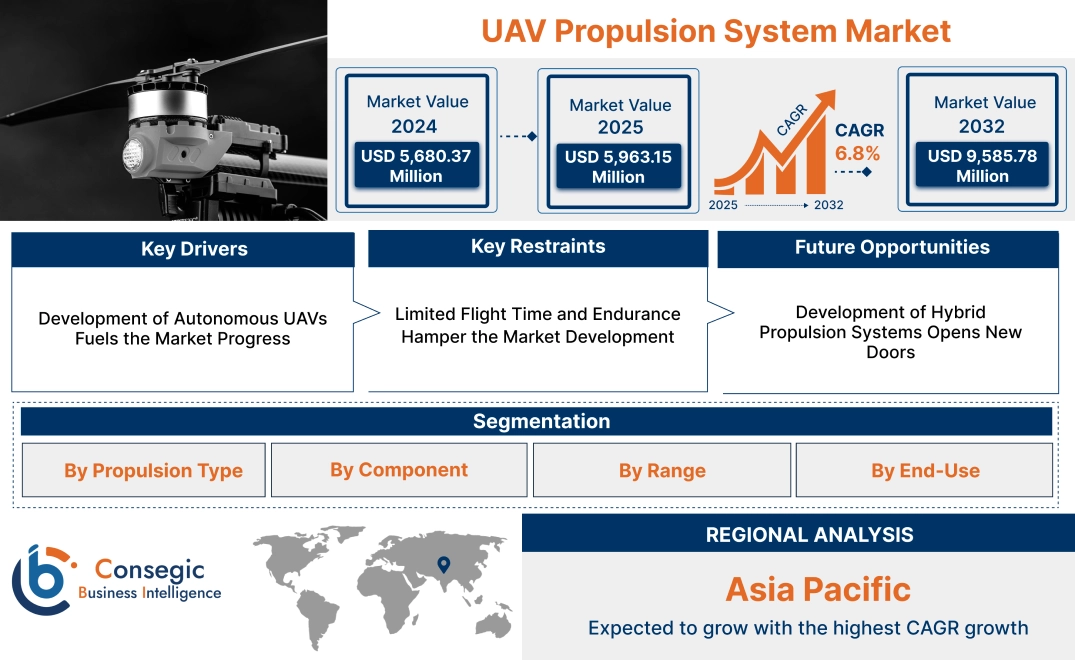
UAV Propulsion System Market size is estimated to reach over USD 9,585.78 Million by 2032 from a value of USD 5,680.37 Million in 2024 and is projected to grow by USD 5,963.15 Million in 2025, growing at a CAGR of 6.8% from 2025 to 2032.
UAV Propulsion System Market Scope & Overview:
A UAV propulsion system is a critical component that provides the necessary thrust and power for unmanned aerial vehicles to operate efficiently. These systems include engines, motors, fuel systems, and associated components that enable UAVs to achieve flight, maintain stability, and carry out mission-specific tasks. They are designed to support a wide range of UAV types, including fixed-wing, rotary-wing, and hybrid configurations.
These propulsion systems are available in various forms, such as internal combustion engines, electric motors, and hybrid systems, each tailored to meet specific operational requirements. They are engineered for efficiency, reliability, and adaptability, ensuring optimal performance under varying environmental conditions. Advanced propulsion technologies also support extended flight durations, enhanced payload capacities, and reduced noise levels, catering to both commercial and defense industry applications.
End-users include manufacturers of surveillance drones, delivery UAVs, and combat drones, as well as research institutions developing specialized UAV technologies. UAV propulsion systems play a vital role in ensuring the operational efficiency and versatility of unmanned aerial platforms.
How is AI Transforming the UAV Propulsion System Market?
AI is being increasingly used in the UAV propulsion system market, for several applications such as real-time performance optimization by adjusting engine parameters for efficiency and stability, predictive maintenance to anticipate failures, and intelligent design of propulsion components such as motors and propellers, which leads to improved autonomy and flight endurance. Moreover, AI can analyze data from sensors to dynamically adjust engine parameters, optimize fuel consumption, and balance power distribution, in turn contributing to more efficient and responsive flight. In addition, AI enables dynamic adjustments to propulsion systems to counter changing flight conditions, which improves flight stability and makes drones more responsive, especially in complex environments. Thus, the above factors are projected to drive the market growth during the forecast period.
UAV Propulsion System Market Dynamics - (DRO) :
Key Drivers:
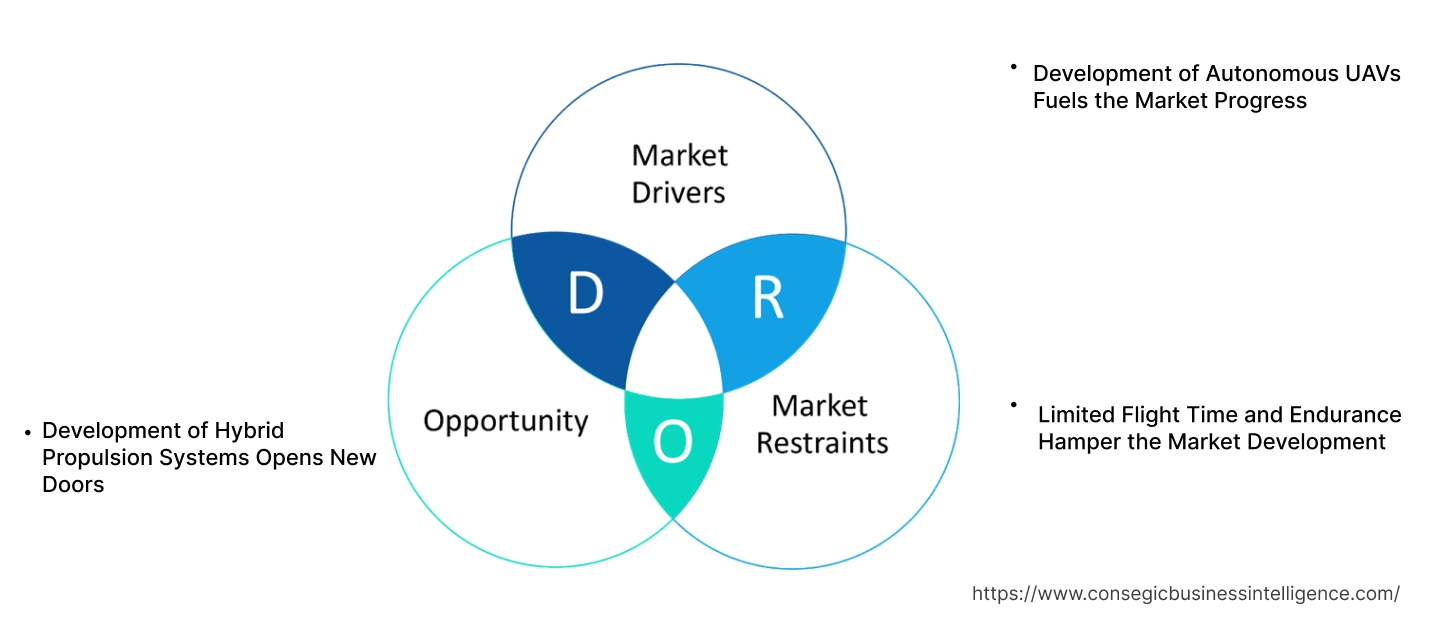
Development of Autonomous UAVs Fuels the Market Progress
The development of autonomous UAVs is driving significant demand for advanced propulsion systems, particularly in sectors such as defense, agriculture, and logistics. Autonomous drones require highly reliable and efficient propulsion systems to perform long-duration missions without human intervention. These UAVs must operate continuously, navigating complex environments, avoiding obstacles, and performing tasks like surveillance, monitoring, or delivery. To ensure consistent performance, autonomous drones rely on propulsion systems that offer extended flight times, high endurance, and the ability to carry heavy payloads for various tasks. Additionally, the need for precise control and reliability in unpredictable environments makes it essential to integrate advanced propulsion technologies that operate autonomously without compromising safety or efficiency. As autonomous UAVs continue to evolve, the requirement for propulsion systems that enhance flight stability, minimize maintenance needs, and increase operational flexibility will continue to rise, boosting their commercial and operational appeal across various industries. Thus, the aforementioned factors are driving the UAV propulsion system market growth.
Key Restraints:
Limited Flight Time and Endurance Hamper the Market Development
Limited flight time and endurance remain major constraints for UAVs, particularly electric drones, despite advancements in propulsion technology. While battery technology has improved, the weight-to-energy ratio of current batteries still limits their performance. Heavier batteries with higher energy storage capacities reduce the UAV's overall payload capacity and operational time. As a result, UAVs powered by electric propulsion often face restricted flight durations, limiting their ability to cover long distances or perform extended missions. Additionally, electric drones require frequent recharging, which disrupts operational efficiency, especially in remote areas or during critical missions. The need for improved energy storage solutions with higher energy density and lighter weight is critical to overcoming these limitations. While hybrid propulsion systems show promise in extending endurance, achieving optimal performance in fully electric UAVs remains a key restraint for manufacturers aiming to meet growing requirement across commercial, military, and industrial applications. In conclusion, the limited flight time of UAV’s are hindering the UAV propulsion system market demand.
Future Opportunities :
Development of Hybrid Propulsion Systems Opens New Doors
Hybrid propulsion systems, which combine electric motors with small internal combustion engines, present a promising solution to the endurance and payload limitations faced by purely electric UAVs. By leveraging the strengths of both power sources, these systems provide enhanced operational capabilities. Electric motors offer high efficiency, quiet operation, and the ability to perform precise maneuvers, while the combustion engine extends flight times and increases the UAV’s range, overcoming the battery limitations of fully electric systems. This combination allows UAVs to carry heavier payloads, such as high-resolution cameras or additional sensors, without compromising flight duration. Hybrid systems also enable more flexible mission planning, as the combustion engine provide power during longer flights or when batteries are low, reducing the need for frequent recharging. As hybrid propulsion technology advances, it offers a viable path to enhancing UAV performance for both commercial and military applications, expanding their capabilities in diverse operational environments and creating new UAV propulsion system market opportunities.
UAV Propulsion System Market Segmental Analysis :
By Propulsion Type:
Based on propulsion type, the market is categorized into electric, thermal, and hybrid propulsion systems.
The electric propulsion segment accounted for the largest revenue of the total UAV propulsion system market share in 2024.
- Electric propulsion is favored for its lower operational cost and reduced environmental impact compared to traditional propulsion systems.
- It offers significant noise reduction, making it ideal for applications in urban and sensitive areas.
- The advancements in battery technology and increased adoption of electric UAVs for surveillance and delivery operations drive its dominance.
- As per the market trends, the segment's prominence reflects the growing trend toward sustainable propulsion solutions across industries, contributing to the UAV propulsion system market expansion.
The hybrid propulsion segment is expected to register the fastest CAGR during the forecast period.
- Hybrid systems combine the efficiency of electric propulsion with the extended range of thermal engines, addressing diverse operational needs.
- Their adaptability for both military and commercial UAVs has contributed to their rapid adoption.
- Hybrid propulsion's ability to optimize energy consumption enhances mission efficiency and endurance.
- As per the UAV propulsion system market analysis, increasing demand for long-endurance UAV operations boosts the adoption of hybrid systems globally.
By Component:
Based on components, the market is segmented into engines, propellers, power storage units, fuel tanks, controllers, and others.
The engine segment accounted for the largest revenue of the total UAV propulsion system market share in 2024.
- Engines remain critical to UAV performance, offering power and reliability for diverse applications.
- Ongoing advancements in lightweight and efficient engines support their dominance in the market.
- The segment's prominence is driven by the demand for enhanced UAV performance in military and commercial operations.
- As per the UAV propulsion system market trends, increasing focus on fuel-efficient engines to reduce operational costs further strengthens the segment's position.
The power storage units segment is expected to register the fastest CAGR during the forecast period.
- The shift toward electric and hybrid propulsion systems increases the demand for advanced energy storage solutions.
- Innovations in battery technology, including higher energy density and faster charging capabilities, drive the segment's growth.
- Power storage units are essential for extending UAV flight time, particularly in surveillance and delivery applications.
- Thus, government initiatives to promote the use of renewable energy sources in UAV operations further accelerate segment growth, driving the UAV propulsion system market demand.
By Range:
Based on range, the market is segmented into long-range, medium-range, and short-range UAVs.
The long-range segment accounted for the largest revenue of 41.9% share in 2024.
- Long-range UAVs are preferred for applications such as military surveillance, environmental monitoring, and disaster response.
- Their ability to cover vast areas without frequent recharging or refueling ensures operational efficiency.
- Technological advancements in propulsion systems and materials enhance the performance of long-range UAVs.
- Increasing military investments in reconnaissance UAVs boosts the segment's dominance, further driving the UAV propulsion system market growth.
The medium-range segment is expected to register the fastest CAGR during the forecast period.
- Medium-range UAVs offer a balance between cost and operational efficiency, making them suitable for diverse applications.
- Their adoption in agriculture, delivery services, and infrastructure monitoring supports rapid segment growth.
- Medium-range UAVs benefit from advancements in hybrid propulsion systems, enhancing their endurance and versatility.
- Therefore, the rising use of medium-range UAVs in civil and commercial operations drives the segment's growth trajectory, contributing to the UAV propulsion system market expansion.

By End-Use:
Based on end-use, the market is segmented into military and civil applications.
The military segment accounted for the largest revenue share in 2024.
- Military UAVs are widely used for surveillance, reconnaissance, target acquisition, and combat operations.
- Governments globally are investing heavily in UAV technology for defense applications, ensuring dominance of this segment.
- High-performance UAVs with advanced propulsion systems enhance mission capabilities and efficiency.
- As per the UAV propulsion system market analysis, the growing need for autonomous UAVs in military operations supports the segment's market share.
The civil segment is expected to register the fastest CAGR during the forecast period.
- Civil UAVs are increasingly adopted for delivery services, environmental monitoring, agriculture, and infrastructure inspection.
- Technological advancements make UAVs more accessible and affordable for civil applications.
- Government initiatives and favorable regulations for UAV integration in civil industry drive the segment's rapid growth.
- As per the UAV propulsion system market trends, the rise of startups offering UAV solutions for commercial purposes contributes to the segment's expanding footprint.
Regional Analysis:
The regions covered are North America, Europe, Asia Pacific, the Middle East and Africa, and Latin America.

Asia Pacific region was valued at USD 1,672.92 Million in 2024. Moreover, it is projected to grow by USD 1,761.16 Million in 2025 and reach over USD 2,918.87 Million by 2032. Out of this, China accounted for the maximum revenue share of 33.6%. The Asia-Pacific region is witnessing rapid advancements in UAV propulsion technology, with countries like China and India leading the charge. A prominent trend is the development and testing of large cargo drones and advanced UAVs, supported by government initiatives to promote a low-altitude economy. Analysis indicates that the increasing orders for different UAV configurations for many military and commercial applications are key factors influencing the UAV propulsion system market opportunities in this area.

North America is estimated to reach over USD 3,106.75 Million by 2032 from a value of USD 1,884.23 Million in 2024 and is projected to grow by USD 1,974.25 Million in 2025. This region commands a substantial portion of the UAV propulsion system market, driven by the United States' emphasis on enhancing defense capabilities through advanced UAV technologies. A notable trend is the increasing investment in research and development to enhance propulsion system efficiency and reliability. Analysis indicates that the integration of sophisticated propulsion systems into military and commercial UAVs is progressing, with companies focusing on developing hybrid and electric propulsion solutions to meet the rising need for sustainable and efficient UAV operations.
European countries are actively exploring UAV propulsion technologies to address environmental concerns and enhance operational efficiency. A significant trend is the collaboration between governments and private companies to develop advanced propulsion systems, focusing on reducing carbon emissions and noise pollution. Analysis suggests that countries like Germany and the UK are leading in adoption, driven by stringent environmental regulations and a strong emphasis on technological innovation.
In the Middle East, nations are investing in UAV propulsion technologies to enhance surveillance and security capabilities. The focus is on developing state-of-the-art propulsion systems to support long-endurance UAV operations in harsh environmental conditions. In Africa, the market is gradually evolving, with efforts to utilize UAVs for various applications, including agriculture and infrastructure monitoring. Analysis indicates that infrastructure development and regulatory frameworks are crucial factors influencing the adoption of advanced UAV propulsion systems in these regions.
Latin American countries are exploring UAV propulsion technologies to address challenges in areas such as agriculture, disaster management, and border surveillance. A notable trend is the interest in developing cost-effective and reliable propulsion systems suitable for diverse applications. Nonetheless, economic constraints and limited technological infrastructure may impact the pace of adoption. Analysis suggests that partnerships with international companies and investments in infrastructure could play a pivotal role in advancing the UAV propulsion system market in this region.
Top Key Players and Market Share Insights:
The UAV Propulsion System market is highly competitive with major players providing products and services to the national and international markets. Key players are adopting several strategies in research and development (R&D), product innovation, and end-user launches to hold a strong position in the global UAV Propulsion System market. Key players in the UAV Propulsion System industry include -
- Northwest UAV (USA)
- LaunchPoint Electric Propulsion Solutions, Inc. (USA)
- PBS Velká Bíteš (Czech Republic)
- Intelligent Energy Limited (UK)
- Orbital UAV (Australia)
- maxon Group (Switzerland)
- ePropelled (USA)
- Plettenberg Elektromotoren GmbH & Co. KG (Germany)
- Turbotech (France)
Recent Industry Developments :
Product Launches:
- In October 2024, ePropelled launched its Falcon propulsion systems, offering 1kW to 20kW power solutions for UAVs. Assembled in the USA, Falcon features efficient motors, intelligent controllers, and real-time data analytics via ePConnected™ services. This range addresses global need amid rising regulatory restrictions on Chinese UAV components, like China's recent export cap on motors above 16kW. The series ensures extended operation, high-altitude efficiency, and quieter performance, catering to civil and military UAV applications.
- In November 2023, Alva unveiled the 2nd generation ALTUS X60 propulsion system, offering enhanced weatherproofing, advanced safety features, and compatibility with various UAV airframes. Designed in Norway, the upgraded system is rugged, reliable, and versatile, with new mechanical interfaces, accessory compatibility, and robust sealing for challenging missions. It integrates plug-and-play functionality for multiple communication protocols, ensuring seamless operation. These advancements cater to manufacturers, integrators, and operators seeking state-of-the-art UAV propulsion solutions for demanding environments.
UAV Propulsion System Market Report Insights :
| Report Attributes | Report Details |
| Study Timeline | 2019-2032 |
| Market Size in 2032 | USD 9,585.78 Million |
| CAGR (2025-2032) | 6.8% |
| By Propulsion Type |
|
| By Component |
|
| By Range |
|
| By End-Use |
|
| By Region |
|
| Key Players |
|
| North America | U.S. Canada Mexico |
| Europe | U.K. Germany France Spain Italy Russia Benelux Rest of Europe |
| APAC | China South Korea Japan India Australia ASEAN Rest of Asia-Pacific |
| Middle East and Africa | GCC Turkey South Africa Rest of MEA |
| LATAM | Brazil Argentina Chile Rest of LATAM |
| Report Coverage |
|
Key Questions Answered in the Report
What is the size of the UAV Propulsion System Market? −
The UAV Propulsion System Market size is estimated to reach over USD 9,585.78 Million by 2032 from a value of USD 5,680.37 Million in 2024 and is projected to grow by USD 5,963.15 Million in 2025, growing at a CAGR of 6.8% from 2025 to 2032.
What are the key segments in the UAV Propulsion System Market? +
The market is segmented by propulsion type (electric, thermal, and hybrid), component (engine, propellers, power storage units, fuel tanks, controllers, and others), range (long range, medium range, short range), and end-use (military, civil).
Which segment is expected to grow the fastest in the UAV Propulsion System Market? +
The hybrid propulsion segment is expected to grow at the fastest CAGR during the forecast period, driven by the need for extended range and operational flexibility in UAVs, especially for military and long-duration missions.
Who are the major players in the UAV Propulsion System Market? +
Key players in the UAV Propulsion System market include Northwest UAV (USA), LaunchPoint Electric Propulsion Solutions, Inc. (USA), maxon Group (Switzerland), ePropelled (USA), Plettenberg Elektromotoren GmbH & Co. KG (Germany), Turbotech (France), PBS Velká Bíteš (Czech Republic), Intelligent Energy Limited (UK), and Orbital UAV (Australia).
Overview
Reputation & Certifications


Our Services
- Market Intelligence & Forecasting
- Custom Research Solutions
- Market Entry Strategy
- Competitive Intelligence
- Customer Insights
- Industry Innovation Analysis
- Investment Advisory