Jump to Content
Maritime Security Market - Size, Share, Industry Trends, and Forecasts (2025 - 2032)
Maritime Security Market Size:
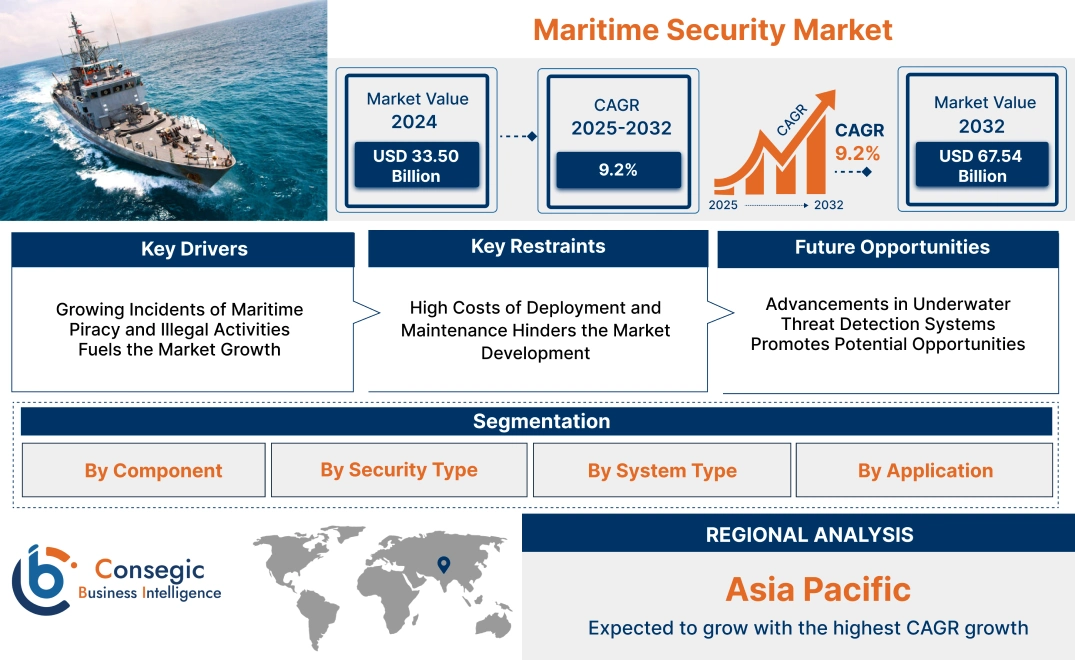
Maritime Security Market size is estimated to reach over USD 67.54 Billion by 2032 from a value of USD 33.50 Billion in 2024 and is projected to grow by USD 35.97 Billion in 2025, growing at a CAGR of 9.2% from 2025 to 2032.
Maritime Security Market Scope & Overview:
Maritime security encompasses strategies, technologies, and measures designed to safeguard vessels, ports, and offshore facilities from threats such as piracy, smuggling, illegal fishing, and terrorism. It involves a combination of surveillance systems, communication networks, and protective measures to ensure the safety of maritime operations and the security of global trade routes. These solutions are critical for maintaining the integrity of international waters and protecting valuable assets.
These security systems include advanced technologies such as radar, satellite tracking, automatic identification systems (AIS), and underwater surveillance equipment. These tools enable real-time monitoring and rapid response to potential risks, ensuring operational continuity. They are deployed across commercial shipping, defense operations, and coastal monitoring activities, providing reliable protection and situational awareness.
End-users include naval forces, port authorities, shipping companies, and government agencies responsible for securing maritime assets and territories. These solutions play a vital role in enhancing the safety and efficiency of maritime operations worldwide.
Maritime Security Market Dynamics - (DRO) :
Key Drivers:
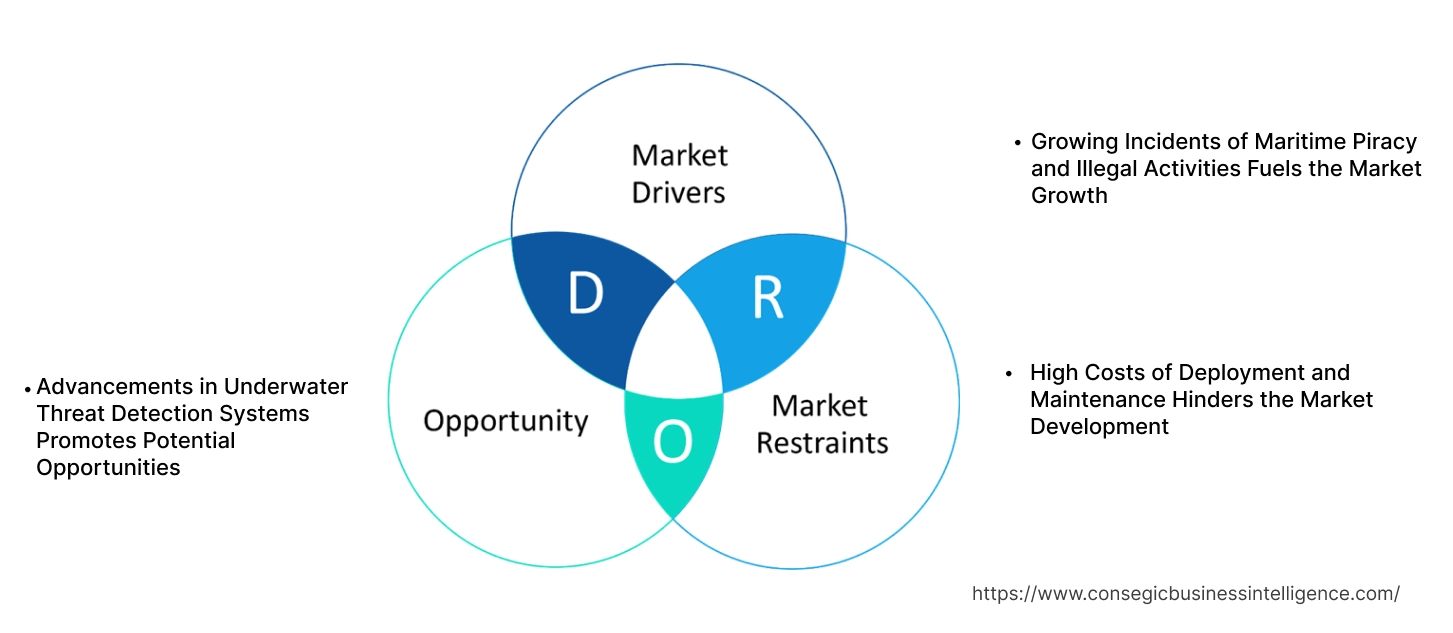
Growing Incidents of Maritime Piracy and Illegal Activities Fuels the Market Growth
The increasing prevalence of piracy, smuggling, and illegal fishing in international waters has created an urgent need for robust maritime security measures. These activities pose significant threats to global trade, economic stability, and the safety of maritime assets. Governments, along with private industry stakeholders, are intensifying their investments in advanced surveillance systems, such as radar technologies, drones, and automatic identification systems (AIS).
Additionally, patrol vessels and coastal monitoring solutions are being deployed to enhance security and deter unlawful activities. The focus is particularly strong in high-risk zones like the Gulf of Aden, the South China Sea, and key shipping lanes. With global supply chains becoming increasingly interdependent, the demand for secure maritime operations is surging, driving growth in technologies and strategies aimed at safeguarding trade routes and ensuring the safe movement of goods. These developments align with the broader trends in global security and technological innovation, contributing to the maritime security market growth.
Key Restraints:
High Costs of Deployment and Maintenance Hinders the Market Development
The deployment of advanced maritime security systems requires substantial financial investment in infrastructure, cutting-edge equipment, and highly skilled personnel. Technologies such as surveillance drones, radar systems, and automatic identification systems (AIS) come with high initial costs, which are challenging for nations with limited defense budgets.
Additionally, ongoing maintenance expenses, including regular upgrades, repairs, and operational training, further strain financial resources. Small and developing countries, in particular, face difficulties in allocating sufficient funds for comprehensive security measures, leaving their coastlines vulnerable to threats. These budgetary constraints limit the adoption of state-of-the-art systems and force reliance on outdated or less effective solutions. As maritime security threats increase globally, the inability to implement and maintain advanced technologies poses significant restraints, particularly in regions heavily reliant on maritime trade and fisheries for economic stability. Thus, the aforementioned factors are limiting the maritime security market demand.
Future Opportunities :
Advancements in Underwater Threat Detection Systems Promotes Potential Opportunities
The increasing need to safeguard critical underwater infrastructure, including subsea pipelines, communication cables, and naval vessels, is driving advancements in underwater threat detection systems. Innovations in sonar technology, autonomous underwater drones, and advanced sensors are enhancing the ability to detect, monitor, and mitigate potential threats in real-time. These systems are capable of identifying anomalies such as unauthorized submersibles, underwater mines, or damaged cables, ensuring the protection of vital assets.
The integration of artificial intelligence and machine learning further improves the accuracy and efficiency of detection, enabling predictive analytics and automated responses. As maritime activities expand and underwater assets grow in importance, the adoption of advanced underwater threat detection systems has become a key focus for governments and private sectors. This trend is particularly significant for regions with strategic underwater infrastructure, where enhanced security is critical for economic and national security. In conclusion, the above mentioned factors are boosting new maritime security market opportunities.
Maritime Security Market Segmental Analysis :
By Component:
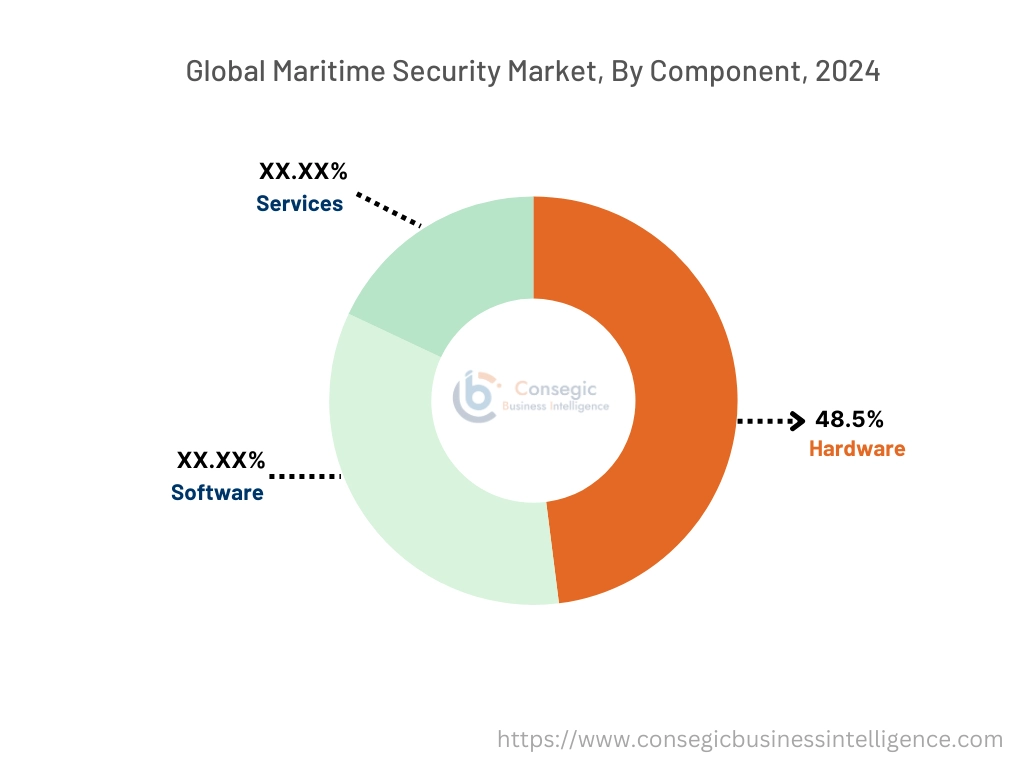
Based on component, the market is segmented into hardware, software, and services.
The hardware segment accounted for the largest revenue of 48.5% of the total maritime security market share in 2024.
- Hardware components such as radars, sonars, and AIS systems are crucial for ensuring real-time monitoring and tracking of maritime activities.
- The demand for high-performance sensors and cameras is driven by the increasing need for surveillance and situational awareness in maritime operations.
- Advanced radar systems are widely used in vessel detection and navigation, ensuring safety and enhancing operational efficiency.
- The dominance of this segment reflects the increasing adoption of modernized hardware solutions to strengthen security infrastructure, fueling the maritime security market expansion.
The services segment is projected to register the fastest CAGR during the forecast period.
- Consulting services help organizations identify vulnerabilities in maritime infrastructure and implement effective security measures.
- Maintenance services are essential for ensuring the longevity and efficiency of critical security systems, reducing downtime and operational disruptions.
- The growing reliance on expert services for integrating cutting-edge technologies into existing systems supports the rapid growth of this segment.
- As per the maritime security market analysis, rising demand for end-to-end solutions encompassing hardware, software, and maintenance drives the adoption of professional services.
By Security Type:
Based on security type, the market is categorized into port security, vessel security, coastal surveillance, and offshore facility security.
The Port security segment held the largest revenue of the maritime security market share in 2024.
- Ports are critical nodes in global trade and are increasingly targeted for smuggling, piracy, and cyberattacks, necessitating robust security measures.
- Advanced technologies such as perimeter intrusion detection systems and access control enhance port security and mitigate risks.
- The segment benefits from significant investments by governments and private operators to secure port facilities against evolving threats.
- As per the maritime security market trends, enhanced port security systems reduce operational inefficiencies, improving the safety of goods and personnel.
The Coastal surveillance segment is expected to grow at the fastest CAGR during the forecast period.
- Coastal surveillance systems provide real-time data on potential threats, ensuring rapid response capabilities.
- Rising incidents of illegal fishing, drug trafficking, and unauthorized border crossings drive the adoption of coastal monitoring solutions.
- The development of advanced monitoring technologies, including drones and satellite-based systems, fuels this segment's growth.
- Thus, increasing awareness of environmental preservation also contributes to the adoption of coastal surveillance systems, driving the maritime security market growth.
By System Type:
Based on system type, the market is segmented into perimeter intrusion detection systems, command & control systems, and communication systems.
The command & control systems segment dominated the market in 2024.
- Command & control systems enable seamless coordination and efficient decision-making during maritime operations.
- These systems provide real-time data integration and situational awareness, ensuring optimal response to potential threats.
- Governments and private operators prioritize these systems to improve maritime domain awareness and enhance operational efficiency.
- The segment benefits from advancements in AI and machine learning, which enhance the functionality of command & control systems, further fueling the maritime security market demand.
The communication systems segment is projected to witness the fastest CAGR during the forecast period.
- Communication systems facilitate secure and uninterrupted connectivity among vessels, ports, and offshore facilities.
- The increasing adoption of satellite communication and advanced broadband networks supports the growth of this segment.
- Rising demand for reliable communication in disaster response and search-and-rescue operations accelerates adoption.
- Thus, innovations in encrypted communication technologies further boost the deployment of modern communication systems, contributing to the maritime security market expansion.
By Application:
Based on application, the market is divided into surveillance & reconnaissance, anti-piracy, search and rescue, disaster response, and others.
The Surveillance & reconnaissance segment accounted for the largest revenue share in 2024.
- Surveillance and reconnaissance systems enable real-time monitoring of maritime zones, ensuring early detection of threats.
- Governments and private organizations invest heavily in advanced surveillance solutions to safeguard assets and personnel.
- High-performance imaging systems, radars, and sensors are widely deployed to improve situational awareness in critical zones.
- As per the maritime security market analysis, the growing need for continuous maritime monitoring supports the dominance of this segment.
The Search and rescue segment is expected to grow at the fastest CAGR during the forecast period.
- Search and rescue operations benefit from modern maritime technologies such as UAVs and GPS tracking systems.
- Increasing instances of maritime accidents and natural disasters highlight the importance of efficient rescue operations.
- Governments and international organizations are actively enhancing rescue capabilities to reduce loss of life and property.
- As per the maritime security market trends, the integration of AI-driven predictive systems in search and rescue missions supports this segment's rapid growth.
Regional Analysis:
The regions covered are North America, Europe, Asia Pacific, the Middle East and Africa, and Latin America.
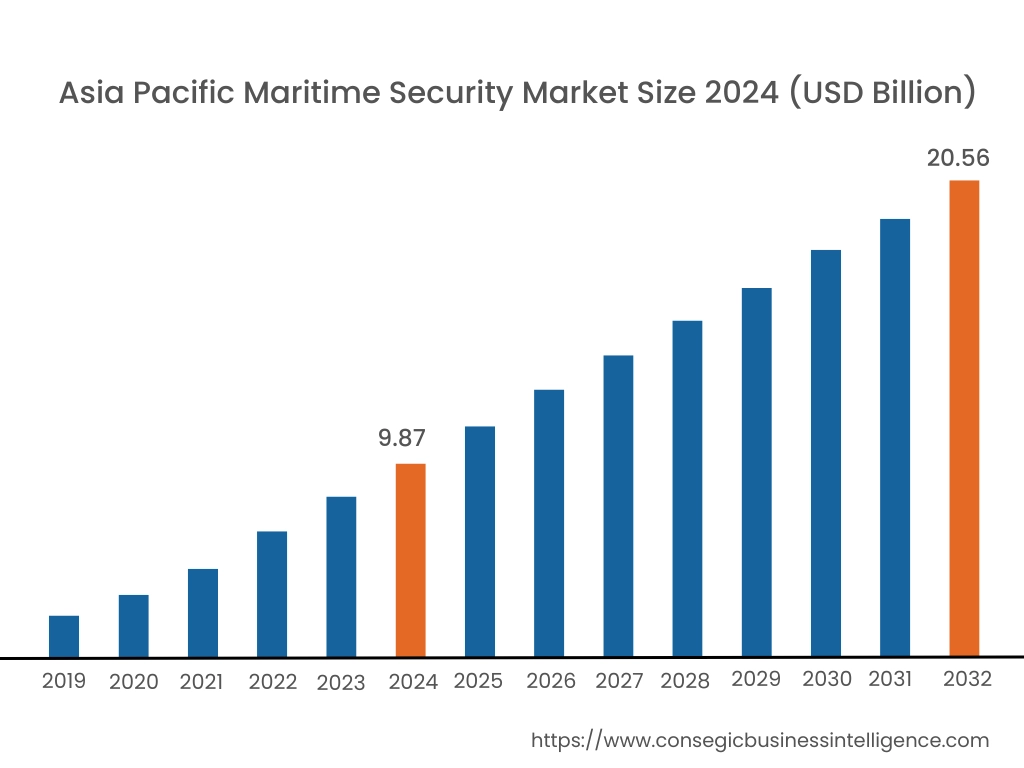
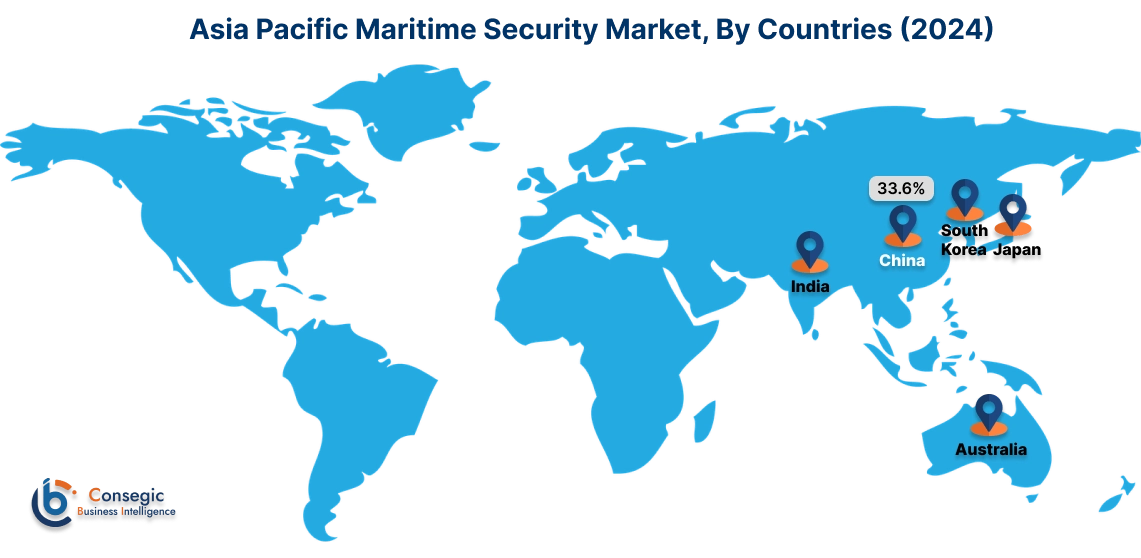
Asia Pacific region was valued at USD 9.87 Billion in 2024. Moreover, it is projected to grow by USD 10.62 Billion in 2025 and reach over USD 20.56 Billion by 2032. Out of this, China accounted for the maximum revenue share of 33.6%. The Asia-Pacific region is witnessing rapid advancements in the maritime security market, driven by increasing maritime trade activities and territorial disputes in critical sea routes. Countries such as China, India, and Japan are investing in sophisticated surveillance and tracking systems to enhance maritime domain awareness. A prominent trend is the adoption of unmanned aerial vehicles (UAVs) and automated surveillance systems to monitor vast maritime zones effectively. Analysis suggests that technological advancements and government initiatives aimed at strengthening the security infrastructure are key factors influencing new maritime security market opportunities in this area.
North America is estimated to reach over USD 21.89 Billion by 2032 from a value of USD 11.11 Billion in 2024 and is projected to grow by USD 11.91 Billion in 2025. This region holds a significant share of the maritime security market, driven by substantial defense budgets and a strong emphasis on safeguarding coastal borders and ports. The United States, in particular, has been actively investing in enhancing security post-9/11, leading to the development and deployment of advanced surveillance and tracking systems. A notable trend is the integration of cutting-edge technologies, such as automated surveillance systems and advanced communication networks, to bolster maritime safety. Analysis indicates that the presence of major maritime security solution providers and system integrators in North America continues to drive technological innovation and upgrades in this industry.
European nations, including the United Kingdom, Germany, and France, are actively enhancing their maritime security capabilities to address evolving threats such as piracy, smuggling, and unauthorized immigration. As per the market analysis, the region's focus on maintaining secure maritime borders has led to investments in advanced screening, scanning, and communication technologies. A significant trend is the collaboration among European Union member states to develop integrated maritime security strategies, promoting information sharing and coordinated responses to maritime threats.
In the Middle East, nations are focusing on securing vital shipping routes and offshore oil installations, given the region's strategic importance in global energy supply chains. Investments in maritime security solutions, including radar systems and long-range acoustic devices, are part of broader efforts to combat piracy and ensure safe navigation. However, political instability and economic diversification efforts in certain areas may impact market dynamics. In Africa, the market is gradually evolving, with a focus on addressing challenges such as illegal fishing and smuggling. Analysis indicates that international collaborations and capacity-building initiatives are playing a crucial role in enhancing maritime security capabilities across the continent.
Latin American countries are increasingly recognizing the importance of maritime security in protecting their extensive coastlines and maritime resources. Nations such as Brazil and Mexico are investing in surveillance and tracking technologies to monitor and secure their maritime domains. A notable trend is the emphasis on developing integrated coastal surveillance systems to detect and respond to illicit activities.
Top Key Players and Market Share Insights:
The Maritime Security market is highly competitive with major players providing products and services to the national and international markets. Key players are adopting several strategies in research and development (R&D), product innovation, and end-user launches to hold a strong position in the global Maritime Security market. Key players in the Maritime Security industry include -
- BAE Systems (UK)
- Thales Group (France)
- Raytheon Technologies (USA)
- Northrop Grumman Corporation (USA)
- Lockheed Martin Corporation (USA)
- SAAB AB (Sweden)
- Leonardo S.p.A. (Italy)
- Elbit Systems Ltd. (Israel)
- Kongsberg Gruppen (Norway)
- Honeywell International Inc. (USA)
Recent Industry Developments :
- In November 2024, The U.S. Department of Defense announced the Maritime Security (MARSEC) Consortium, a collaborative initiative to enhance Southeast Asian maritime security. In partnership with industry and regional governments, it focuses on delivering cost-effective solutions for maritime domain awareness and defense. The consortium plans to invest $95 Billion annually, conduct technology demonstrations, and align activities with security cooperation goals. Its efforts aim to ensure free and open shipping lanes, vital for regional and global trade, supporting sovereignty and prosperity in Southeast Asia.
Maritime Security Market Report Insights :
| Report Attributes | Report Details |
| Study Timeline | 2018-2032 |
| Market Size in 2032 | USD 67.54 Billion |
| CAGR (2025-2032) | 9.2% |
| By Component |
|
| By Security Type |
|
| By System Type |
|
| By Application |
|
| By Region |
|
| Key Players |
|
| North America | U.S. Canada Mexico |
| Europe | U.K. Germany France Spain Italy Russia Benelux Rest of Europe |
| APAC | China South Korea Japan India Australia ASEAN Rest of Asia-Pacific |
| Middle East and Africa | GCC Turkey South Africa Rest of MEA |
| LATAM | Brazil Argentina Chile Rest of LATAM |
| Report Coverage |
|
Key Questions Answered in the Report
What is the size of the Maritime Security Market? −
The Maritime Security Market size is estimated to reach over USD 67.54 Billion by 2032 from a value of USD 33.50 Billion in 2024 and is projected to grow by USD 35.97 Billion in 2025, growing at a CAGR of 9.2% from 2025 to 2032.
What are the key segments in the Maritime Security Market? +
The market is segmented by component (hardware, software, and services), security type (port security, vessel security, coastal surveillance, and offshore facility security), system type (perimeter intrusion detection systems, command & control systems, and communication systems), and application (surveillance & reconnaissance, anti-piracy, search and rescue, disaster response, and others).
Which segment is expected to grow the fastest in the Maritime Security Market? +
The coastal surveillance segment is expected to grow at the fastest CAGR during the forecast period, driven by increasing incidents of illegal fishing, drug trafficking, and unauthorized border crossings, alongside the development of advanced monitoring technologies like drones and satellite-based systems.
Who are the major players in the Maritime Security Market? +
Key players in the Maritime Security market include BAE Systems (UK), Thales Group (France), Raytheon Technologies (USA), Northrop Grumman Corporation (USA), Lockheed Martin Corporation (USA), SAAB AB (Sweden), Leonardo S.p.A. (Italy), Elbit Systems Ltd. (Israel), Kongsberg Gruppen (Norway), and Honeywell International Inc. (USA).
Overview
Reputation & Certifications


Our Services
- Market Intelligence & Forecasting
- Custom Research Solutions
- Market Entry Strategy
- Competitive Intelligence
- Customer Insights
- Industry Innovation Analysis
- Investment Advisory