Jump to Content
Airside Services Market - Size, Share, Industry Trends, and Forecasts (2025-2032)
Airside Services Market Size:
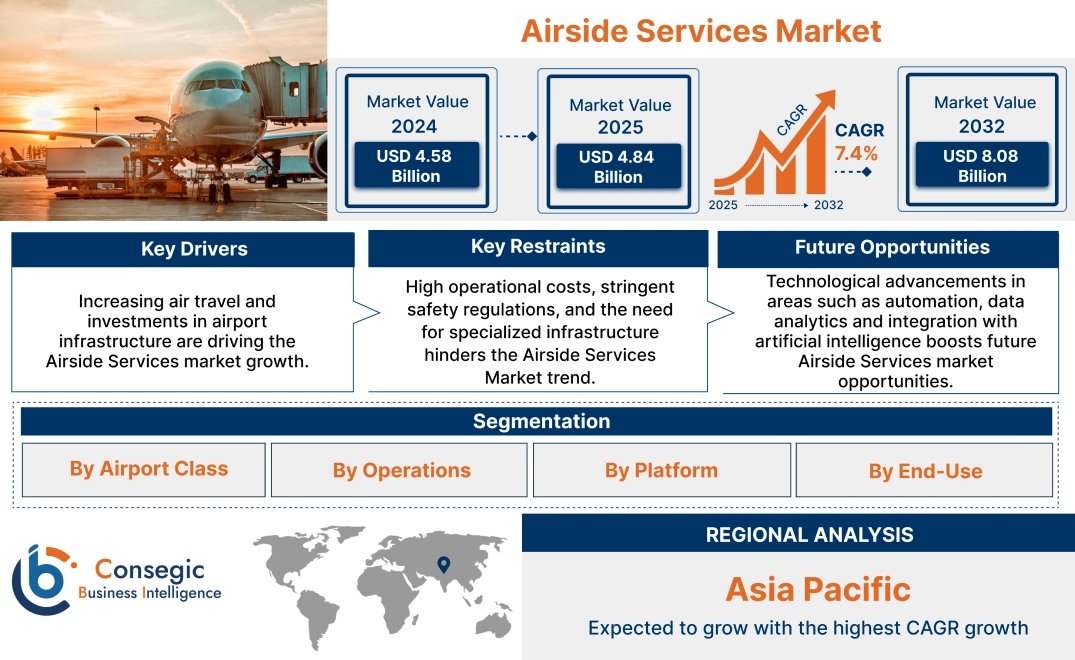
The Airside Services Market size is estimated to reach over USD 8.08 Billion by 2032 from a value of USD 4.58 Billion in 2024 and is projected to grow by USD 4.84 Billion in 2025, growing at a CAGR of 7.4% from 2025 to 2032.
Airside Services Market Scope & Overview:
Airside refers to an area of an airport that is directly involved with aircraft operations, including runways, taxiways, aprons, and aircraft parking areas. Airside services encompass all the activities and operations that occur within the restricted area of an airport, focused on the safe and efficient movement of aircraft, including tasks such as aircraft handling, ground handling, refueling, maintenance and repair, safety and security, and coordination. It is the area beyond security checks and passport and customs control in an airport terminal and it ensures that the aircraft performs on time arrival and departure safely. Stringent regulations and operational procedures govern airside activities to maintain high safety standards. Their end-user industry encompasses both commercial and military sectors.
Airside Services Market Dynamics - (DRO):
Key Drivers:
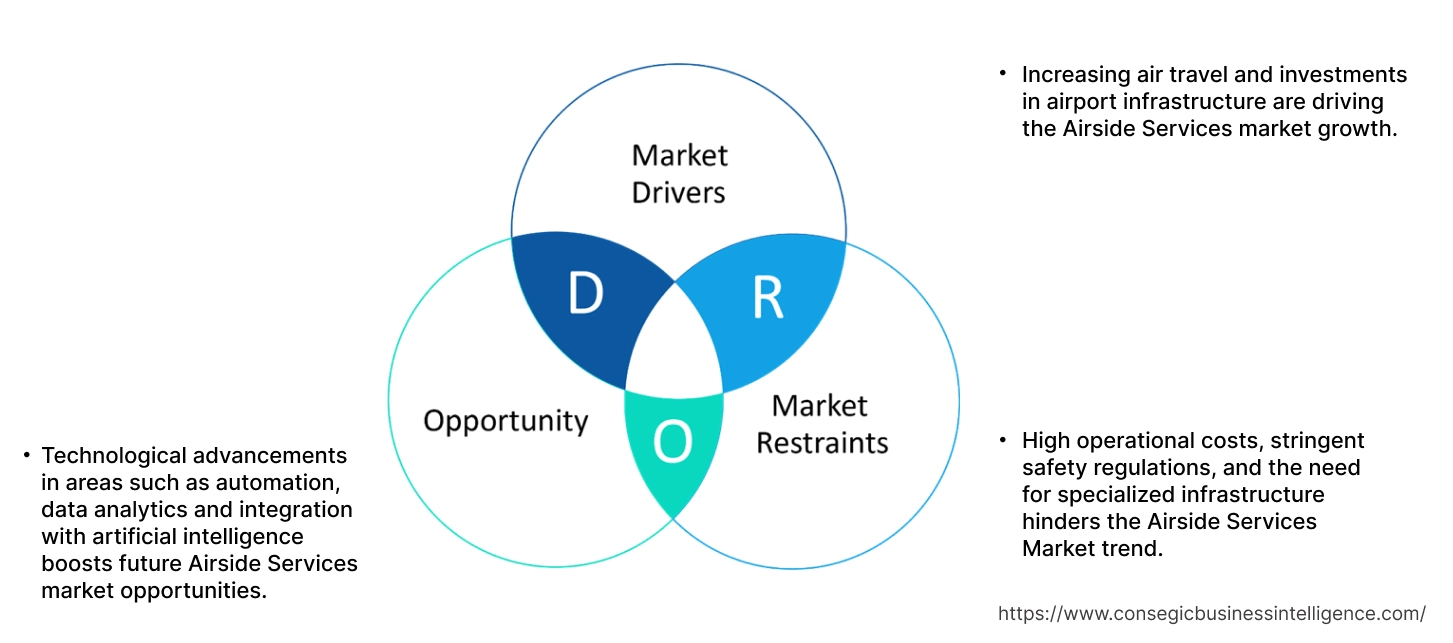
Increasing air travel and investments in airport infrastructure are driving the Airside Services market growth.
Increased air travel necessitates efficient airside services, driving the market trend as airports and airlines strive to manage more passengers and aircraft movements effectively. The rising number of passengers and cargo transported by air is a primary driver, necessitating enhanced ground handling, aircraft maintenance, and other airside operations. More aircraft movements and passengers require more efficient and reliable services, leading to increased utilization. Airports are expanding and modernizing to manage larger planes and rising passenger numbers, creating opportunities for airside service companies. Strict safety and security regulations necessitate specialized services to ensure compliance. Innovations in ground support equipment, baggage handling systems, and other airside technologies are enhancing efficiency and reducing operational costs. Investments in both existing airports and new airports projects are also fueling their demand, as airports expand their capacity and capabilities.
- In September 2024, Menzies Aviation, the leading service partner to the world’s airports and airlines, renewed its long-standing partnership with Ryanair for the provision of ground handling services at 10 locations across Europe. Under the renewed contract, which is set to run until October 2029, Menzies will continue to provide ground handling services to Ryanair.
Thus, the increasing air travel, investments in airport infrastructure, and the adoption of new technologies like automation and self-service solutions is bolstering airside services market growth.
Key Restraints:
High operational costs, stringent safety regulations, and the need for specialized infrastructure hinders the Airside Services Market trend.
High operational costs of airside services, encompassing ground handling and related activities, are a significant challenge for airports due to the need for specialized equipment, labor, and adherence to regulations, impacting overall airport economics. Requirement of investments in specialized equipment like fuel trucks, baggage handling systems, and de-icing vehicles leads to high costs. They involve complex operations and require specialized equipment and personnel, leading to high operational costs.
In areas like runways and taxiways, they require stringent safety regulations to ensure the safety of aircraft, personnel, and passengers. These regulations cover various aspects, including training procedures, and equipment maintenance, enforced by regulatory bodies and airport authorities adding to complexity and cost of airside operations.
Developing and maintaining specialized infrastructures such as runways, aprons, taxiways, and parking areas are expensive and time-consuming, which are a barrier to entry for new players.
Thus, these factors adversely affect their trend, severely hindering the Airside Services Market demand.
Future Opportunities:
Technological advancements in areas such as automation, data analytics and integration with artificial intelligence boosts future Airside Services market opportunities.
Automation in airside services using technology to streamline various airport operations, from baggage handling and ground support to air traffic management, aiming for efficiency and safety improves overall passenger experience. Robotic baggage handling systems, automated pushback and towing vehicles, and autonomous ground support vehicles improves efficiency.
Data analytics is transforming them by optimizing airport operations, improving passenger experience, and enabling better resource management through predictive analytics, real-time data analysis, and data-driven decision-making. Data analytics helps predict traffic flows, identify peak hours, and anticipate potential delays, enabling airports to optimize resource allocation (stands, gates, check-in counters) and improve operational efficiency. It also enables airports to understand passenger needs and preferences, allowing them to offer personalized services and enhance the overall travel experience.
AI is transforming these services, enhancing efficiency, safety, and passenger experience through applications like AI-powered security screening, predictive maintenance, and optimized traffic management. AI-powered systems speeds up check-in, manage queues efficiently, and provide personalized services, such as suggesting the quickest route to the gate. AI optimizes baggage managing processes, reducing delays, and improving efficiency.
- For instance, in July 2024, Ottawa International Airport Authority (OIAA) and Searidge Technologies entered into a strategic collaboration to conduct an extensive nine-month demonstration of Searidge’s Smart Stand at the Ottawa International Airport (YOW) to advance airport operations with artificial intelligence. With the use of Artificial Intelligence (AI), Smart Stand enables the digitalization of ramp operations.
Thus, these technological advancements and integration of data analytics and Artificial Intelligence leads to increased Airside Services market demand.
Airside Services Market Segmental Analysis :
By Airport Class:
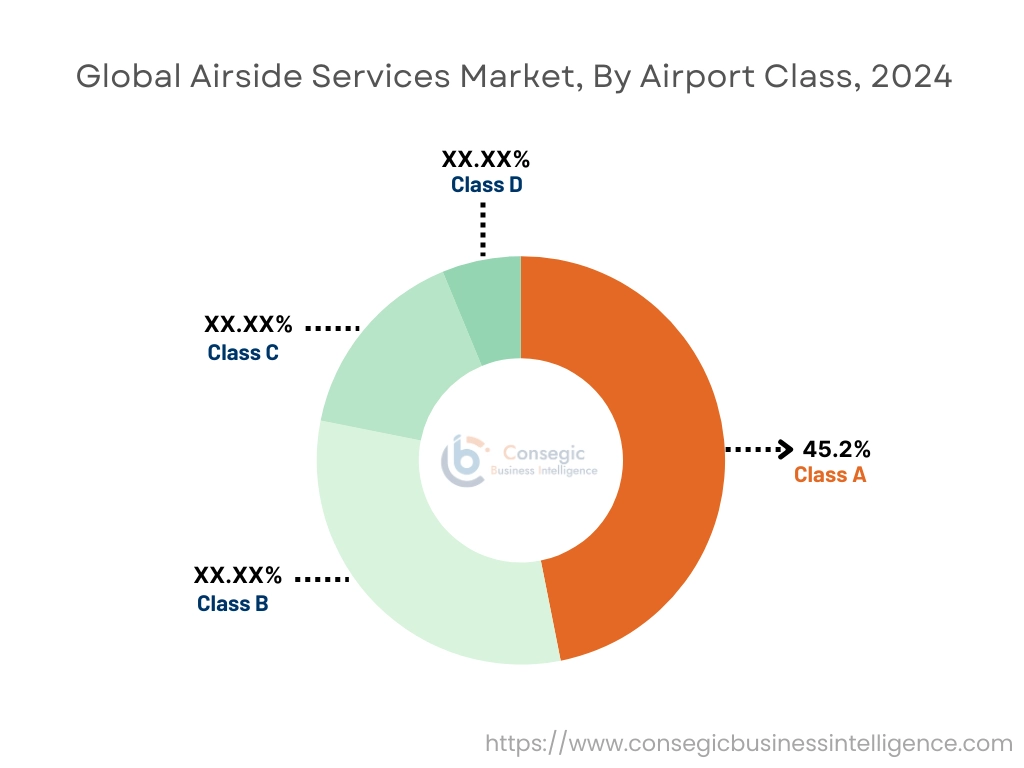
Based on airport class, market is segmented into Class A, Class B, Class C, and Class D.
The Class A segment accounted for the largest revenue share of 45.2% in 2024.
- Class A airports are major international hubs handling the highest volume of passenger and cargo traffic, necessitating comprehensive and sophisticated airside services.
- These airports invest significantly in runway management, ground handling, apron services, and aircraft maintenance support to ensure seamless operations and minimal turnaround times.
- The segment benefits from the presence of advanced infrastructure, high aircraft movement frequency, and the need for continuous safety and efficiency enhancements.
- As per market analysis, large-scale airside service contracts and public-private partnerships contribute to the dominance of Class A airports in global service expenditure.
- With growing air traffic and global connectivity, Class A airports continue to prioritize automation and digital transformation in airside operations.
The Class B segment is anticipated to have the highest CAGR during the forecast period in the Airside Services market.
- Class B airspaces are in trend and are designed to improve aviation safety by reducing the risk of mid-air collisions in the airspace surrounding airports with high-density air traffic operations.
- They provide services to arriving and departing aircraft on the ground and in the immediate vicinity of the airport.
- They also provides radar services to aircraft approaching and departing the airport, ensuring safe separation, and sequencing.
- In Class B airspace, these services primarily involve Air Traffic Control (ATC), providing clearances and guidance to aircraft for operations within or through the airspace, ensuring separation and safety.
- Thus, the surge in domestic flights fuels their market trend in class B airspace.
By Operations:
Based on Operations, the market is segmented into aircraft handling, passenger handling, and cargo handling.
The Passenger handling segment accounted for the largest revenue in the Airside Services Market Share in 2024.
- Passenger handling segment encompass all activities related to aircraft operations and passenger management within the airside area of an airport, including tasks like check-in, boarding, and baggage handling.
- Encompasses the services provided to passengers from their arrival at the airport to their departure, including Check-in, boarding, baggage handling, gate services, customer services.
- Passenger handling staff aid passengers in checking in for their flights, issuing boarding passes, and providing pertinent flight information, streamlining the check-in process, and ensuring passengers are well-informed.
- Staff assist passengers with checking their luggage, ensuring proper tagging, and loading onto the aircraft, and aiding in retrieving luggage upon arrival, facilitating a smooth baggage claim process.
- Passenger handling personnel facilitate orderly boarding onto the aircraft, ensuring passenger seating and accommodating special needs or requests, contributing to an efficient boarding process.
- For instance, in July 2024, SATS Airport Services Pte Ltd, a wholly-owned subsidiary of SATS Ltd, (SATS), the world’s largest provider of air cargo handling services and Asia’s pre-eminent provider of food solutions, SIA Engineering Company Limited (SIAEC) and Changi Airport Group (CAG), have signed a Memorandum of Understanding (MoU) to start a proof of concept (POC) on the use of autonomous buses to transport airport staff around Changi Airport’s airside. It will validate the self-driving capabilities of the autonomous bus to gain confidence of its operational and safety performance.
- Thus, the passenger handling segment accounts for the highest revenue share in the market.
The Cargo Handling segment is anticipated to have the highest CAGR during the forecast period.
- Cargo handling drives the market trend as it encompass the entire process of moving goods from airport storage to aircraft and vice versa, including loading, unloading, and related tasks like customs clearance and security checks.
- It focuses on the activities that take place on the airfield side of the airport, specifically related to aircraft operations and cargo handling.
- The key activities include preparing aircraft for cargo loading and unloading, transporting cargo between the cargo terminal and the aircraft, moving cargo and baggage around the airside using specialized vehicles and equipment.
- The need for air freight is expected to increase due to factors like the rise of e-commerce and the need for efficient shipping, leading to a higher workload on airports and a need for enhanced cargo handling capabilities.
- For instance, in Feb 2025, Swissport International, the global leader in airport ground services and air cargo handling announced the growth of its air cargo handling business further in Australia, serving airline customers and freight forwarders in new air cargo centers in Melbourne and Sydney. A newly acquired facility in Auckland, New Zealand. The new locations in Melbourne, Sydney and Auckland feature advanced temperature-controlled spaces, direct airside access, and state-of-the-art equipment to ensure safe and efficient operations. These capabilities empower our customers to deliver exceptional service quality across the supply chain.
- Thus, the cargo handling segment is driving the market and has potential future airside services market opportunities.
By Platform:
Based on platform, the market is segmented into hardware, software, and services.
The hardware segment accounted for the largest revenue in the Airside Services market share in 2024.
- Hardware segment refers to the equipment and systems used for aircraft operations and maintenance in the airside area of an airport, including runways, taxiways, and aprons.
- This encompasses the physical equipment and infrastructure essential for these operations, such as runway and taxiway lighting, aerodrome signage, aircraft parking and docking equipment, ground support equipment such as baggage loaders, tow tractors, and fuel trucks, communication systems, and navigation systems.
- It utilizes baggage handling equipment which are automated systems used for sorting, loading, and unloading baggage.
- Smart visual docking systems optimizes gate capacity and efficiency and provides integration with advanced surface movement guidance systems and other airside systems resulting in precise guidance for safer docking.
- In March 2025, GMR Airports Limited-led Delhi International Airport Limited (DIAL) announced the launch of Unified Total Airside Management (UTAM), a revolutionary system designed to make airside operations safer, more efficient, and smoother for everyone involved. UTAM is a state-of-the-art system that integrates real-time data from multiple sources across the airport, enabling operators to monitor aircraft movements, ground service equipment (GSE), and vehicle activity with unmatched precision.
- Thus, this analysis shows the increased use of hardware segment in the airside operations is driving the market.
The services platform is projected to be the fastest growing during the forecast period.
- The services segment is expected to be the fastest-growing due to the increasing need for ramp processing services, aircraft unloading, pushback, loading planning, shunting, surface maintenance, and airport transportation.
- Airside services encompass all activities related to aircraft operations on the airport side, and service equipment includes the tools and vehicles used to support these operations, such as tugs, fuel trucks, and baggage carts.
- Aircraft handling services includes tasks like pushing aircraft back from the gate, towing, fueling, and providing ground power.
- Passenger Handling services involves passenger boarding and disembarkation, baggage handling, and ensuring a smooth transfer between the aircraft and the terminal.
- Its other functions include marshalling, parking, cooling/heating, ramp to flight deck communication, ensuring safe loading and unloading, providing ground support such as pushback vehicles, and air starter units.
- For instance, in October 2023, Transoft Solutions announced a new addition to their aviation product portfolio that bridges the gap between airside planning and operations. AeroCENTRAL, the company’s first SaaS solution for the aviation industry, allows users to share key airside infrastructural and operational information across teams and departments, through a single, centralized system. The two applications on the AeroCENTRAL platform that are available at launch are Stand Guide and Specifications. These applications allow airports, airlines, ground service providers and their partners to publish, distribute, and view aircraft parking stand configurations, equipment locations, turnaround procedures, and aircraft technical specifications supporting safer operations and more efficient decision making.
- Thus, the requirement for these services in the aviation industry is driving the airside services market trend.
By End-Use:
Based on end-use, the market is segmented into Commercial and Military sector.
The commercial sector accounted for the largest revenue share and is anticipated to have the highest CAGR during the forecast period in the Airside Services Market.
- The commercial aviation sector, encompassing passenger and cargo transportation, is the largest and fastest-growing segment in the market.
- Increased air travel volume, both for leisure and business, is a major driver of the airline services market.
- The growth of air freight, including the movement of essential goods and emergency medical supplies, is also fueling demand.
- The adoption of new technologies like self-check-in kiosks and automated baggage handling systems are improving efficiency and passenger experience.
- For instance, in July 2024, Worldwide Flight Services (WFS), a member of the SATS Group, started a three-month trial using HVO biofuel in its airside transport fleet at London’s Heathrow Airport in support of SATS’ environmental, social and governance (ESG) group priorities and Heathrow’s goal for all airport vehicles to be zero-emission or using biofuels by 2030. WFS began increasing the use of biofuel across its fleet of 77 airside vehicles, which conduct approximately 130,000 truck movements a year at Heathrow in support of 10 airline customers.
- Thus, the surge in commercial flights and increased air travel are contributing to the surge of the market.
Regional Analysis:
The regions covered are North America, Europe, Asia Pacific, the Middle East and Africa, and Latin America.
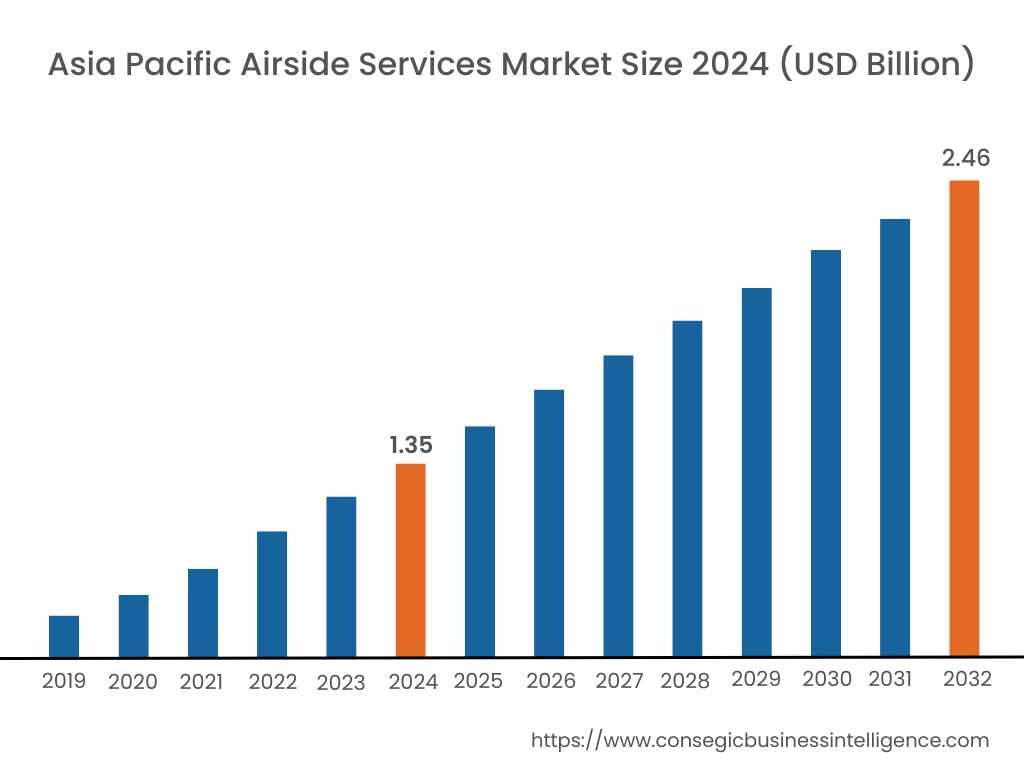
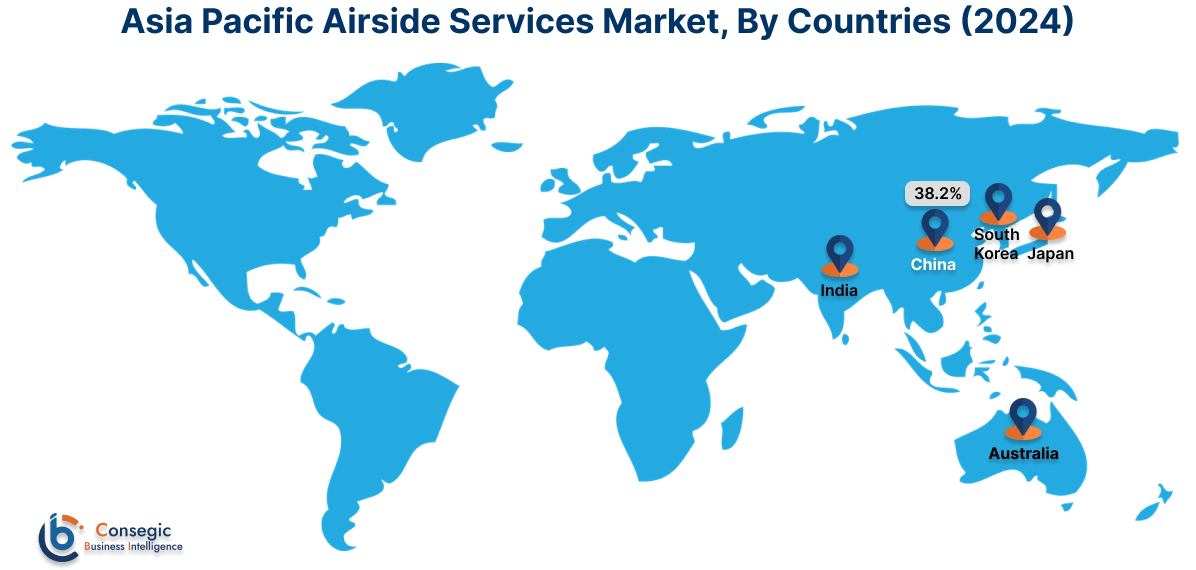
Asia Pacific region was valued at USD 1.35 Billion in 2024. Moreover, it is projected to grow by USD 1.43 Billion in 2025 and reach over USD 2.46 Billion by 2032. Out of this, China accounted for the maximum revenue share of 38.2%.
The advent of smart airport technology has revolutionized airport systems across Asia-Pacific region, including in airside operations. Airside technology in APAC airports is pivotal in optimizing various processes, ensuring seamless operations.
One of the primary areas of transformation is the adoption of automated systems. Automated baggage handling systems, for instance, streamline the process of sorting and transporting luggage, reducing manual labor, and minimizing errors. Additionally, integrating autonomous baggage carts and tugs enhances efficiency in transporting luggage across large airport terminals.
Several smart technologies are being implemented in airside applications to enhance operational capabilities. One such innovation is digital twin technology, which involves creating a digital replica of the physical airport environment allowing for real-time monitoring and management of airport operations, providing insights into potential bottlenecks, and enabling swift corrective actions. Airport authorities can optimize resource allocation and improve overall efficiency by simulating different scenarios.
- F. Express Singapore, a leader in Asia’s logistics landscape, marked a significant milestone with the official opening of its airside logistics centre located at SATS Core A warehouse in Changi Airfreight Centre. The new facility enables the optimisation of export and import operations, resulting in improved flexibility and faster turnaround times for customers. The development facilitates the enhancement of S. F. Express Singapore’s expansion across Southeast Asia and globally. With the launch of the airside logistics centre, the expected on-airport processing time will be reduced from 4 to 6 hours to 1.5 to 2 hours.
In addition to airside-specific technologies, Southeast Asian airports are adopting various other smart technologies to improve overall operations. Biometric Recognition, for instance, uses facial recognition and fingerprint scanning to streamline passenger processing at check-in, security, and boarding gates. This technology enhances security and speeds up the processing time.
Thus, according to the airside services market analysis, they are an emerging trend in the Asia-Pacific region due to the increase in the number of commercial airports.
North America is estimated to reach over USD 2.62 Billion by 2032 from a value of USD 1.52 Billion in 2024 and is projected to grow by USD 1.60 Billion in 2025.
According to the airside services market analysis, the North American region is the largest revenue contributor to the global airside services market, driven by factors like technological advancements, strict regulations, and increasing air traffic. The market is experiencing growth, fueled by airport demand for both business and commercial aircraft.
The U.S. holds the largest market revenue, while Canada's market is experiencing rapid increment. Airports around the world are experiencing heavy traffic, which increases complexity to ensure the safety of customers and ground staff while staying complaint. Airport ground handling services are a mix of multiple vendors/third-party providers, staff, ATC, crew, caterers, baggage control, etc. They form an interdisciplinary organization that needs to work together for smooth airport operations. The synchronous management of distinct entities is crucial to gain maximum effectiveness of airport operations.
Airside facilities include runways, taxiways, aprons, runway and taxiway bridges, passenger terminals, cargo facilities, air traffic control buildings, hangars, maintenance facilities, and fire and rescue facilities. These services ensure the safe and efficient movement of aircraft, including ground handling, aircraft towing, fueling, and maintenance. Increased passenger and freight air traffic is driving the need for efficient airside services in the United States. The development of LCCs is contributing to higher demand for ramp handling and turnaround services. Increasing emphasis on safety and security measures is leading to investments in airside infrastructure and services. In Canada, airside services encompass the various activities and operations that take place on the restricted, aircraft-facing side of an airport, including security, ground handling, and aviation support services.
- For instance, in January 2025, global aviation training leader CAE has inaugurated its first Air Traffic Services (ATS) Training Centre, on its campus in Montreal, Canada. Last October, CAE partnered with NAV CANADA to meet the increasing global demand for air traffic services personnel and train the highly skilled professionals they need to manage air traffic safely.
Thus, the market analysis highlights that the North American region is the largest user of these services in the airports due to the largest number of airports present in the region globally.
In the European region, airside services comprises of all activities related to aircraft operations within the airport's airside area, including runways, taxiways, aprons, and parking areas, ensuring safe and efficient handling of aircraft. The European Union Aviation Safety Agency (EASA) plays a key role in ensuring safety and environmental protection in air transport in Europe.
The services include aircraft handling, maintenance, refueling, cargo handling, and ground support equipment. Air navigation services, managed by organizations like EUROCONTROL, play a vital role in ensuring the safe and efficient movement of aircraft in European airspace. The European Union helps in shaping the air transport industry through policies that promote competition, ensure safety, and improve service quality. The EU's internal market has removed commercial restrictions for airlines flying within the EU, leading to more routes, lower prices, and increased choice for passengers. The availability of competitive airport services, including runways, passenger terminals and ground handling services, is critical for the continued success of the EU’s aviation sector. The EU regulatory framework on airports consists of rules on the allocation of slots, ground handling services and airport charges.
Thus, the market analysis shows that factors like adoption of total airport management (TAM), change in consumer dynamics, privatization of airports, and the arrival of electric vertical takeoff & landing vehicles (eVTOL) are anticipated to support business potential.
The market in Latin America is experiencing significant growth due to rising air travel passenger traffic, with services like ground handling, aircraft maintenance, cargo handling, and fueling all contributing to this increment.
The region's increasing air travel requirement is a primary driver for their growth. The development of air connectivity within Latin America, including cross-routes and secondary airports, is expected to further stimulate growth. Continued fleet modernization and investment in new aircraft will create opportunities for reuse, repair, and recycling.
Thus, the market analysis shows the scope of airside services market expansion in Latin American region.
The Middle East is witnessing a rise in air travel, fueled by a growing middle class and increasing affordability further increasing the scope of the airside services industry.
It encompass activities related to aircraft operations, including runway maintenance, air traffic control, and ground handling, with companies like Serco and dnata playing key roles. Airports in the Middle East are investing heavily in expanding capacity and upgrading passenger and cargo facilities. There are air traffic control services at Dubai, Al Maktoum, Sharjah, Ras Al Khaimah and Baghdad International Airports and are rapidly expanding within the sector, building upon over 5 decades of operational experience in the region.
Middle East Airports Services S.A.L. (MEAS) is a company totally specialized in management operations and maintenance of facilities offers high quality services, supported by a team of more than 700 engineers and technicians who are highly qualified and trained.
In Africa, like elsewhere, they prioritize safety and efficiency, with a focus on minimizing delays and ensuring smooth operations. AFS (Africa Flight Services) provides state-of-the-art cargo managing facilities, including automated pallet handling systems and temperature-controlled storage. Airside operations teams are responsible for removing any debris from runways and taxiways. They conduct regular inspections to ensure runway lights, paint markings, and signage are in working order and assigns parking stands and ensuring efficient aircraft movement.
Hence, the market analysis highlights the potential Airside Services market Expansion in the Middle East and African region.
Top Key Players & Market Share Insights:
The Airside Services market is highly competitive with major players providing products and services to the national and international markets. Key players are adopting several strategies in research and development (R&D), product innovation, and end-user launches to hold a strong position in the global Airside Services market. Key players in the Airside Services industry include –
- Honeywell International (US)
- Vanderlande (Netherlands)
- Pteris Global Limited (Singapore)
- Damarel systems private limited (UK)
- Aena (Spain)
- BEUMER Group (Germany)
- DAIFUKU (Japan)
- SIEMENS (Germany)
- Cisco (US)
- SITA (Switzerland)
Recent Industry Developments :
- In December 2024, SITA, the global leader in air transport technology, and IDEMIA Public Security, a world leader in computer vision & digital technologies, biometrics, and security, are expanding their partnership to tackle key challenges in baggage handling and airport operations. Leveraging IDEMIA’s expertise in computer vision, combined with SITA’s expertise in baggage processing, improves operational efficiency and provides smoother experience for both travelers and airlines.
Airside Services Market Report Insights:
| Report Attributes | Report Details |
| Study Timeline | 2019-2032 |
| Market Size in 2032 | USD 8.08 Billion |
| CAGR (2025-2032) | 7.4% |
| By Airport Class |
|
| By Operations |
|
| By Platform |
|
| By End-Use |
|
| By Region |
|
| Key Players |
|
| North America | U.S. Canada Mexico |
| Europe | U.K. Germany France Spain Italy Russia Benelux Rest of Europe |
| APAC | China South Korea Japan India Australia ASEAN Rest of Asia-Pacific |
| Middle East and Africa | GCC Turkey South Africa Rest of MEA |
| LATAM | Brazil Argentina Chile Rest of LATAM |
| Report Coverage |
|
Key Questions Answered in the Report
What are Airside Services? −
Airside services comprises of all the activities and operations focusing on the safe and efficient movement of aircraft. It includes tasks such as aircraft handling, ground handling, refueling, maintenance and repair, safety and security, and coordination. It ensures the arrival and departure of aircraft on time.
What are the major drivers of the Airside Services market? +
The increasing air travel and investments in airport infrastructure is the major driver of the airside services market. The increasing number of passengers and cargo drives the market, necessitating the ground handling, maintenance of the aircraft, and various other airside operations. The development of airports to manage larger planes and the rise in the number of passengers creates opportunities for the market.
What specific segmentation details are covered in the report, and how is the dominating segment impacting market growth? +
The Airside services market is segmented on the basis of Airport class, Operations, Platform, and End-Use and are further divided into sub-segments. For instance, the segment ‘By End-Use’ is sub-segmented into Commercial and Military, in which, Commercial sector is the largest and has the highest CAGR due to the widespread use of commercial flights by users globally. The increase in the population and the number of airport results in the commercial sector rapid growth.
Which region holds the largest revenue share in 2024 in the Airside Services market? +
The North American region holds the largest revenue share in the Airside services market in 2024 due to the factors like technological advancements and increasing traffic. Increased passenger and freight air traffic drives the market. Expansion of Low cost carriers contributes to higher demand of ramp handling and turnaround services.
What are Airside Services? +
Airside services comprises of all the activities and operations focusing on the safe and efficient movement of aircraft. It includes tasks such as aircraft handling, ground handling, refueling, maintenance and repair, safety and security, and coordination. It ensures the arrival and departure of aircraft on time.
What are the major drivers of the Airside Services market? +
The increasing air travel and investments in airport infrastructure is the major driver of the airside services market. The increasing number of passengers and cargo drives the market, necessitating the ground handling, maintenance of the aircraft, and various other airside operations. The development of airports to manage larger planes and the rise in the number of passengers creates opportunities for the market.
What specific segmentation details are covered in the report, and how is the dominating segment impacting market growth? +
The Airside services market is segmented on the basis of Airport class, Operations, Platform, and End-Use and are further divided into sub-segments. For instance, the segment ‘By End-Use’ is sub-segmented into Commercial and Military, in which, Commercial sector is the largest and has the highest CAGR due to the widespread use of commercial flights by users globally. The increase in the population and the number of airport results in the commercial sector rapid growth.
Which region holds the largest revenue share in 2024 in the Airside Services market? +
The North American region holds the largest revenue share in the Airside services market in 2024 due to the factors like technological advancements and increasing traffic. Increased passenger and freight air traffic drives the market. Expansion of Low cost carriers contributes to higher demand of ramp handling and turnaround services.
Overview
Reputation & Certifications


Our Services
- Market Intelligence & Forecasting
- Custom Research Solutions
- Market Entry Strategy
- Competitive Intelligence
- Customer Insights
- Industry Innovation Analysis
- Investment Advisory