Jump to Content
Toy Drones Market - Size, Share, Industry Trends, and Forecasts (2025-2032)
Toy Drones Market Size:
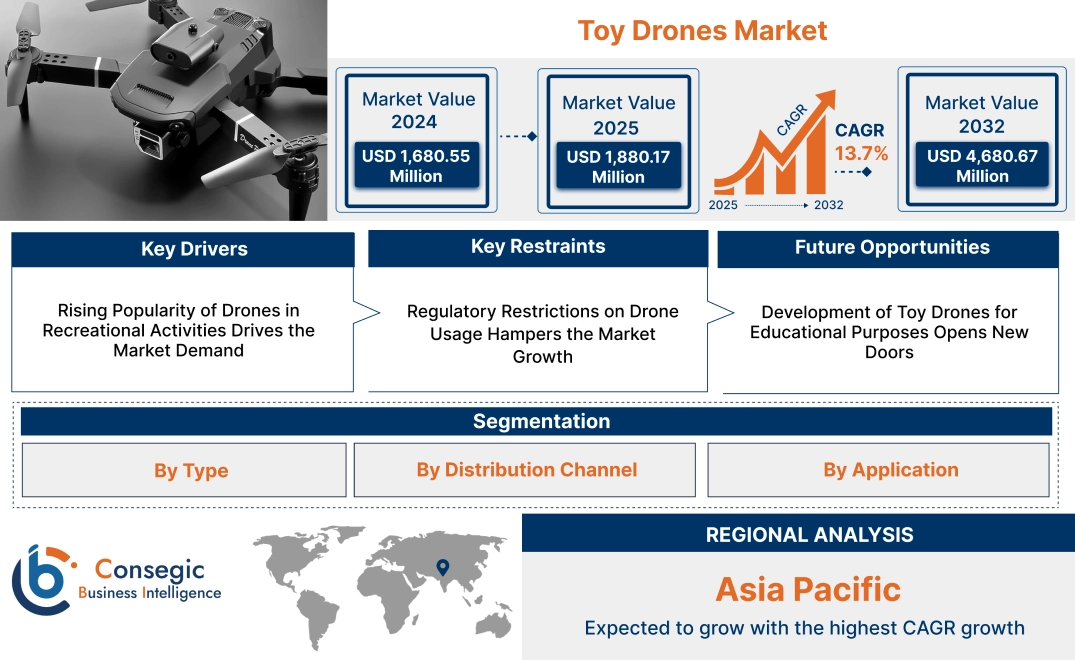
Toy Drones Market size is estimated to reach over USD 4,680.67 Million by 2032 from a value of USD 1,680.55 Million in 2024 and is projected to grow by USD 1,880.17 Million in 2025, growing at a CAGR of 13.7% from 2025 to 2032.
Toy Drones Market Scope & Overview:
Toy drones are small, lightweight unmanned aerial vehicles designed primarily for recreational use and beginner-level drone operations. These drones are equipped with basic flight capabilities and features such as remote controls, built-in cameras, and simple stabilization systems to offer an enjoyable and user-friendly experience. They are commonly used for entertainment, photography, and learning purposes.
These drones are available in various designs, including quadcopters and mini-drones, catering to different age groups and skill levels. They are constructed with durable and lightweight materials, ensuring safety and ease of use, particularly for indoor and outdoor recreational activities. Some models also include features like one-touch takeoff and landing, altitude hold, and simple camera functions, enhancing their appeal for casual users and hobbyists.
End-users include hobbyists, children, and individuals interested in exploring drone technology at an entry level. These drones serve as an accessible and affordable introduction to aerial devices, making them a popular choice for leisure and basic drone training.
Toy Drones Market Dynamics - (DRO) :
Key Drivers:
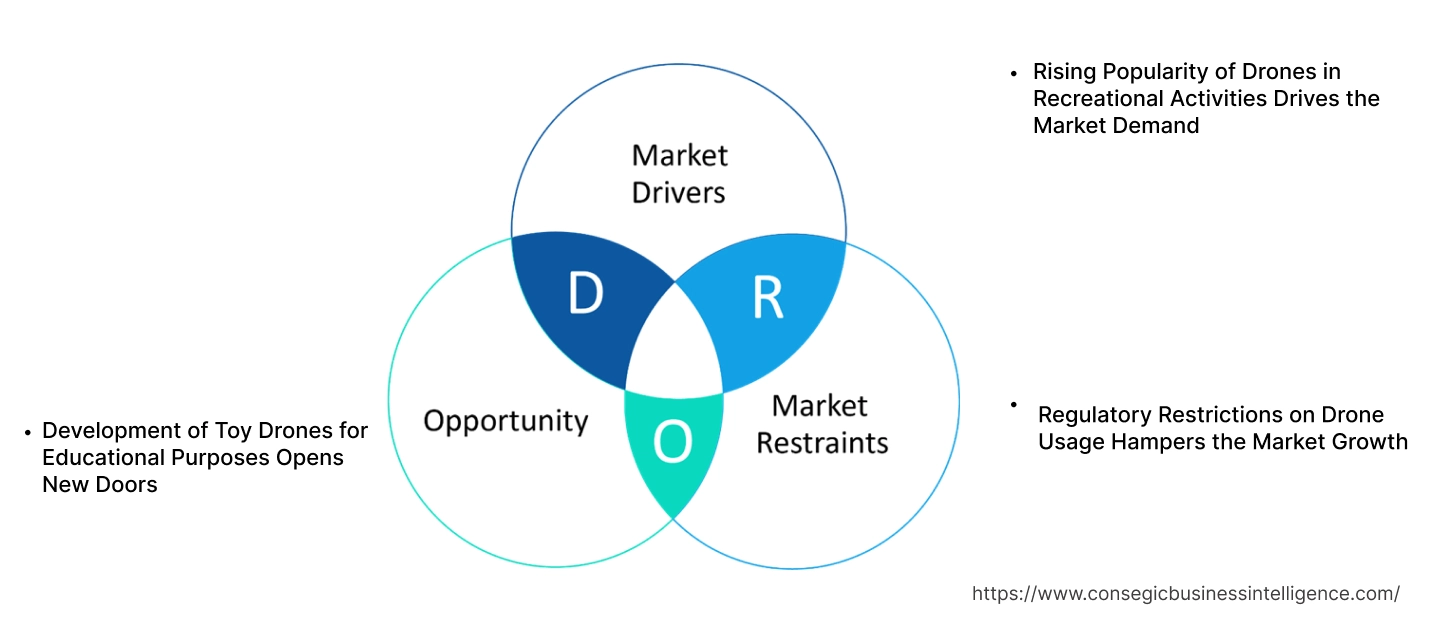
Rising Popularity of Drones in Recreational Activities Drives the Market Demand
The rising popularity of drones for recreational activities is a key driver of growth in the toy drone market. Drones have become a favorite pastime, especially among children and hobbyists, offering a unique blend of fun, entertainment, and learning. The thrill of flying drones, combined with their easy-to-use controls, has made them highly appealing. Toy drones, which are more affordable and accessible than professional models, provide an entry point for beginners to experience the excitement of drone flying without the complexity or high costs. These drones are often equipped with user-friendly features, such as automatic takeoff, landing, and stability control, making them perfect for casual use and learning. This growing interest in drone-based activities is fueling demand, contributing to the toy drones market growth.
Key Restraints:
Regulatory Restrictions on Drone Usage Hampers the Market Growth
Regulatory restrictions on drone usage present a significant challenge to the toy drone market. In many regions, laws limit drone operations in specific airspace, such as near airports or densely populated areas, and impose restrictions on maximum altitude and flight distance. These regulations are intended to ensure airspace safety, particularly with the rising number of drones in use. However, for recreational drone users, these limitations can diminish the appeal of toy drones. Restrictions often prevent users from fully enjoying the flying experience, especially in urban areas where open spaces for drone operation are limited. Additionally, varying regulations across countries and regions can create confusion, further restraining the global growth of the market. As a result, manufacturers and operators face the challenge of navigating complex legal landscapes, which slow down product adoption and innovation, hindering the toy drones market demand.
Future Opportunities :
Development of Toy Drones for Educational Purposes Opens New Doors
The development of toy drones for educational purposes is creating significant opportunities in the market, particularly with the rising focus on STEM (Science, Technology, Engineering, Mathematics) education. These drones provide a hands-on, engaging way for children to learn fundamental concepts in aerodynamics, programming, and robotics. By integrating drones into the curriculum, educators can help students understand how these fields interact in real-world applications. Toy drones are being marketed as educational tools that teach critical skills such as problem-solving, logic, and spatial awareness. Additionally, drone kits designed for educational purposes allow students to assemble and customize their drones, fostering creativity and technical skills. This trend opens new avenues in schools, after-school programs, and specialized STEM education kits, expanding the appeal of drones beyond recreational use. With increased interest in technology-based learning, the educational drone market has vast potential to grow, attracting both educational institutions and parents seeking interactive learning solutions. Thus, the aforementioned factors are boosting the toy drones market opportunities.
Toy Drones Market Segmental Analysis :
By Type:
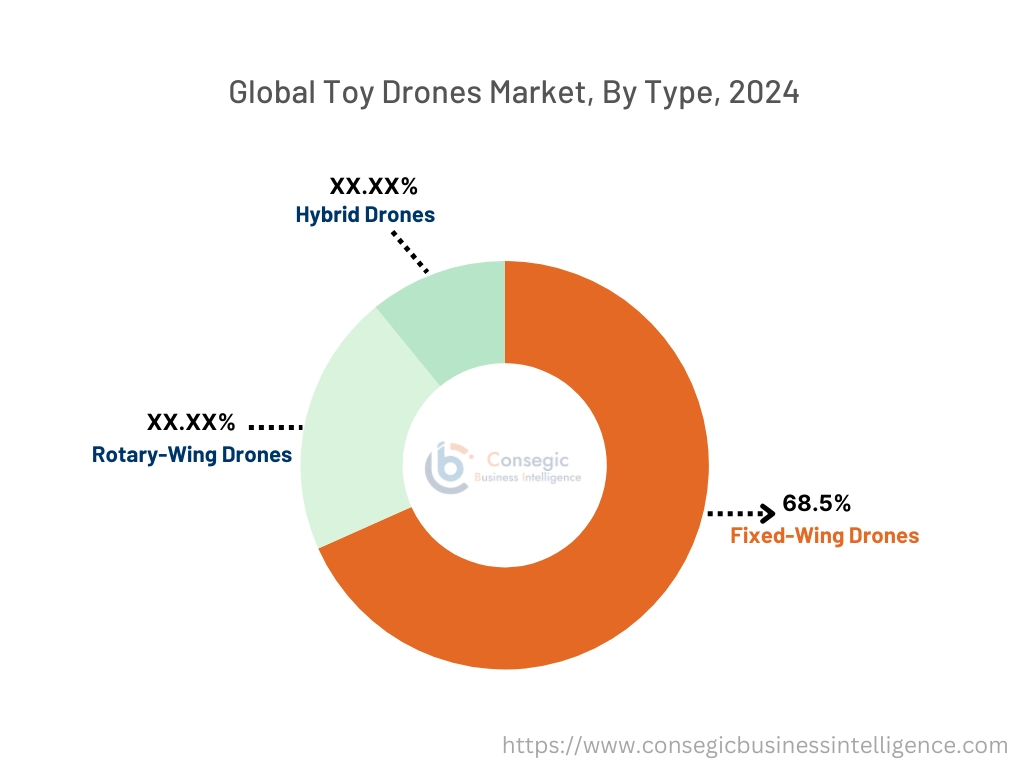
Based on type, the market is segmented into fixed-wing drones, rotary-wing drones, and hybrid drones.
The fixed-wing drones segment held the largest revenue of 68.5% of the total toy drones market share in 2024.
- Fixed-wing drones are favored for their longer flight durations and ability to cover large distances, making them popular among hobbyists and educational institutions.
- These drones are widely used in outdoor recreational activities such as aerial photography, mapping, and gliding competitions.
- Fixed-wing drones’ aerodynamic design ensures efficient energy usage, allowing extended flight times compared to rotary-wing models.
- Thus, the increasing adoption for innovative outdoor activities supports their dominance, fueling the toy drones market expansion.
The hybrid drones segment is expected to register the fastest CAGR during the forecast period.
- Hybrid drones combine the capabilities of fixed-wing and rotary-wing drones, offering extended flight times and enhanced stability.
- Their ability to perform vertical take-offs and landings makes them suitable for advanced hobbyists and professionals.
- Continuous innovation in hybrid drone designs boosts their adoption for both educational and creative applications.
- As per the toy drones market analysis, the segment benefits from rising demand for multifunctional drones, supporting its rapid expansion.
By Distribution Channel:
Based on distribution channel, the market is segmented into online retail and offline retail.
The online retail segment accounted for the largest revenue of the total toy drones market share in 2024.
- Online platforms provide extensive product variety, competitive pricing, and customer reviews, making them the preferred choice for consumers.
- E-commerce channels offer convenience, discounts, and easy access to the latest drone models, driving significant sales.
- The rapid penetration of smartphones and increasing internet accessibility in emerging markets further bolster online sales.
- As per market trends, partnerships between manufacturers and online retailers ensure the availability of a broad range of drones globally, driving the toy drones market growth.
The offline retail segment is projected to grow at the fastest CAGR during the forecast period.
- Specialty stores and toy shops allow consumers to experience drones firsthand, driving in-store purchases.
- Offline retailers often provide after-sales services and technical support, enhancing consumer confidence.
- Drone demonstrations and interactive retail setups attract a growing customer base, especially among first-time buyers.
- As per the toy drones market trends, the segment benefits from collaborations between drone manufacturers and local distributors to expand regional market presence.
By Application:
Based on application, the market is segmented into photography & videography, racing, education, entertainment, and others.
The photography & videography segment held the largest revenue share in 2024.
- Toy drones equipped with high-resolution cameras are popular among hobbyists and content creators for capturing unique aerial footage.
- These drones are increasingly used for creative projects and personal content sharing on social media platforms.
- Continuous advancements in camera technology, including stabilization and live-streaming features, support the segment’s dominance.
- As per toy drones market analysis, rising interest in aerial photography and videography drives the segment’s consistent growth.
The racing segment is expected to grow at the fastest CAGR during the forecast period.
- Drone racing has emerged as a competitive sport, attracting enthusiasts and hobbyists globally.
- Lightweight, high-speed drones with aerodynamic designs are gaining traction among racing participants.
- Increasing participation in drone racing leagues and events contributes to the rapid adoption of racing drones.
- As per the toy drones market trends, the affordability of entry-level racing drones encourages new users to explore this application, boosting market growth.
Regional Analysis:
The regions covered are North America, Europe, Asia Pacific, the Middle East and Africa, and Latin America.
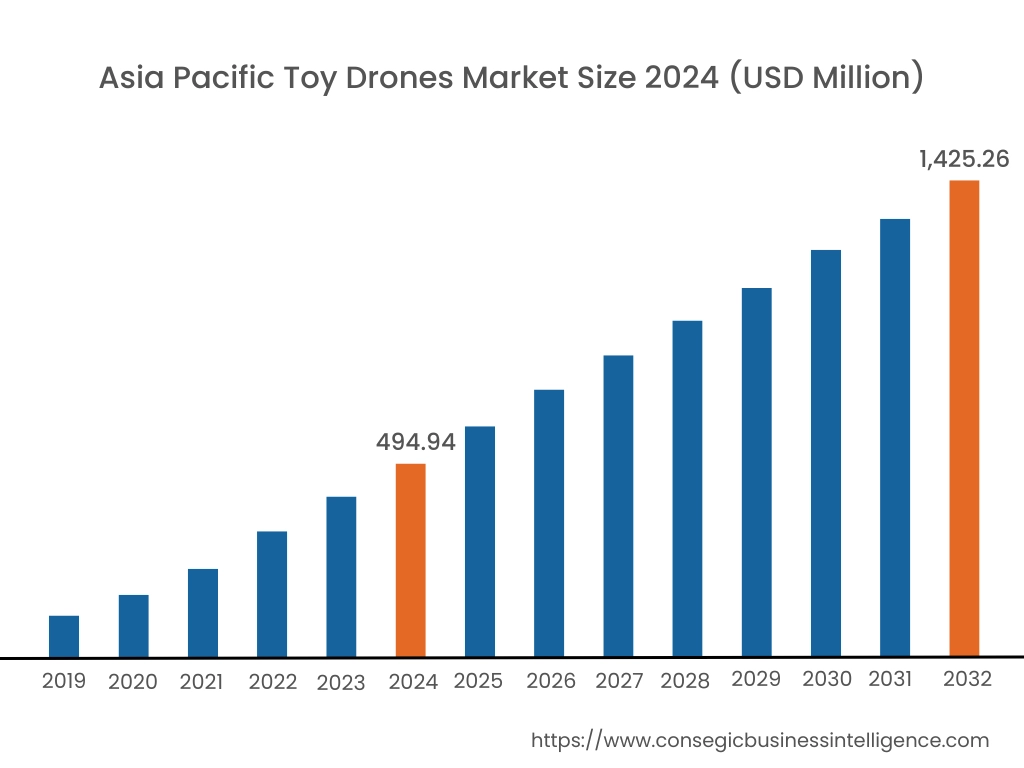
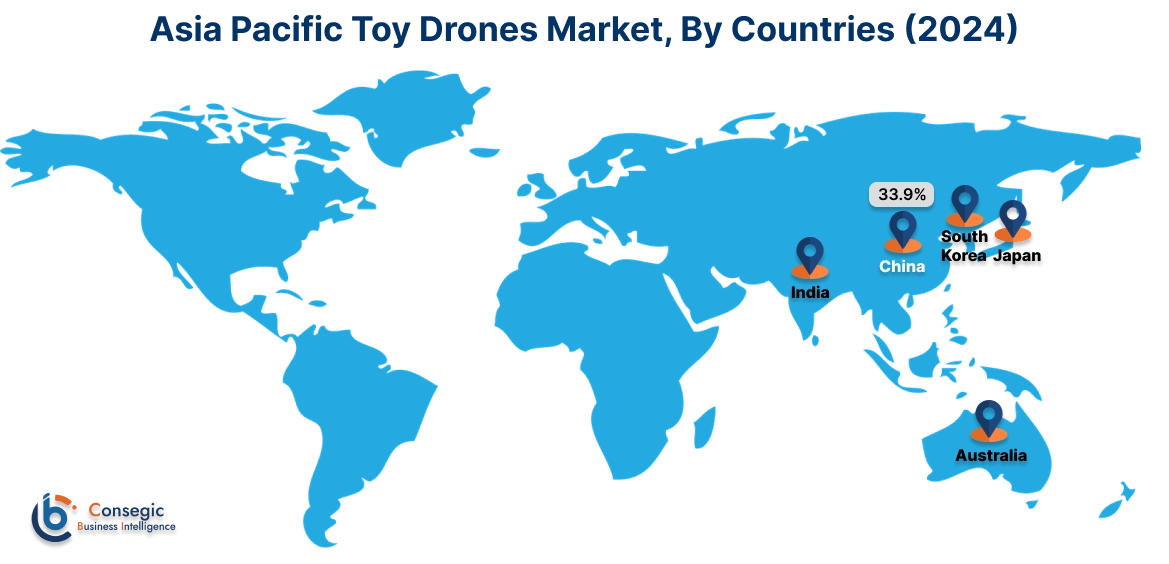
Asia Pacific region was valued at USD 494.94 Million in 2024. Moreover, it is projected to grow by USD 555.29 Million in 2025 and reach over USD 1,425.26 Million by 2032. Out of this, China accounted for the maximum revenue share of 33.9%. The Asia-Pacific region is witnessing rapid growth in the toy drones market, attributed to increasing urbanization and a burgeoning middle class. A prominent trend is the rising popularity of drone racing and aerial photography, driving demand for high-performance toy drones. Analysis indicates that countries like China and Japan are leading the market, with China being a major manufacturer and exporter of the drones, while Japan shows a growing interest in drone-related recreational activities creating substantial toy drones market opportunities.
North America is estimated to reach over USD 1,517.00 Million by 2032 from a value of USD 557.45 Million in 2024 and is projected to grow by USD 622.48 Million in 2025. This region holds a significant share of the market, driven by high disposable incomes and a strong inclination towards recreational activities. A notable trend is the increasing adoption of toy drones equipped with advanced features such as integrated cameras and user-friendly controls, enhancing their appeal among hobbyists and children. Analysis indicates that the presence of key manufacturers and a robust distribution network further bolster toy drones market expansion in North America.
European countries, particularly the UK, Germany, and France, are key players in the toy drones market, with a strong emphasis on safety regulations and educational applications. A significant trend is the collaboration between educational institutions and manufacturers to develop drones that serve as learning tools, fostering interest in STEM (Science, Technology, Engineering, and Mathematics) subjects among students. Analysis suggests that stringent safety standards and a focus on innovative educational products are shaping the market landscape in this region.
In the Middle East, the market is influenced by a growing interest in technological gadgets and recreational activities. The focus is on introducing affordable and durable toy drones suitable for outdoor activities, catering to both locals and tourists. In Africa, the market is gradually developing, with efforts to increase awareness and accessibility of drones among the youth. Analysis suggests that economic diversification efforts and investments in the entertainment industry are contributing to toy drones market demand in these regions.
Latin American countries are increasingly recognizing the appeal of toy drones as recreational devices and educational tools. A notable trend is the incorporation of drones into school curricula to enhance learning experiences and promote technological literacy. However, economic constraints and limited access to advanced technology may impact the pace of adoption. Analysis indicates that government initiatives to improve educational infrastructure and technological integration could play a pivotal role in advancing the drones market in this region.
Top Key Players and Market Share Insights:
The Toy Drones market is highly competitive with major players providing products and services to the national and international markets. Key players are adopting several strategies in research and development (R&D), product innovation, and end-user launches to hold a strong position in the global Toy Drones market. Key players in the Toy Drones industry include -
Recent Industry Developments :
- In June 2024, Potensic has introduced the ATOM SE, a compact drone weighing under 249 grams, featuring a 4K camera capable of capturing 12MP photos and 4K videos at 30 fps. It offers up to 31 minutes of flight time and a transmission range of up to 4 km. The ATOM SE is equipped with ShakeVanish EIS Technology for stable footage and the SurgeFly Flight Control System with three flight modes.
Toy Drones Market Report Insights :
| Report Attributes | Report Details |
| Study Timeline | 2019-2032 |
| Market Size in 2032 | USD 4,680.67 Million |
| CAGR (2025-2032) | 13.7% |
| By Type |
|
| By Distribution Channel |
|
| By Application |
|
| By Region |
|
| Key Players |
|
| North America | U.S. Canada Mexico |
| Europe | U.K. Germany France Spain Italy Russia Benelux Rest of Europe |
| APAC | China South Korea Japan India Australia ASEAN Rest of Asia-Pacific |
| Middle East and Africa | GCC Turkey South Africa Rest of MEA |
| LATAM | Brazil Argentina Chile Rest of LATAM |
| Report Coverage |
|
Key Questions Answered in the Report
What is the size of the Toy Drones Market? −
The Toy Drones Market size is estimated to reach over USD 4,680.67 Million by 2032 from a value of USD 1,680.55 Million in 2024 and is projected to grow by USD 1,880.17 Million in 2025, growing at a CAGR of 13.7% from 2025 to 2032.
What are the key segments in the Toy Drones Market? +
The market is segmented by type (fixed-wing drones, rotary-wing drones, hybrid drones), distribution channel (online retail, offline retail), and application (photography & videography, racing, education, entertainment, and others).
Which segment is expected to grow the fastest in the Toy Drones Market? +
The racing segment is expected to grow at the fastest CAGR during the forecast period, driven by the increasing participation in drone racing leagues and events.
Who are the major players in the Toy Drones Market? +
Key players in the Toy Drones market include DJI (China), Parrot SA (France), Hubsan (China), Syma Toys (China), Holy Stone (USA), TYX Toys (China), Potensic (China), UDI RC Toys (China).
Overview
Reputation & Certifications


Our Services
- Market Intelligence & Forecasting
- Custom Research Solutions
- Market Entry Strategy
- Competitive Intelligence
- Customer Insights
- Industry Innovation Analysis
- Investment Advisory