Jump to Content
Operating Training Simulator Market - Size, Share, Industry Trends, and Forecasts (2025-2032)
Operating Training Simulator Market Size:
Operating Training Simulator Market size is estimated to reach over USD 28.22 Billion by 2032 from a value of USD 11.83 Billion in 2024 and is projected to grow by USD 12.98 Billion in 2025, growing at a CAGR of 12.7% from 2025 to 2032.
Operating Training Simulator Market Scope & Overview:
An operator training simulator (OTS) is a computer-based system that duplicates industrial processes and control systems, allowing operators to practice and improvise skills in a safe and virtual environment. OTS is designed to train operators for different operations including start-up, shut-down, normal operations, emergency situations, and equipment malfunctions. They simulate the real-time behavior of a plant, including dynamic models of processes, control systems, and operator interfaces. Moreover, operator training simulator offers a safe, controlled environment to train operators on complex processes, improving skills, and reducing errors leading to safer and more efficient operations.
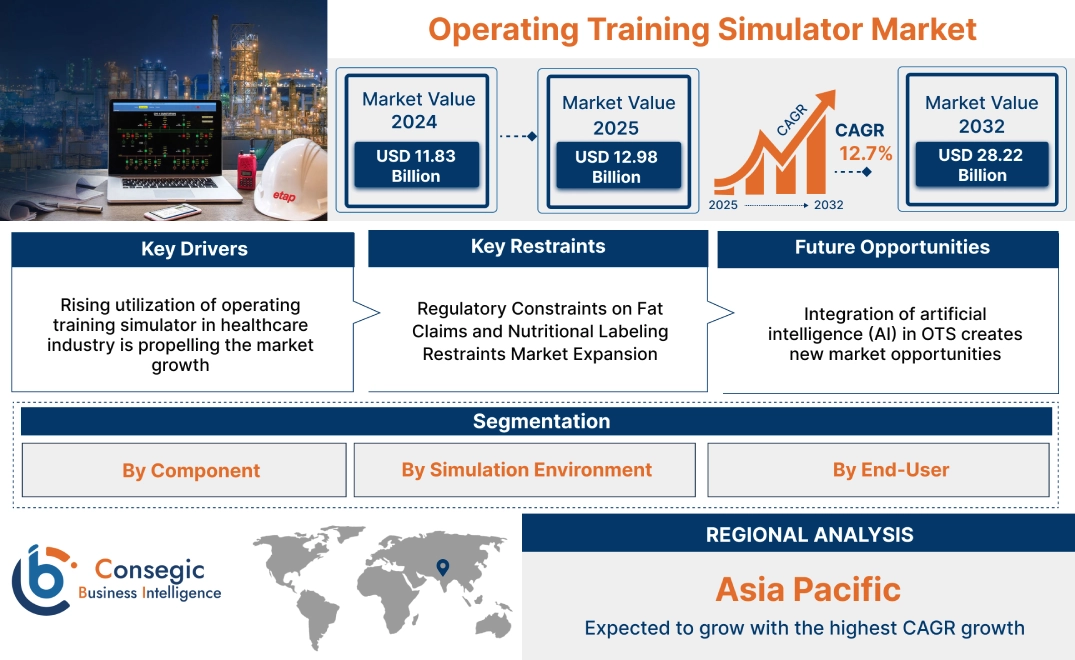
Operating Training Simulator Market Dynamics - (DRO):
Key Drivers:
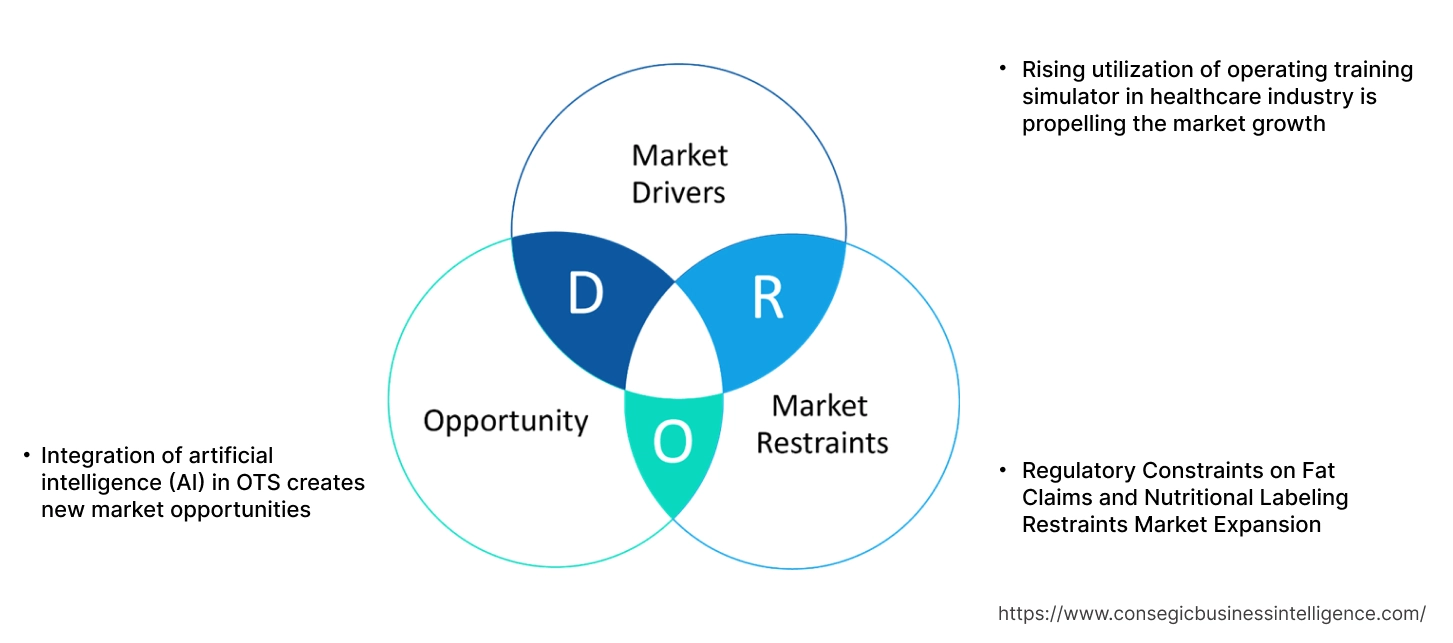
Rising utilization of operating training simulator in healthcare industry is propelling the market growth
OTS uses simulations to replicate real-life clinical scenarios, allowing trainees to practice procedures and make mistakes without harming any patients. Simulators mimic operating rooms, patient care areas, and other clinical settings. These simulations utilize various tools, including virtual reality, task trainers, and other technologies. Trainees practice procedures, develop skills, and improve decision-making abilities in a safe environment.
- For instance, in November 2024, Corewell opened simulation center for immersive healthcare training in Grand Rapids. The training center contains simulated operating rooms that are exact replicas of the actual operating rooms in the hospitals.
Thus, the aforementioned factors are boosting the usage of OTS in healthcare sector, in turn, driving the operating training simulator market growth.
Key Restraints:
Regulatory Constraints on Fat Claims and Nutritional Labeling Restraints Market Expansion
Advanced OTS systems require high initial investment hindering their adoption on large scale. Moreover, simulators require regular maintenance and upgrades to stay current with technology and plant operations, adding to the total cost of ownership.
Furthermore, due to the rapid pace of technological change, simulators become outdated quickly, necessitating frequent updates and replacements. These factors increase the overall investment requirement, leading to higher costs. Thus, the market analysis shows that the aforementioned factors are restraining the operating training simulator market demand.
Future Opportunities:
Integration of artificial intelligence (AI) in OTS creates new market opportunities
OTS in integration with AI enhances training by providing a realistic, risk-free environment to practice plant operations. AI algorithms analyze a trainee's performance and tailor the training scenarios and feedback to their individual needs and learning style. AI analyzes historical data and real-time performance data to predict potential issues or problems, allowing trainers to proactively address them. AI optimizes the training process by identifying the most effective learning methods and pacing for each trainee. AI provides immediate and objective feedback on a trainee's performance, helping them identify areas for improvement. AI generate realistic and challenging training scenarios, ensuring that operators are prepared for a wide range of situations.
- For instance, in March 2025, Airbus A320 flight simulator combining artificial intelligence was introduced at a training facility near Gatwick Airport. The system features AI-driven virtual ground crew communication, air traffic control, and AI-coordinated cabin operations.
Thus, the ongoing advancements in AI and its integration with OTS are projected to drive operating training simulator market opportunities during the forecast period.
Operating Training Simulator Market Segmental Analysis :
By Component:
Based on the component, the market is segmented into hardware, software, and services.
Trends in the Component:
- Rising growth in adoption of advanced software in OTS systems to provide complex simulations, and dynamic process simulation, among others.
- Increasing trend in adoption of OTS services across industries including oil and gas, healthcare, power, chemicals, refining, and others to provide hands-on training, in turn, leading to reduced human errors and improved operational efficiency.
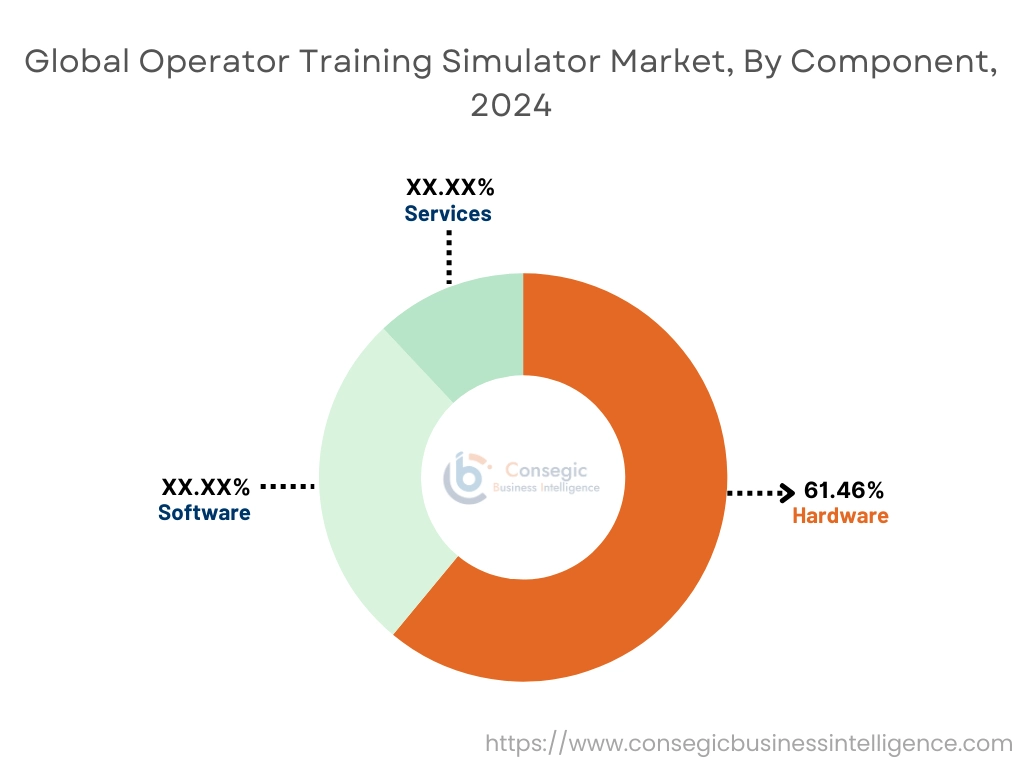
The hardware segment accounted for the largest revenue share of 61.46% in the market in 2024.
- Hardware in OTS includes powerful CPUs, RAM, graphics card, multiple high resolution displays, controls, network infrastructure, and others hardware components.
- For instance, AVEVA provides operator training simulator products for power, oil, gas, chemical, and refining sector. The products offer dynamic process simulation, controlled emulation, instructor tools, and systems design and delivery.
- Therefore, the aforementioned benefits are bolstering the operating training simulator market demand.
The services segment is expected to register the fastest CAGR during the forecast period.
- Services of OTS includes OTS development, training program development, integration, support, maintenance, training facilitation, updates, and others.
- For instance, TATA Consulting Engineers Ltd. offers operator training simulator services in power sector. The services offered include project management and safety as well as digital and advanced technologies.
- Thus, the increasing developments related to services are expected to boost the operating training simulator market trends during the forecast period.
By Simulation Environment:
Based on the simulation environment, the market is segmented into console operator training and field operator training.
Trends in the Simulation Environment:
- Rising demand for console operator training to improve safety, enhance skills, reduced errors, and to provide cost effective training is boosting the operating training simulator market size.
- Increasing trend in adoption of field operator training to provide hands-on training with machinery simulation to trainees, leading to reduced human errors in the actual work.
The console operator training segment accounted for the largest revenue share in the operating training simulator market share in 2024.
- Console operator training is used for managing complex systems and processes from a control room. The training focuses on equipping individuals with the skills to monitor, manage, and troubleshoot computer systems, including hardware controls, system maintenance, and security protocols.
- For instance, in May 2024, FlySight collaborated with the Airborne Sensor Operators Group (ASOG) to provide specialized training for airborne sensor operators, technicians, specialists, and supervisors involved in aerial work aviation operations.
- Therefore, market analysis shows that the increasing advancements associated with console operator training are driving the operating training simulator market growth.
The field operator training segment is expected to register the fastest CAGR during the forecast period.
- Field operator training is used to equip individuals to operate and maintain equipment in the field, focusing on safety protocols, troubleshooting, and communication. The functions in this training include operating machinery, monitoring processes, and ensuring compliance with regulations.
- For instance, in March 2025, LSCT explored advanced crane operator training simulation in Rotterdam. The simulator accurately replicates the real operational conditions of a container terminal.
- Thus, market analysis states that the increasing innovations associated with field operator training are anticipated to propel the operating training simulator market trends during the forecast period.
By End User:
Based on the end user, the market is segmented into aerospace & defense, chemical, energy & power, healthcare, industrial, oil & gas, pulp & paper, and others.
Trends in the End User:
- Rising demand for OTS systems in chemical sector to train operators to respond to chemical accidents and emergencies and to optimize the processes.
- Increasing trend in adoption of OTS systems in pulp and paper sector for improvised operator skills, early detection of problems, and reduced human errors is boosting the operating training simulator market size.
The aerospace & defense segment accounted for the largest revenue share in the operating training simulator market share in 2024.
- Simulators allow trainees to practice complex procedures and react to critical situations in a controlled, risk-free environment, which is especially important for high-stakes operations.
- Simulators help improve decision-making, teamwork, and overall operational capabilities, leading to better preparedness for real-world missions.
- Simulation training reduce the cost of physical training by minimizing the need for expensive equipment and resources.
- For instance, in January 2025, One-G simulation launched Tarbes 8 Flight simulator. The Tarbes 8 closely replicates the real-world aircraft and is equipped with a model-specific flight deck that features full-scale TBM 850 flight controls.
- Therefore, the market analysis depicts that the wide applications of OTS systems in aerospace & defense sector are boosting the market demand.
The oil & gas segment is expected to register the fastest CAGR growth during the forecast period.
- Operators practice the procedures and protocols involved in bringing a plant online or shutting it down, minimizing risks and ensuring a smooth transition.
- Operators practice handling various emergencies, such as equipment malfunctions, spills, or fires, in a simulated environment, improving their ability to react quickly and effectively in real-life situations.
- OTS can be used to simulate different types of equipment malfunctions, allowing operators to learn how to diagnose and troubleshoot problems, and develop effective responses.
- For instance, Yokogawa Ltd. offers operator training simulator products for oil and gas sector. The solutions offered are OmegaLand OTS & MIRROR PLANT.
- Thus, the ongoing advancements in OTS systems in oil and gas sector are expected to boost the operating training simulator market opportunities during the forecast period.
Regional Analysis:
The regions covered are North America, Europe, Asia Pacific, the Middle East and Africa, and Latin America.
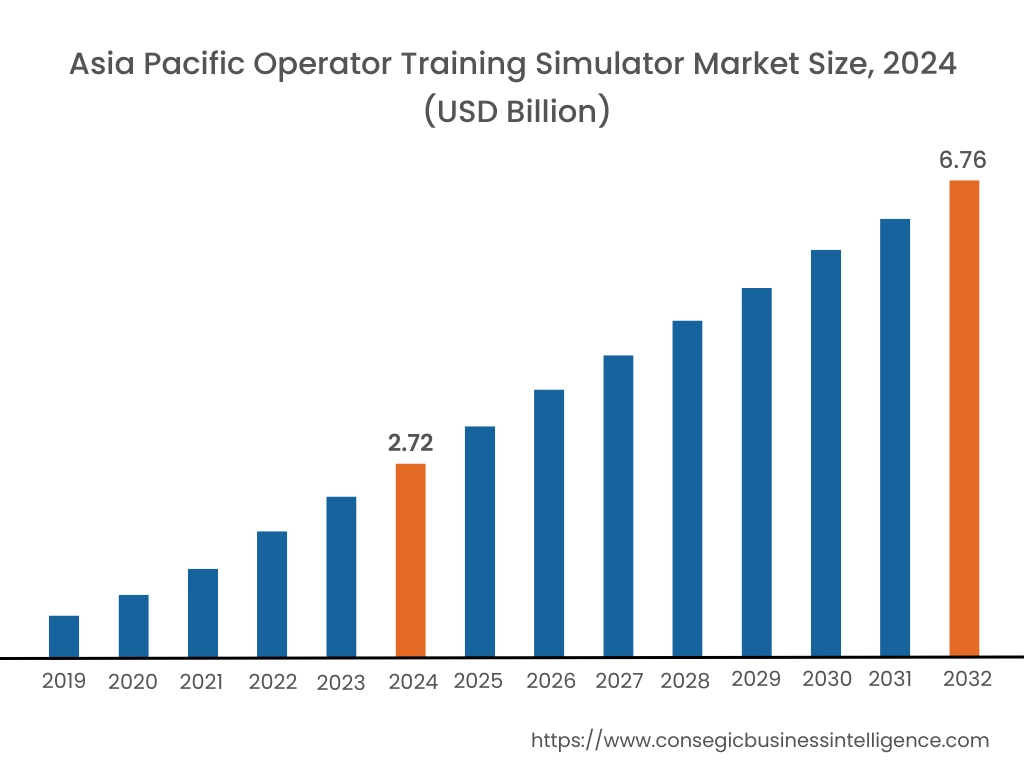
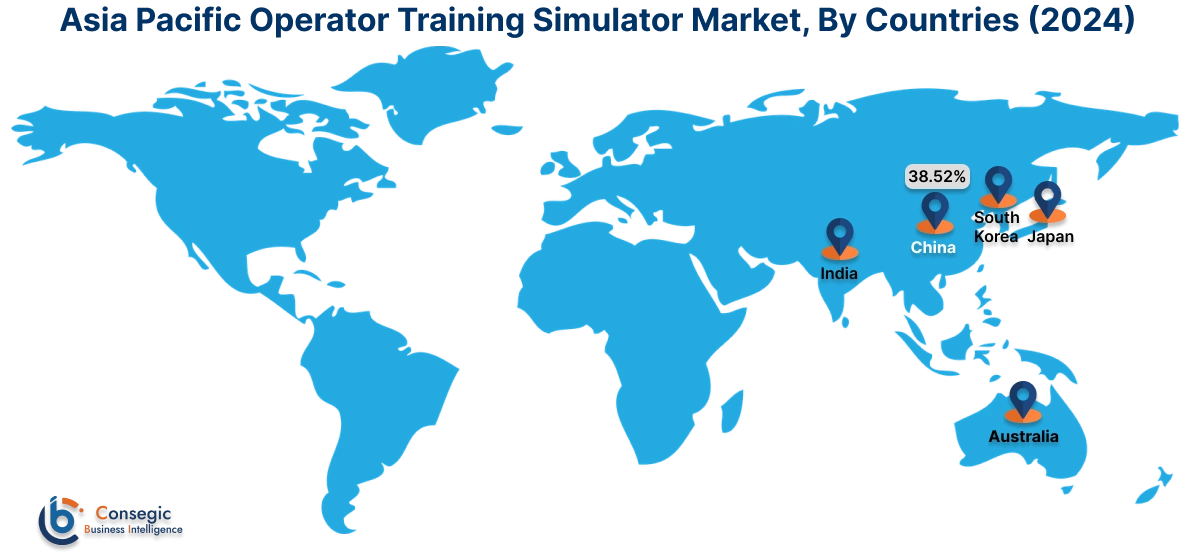
Asia Pacific region was valued at USD 2.72 Billion in 2024. Moreover, it is projected to grow by USD 2.99 Billion in 2025 and reach over USD 6.76 Billion by 2032. Out of this, China accounted for the maximum revenue share of 38.52%. The market in the region is growing due to the adoption of OTS systems in aerospace & defense, energy and power, chemical, and healthcare sectors. Moreover, the government investments in aerospace and defense sector in the region, leads to the operating training simulator market expansion.
- For instance, in March 2025, Zen Technologies secured a contract with Indian Defense Ministry. The company will provide an integrated air-defense combat simulator (IADCS) for the L70 gun system.
North America is estimated to reach over USD 10.50 Billion by 2032 from a value of USD 4.44 Billion in 2024 and is projected to grow by USD 4.86 Billion in 2025. The operating training simulator market analysis shows that the market is growing due to well-established aerospace & defense and healthcare industries that require advanced OTS systems for training and simulation purposes, in turn, driving the market growth.
- For instance, in September 2024, CAE secured a contract with the US States Navy under a U.S. Foreign Military Sales (FMS) program. The contract states to provide two training devices and support of training MH-60R Seahawk helicopter pilots and mission crew to the Indian Navy.
The operating training simulator market analysis depicts that in Europe, the market is driven due to wide adoption of OTS systems in petrochemical, chemical, and industrial applications. In Latin America, the market is growing due to well-established healthcare sector, and rising investments in advanced OTS systems for enhanced training programs in institutes and organizations. In Middle East and Africa, the market is primarily driven to rising adoption of OTS systems in the oil and gas sector, leading to the operating training simulator market expansion.
Top Key Players & Market Share Insights:
The operating training simulator industry is highly competitive with major players providing solutions to the national and international markets. Key players are adopting several strategies in research and development (R&D), product innovation, and end-user launches to hold a strong position in the global operating training simulator market. Key players in the operating training simulator industry include -
- DNV GL (Norway)
- Emerson Electric Co. (US)
- Applied Research Associates, Inc. (US)
- Aspen Technology Inc. (US)
- AVEVA Group Limited (UK)
- ESI Group (France)
- FLSmidth (Denmark)
- Honeywell International Inc. (US)
- ABB (Switzerland)
- ANDRITZ (Austria)
Recent Industry Developments :
Product Expansion:
- In March 2025, CM Labs expanded its simulation training portfolio by introducing single drummer roller simulation training pack. The pack includes comprehensive exercises, detailed metrics, and advanced features tailored for optimal learning.
Operating Training Simulator Market Report Insights:
| Report Attributes | Report Details |
| Study Timeline | 2019-2032 |
| Market Size in 2032 | USD 28.22 Billion |
| CAGR (2025-2032) | 12.7% |
| By Component |
|
| By Simulation Environment |
|
| By End User |
|
| By Region |
|
| Key Players |
|
| North America | U.S. Canada Mexico |
| Europe | U.K. Germany France Spain Italy Russia Benelux Rest of Europe |
| APAC | China South Korea Japan India Australia ASEAN Rest of Asia-Pacific |
| Middle East and Africa | GCC Turkey South Africa Rest of MEA |
| LATAM | Brazil Argentina Chile Rest of LATAM |
| Report Coverage |
|
Key Questions Answered in the Report
How big is the operating training simulator market? −
Operating Training Simulator Market size is estimated to reach over USD 28.22 Billion by 2032 from a value of USD 11.83 Billion in 2024 and is projected to grow by USD 12.98 Billion in 2025, growing at a CAGR of 12.7% from 2025 to 2032.
What are the major segments covered in the operating training simulator market report? +
The segments covered in the report are component, simulation environment, end user, and region.
Which region holds the largest revenue share in 2024 in the operating training simulator market? +
North America holds the largest revenue share in the operating training simulator market in 2024.
Who are the major key players in the operating training simulator market? +
The major key players in the market are DNV GL (Norway), Emerson Electric Co. (US), ESI Group (France), FLSmidth (Denmark), Honeywell International Inc. (US), ABB (Switzerland), ANDRITZ (Austria), Applied Research Associates, Inc. (US), Aspen Technology Inc. (US), and AVEVA Group Limited (UK).
Overview
Reputation & Certifications


Our Services
- Market Intelligence & Forecasting
- Custom Research Solutions
- Market Entry Strategy
- Competitive Intelligence
- Customer Insights
- Industry Innovation Analysis
- Investment Advisory