Jump to Content
Satellite Manufacturing Market - Size, Share, Industry Trends, and Forecasts (2025 - 2035)
What is Satellite Manufacturing and How Does It Work?
Satellite manufacturing is the development and production of artificial satellites that are used for communication, navigation, earth observation, and scientific research purposes. The satellite manufacturing system operates by designing, assembling, and integrating subsystems such as payloads, power units, and communication modules to deliver accurate data transmission. Satellites are made up of structural, electronic, and software components that provide real-time data, and signal processing to optimize operational efficiency.
In addition, the key factors driving the satellite manufacturing market include the growing demand for satellite-based communication services, and the need for reliable earth observation and navigation systems. Moreover, satellites offer several benefits, such as improved global connectivity, enhanced monitoring & surveillance, and ease of data collection.
Satellite Manufacturing Market Size:
- 2024 Market Size: USD 22.26 Billion
- 2025 Market Size: USD 25.85 Billion
- 2035 projected Market Size: USD 115.54 Billion
- CAGR (2025-2035): 16.15%
- Largest Market in 2025: North America
Key Industry Analysis:
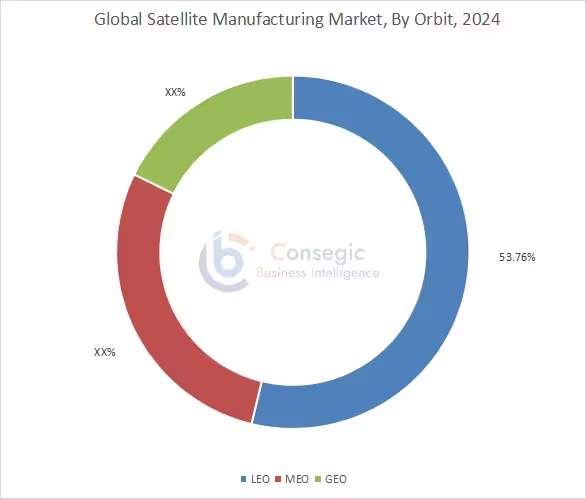
- LEO satellites led the market with a 53.76%share in 2024.
- Increasing global demand for satellite-based communication is driving the growth of satellite manufacturing market.
- Rapid increase in satellite launches is creating demand for the satellite manufacturing market.
- Rising global investment for space program creates opportunity for the market.
- Rapid growth of global space economy creates market opportunity.
- Asia Pacific satellite manufacturing market is anticipated to grow at the fastest CAGR during the forecast period.

Impact of Global Trends and Market Dynamics in the Satellite Manufacturing Market:
Increasing Global Demand for Satellite-Based Communication Drives Market Growth
The growing demand for the services provided by satellite-based communication systems around the globe is one of the key factors that is driving the adoption of the manufacturing of satellites. The space organizations are using the latest technology in the form of high throughput satellites and low earth orbit satellites to enhance the process of communication and the availability of data. For example, Indian Space Research Organisation (ISRO) launched two communication satellites GSAT-N2 in November 2024 and CMS-03 in November 2025.
Rapid Increase in Satellite Launches is Creating Demand for Satellite Manufacturing Market
The rise in the number of satellite launches is contributing to the growth of satellite manufacturing market. Space agencies, and defense organizations are launching satellites frequently to enhance their capabilities and strengthen global infrastructure. The high rate of satellite launches resulting the continuous satellite deployment and replacement, thereby driving the market growth.
As per the Indian Space Situational Assessment Report presented by ISRO, in 2024, a total of 261 satellite launch attempts were made globally, of which 254 were successful, resulting in the addition of 2578 operational satellites in orbit.
High Development Costs Limit Adoption of Satellite Manufacturing Market
The high cost associated with the development and manufacturing of satellites, including components, launch, and testing, is resulting in a slower rate of adoption for satellite manufacturing. In addition, the complexity involved in satellite design, assembly, and system integration is further contributing to rise in development cost. Moreover, budget-constrained organizations are facing financial limitations, technical expertise, and long development cycles, which are hindering the adoption of satellite manufacturing market.
Rising Global Investment in Space Programs to Create Opportunities for the Market
The increasing global investment in space programs is expected to provide significant growth opportunities to the satellite manufacturing market. The governments and organizations are investing heavily in the development of communication satellites and navigation satellites, to improve global connectivity and space-based monitoring solutions. Additionally, the rise of commercial space activities and the involvement of private companies are improving the use of advanced satellite manufacturing solutions.
For instance, the annual budget of NASA is expected to reach USD 27.47 billion by 2029 from USD 25.38 billion in 2024. This rising investment will fund various space missions including Artemis III in 2026 and Artemis IV in 2028.
Rapid Growth of Global Space Economy to Create Market Opportunities
The growth rate of the global space economy is expected to open new opportunities for the satellite manufacturing market. The governments and private players are increasing their involvement in various sectors such as communication, navigation, and earth observation, which improves global connectivity. In addition, the increasing commercialization of the space sector is pushing the faster development of advanced technologies for manufacturing satellites.
For instance, in 2025, Space Foundation reported that the global space economy reached USD 613 billion in 2024, recording 7.8% year-on-year growth. This reflects the increasing demand for space-based services and infrastructure, thereby driving the need for large-scale satellite production.
Segment-Wise Market Insights:
By Satellite Type:
The large satellites segment held the highest revenue share in 2024. Large satellites are the primary satellite type and help in delivering high-capacity communication, navigation, and earth observation services. Also, the growing deployment of large communication satellites for broadcasting and defense applications is driving segment dominance.
The nano satellites segment is anticipated to exhibit the highest CAGR during the forecast period. Nano satellites help in cost-effective deployment and flexible mission capabilities, which is increasing their adoption. Also, the rising demand for satellite constellations for broadband internet and earth observation is fueling the adoption of nano satellites.
By Application:
The communication segment contributed the highest revenue share in 2024. Communication satellites are the primary application and help in delivering television broadcasting, broadband internet, and mobile communication services. Also, the growing demand for high-speed internet and global connectivity is driving demand for communication satellites.
The earth observation segment is projected to grow at the highest CAGR during the forecast period. Earth observation satellites help in environmental monitoring, disaster management, and surveillance, which is increasing their adoption. In addition, the rising demand for climate monitoring and resource management is fueling the adoption of earth observation satellites.
By Orbit:
The LEO segment was responsible for the highest revenue share of 53.76% in 2024. LEO satellites are lower earth orbit satellites, that helps in providing broadband internet, Earth observation, and communication services. Moreover, the growing demand for low-latency communication and high-speed data transmission is driving segment dominance.
The MEO segment is anticipated to grow at the highest CAGR during the forecast period. MEO satellites help in navigation, positioning, and communication services, which is increasing their adoption. Additionally, the rising demand for accurate navigation and positioning systems is fueling the adoption of MEO satellites.
By Subsystem:
The payloads segment accounted for the highest revenue share in 2024. Payloads are the primary functional subsystem that helps in performing mission-specific operations such as communication, imaging, and signal transmission. Also, the growing demand for high-performance communication and imaging systems is driving segment dominance.
The solar panels segment is anticipated to exhibit the highest CAGR during the forecast period. Solar panels provide reliable power supply for satellite operations, which is increasing their adoption. Furthermore, the rising demand for energy-efficient and long-lasting satellites is fueling the adoption of advanced solar panel technologies.
Regional Market Overview:
The study covers key geographic markets including North America, Europe, Asia Pacific, Latin America, and the Middle East & Africa.
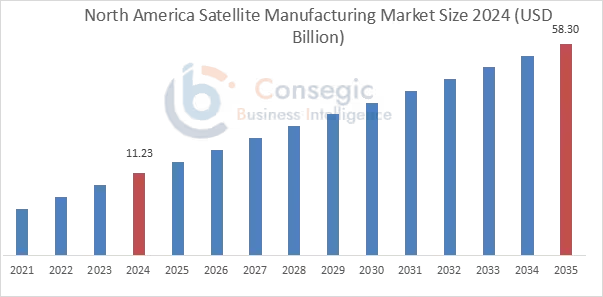
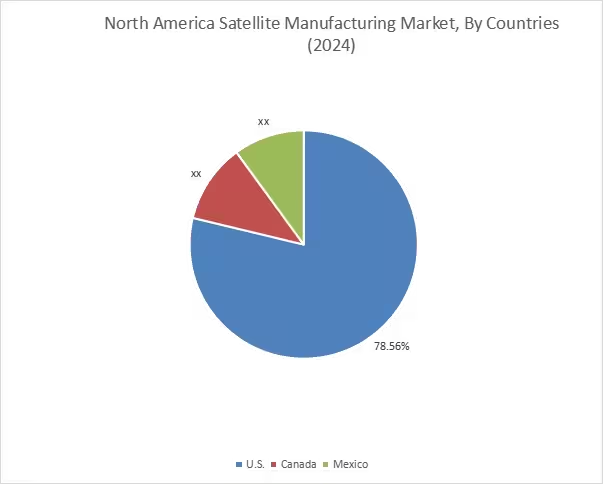
North America held the highest share in the global market in 2024, accounting for around 50.45% share, with a valuation of USD 11.23 Billion and is expected to reach USD 58.30 Billion by 2035. The US was the highest contributor in North America region, accounting for around 78.56% share in the base year. The market growth is primarily driven by presence of major satellite manufacturers, and government investments in space technology. In addition, the presence of major space organizations such as NASA and SpaceX is boosting the growth of satellite manufacturing market.
For example, in March 2026, the O3b mPOWER satellites developed by Boeing, have entered into commercial service which enhance global connectivity with advanced software-defined capabilities. This rising demand for communication satellite further drives the market growth.
Asia Pacific is forecasted to experience the fastest growth rate during the forecast period due to the increasing investments in national space programs and the requirement for communication and earth observation satellites. Additionally, countries such as China, India, and Japan are investing in the development of satellites to enhance communication infrastructure.
For instance, in July 2025, ISRO partnered with NASA to launch NISAR on July 30 2025. It inspects the globe to provide all-weather, day-and-night data for ground deformation monitoring, ice sheet tracking, shoreline mapping, and disaster response. The partnership between major space companies further drives the demand for satellite manufacturing market.
Companies & Market Share Analysis:
The satellite manufacturing market is highly competitive at the global level, with leading space technology providers and aerospace companies offering solutions for government and commercial applications. The companies operating in the market are providing a wide range of solutions such as communication satellites, earth observation satellites, and navigation satellites. In addition, companies are using strategies such as innovation in satellite technologies, partnerships, mergers and acquisitions to gain a competitive advantage.
Major companies operating in the satellite manufacturing market include
- SpaceX
- Airbus SE
- Lanteris Space Systems
- The Boeing Company
- Surrey Satellite Technology Ltd.
- Planet Labs PBC
- MDA Space Ltd.
- Dhruva Space Private Limited
- Thales Alenia Space
- Lockheed Martin Corporation.
Latest Developments in the Industry:
- In February 2026, SpaceX acquired xAI to build a highly integrated technology platform that brings together artificial intelligence, rocket launch capabilities, satellite internet services, and direct-to-device communication systems to accelerate innovation in space operations and global digital connectivity.
- In August 2025,Boeing delivered the Satelit Nusantara Lima communications satellite to PT Pasifik Satelit Nusantara to provide high-capacity connectivity for PSN users across Indonesia and Southeast Asia.
- In April 2024, Airbus successfully launched the EUTELSAT 36D telecommunication satellite into geostationary orbit using a Falcon 9 rocket. The satellite is intended to provide TV broadcasting and government communication services to Africa, Europe, and the surrounding regions for a period of over 15 years.
Satellite Manufacturing Market Report Insights:
| Report Attributes | Report Details |
|---|---|
| Study Timeline | 2024-2035 |
| Market Size in 2035 (USD Billion) | USD 115.54 Billion |
| CAGR (2025-2035) | 16.15% |
| By Satellite type |
|
| By Application |
|
| By Orbit |
|
| By Subsystem |
|
| By Region |
|
| Key Players |
|
| Report Coverage |
|
Key Questions Answered in the Report
How big is the satellite manufacturing market? −
Satellite Manufacturing market size is estimated to reach over USD 115.54 Billion by 2035 from a value of USD 22.26 Billion in 2024 and is projected to grow by USD 25.85 Billion in 2025, growing at a CAGR of 16.15% from 2025 to 2035.
Which segmentation details are covered in the satellite manufacturing report? +
The satellite manufacturing report includes specific segmentation details for satellite type, application, orbit, subsystem, and regions.
Which is the fastest segment anticipated to impact the market growth? +
In the satellite manufacturing market, the earth observation segment is the fastest-growing segment during the forecast period, due to the rising demand for climate monitoring and resource management.
Who are the major players in the satellite manufacturing market? +
The key participants in the satellite manufacturing market are SpaceX (US), Airbus SE (France), Lanteris Space Systems (US), The Boeing Company (US), Surrey Satellite Technology Ltd. (UK), Planet Labs PBC (US), MDA Space Ltd. (Canada), Dhruva Space Private Limited (India), Thales Alenia Space (France), and Lockheed Martin Corporation (US), and others.
What are the key trends in the satellite manufacturing market? +
The satellite manufacturing market is shaped by key trends including the increasing global demand for satellite-based communication.
Overview
Reputation & Certifications


Our Services
- Market Intelligence & Forecasting
- Custom Research Solutions
- Market Entry Strategy
- Competitive Intelligence
- Customer Insights
- Industry Innovation Analysis
- Investment Advisory