Jump to Content
Solar Panels Market - Size, Share, Industry Trends, and Forecasts (2025-2032)
Solar Panels Market Size:
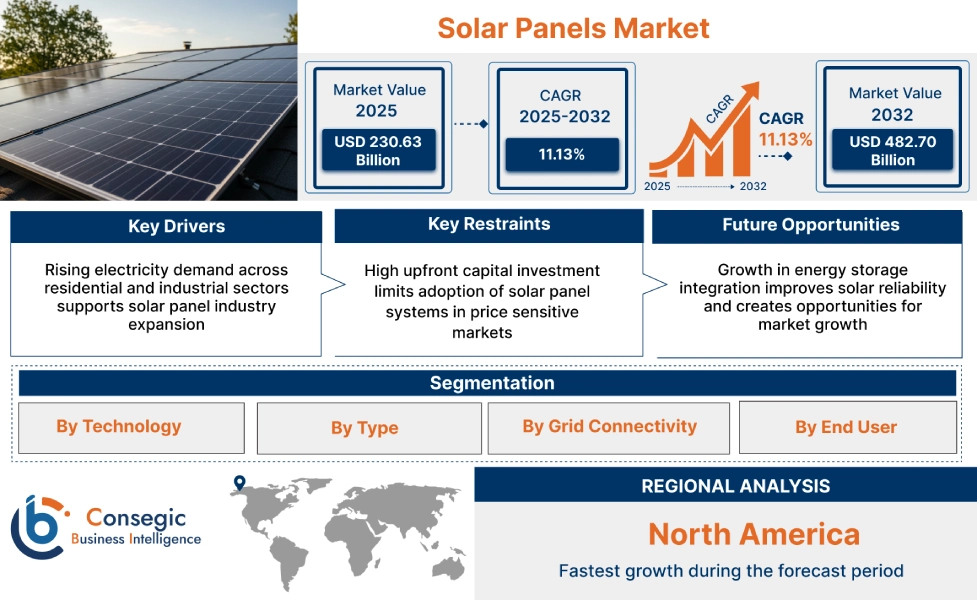
Solar Panels Market size is estimated to reach over USD 482.70 Billion by 2032 from a value of USD 207.16 Billion in 2024 and is projected to grow by USD 230.63 Billion in 2025, growing at a CAGR of 11.13% from 2025 to 2032
Solar Panels Market Scope & Overview:
Solar panels are renewable energy resources that use photovoltaic technology to turn sunlight into electricity in order to facilitate clean electricity production. The solar panel system functions by capturing solar radiation through photovoltaic cells, converting it into direct current electricity, and supplying power through inverters and grid integration systems for end use. The system combines modules, mounting structures, inverters, and monitoring software that enable efficient energy generation, performance tracking, and long-term operational management across rooftops, solar farms, and distributed energy projects to improve energy reliability and cost control.
Further, the key drivers that are contributing to the growth of the solar panels market include the increasing demand for clean energy, favorable government initiatives, and decreasing installation costs. Additionally, solar panel technology has various advantages, including low electricity bills, reduced carbon emissions, low maintenance costs, and a long lifespan. The solar panels market is experiencing steady growth due to these fundamental energy transformation trends.
Solar Panels Market Dynamics - (DRO):
Key Drivers:
Rising electricity demand across residential and industrial sectors supports solar panel industry expansion
The rising demand for electricity in the residential and industrial sectors is driving the adoption of solar panel systems to cater to the rising demands for electricity. The fast pace of urbanization and industrialization is putting pressure on the traditional power infrastructure, which is fueling the adoption of solar power as a decentralized source of electricity. Moreover, large commercial and industrial setups are adopting solar power solutions to control their electricity bills in the long run. The solar panels industry is witnessing expansion in response to these demand-side factors.
- In February 2026, the IEA expects the world’s electricity demand to expand by 3.5% per year until 2030, which is equivalent to the consumption of two European Unions.
Thus, the solar panels market is undergoing growth due to the increasing demand for electricity in the residential as well as industrial sectors.
Key Restraints:
High upfront capital investment limits adoption of solar panel systems in price sensitive markets
The initial installation cost of solar panels, including the cost of modules, inverters, installation, and grid connection, is hindering the growth of the solar panels market in cost-sensitive markets. The financial constraints faced by residential customers and small businesses are causing delays in project implementation. Furthermore, the costs of installation, approval, and maintenance are adding to the total project cost, which is impacting the return on investment in some areas.
Therefore, the solar panels industry is being constrained by high upfront capital investment requirements.
Future Opportunities:
Growth in energy storage integration improves solar reliability and creates opportunities for market growth
The increasing integration of battery energy storage systems with solar installations is improving power reliability and addressing intermittency concerns. Storage technologies enable surplus energy utilization during non-sunlight hours, which enhances system efficiency and grid stability. In addition, commercial and utility scale developers are adopting hybrid solar plus storage projects to strengthen energy management capabilities. This integration trend is expanding the practical application scope of solar power across multiple end use segments.
- For instance, TotalEnergies plans to build 5–7 GW of battery storage capacity by 2030, primarily in Europe and the US, through its subsidiaries Saft Groupe and Kyon Energy to strengthen its stationary energy storage portfolio.
Hence, the expansion of energy storage integration is expected to create additional deployment opportunities for the solar panels industry during the forecast period.
Solar Panels Market Segmental Analysis:
By Technology:
On the basis of technology, the solar panels market is segmented into solar PV and concentrated solar power.
Trends in the Technology:
- The declining cost of photovoltaic modules is supporting large scale Solar PV deployment.
- The increasing demand for utility scale renewable projects is strengthening Solar PV installations across major markets.
The solar PV was responsible for the highest revenue share in 2024.
- Solar PV systems are amenable to modularization in rooftop and ground-mounted applications.
- Moreover, lower capital costs compared to thermal-based systems make investments more feasible.
- In addition, faster project development cycles facilitate quicker commissioning
- Further, well-established global supply chains guarantee access to equipment.
- Furthermore, favorable policies for distributed generation make it more attractive.
- Thus, solar PV dominance is driven by scalability, cost efficiency, and supply chain maturity.
It is anticipated that the concentrated solar (CSP) power will exhibit the highest compound annual growth rate (CAGR) during the forecast period.
- CSP enables integrated thermal storage for extended power generation hours.
- Moreover, increasing demand for dispatchable renewable energy is supporting project approvals.
- In addition, high irradiation regions are attracting utility backed CSP developments.
- Further, grid stability requirements are encouraging hybrid renewable configurations.
- Furthermore, long duration energy supply capability supports peak load management.
- Therefore, the focus on firm renewable power supply is accelerating CSP growth.
By Type:
On the basis of type, the solar panels market is segmented into thin film and crystalline.
Trends in the type:
- Efficiency improvements in crystalline silicon modules are strengthening demand.
- Application specific demand is supporting thin film penetration in niche markets.
The crystalline was responsible for the highest revenue share in 2024.
- Higher energy conversion efficiency improves power output per square meter.
- Moreover, proven durability supports long operational life cycles.
- In addition, wide installer familiarity reduces project execution risk.
- Further, strong residential and commercial rooftop demand sustains volume growth.
- Furthermore, large scale manufacturing capacity supports cost competitiveness.
- Hence, performance reliability and manufacturing scale are supporting crystalline segment dominance.
It is anticipated that the thin film will exhibit the highest compound annual growth rate (CAGR) during the forecast period.
- Flexible structure supports integration in lightweight installations.
- Also, improved performance in low light conditions enhances application range.
- Moreover, reduced material usage supports cost control in selective deployments.
- Additionally, increasing use in building integrated photovoltaic projects expands demand.
- Furthermore, emerging research in efficiency enhancement is strengthening future prospects.
- Therefore, evolving application scope is supporting thin film segment expansion.
By Grid Connectivity:
On the basis of grid connectivity, the market is divided into on-grid and off-grid.
Trends in the Grid Connectivity:
- Expansion of net metering frameworks is supporting grid connected systems.
- Energy access initiatives are encouraging decentralized off-grid installations.
On-Grid represented the highest revenue share in 2024.
- Direct connection to utility networks enables power export mechanisms.
- Also, net metering improves economic returns for consumers.
- Moreover, urban infrastructure development supports grid linked installations.
- In addition, lower battery dependency reduces overall system cost.
- Furthermore, commercial and industrial facilities prefer grid integrated systems for stability.
- Thus, infrastructure availability and financial incentives are sustaining on-grid dominance.
The off-grid is expected to have the highest compound annual growth rate (CAGR) during the forecast period.
- Remote and rural electrification programs are increasing adoption.
- Moreover, integration with battery storage enhances system reliability.
- In addition, the growing demand for energy independence supports standalone systems.
- Further, disaster resilient power solutions are driving interest in isolated setups.
- Furthermore, microgrid development initiatives are strengthening decentralized generation.
- Therefore, rising decentralized energy demand is accelerating off-grid growth.
By End User:
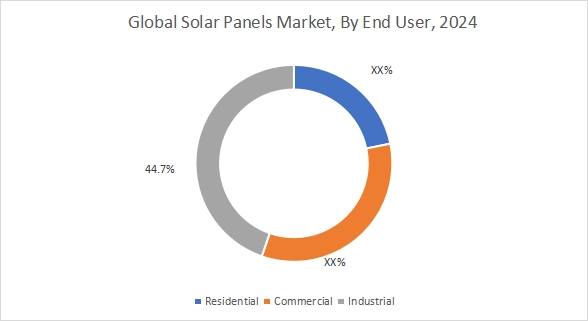
On the basis of end user, the solar panels market is divided into residential, commercial, and industrial.
Trends in the End User:
- Rising electricity tariffs are encouraging solar investments across user categories.
- Corporate decarbonization targets are supporting clean energy procurement.
Industrial accounted for the largest revenue share of 44.7% in the year 2024.
- High energy consumption supports large capacity installations.
- Also, captive solar projects improve long term cost visibility.
- Moreover, availability of large rooftop and land area enables scale deployment.
- Further, power purchase agreements strengthen financial planning.
- Furthermore, grid demand charges encourage onsite renewable generation.
- Hence, operational cost control requirements are supporting industrial segment dominance.
Residential is anticipated to register the fastest CAGR during the forecast period.
- Government subsidy schemes are improving homeowner affordability.
- Also, financing options are supporting rooftop adoption.
- Moreover, increasing consumer awareness regarding clean energy strengthens uptake.
- In addition, smart energy monitoring tools improve household energy management.
- Furthermore, urban housing expansion increases rooftop installation potential.
- For example, in November 2025, Galo Solar has introduced a new range of solar inverters tailored for Indian households to support residential renewable energy adoption and improve system performance.
- Therefore, supportive policy and rising household energy demand are accelerating residential growth.
Regional Analysis:
North America, Europe, Asia Pacific, the Middle East and Africa, and Latin America are the regions of coverage.
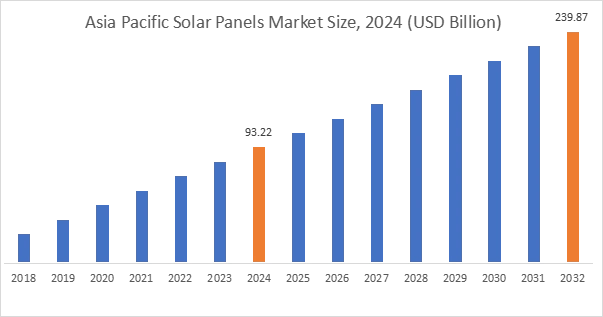
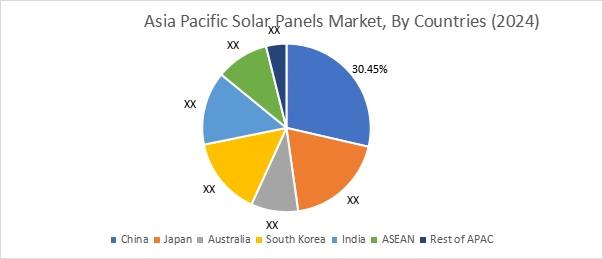
Asia Pacific region was valued at USD 93.22 billion in 2024. Furthermore, it is expected to increase steadily during the forecast period. China accounted for the highest revenue share 30.45%. Market growth is driven by large scale solar capacity installations supported by government renewable energy targets and domestic manufacturing strength. In addition, strong policy frameworks and utility scale project development are supporting regional dominance. Other countries such as India, Japan, and Australia are expected to contribute to regional demand during the forecast period.
- According to Source of Asia, the renewable energy market in Southeast Asia is expanding steadily, as electricity demand across ASEAN increases by 3–4% annually and governments raise investment in clean power. Regional renewable capacity is projected to reach 124.6 GW in 2025 and grow to 178.1 GW by 2030, reflecting a 7.4% annual growth rate.
North America solar panels market is driven by federal tax incentives, corporate renewable procurement, and large-scale utility solar projects in the US and Canada. Manufacturing investments supported by clean energy legislation are fueling domestic solar panel production capacity expansion.
- For instance, the U.S. Department of Energy implemented solar manufacturing and deployment incentives in 2024 under programs funded through the Bipartisan Infrastructure Law and the Inflation Reduction Act. These programs provide financial support for domestic solar module production, supply chain expansion, and large-scale project deployment, driving panel manufacturing and installation activity across the US.
Europe solar panels market is driven by decarbonization targets, energy diversification strategies, and expansion of rooftop solar installations across Germany, Spain, Italy, and France. Policy-backed renewable auctions and grid integration programs are fueling consistent project pipelines across EU member states.
Latin America solar panels market is driven by strong solar irradiation levels, competitive project economics, and expanding utility-scale projects in Brazil, Chile, and Mexico. Power purchase agreements and auction-based procurement systems are fueling steady solar capacity additions across the region.
Middle East and Africa market is expected to register significant growth during the forecast period. This is due to the increasing investment in utility-scale solar parks and the shift from fossil fuel-based power production. Furthermore, the high solar irradiation level and the support of the government’s renewable energy strategy are also contributing factors to the growth of this market.
- In January 2026, Engie and Khazna Energy started the construction of a 30 MW solar PV project in the UAE. The project aims to provide clean energy and support the UAE’s renewable energy goals.
Top Key Players & Market Share Insights:
The global solar panels market is moderately competitive, with major players producing solar panels and components for solar systems in the domestic as well as international markets. Moreover, players in the solar panels market are also concentrating on capacity enhancement, technological advancements, partnerships, and supply agreements to enhance their market position. Key participants in the market for solar panels include:
- JinkoSolar Holding Co., Ltd.– China
- Trina Solar Co., Ltd.– China
- LONGi Green Energy Technology Co., Ltd.– China
- Canadian Solar Inc. – Canada
- JA Solar Technology Co., Ltd. – China
- First Solar, Inc. – US
- Hanwha Qcells Co., Ltd. – South Korea
- Risen Energy Co., Ltd. – China
- TCL Zhonghuan Renewable Energy Technology Co., Ltd. – China
- Adani Green Energy Limited – India
Recent Industry Developments:
Product Launches
- In February 2026, JinkoSolar has launched a new dust-resistant solar module with a 3D dust-repellent design and self-cleaning nano-coating to improve the efficiency of power generation compared to traditional solar panels.
- In February 2026, Zelestra has launched a 9.5 MW agrivoltaic solar project in Sicily under a long-term power purchase agreement, combining agricultural use with renewable energy generation to optimize land value and support sustainable power supply.
- In February 2026, Evecon and Mirova’s Baltic Renewable Energy Platform has launched Estonia’s largest solar-plus-storage hybrid project by combining a 77.5 MWp solar plant with a 55 MW/250 MWh BESS and signing the Baltics’ first long-term flexibility and power purchase agreement to support grid stability and renewable integration.
Solar Panels Market Report Insights:
| Report Attributes | Report Details |
|---|---|
| Study Timeline | 2019-2032 |
| Market Size in 2032 (USD Billion) | USD 482.70 Billion |
| CAGR (2025-2032) | 11.13% |
| By Technology |
|
| By Type |
|
| By Grid Connectivity |
|
| By End User |
|
| By Region |
|
| Key Players |
|
| Report Coverage |
|
Key Questions Answered in the Report
How big is the solar panels market? −
The solar panels market size is estimated to reach over USD 482.70 Billion by 2032 from a value of USD 207.16 Billion in 2024 and is projected to grow by USD 230.63 Billion in 2025, growing at a CAGR of 11.13% from 2025 to 2032.
Which segmentation details are covered in the solar panels report? +
The solar panels report includes specific segmentation details for technology, type, grid connectivity, end user, and regions.
Which is the fastest segment anticipated to impact the market growth? +
Off-grid solar systems are the fastest growing segment, driven by rising rural electrification programs and increasing demand for decentralized energy solutions.
Who are the major players in the solar panels market? +
The key participants in the solar panels marketare JinkoSolar Holding Co., Ltd. (China), Trina Solar Co., Ltd. (China), LONGi Green Energy Technology Co., Ltd. (China), Canadian Solar Inc. (Canada), JA Solar Technology Co., Ltd. (China), First Solar, Inc. (US), Hanwha Qcells Co., Ltd. (South Korea), Risen Energy Co., Ltd. (China), TCL Zhonghuan Renewable Energy Technology Co., Ltd. (China), Adani Green Energy Limited (India), and others.
What are the key trends in the solar panels market? +
The solar panels market is shaped by key trends including expansion of utility scale solar parks, integration of battery energy storage systems, growth in rooftop installations.
Overview
Reputation & Certifications


Our Services
- Market Intelligence & Forecasting
- Custom Research Solutions
- Market Entry Strategy
- Competitive Intelligence
- Customer Insights
- Industry Innovation Analysis
- Investment Advisory