Jump to Content
Maritime VSAT Market - Size, Share, Industry Trends, and Forecasts (2025 - 2032)
Maritime VSAT Market Size:
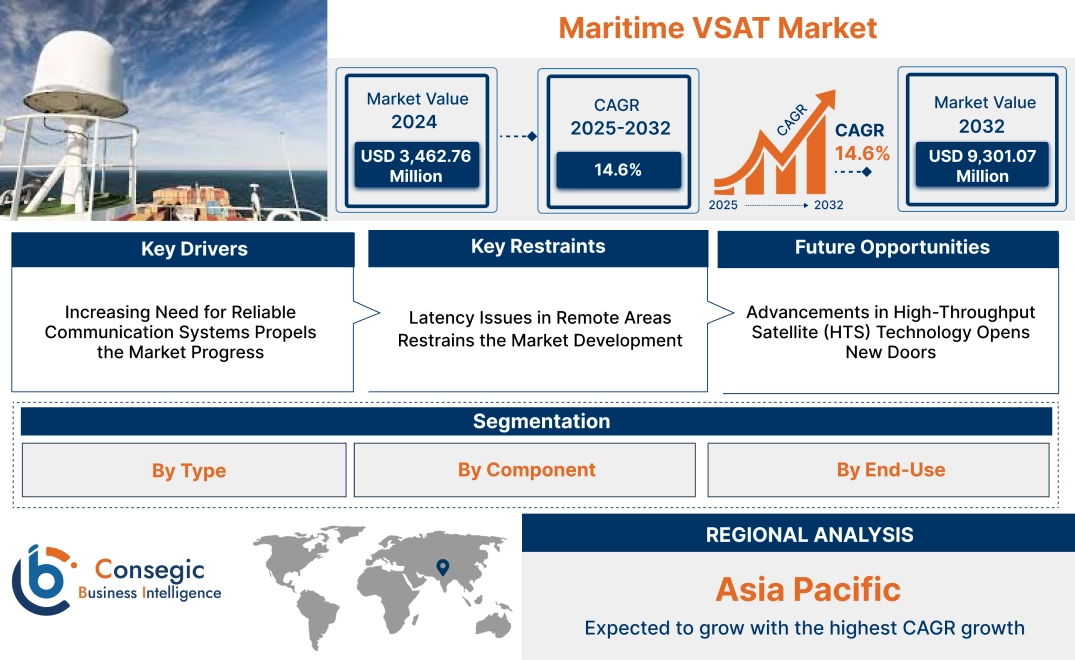
Maritime VSAT Market size is estimated to reach over USD 9,301.07 Million by 2032 from a value of USD 3,462.76 Million in 2024 and is projected to grow by USD 3,857.72 Million in 2025, growing at a CAGR of 14.6% from 2025 to 2032.
Maritime VSAT Market Scope & Overview:
Maritime VSAT (Very Small Aperture Terminal) systems provide satellite-based communication solutions for vessels, enabling reliable voice, data, and internet connectivity even in remote oceanic regions. These systems are essential for ensuring seamless communication between ships, ports, and onshore facilities, supporting operational efficiency and crew welfare in the maritime sector. They are widely deployed across commercial shipping, fishing vessels, and naval operations.
Maritime VSAT systems include antennas, modems, and satellite transceivers designed to operate efficiently under challenging sea conditions. These systems provide high-speed broadband connectivity, supporting applications such as navigation updates, real-time monitoring, and entertainment services for crew members. The integration of advanced technologies ensures uninterrupted and secure communication, regardless of the vessel's location.
End-users include shipping companies, offshore oil and gas operators, and naval forces seeking reliable communication solutions for operational and safety requirements. Maritime VSAT systems play a critical role in modernizing maritime connectivity and enhancing the efficiency of ocean-based operations.
Maritime VSAT Market Dynamics - (DRO) :
Key Drivers:
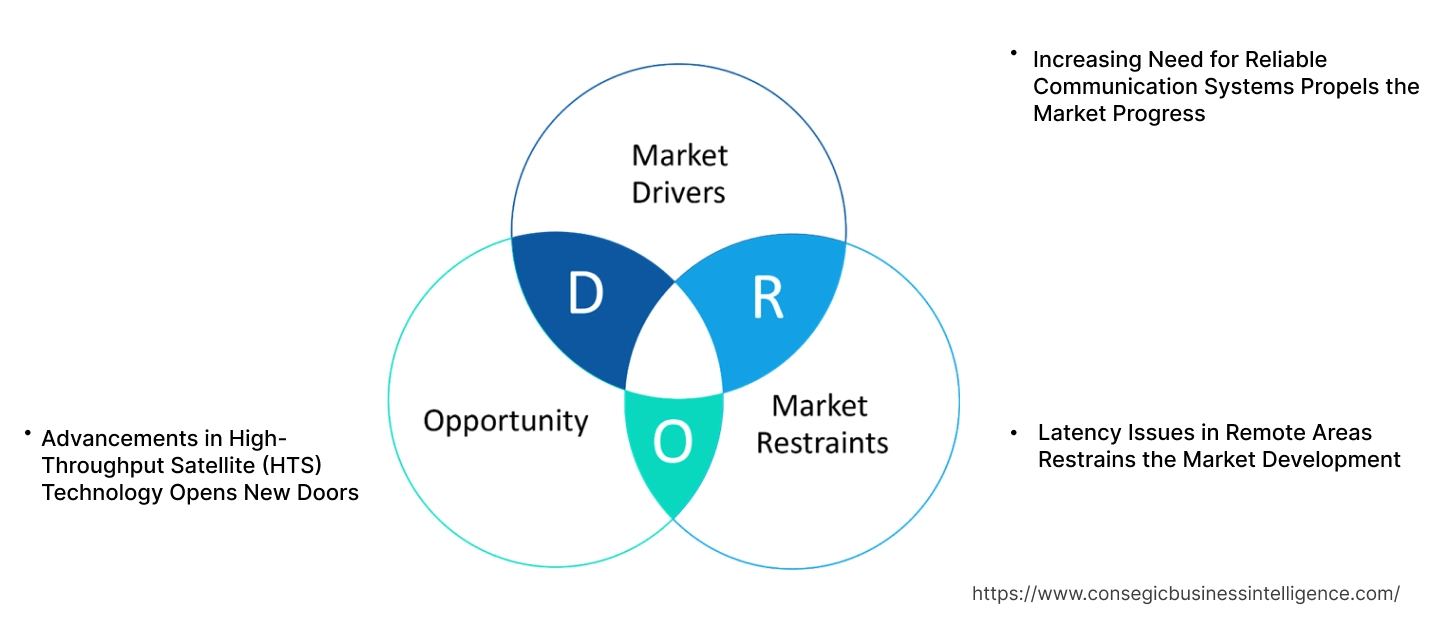
Increasing Need for Reliable Communication Systems Propels the Market Progress
As the maritime sector continues to grow, reliable communication systems have become a critical requirement for efficient operations. Navigation, crew welfare, and operational processes rely heavily on seamless data exchange. VSAT solutions provide uninterrupted connectivity for voice, data, and video communication, ensuring that maritime vessels maintain real-time communication regardless of location. These systems are particularly vital for shipping, offshore exploration, and passenger vessels, where operational safety and efficiency are paramount.
Recent advancements in satellite technology, including high-throughput satellites (HTS), have significantly increased data capacity and speed, further enhancing the performance of VSAT networks. This improvement enables the adoption of advanced digital applications, such as IoT systems and real-time tracking, across the maritime industry. As a result, the demand for robust and high-performance VSAT solutions continues to rise, supporting the sector's growing need for reliable and efficient communication infrastructure. Thus, the aforementioned factors are driving the maritime VSAT market growth.
Key Restraints:
Latency Issues in Remote Areas Restrains the Market Development
VSAT technology offers extensive global coverage, making it indispensable for maritime communication. However, latency remains a significant constraint, particularly in remote areas far from terrestrial infrastructure. The geostationary satellite systems commonly used in VSAT solutions introduce delays due to the long distances signals must travel between Earth and satellites. This high latency negatively impact the performance of time-sensitive applications, such as VoIP, video conferencing, and real-time data monitoring.
For critical maritime operations, where timely communication is crucial, latency issues hinder decision-making and operational efficiency. Industries such as offshore exploration and emergency response are particularly affected, as these sectors rely heavily on seamless, low-latency communication, further hindering the maritime VSAT market demand. Despite advancements in satellite technology, addressing latency restraints remains essential to fully unlock the potential of VSAT systems in maritime applications.
Future Opportunities :
Advancements in High-Throughput Satellite (HTS) Technology Opens New Doors
High-Throughput Satellite (HTS) technology is revolutionizing the satellite communication landscape by providing significantly higher data capacity compared to traditional satellites. By utilizing spot beam technology and frequency reuse techniques, HTS systems deliver enhanced bandwidth efficiency and faster data speeds. This advancement has made satellite connectivity more cost-effective, allowing operators to offer affordable services across various sectors, including maritime, aviation, and remote enterprise networks.
HTS technology is particularly valuable in underserved and remote regions where terrestrial communication infrastructure is limited or non-existent. For the maritime industry, HTS enables improved onboard connectivity for crew welfare, navigation, and operational efficiency. The reduced cost per bit and increased capacity offered by HTS are driving its adoption, creating maritime VSAT market opportunities for expanding communication services globally while addressing the growing demand for high-speed internet in remote and challenging environments.
Maritime VSAT Market Segmental Analysis :
By Type:
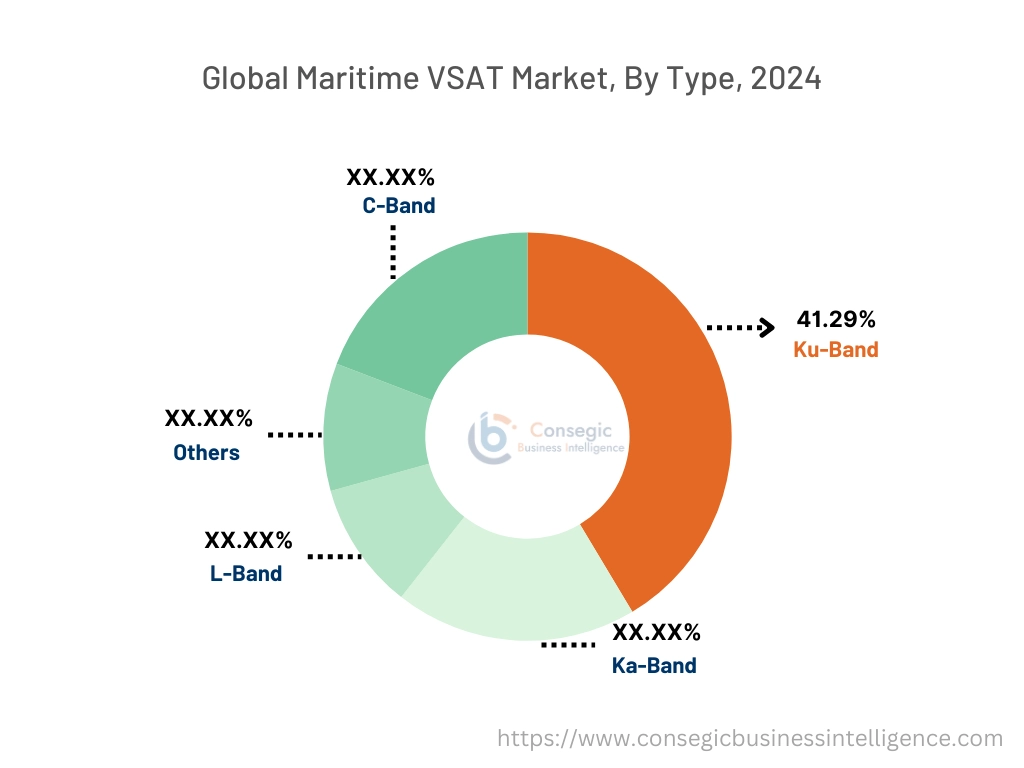
Based on type, the market is segmented into C-Band, Ku-Band, Ka-Band, L-Band, and others.
The Ku-Band segment accounted for the largest revenue of 41.29% of the total maritime VSAT market share in 2024.
- Ku-Band is widely used for maritime VSAT due to its balanced bandwidth and coverage, making it ideal for commercial shipping and passenger vessels.
- Its capability to provide seamless connectivity for communication and data-intensive applications positions it as the preferred choice for many operators.
- Increasing deployment in both developed and developing maritime economies is further enhancing the segment's adoption.
- As per segmental trends analysis, the dominance of Ku-Band reflects its suitability for high-speed data transfer and efficient global coverage, contributing to the maritime VSAT market expansion.
The Ka-Band segment is expected to grow at the fastest CAGR during the forecast period.
- Ka-Band offers higher data speeds and enhanced satellite efficiency, supporting growing demand for advanced maritime communication solutions.
- Its ability to support video streaming, real-time navigation, and IoT-based monitoring in naval operations is driving adoption.
- Emerging innovations in Ka-Band technology for reduced latency and improved coverage are expected to fuel the segment's expansion.
- As per the maritime VSAT market trends, the segment's growth is further attributed to increasing investments in next-generation satellite systems.
By Component:
Based on components, the market is segmented into antennas, modems, power supply units, network management systems, and others.
The antennas segment accounted for the largest revenue of the total maritime VSAT market share in 2024.
- Antennas are a critical component in maritime VSAT systems, enabling reliable satellite communication and data transfer.
- Continuous advancements in antenna design, including compact and lightweight models, enhance their deployment on various vessel types.
- High adoption across both commercial and military vessels ensures the segment’s significant contribution to market revenue.
- As per the maritime VSAT market analysis, the dominance of antennas is also supported by the rising need for robust communication systems in remote and offshore maritime operations.
The network management systems segment is projected to grow at the fastest CAGR during the forecast period.
- These systems provide efficient monitoring and management of maritime communication networks, ensuring uninterrupted service.
- The increasing reliance on real-time analytics and intelligent troubleshooting to enhance maritime operations supports the segment's growth.
- Adoption of network management systems is rising due to the growing importance of integrated communication solutions for optimized fleet performance.
- Thus, the segment's extension is also driven by advancements in software-defined networking technologies, further fueling the maritime VSAT market growth.
By End-Use:
Based on end-use, the market is segmented into military and civil.
The civil segment held the largest revenue share in 2024.
- Civil applications, including commercial shipping, leisure vessels, and offshore platforms, account for the widespread adoption of maritime VSAT systems.
- The segment's dominance is supported by rising need for seamless connectivity for crew welfare, navigation, and operational efficiency.
- Growing deployment of VSAT systems in passenger vessels to meet entertainment and communication needs further enhances its adoption.
- The maritime VSAT market trends indicate significant investments in upgrading communication infrastructure for civil maritime applications.
The military segment is expected to grow at the fastest CAGR during the forecast period.
- Military applications of maritime VSAT focus on secure communication, real-time situational awareness, and mission-critical data sharing.
- Increasing adoption of advanced satellite technologies for naval fleets drives the growth of this segment.
- The segment's progress is supported by rising defense budgets and initiatives to enhance maritime security capabilities globally.
- As per analysis, the military segment is poised to witness robust growth due to increasing reliance on VSAT systems for enhanced operational efficiency, driving the maritime VSAT market demand.
Regional Analysis:
The regions covered are North America, Europe, Asia Pacific, the Middle East and Africa, and Latin America.
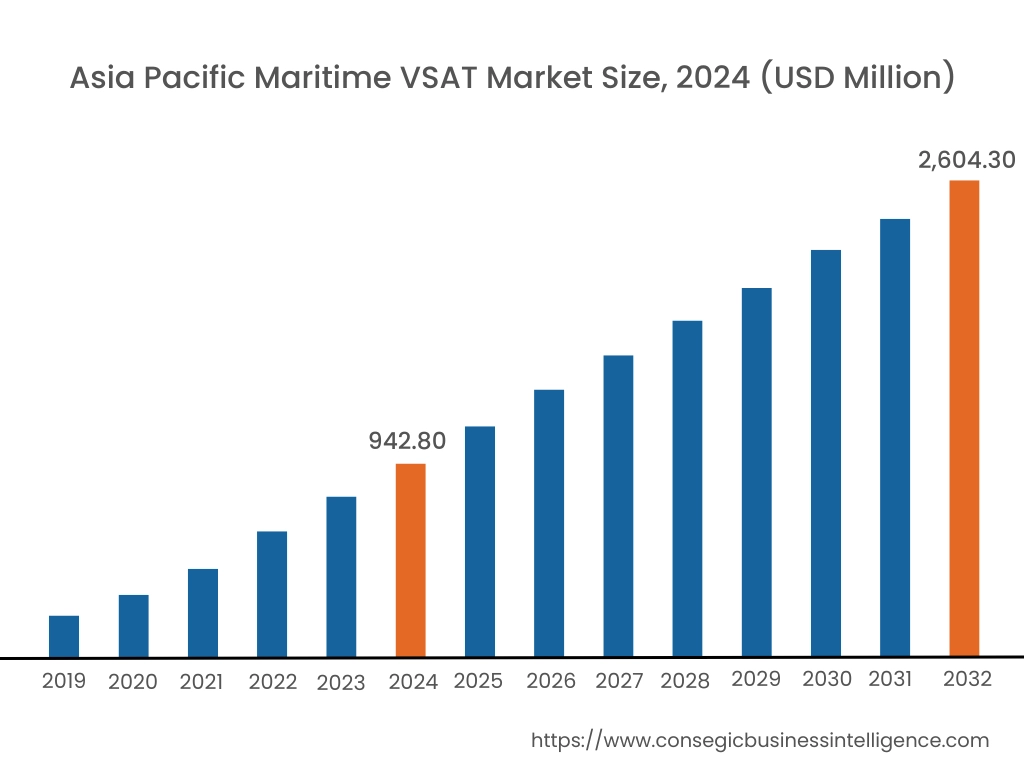
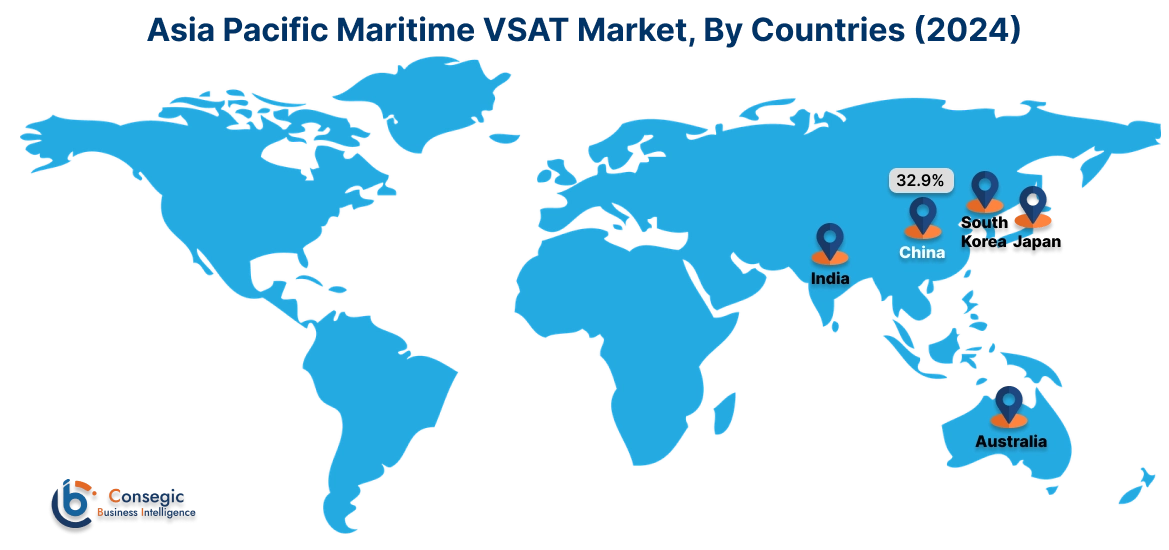
Asia Pacific region was valued at USD 942.80 Million in 2024. Moreover, it is projected to grow by USD 1,052.82 Million in 2025 and reach over USD 2,604.30 Million by 2032. Out of this, China accounted for the maximum revenue share of 32.9%. The Asia-Pacific region is witnessing rapid growth in the maritime VSAT market, propelled by the enlargement of the shipping industry and increasing demand for digitalization. Countries such as China, Japan, and South Korea are investing in sophisticated surveillance and tracking systems to enhance maritime domain awareness. A prominent trend is the adoption of unmanned aerial vehicles (UAVs) and automated surveillance systems to monitor vast maritime zones effectively. Analysis suggests that technological advancements and government initiatives aimed at strengthening maritime security infrastructure are key factors influencing the maritime VSAT market expansion in this area.
North America is estimated to reach over USD 2,986.58 Million by 2032 from a value of USD 1,121.20 Million in 2024 and is projected to grow by USD 1,248.22 Million in 2025. This region maintains a significant share of the maritime VSAT market, driven by the need for reliable communication solutions from the U.S. Navy and commercial shipping companies. A notable trend is the integration of advanced satellite communication technologies to enhance operational efficiency and crew welfare. Analysis indicates that the presence of major maritime security solution providers and system integrators in North America continues to drive technological innovation and upgrades in this sector, creating significant maritime VSAT market opportunities.
Europe's mature maritime industry has led to a high adoption rate of VSAT services among major shipping companies and government agencies. As per the maritime VSAT market analysis, the region's focus on maintaining secure maritime borders has led to investments in advanced screening, scanning, and communication technologies. A significant trend is the collaboration among European Union member states to develop integrated maritime security strategies, promoting information sharing and coordinated responses to maritime threats.
The Middle East is experiencing steady growth in the maritime VSAT market, driven by the demand for VSAT connectivity from naval and commercial shipping sectors. Investments in maritime security solutions, including radar systems and long-range acoustic devices, are part of broader efforts to combat piracy and ensure safe navigation. In Africa, the maritime security market is gradually evolving, with a focus on addressing challenges such as illegal fishing and smuggling. The analysis of market trends indicate that international collaborations and capacity-building initiatives are playing a crucial role in enhancing maritime security capabilities across the continent.
Latin America is witnessing a growing market for maritime VSAT services, as shipping companies upgrade their connectivity to improve operational efficiency and safety. Nations such as Brazil and Mexico are investing in surveillance and tracking technologies to monitor and secure their maritime domains. A notable trend is the emphasis on developing integrated coastal surveillance systems to detect and respond to illicit activities.
Top Key Players and Market Share Insights:
The Maritime VSAT market is highly competitive with major players providing products and services to the national and international markets. Key players are adopting several strategies in research and development (R&D), product innovation, and end-user launches to hold a strong position in the global Maritime VSAT market. Key players in the Maritime VSAT industry include -
- KVH Industries, Inc. (USA)
- Intelsat (USA)
- Viasat Inc. (USA)
- Iridium Communications Inc. (USA)
- Marlink AS (Norway)
- SES S.A. (Luxembourg)
- Cobham SATCOM (Denmark)
- Hughes Network Systems (USA)
- Speedcast International Limited (Australia)
- Inmarsat Global Limited (UK)
Recent Industry Developments :
Partnerships & Collaborations:
- In April 2024, Satcom Global partnered with Intelsat to enhance its AuraNow VSAT service, expanding Ku-band coverage with Intelsat's advanced satellite network. The agreement improves global maritime connectivity, covering new regions and doubling assets in areas like East Asia and the Atlantic. AuraNow offers flexible, uncapped bandwidth and a 24-hour contract commitment, supporting dynamic maritime needs. Intelsat’s FlexMaritime service ensures reliable, high-speed connectivity for vessels, meeting growing operational and crew communication requirements. This collaboration reinforces the focus on providing seamless, adaptable connectivity for maritime operators worldwide.
Maritime VSAT Market Report Insights :
| Report Attributes | Report Details |
| Study Timeline | 2019-2032 |
| Market Size in 2032 | USD 9,301.07 Million |
| CAGR (2025-2032) | 14.6% |
| By Type |
|
| By Component |
|
| By End-Use |
|
| By Region |
|
| Key Players |
|
| North America | U.S. Canada Mexico |
| Europe | U.K. Germany France Spain Italy Russia Benelux Rest of Europe |
| APAC | China South Korea Japan India Australia ASEAN Rest of Asia-Pacific |
| Middle East and Africa | GCC Turkey South Africa Rest of MEA |
| LATAM | Brazil Argentina Chile Rest of LATAM |
| Report Coverage |
|
Key Questions Answered in the Report
What is the size of the Maritime VSAT Market? −
The Maritime VSAT Market size is estimated to reach over USD 9,301.07 Million by 2032 from a value of USD 3,462.76 Million in 2024 and is projected to grow by USD 3,857.72 Million in 2025, growing at a CAGR of 14.6% from 2025 to 2032.
What are the key segments in the Maritime VSAT Market? +
The market is segmented by type (C-Band, Ku-Band, Ka-Band, L-Band, and others), component (antennas, modems, power supply units, network management systems, and others), and end-use (military and civil).
Which segment is expected to grow the fastest in the Maritime VSAT Market? +
The Ka-Band segment is expected to grow at the fastest CAGR during the forecast period, driven by its higher data speeds and ability to support advanced maritime communication needs like video streaming, real-time navigation, and IoT-based monitoring.
Who are the major players in the Maritime VSAT Market? +
Key players in the Maritime VSAT market include KVH Industries, Inc. (USA), Intelsat (USA), SES S.A. (Luxembourg), Cobham SATCOM (Denmark), Hughes Network Systems (USA), Speedcast International Limited (Australia), Inmarsat Global Limited (UK), Viasat Inc. (USA), Iridium Communications Inc. (USA), and Marlink AS (Norway).
Overview
Reputation & Certifications


Our Services
- Market Intelligence & Forecasting
- Custom Research Solutions
- Market Entry Strategy
- Competitive Intelligence
- Customer Insights
- Industry Innovation Analysis
- Investment Advisory