Jump to Content
Military Drone Market - Size, Share, Industry Trends, and Forecasts (2026-2034)
Military Drone Market Size :
Military Drone Market size is estimated to reach over USD 55.42 Billion by 2034 from a value of USD 18.74 Billion in 2025 and is projected to grow by USD 20.80 Billion in 2026, growing at a CAGR of 11.5% from 2026 to 2034.
Military Drone Market Key Takeaways
- Rising defense spending and surveillance needs are driving military drone demand.
- North America held a significant share, supported by advanced defense capabilities.
- Fixed-wing drones dominated due to their long endurance and reconnaissance capabilities.
- AI-enabled autonomy and swarm technologies are creating new growth opportunities.
- Intelligence, surveillance, and reconnaissance (ISR) remained key military applications.
- Northrop Grumman, Lockheed Martin, General Atomics, and Elbit Systems were major players.
Military Drone Market Scope & Overview:
A military drone, also known as an unmanned aerial vehicle (UAV), is an aircraft that operates without an onboard human pilot. It is guided by remote control or pre-programmed autonomous systems, primarily built for gathering intelligence, carrying out precision strikes, and conducting logistical operations without putting personnel at direct risk. Additionally, the market is driven by factors such as rising geopolitical tensions, increased defense budgets, rapid advancements in artificial intelligence (AI) and autonomy, and rising adoption of uncrewed systems for modern combat, reconnaissance, and border security.

Military Drone Market Dynamics - (DRO) :
Market Drivers:
Rising global geopolitical tensions and increased defense budgets are driving the market growth
Escalating global geopolitical tensions and increased defense budgets are among the key factors driving the military drone market. As nations face disputed borders and unconventional threats, governments worldwide are allocating a considerably larger share of their GDP to modernize armed forces, shifting focus heavily toward the procurement and research of advanced, cost-effective, and autonomous defense technologies. Instead of risking human lives in high-risk zones, military organizations increasingly rely on drones for conducting crucial operations such as intelligence, surveillance, and reconnaissance (ISR), border monitoring, electronic warfare, and precision-strike operations. Consequently, major military organizations are constantly investing in both domestic manufacturing and international contracts to ensure delivery of advanced drones for military operations, which is further driving the market.
- For instance, the general budget for the European Defence Agency was valued at approximately USD 66,686.20 thousand in 2025, witnessing an increase of 3% in comparison to USD 64,807.60 thousand in 2024.
Hence, the rising global geopolitical tensions and increased defense budgets are driving the military drone market size.
Market Restraints:
High initial investment and electronic warfare vulnerabilities are restraining the military drone market growth
The high initial investment associated with the development and deployment of military drones, along with electronic warfare vulnerabilities, are among the primary factors restricting the market growth. These drones involve the utilization of advanced technologies, including sensors, control units, stealth capabilities, and others. The cost of procuring these systems and integrating them can be significantly high. Moreover, the additional costs associated with the drone’s operation and maintenance can limit its adoption, particularly among developing nations and military & defense organizations operating within strict budgetary limits.
Further, modern military drones rely on wireless communication, GPS, and digital control links, which makes them highly vulnerable to sophisticated electronic warfare tactics, including signal jamming, spoofing, and cyber intrusions. Moreover, adversaries can exploit these technological gaps for hijacking navigation, corrupting mission data, or cutting communication lines, potentially resulting in the loss of valuable assets. Consequently, the above factors are hindering the military drone market expansion.
Future Market Opportunities :
Increasing technological advancements associated with defence drones are expected to drive the military drone market opportunities
Military drone manufacturers are frequently investing in the development of new products and solutions with updated features and technologies, such as AI, edge computing, and others, to ensure their safe and effective utilization in military and defence operations, thereby offering lucrative prospects for market growth.
The integration of artificial intelligence (AI) and edge computing enables autonomous target recognition and real-time decision-making, while drone swarm technology allows coordinated strikes that can overwhelm adversary air defenses. These capabilities also reduce human troop exposure in hostile environments while offering significant tactical advantages. In addition, modern developments in stealth materials, cyber-hardened electronics, and long-endurance hybrid propulsion systems enable persistent intelligence, surveillance, and reconnaissance (ISR) across vast airspaces and maritime channels.
- For instance, in 2025, Helsing, a German defense firm, announced its aim of producing 6,000 AI-guided HX-2 attack drones for Ukraine. Capable of reaching speeds up to 220 km/h with a 12 kg payload, the HX-2 drone uses advanced AI for autonomous targeting, allowing it to bypass electronic warfare jamming and function in extreme weather.
Hence, as per the analysis, the above factors are anticipated to boost the market opportunities during the forecast period.
Military Drone Market Segmental Analysis:
By Product Type:
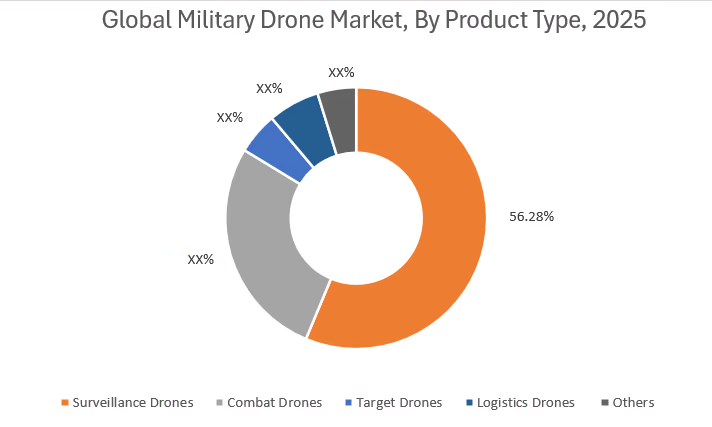
Based on the product type, the market is segmented into surveillance drones, combat drones, target drones, logistics drones, and others.
Trends in the product type:
- The rapid modernization of defense forces along with the rising demand for secure, cost-effective border monitoring are key trends driving the adoption of surveillance drones.
- There is a rising trend towards utilization of logistics drones in the military & defense sector, driven by the need to efficiently transport vital equipment, ammunition, and medical supplies to remote or heavily disputed environments.
The surveillance drones segment accounted for the largest revenue share of 56.28% in the market in 2025.
- Surveillance drones, also known as intelligence, surveillance, and reconnaissance (ISR) UAVs, play a crucial role in modern armed forces.
- Surveillance drones are equipped with advanced sensors, including high-resolution optical cameras, infrared (IR), and thermal imaging, which allow them to monitor specific territories or track enemy troop movements across hostile and inaccessible terrain.
- Moreover, surveillance drones also offer continuous, real-time visual data directly to command centers and ground troops.
- In addition, factors including the rapid modernization of defense forces, combined with the rising need for secure, cost-effective border monitoring, are driving the adoption of military surveillance drones.
- According to the military drone market analysis, the above factors are further propelling the market growth.
The logistics drones segment is anticipated to register the fastest CAGR during the forecast period.
- Military logistics drones are specialized unmanned aerial vehicles designed to autonomously or remotely transport mission-critical payloads like ammunition, medical supplies, and rations.
- Logistics drones provide a vital benefit by eliminating the need for manned ground convoys in hostile or hazardous terrain, which in turn helps in preventing human casualties and ensuring rapid, uninterrupted supply lines directly to forward-operating bases.
- Also, the segment is primarily driven by the need to efficiently transport vital equipment, ammunition, and medical supplies to remote or heavily disputed environments, combined with an increase in global defense spending and rising integration of AI for autonomous operation.
- Consequently, the above factors are anticipated to boost the market during the forecast period.
By Wing Type:
Based on wing type, the market is segmented into fixed-wing drones, rotary-blade drones, and hybrid drones.
Trends in the wing type:
- Increasing trend in utilization of fixed-wing drones, due to their higher speed capabilities, longer flight range, and greater payload capacity, is driving the market.
- Rising advancements associated with hybrid drones to provide extended flight times, versatile take-off and landing capabilities, and the ability to operate in rugged environments without requiring a runway are driving the market.
The fixed-wing drones segment accounted for the largest revenue share in the market in 2025.
- Military fixed-wing drones are unmanned aerial vehicles designed with rigid stationary wings that utilize aerodynamic lift rather than continuous vertical thrust.
- Fixed-wing drones offer several benefits such as exceptional long-range coverage, unmatched flight endurance, and superior payload capacity for intelligence, surveillance, and reconnaissance (ISR) and combat operations.
- For instance, Airbus offers fixed-wing airborne target UAVs in its defence product offerings, which are capable of simulating the complete engagement process from detection to action.
- Therefore, the aforementioned benefits of fixed-wing drones are further increasing its adoption in military operations, thereby driving the market.
The hybrid drones segment is anticipated to register the fastest CAGR growth during the forecast period.
- Hybrid drones combine features of multi-rotor and fixed-wing drones, in turn offering extended flight times, versatile take-off and landing capabilities, heavier payload capacity, and the ability to operate in rugged environments without needing a runway.
- Moreover, hybrid drones allow units to conduct persistent, long-range surveillance while retaining the flexibility to hover and land in confined spaces.
- Additionally, the ability to take off and land vertically, combined with the efficiency of fixed-wing flight, enables deployment of hybrid drones in various terrains and environments, even in areas with limited space.
- Hence, the aforementioned factors are anticipated to drive the adoption of hybrid drones for military operations, in turn propelling the market during the forecast period.
By Operation Mode:
Based on operation mode, the market is segmented into remotely piloted, semi-autonomous, and fully autonomous.
Trends in the operation mode:
- The market is propelled by escalating geopolitical conflicts, increasing need for enhanced border security, along with rising demand for real-time intelligence, surveillance, and reconnaissance (ISR) capabilities.
- The fully autonomous drones segment is mainly driven by advancements in artificial intelligence (AI), machine learning, and the growing need for rapid decision-making and precision strikes in contested environments.
The remotely piloted segment accounted for the largest revenue in the military drone market share in 2025.
- Remotely piloted defence drones are uncrewed aerial vehicles (UAVs) controlled by operators from a ground station or command center through secure communication links.
- They offer several benefits such as minimizing human risk in hostile zones, delivering extended, persistent surveillance over vast territories, and executing highly precise targeting while maintaining lower operational costs than manned aircraft.
- Moreover, rapid technological advancements in artificial intelligence (AI), machine learning, and secure communication systems enable remotely piloted drones to operate deeper in contested environments while minimizing risks to human personnel.
- Therefore, the above factors are driving the adoption of remotely piloted defence drones, in turn propelling the market growth.
The fully autonomous segment is anticipated to register the fastest CAGR during the forecast period.
- Fully autonomous defence drones are equipped with artificial intelligence (AI) which allows them to search for, identify, and engage targets without human intervention.
- Unlike remotely piloted drones, which rely on a human operator to make the final strike decision, autonomous drones are capable of processing battlefield data onboard to execute missions independently.
- Moreover, key factors driving the segment include critical enhancements in AI and sensor integration, which enable real-time threat detection and autonomous target engagement with minimal human intervention.
- In addition, escalating global geopolitical tensions and the proven combat utility of unmanned systems in modern conflicts are also driving governments worldwide to significantly increase defense budgets and procure next-generation autonomous platforms.
- Hence, the above factors are anticipated to boost the market during the forecast period.
By End User:
Based on end use, the market is segmented into intelligence, surveillance & reconnaissance (ISR), precision strike & combat operations, electronic warfare & cyber operations, search and rescue (SAR), logistics & supply drops, and others.
Trends in the end use:
- The market is driven by key factors such as rising defense budgets, increasing demand for real-time, risk-free battlefield data, combined with constant advancements in AI, miniaturized sensors, and extended-range communication for facilitating autonomous, long-range ISR missions.
- The segment is also driven by the growing demand to safely resupply frontline troops in contested environments without risking human personnel, combined with advancements in heavy-payload hybrid-VTOL technology, and increased defense budgets, among others.
The intelligence, surveillance & reconnaissance (ISR) segment accounted for the largest revenue share in the market in 2025.
- Military UAVs serve a vital role in intelligence, surveillance, and reconnaissance (ISR) operations by gathering real-time data without putting human personnel at risk.
- The primary benefits of using military UAVs for ISR operations include prolonged loitering capabilities, covert monitoring through advanced thermal and optical sensors, along with rapid delivery of actionable intelligence to ground commanders.
- Moreover, the use of drones can significantly enhance situational awareness, while allowing military forces to track enemy movements, assess battle damage, and intercept communications with pinpoint accuracy.
- The segment is driven by rising defense budgets, increasing need for real-time, risk-free battlefield data, combined with constant advancements in AI, miniaturized sensors, and extended-range communication for facilitating autonomous, long-range ISR missions.
- According to the analysis, the aforementioned factors are driving the military drone market trends.
The logistics & supply drops segment is anticipated to register the fastest CAGR during the forecast period.
- Military UAVs are transforming supply chain operations by rapidly transporting critical payloads, such as medical supplies, ammunition, and rations, directly to the front lines or personnel operating in harsh environments.
- The use of drones for logistics operations helps in bypassing hazardous terrain and hostile ground threats, which in turn significantly reduces delivery times and keeps human personnel safe during high-risk resupply missions.
- The segment is driven by the need to safely resupply frontline troops in contested environments without risking human personnel, combined with advancements in heavy-payload hybrid-VTOL technology, and increased defense budgets, among others.
- Consequently, the aforementioned factors are projected to drive the market during the forecast period.
Military Drone Market Regional Analysis:
The regions covered are North America, Europe, Asia Pacific, Middle East and Africa, and Latin America.
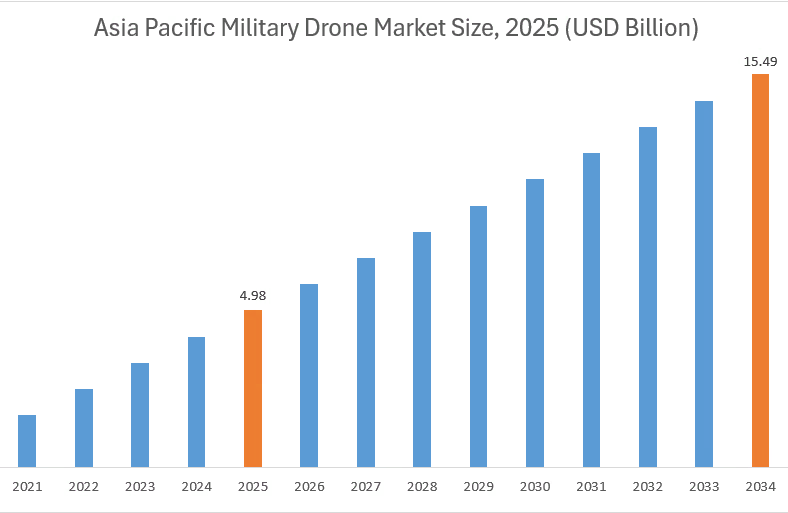
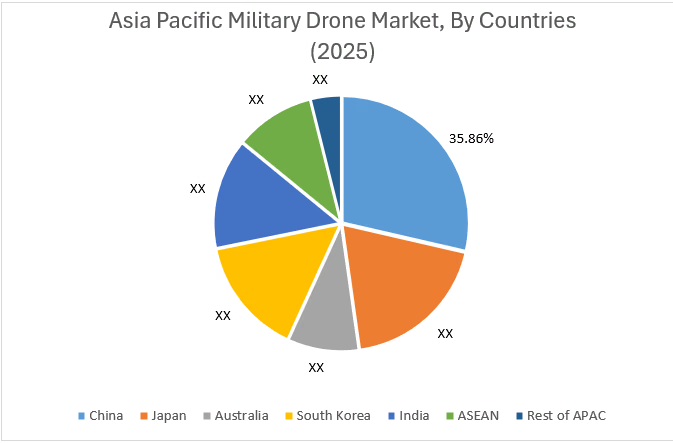
Asia Pacific region was valued at USD 4.98 Billion in 2025. Moreover, it is projected to grow by USD 5.56 Billion in 2026 and reach over USD 15.49 Billion by 2034. Out of this, China accounted for the maximum revenue share of 35.86%. As per the market analysis, the adoption of military UAVs in the Asia-Pacific region is primarily driven by the increasing geopolitical tensions, rising investments in the military & defense industry, and growing need to enhance military preparedness, among others. Additionally, factors such as the prevalence of active border security disputes and increasing domestic defense modernization initiatives are further accelerating the market expansion.
- For instance, India's Ministry of Defence (MoD) was allocated approximately USD 72.62 billion in the 2024-2025 Union Budget, an increase of around 18.35% as compared to the previous year. The above factors are further driving the adoption of military UAVs, thereby driving the market in the Asia-Pacific region.
North America is estimated to reach over USD 19.87 Billion by 2034 from a value of USD 6.78 Billion in 2025 and is projected to grow by USD 7.52 Billion in 2026. In North America, the military drone industry is mostly driven by the prevalence of substantial number of defense agencies and the growing military & defense industry, among others. Similarly, the increasing geopolitical tensions, rising government funding for military and defense modernizations, and the integration of artificial intelligence for autonomous swarming are further contributing to the military drone market demand.
- For instance, the United States dedicated approximately USD 919.2 billion to defense spending in 2025, accounting for 13% of the overall government budget. The above factors are expected to propel the market trends in North America during the forecast period.
Meanwhile, according to the regional analysis, factors including strategic initiatives to achieve defense sovereignty, advancements in AI and low-cost autonomous platforms, and growing demand for real-time military intelligence are driving the market in Europe. Furthermore, according to the market analysis, the market in Latin America, Middle East, and African regions is expected to grow at a considerable rate due to factors such as increasing geopolitical tensions, rising regional conflicts and security challenges, combined with growing need for enhanced border security and intelligence gathering capabilities.
Top Key Players & Market Share Insights:
The global military drone market is highly competitive, with major players providing solutions to the national and international markets. Key players are adopting several strategies in research and development (R&D), product innovation, and end-user launches to hold a strong position in the military drone market. Key players in the market include-
- Northrop Grumman Corporation (USA)
- Lockheed Martin Corporation (USA)
- General Atomics (USA)
- Elbit Systems Ltd. (Israel)
- BAYKAR TECH (Turkey)
- Airbus (France)
- AeroVironment Inc. (USA)
- Shield AI (USA)
- Anduril Industries (USA)
- Thales Group (France)
- Teledyne FLIR (USA)
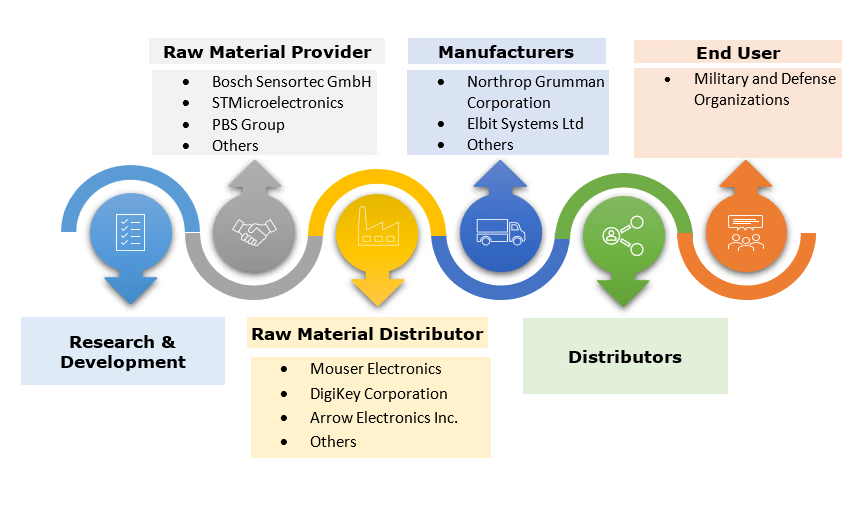
Military Drone Market Ecosystem:
Recent Industry Developments :
Partnership & Agreement:
- In May 2025, Diehl Defence strengthened its partnership with RV Connex, a defence and security company based in Thailand. RV Connex and Diehl Defence signed a contract for delivering target drones and related services for conducting live firing tests with IRIS-T air-to-air-missile from Diehl Defence.
Military Drone Market Report Insights :
| Report Attributes | Report Details |
|---|---|
| Study Timeline | 2021-2034 |
| Market Size in 2034 | USD 55.42 Billion |
| CAGR (2026-2034) | 11.5% |
| By Product Type |
|
| By Wing Type |
|
| By Operation Mode |
|
| By End Use |
|
| By Region |
|
| Key Players |
|
Key Questions Answered in the Report
How big is the military drone market? −
The military drone market was valued at USD 18.74 Billion in 2025 and is projected to grow to USD 55.42 Billion by 2034.
Which is the fastest-growing region in the market? +
Asia-Pacific is the region experiencing the most rapid growth in the market.
What specific segmentation details are covered in the military drone report? +
The military drone report includes specific segmentation details for product type, wing type, operation mode, end use, and region.
Who are the major players in the market? +
The key participants in the market are Northrop Grumman Corporation (USA), Lockheed Martin Corporation (USA), General Atomics (USA), Elbit Systems Ltd. (Israel), BAYKAR TECH (Turkey), Airbus (France), AeroVironment Inc. (USA), Shield AI (USA), Anduril Industries (USA), Thales Group (France), Teledyne FLIR (USA), and others.
Overview
Reputation & Certifications


Our Services
- Market Intelligence & Forecasting
- Custom Research Solutions
- Market Entry Strategy
- Competitive Intelligence
- Customer Insights
- Industry Innovation Analysis
- Investment Advisory