Jump to Content
Monolithic Microwave IC Market - Size, Share, Industry Trends, and Forecasts (2024 - 2031)
Monolithic Microwave IC Market Size:
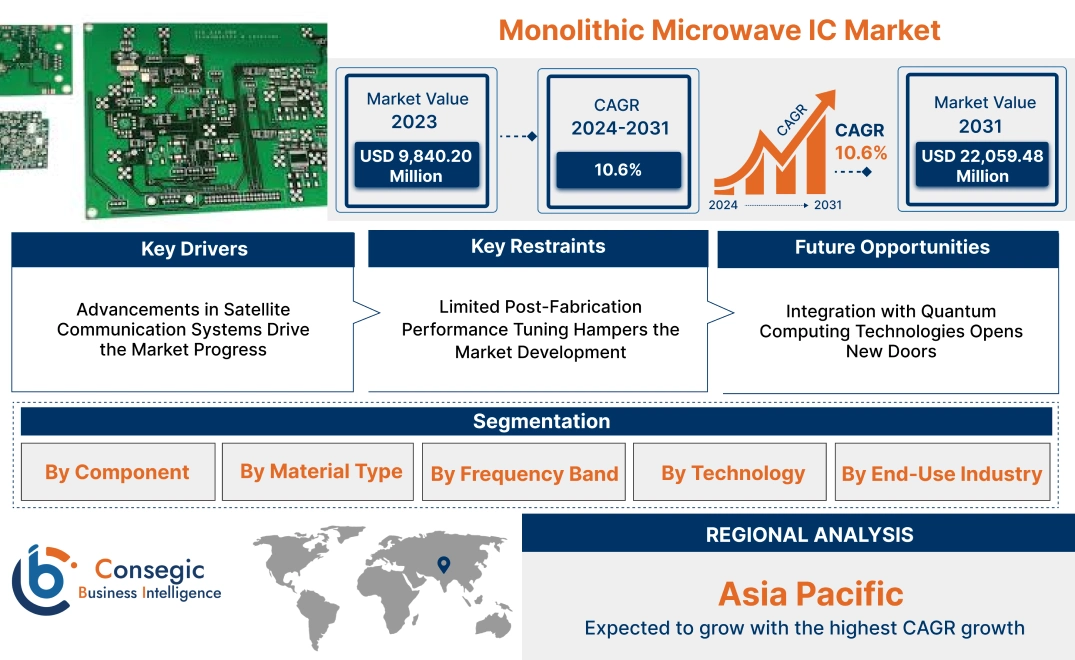
Monolithic Microwave IC Market size is estimated to reach over USD 22,059.48 Million by 2031 from a value of USD 9,840.20 Million in 2023 and is projected to grow by USD 10,709.68 Million in 2024, growing at a CAGR of 10.6% from 2024 to 2031.
Monolithic Microwave IC Market Scope & Overview:
Monolithic microwave integrated circuits (MMICs) are compact semiconductor devices that integrate multiple microwave and RF components onto a single chip. These circuits are designed for high-frequency applications, offering superior performance in terms of signal amplification, mixing, and transmission. MMICs are widely utilized in industries such as telecommunications, aerospace, defense, and automotive, where efficient and reliable high-frequency signal processing is essential.
MMICs are manufactured using advanced materials such as gallium arsenide (GaAs) or gallium nitride (GaN), enabling them to operate at high frequencies with minimal power consumption and heat generation. These circuits are employed in a variety of applications, including radar systems, satellite communications, wireless infrastructure, and electronic warfare systems. Their compact design and integration capabilities make them ideal for devices with stringent size and performance requirements.
End-users of MMICs include telecommunication service providers, defense organizations, and automotive manufacturers that require robust and efficient RF and microwave solutions. These integrated circuits play a vital role in advancing the capabilities of modern communication and signal processing systems.
Monolithic Microwave IC Market Dynamics - (DRO) :
Key Drivers:
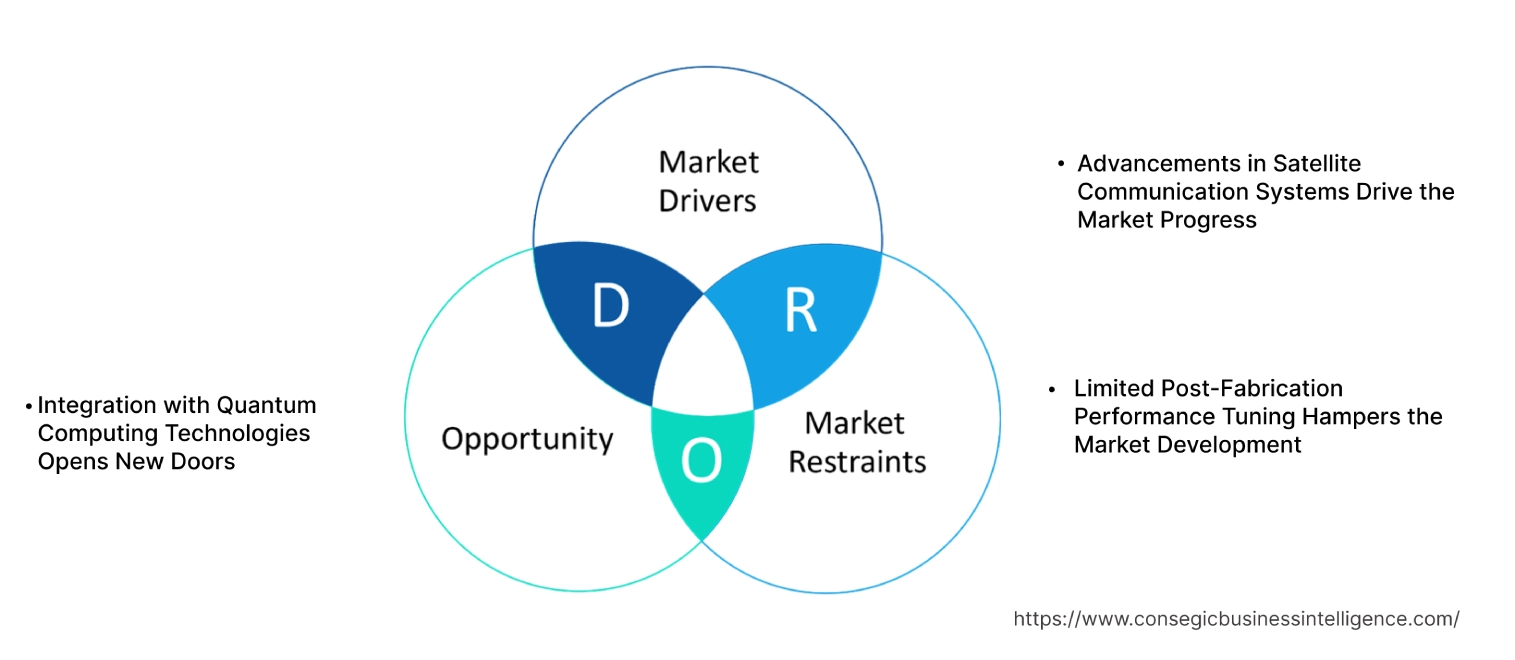
Advancements in Satellite Communication Systems Drive the Market Progress
Advancements in satellite communication systems are significantly driving the demand for high-performance integrated circuits. MMICs play a crucial role in enabling efficient RF signal amplification, transmission, and processing, making them integral components of modern satellite systems. The growing need for reliable and high-speed broadband internet, global positioning services, and communication networks is pushing the adoption of compact and high-efficiency MMIC designs.
Moreover, the rapid expansion of low-earth orbit (LEO) satellite constellations, aimed at providing global internet coverage and enhancing connectivity in remote areas, has amplified the need for innovative MMIC solutions. These ICs are designed to operate seamlessly in high-frequency environments, ensuring low signal loss and optimal performance under challenging conditions. As the satellite communication sector evolves, MMICs are expected to remain at the forefront of technological advancements, enabling next-generation applications in both commercial and defense sectors. Thus, the aforementioned factors are driving the monolithic microwave IC market growth.
Key Restraints :
Limited Post-Fabrication Performance Tuning Hampers the Market Development
One of the key limitations of MMICs is the inability to modify or tune their performance once the fabrication process is completed. Unlike discrete components, which are adjusted or replaced to optimize performance, MMICs are monolithic by design, meaning all components are integrated into a single chip. This lack of flexibility poses constraints in applications where precise performance adjustments are critical, such as high-frequency communications and advanced radar systems.
Any design flaw or performance inefficiency identified post-fabrication requires the entire chip to be redesigned and re-fabricated, leading to increased costs and extended development timelines. This limitation restricts the adoption of MMICs in scenarios demanding dynamic tuning capabilities or iterative development processes, impacting their competitiveness in certain high-precision and rapidly evolving markets. Thus, the above-mentioned factors limit the monolithic microwave IC market demand.
Future Opportunities :
Integration with Quantum Computing Technologies Opens New Doors
Quantum computing is rapidly advancing, requiring precise and efficient microwave signal processing to control and communicate with qubits. MMICs, with their ability to operate at high frequencies and their compact, monolithic design, are emerging as a key enabler in this field. Their high-frequency performance allows for accurate signal generation and transmission, which are essential for quantum operations like qubit initialization and error correction.
Additionally, their compact size is ideal for integration into the highly dense and complex architectures of quantum computing systems. As quantum technology progresses toward commercial viability, the demand for reliable and high-performance microwave ICs is expected to grow significantly. This integration represents a transformative opportunity for MMICs, positioning them as an essential component in the development of scalable and efficient quantum computing hardware. Therefore, the aforementioned factors are fueling the monolithic microwave IC market opportunities.
Monolithic Microwave IC Market Segmental Analysis :
By Component:
Based on components, the market is segmented into power amplifiers, low-noise amplifiers, mixers, oscillators, switches, and others.
The power amplifiers segment accounted for the largest revenue of the total monolithic microwave IC market share in 2023.
- Power amplifiers are widely adopted in telecommunications and defense systems due to their critical role in enhancing signal strength across high-frequency bands.
- Their application in 5G infrastructure and satellite communications contributes significantly to their market dominance.
- Advancements in GaN-based power amplifiers further enhance their performance, particularly in high-power and high-frequency applications.
- The dominance of this segment reflects the rising integration of power amplifiers in high-frequency systems for superior data transmission, driving the monolithic microwave IC market expansion.
The low noise amplifiers segment is expected to grow at the fastest CAGR during the forecast period.
- Low noise amplifiers are critical for applications requiring minimal signal distortion, such as satellite communication and medical imaging.
- Their adoption in high-frequency bands and evolving 5G networks drives their rapid growth.
- Integration into advanced radar systems further accelerates their market penetration.
- As per market trends, the proliferation of IoT devices and connected ecosystems significantly boosts the low noise amplifiers segment, contributing to the monolithic microwave IC market growth.
By Material Type:
Based on material type, the market is segmented into gallium arsenide (GaAs), gallium nitride (GaN), indium phosphide (InP), silicon (Si), and others.
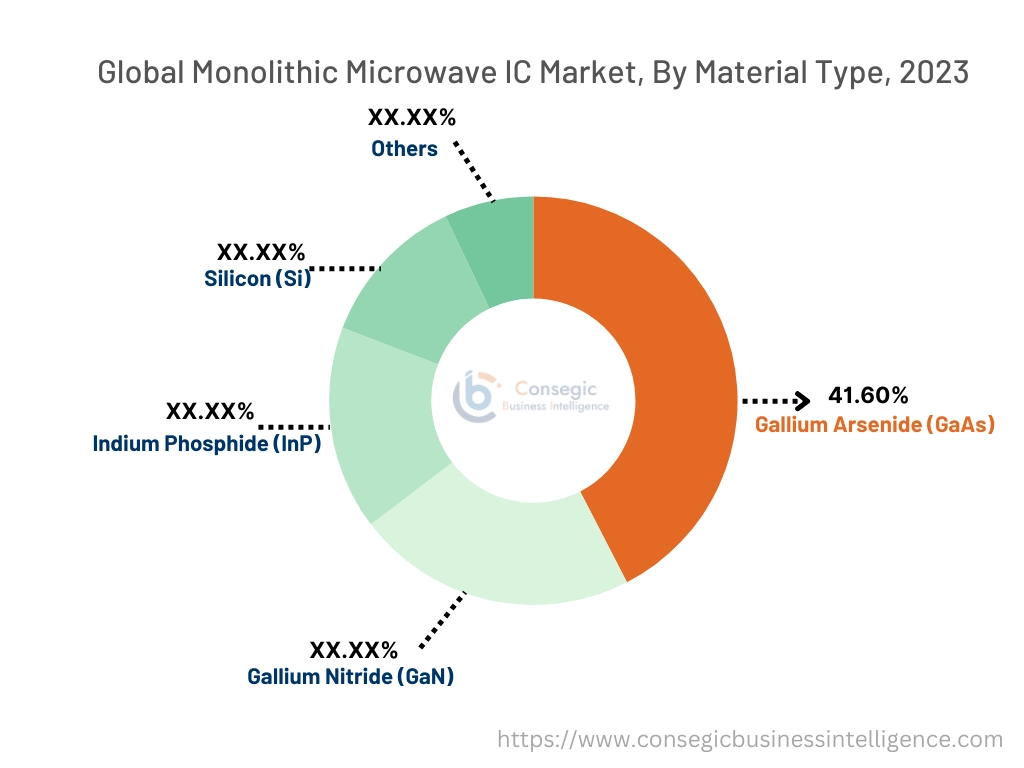
The Gallium arsenide segment accounted for the largest revenue of 41.60% of the total monolithic microwave IC market share in 2023.
- GaAs are extensively used in radar systems, satellite communications, and high-frequency applications due to their superior electron mobility.
- It dominates the market for consumer electronics and telecommunications due to its cost-efficiency and performance stability.
- The segment benefits from continued investment in advanced GaAs-based MMICs for military and space applications.
- As per the monolithic microwave IC market analysis, the widespread applicability of gallium arsenide across both commercial and defense industries ensures its leading position in the market.
The Gallium nitride segment is expected to grow at the fastest CAGR during the forecast period.
- GaN offers superior power efficiency and thermal stability, making it critical for next-generation 5G networks and defense applications.
- It is rapidly adopted in power amplifiers and RF systems for advanced telecommunications infrastructure.
- GaN-based innovations enhance the performance of radar systems and electronic warfare equipment, further driving its growth.
- As per market analysis, GaN’s extension is fueled by its ability to operate under extreme conditions while maintaining high performance, facilitating the monolithic microwave IC market demand.
By Frequency Band:
Based on frequency band, the market is segmented into L Band (1–2 GHz), S Band (2–4 GHz), C Band (4–8 GHz), X Band (8–12 GHz), Ku Band (12–18 GHz), K Band (18–27 GHz), Ka Band (27–40 GHz), V Band (40–75 GHz), and W Band (75–110 GHz).
The Ka Band (27-40 GHz) segment held the largest revenue share in 2023.
- Ka Band is extensively used in high-frequency satellite communications and radar systems due to its ability to transmit large volumes of data efficiently.
- The demand for Ka Band in military applications, such as surveillance and reconnaissance, contributes to its dominance.
- Its adoption in satellite TV broadcasting and internet services ensures sustained market leadership.
- As per the monolithic microwave IC market trends, the growing investment in space exploration and satellite-based communication drives its market position further.
The W Band segment is expected to grow at the fastest CAGR during the forecast period.
- The W Band is increasingly adopted in military systems and high-frequency scientific research due to its unmatched data transmission capabilities.
- Its application in advanced radar and high-speed wireless communication systems enhances its growth trajectory.
- The segment benefits from technological advancements that expand its utility in niche, high-performance applications.
- The rise in defense spending and adoption in aerospace further accelerates the growth of the W Band, encouraging the monolithic microwave IC market expansion.
By Technology:
Based on technology, the market is segmented into HEMT, pHEMT, HBT, MESFET, mHEMT, and MOS.
The HEMT segment accounted for the largest revenue share in 2023.
- HEMT technology is widely used in high-power amplification and low-noise applications for the defense and aerospace sectors.
- It ensures high-frequency operation, making it essential for satellite communications and advanced radar systems.
- The integration of HEMT in 5G infrastructure supports its market dominance.
- As per the monolithic microwave IC market analysis, the segment’s leadership is attributed to its high efficiency, reliability, and advanced performance characteristics.
The pHEMT segment is expected to grow at the fastest CAGR during the forecast period.
- PHEMT technology is increasingly adopted in 5G devices and IoT applications due to its high-frequency capabilities.
- Its suitability for compact, high-performance designs ensures widespread adoption in next-generation systems.
- The segment benefits from advancements in semiconductor manufacturing technologies, enhancing its performance metrics.
- The growing need for high-speed wireless communication accelerates the expansion of the pHEMT segment, creating significant monolithic microwave IC market opportunities.
By End-User Industry:
Based on end-user industry, the market is segmented into IT & telecom, automotive, healthcare, industrial, aerospace & defense, and others.
The IT & telecom segment accounted for the largest revenue share in 2023.
- The rising deployment of 5G infrastructure drives the adoption of MMICs for seamless connectivity and high-speed data transfer.
- IT & telecom relies heavily on MMICs for applications in base stations, satellite communications, and IoT devices.
- Investment in advanced telecommunication systems ensures the segment’s market leadership.
- As per the monolithic microwave IC market trends, the segment benefits from the increasing proliferation of connected devices and digital ecosystems.
The aerospace & defense segment is expected to grow at the fastest CAGR during the forecast period.
- Aerospace and defense industries extensively adopt MMICs in radar systems, electronic warfare, and satellite communications.
- High-frequency performance and reliability make MMICs indispensable in critical defense applications.
- Increased defense spending and advancements in electronic warfare systems fuel the growth of this segment.
- The analysis of segmental trends depicts that the integration of MMICs in military applications ensures sustained growth.
Regional Analysis:
The regions covered are North America, Europe, Asia Pacific, the Middle East and Africa, and Latin America.
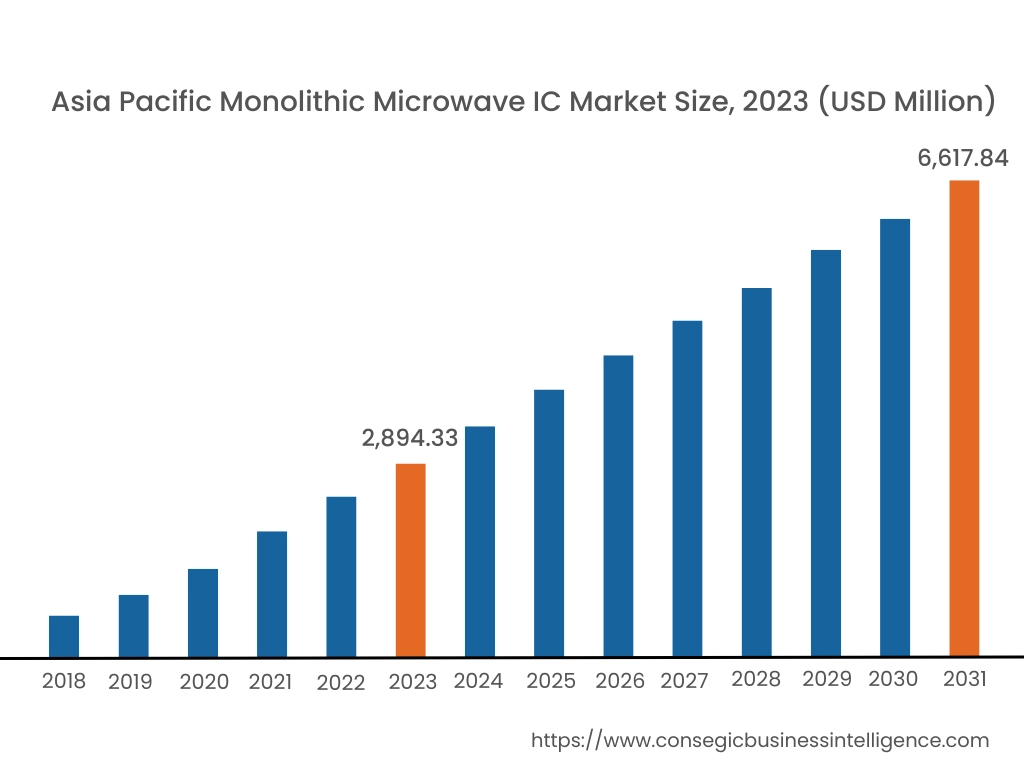
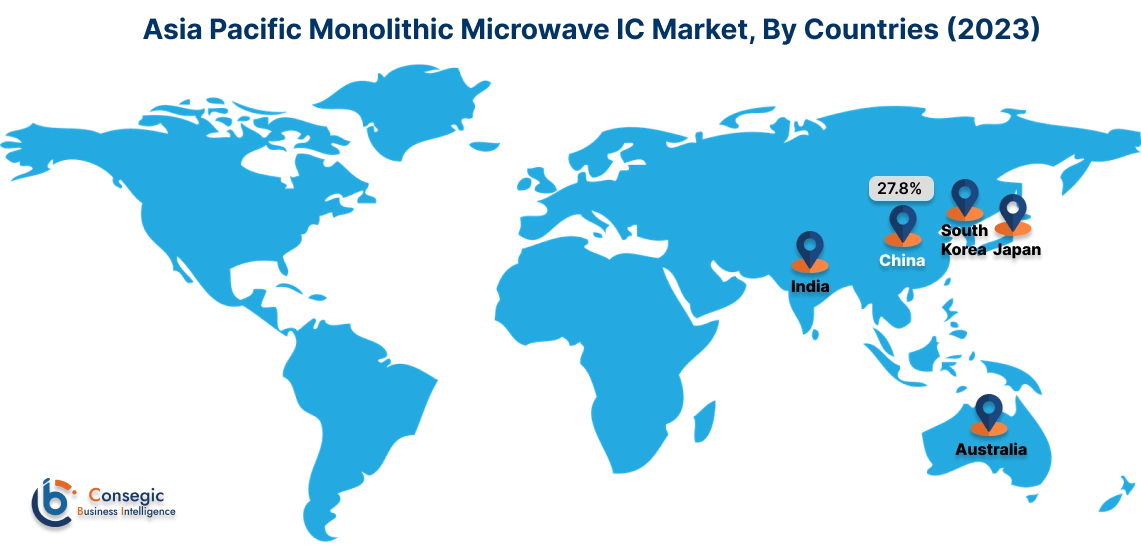
Asia Pacific region was valued at USD 2,894.33 Million in 2023. Moreover, it is projected to grow by USD 3,155.31 Million in 2024 and reach over USD 6,617.84 Million by 2031. Out of these, China accounted for the largest share of 27.8% in 2023. The Asia-Pacific region is experiencing rapid development in the MMIC market, driven by industrialization and technological advancements in countries such as China, Japan, and South Korea. The proliferation of consumer electronics and wireless communication networks has intensified the need for compact and efficient MMIC solutions. Government initiatives promoting digital transformation further influence market trends.
North America is estimated to reach over USD 7,257.57 Million by 2031 from a value of USD 3,270.80 Million in 2023 and is projected to grow by USD 3,556.78 Million in 2024. This region holds a significant portion of the MMIC market, driven by rapid technological innovation and the presence of major industry players. The United States, in particular, has seen extensive adoption of MMICs across sectors such as aerospace, defense, and telecommunications. A notable trend is the integration of MMICs in advanced radar systems and 5G infrastructure, enhancing performance and reliability.
Europe represents a substantial portion of the global MMIC market, with countries like Germany, France, and the United Kingdom leading in adoption and innovation. The region's emphasis on automotive radar systems and industrial automation has propelled the utilization of MMICs. Analysis indicates a growing trend towards the deployment of MMICs in satellite communications and defense applications, aiming to improve operational efficiency and connectivity.
The Middle East & Africa region shows a growing interest in MMIC solutions, particularly in the telecommunications and defense sectors. Countries like the United Arab Emirates and South Africa are investing in advanced MMIC technologies to support digitalization efforts. Analysis suggests an increasing trend towards adopting MMICs in wireless communication infrastructure and military applications, enhancing connectivity and operational capabilities.
Latin America is an emerging market for MMICs, with Brazil and Mexico being key contributors. The region's growing electronics manufacturing sector and initiatives to promote technological innovation have spurred the adoption of advanced MMIC solutions. Government policies aimed at modernizing infrastructure and enhancing digital capabilities influence market trends.
Top Key Players and Market Share Insights:
The Monolithic Microwave IC market is highly competitive with major players providing products and services to the national and international markets. Key players are adopting several strategies in research and development (R&D), product innovation, and end-user launches to hold a strong position in the global Monolithic Microwave IC market. Key players in the Monolithic Microwave IC industry include –
- Analog Devices, Inc. (USA)
- Broadcom Inc. (USA)
- Qorvo, Inc. (USA)
- Skyworks Solutions, Inc. (USA)
- Infineon Technologies AG (Germany)
- MACOM Technology Solutions Inc. (USA)
- Mini-Circuits (USA)
- NXP Semiconductors N.V. (Netherlands)
Recent Industry Developments :
Acquisitions & Mergers:
- In November 2024, MACOM Technology Solutions Holdings, Inc. acquired ENGIN-IC, a fabless semiconductor company specializing in advanced Gallium Nitride (GaN) monolithic microwave integrated circuits (MMICs) and integrated microwave assemblies. The acquisition enhances MACOM’s design capabilities and market stake, especially in defense-related applications.
Product Launches:
- In May 2024, Abracon launched a new line of MMIC Low Noise Amplifiers (LNAs) with a frequency range of 800 MHz to 10.5 GHz. These LNAs offer excellent low-noise performance, high linearity, and gain, making them ideal for applications in wireless communications, radar systems, and test equipment. Their compact design ensures they can be easily integrated into space-constrained environments.
Monolithic Microwave IC Market Report Insights :
| Report Attributes | Report Details |
| Study Timeline | 2018-2031 |
| Market Size in 2031 | USD 22,059.48 Million |
| CAGR (2024-2031) | 10.6% |
| By Component |
|
| By Material Type |
|
| By Frequency Band |
|
| By Technology |
|
| By End-User Industry |
|
| By Region |
|
| Key Players |
|
| North America | U.S. Canada Mexico |
| Europe | U.K. Germany France Spain Italy Russia Benelux Rest of Europe |
| APAC | China South Korea Japan India Australia ASEAN Rest of Asia-Pacific |
| Middle East and Africa | GCC Turkey South Africa Rest of MEA |
| LATAM | Brazil Argentina Chile Rest of LATAM |
| Report Coverage |
|
Key Questions Answered in the Report
How big is the Monolithic Microwave IC Market? −
Monolithic Microwave IC Market size is estimated to reach over USD 22,059.48 Million by 2031 from a value of USD 9,840.20 Million in 2023 and is projected to grow by USD 10,709.68 Million in 2024, growing at a CAGR of 10.6% from 2024 to 2031.
What specific segmentation details are covered in the Monolithic Microwave IC Market report? +
The market is segmented based on component (Power Amplifiers, Low Noise Amplifiers, Mixers, Oscillators, Switches, Others), material type (Gallium Arsenide, Gallium Nitride, Indium Phosphide, Silicon, Others), frequency band (L Band, S Band, C Band, X Band, Ku Band, K Band, Ka Band, V Band, W Band), technology (HEMT, pHEMT, HBT, MESFET, mHEMT, MOS), end-user industry (IT & Telecom, Automotive, Healthcare, Industrial, Aerospace & Defense, Others), and region (Asia-Pacific, Europe, North America, Latin America, Middle East & Africa).
Which is the fastest-growing segment in the Monolithic Microwave IC Market? +
The Aerospace & Defense segment is expected to grow at the fastest CAGR during the forecast period, driven by the increasing demand for MMICs in radar systems, electronic warfare, and satellite communications.
Who are the major players in the Monolithic Microwave IC Market? +
Major players in the Monolithic Microwave IC market include Analog Devices, Inc. (USA), Broadcom Inc. (USA), Infineon Technologies AG (Germany), MACOM Technology Solutions Inc. (USA), Mini-Circuits (USA), NXP Semiconductors N.V. (Netherlands), Qorvo, Inc. (USA), and Skyworks Solutions, Inc. (USA).
Overview
Reputation & Certifications


Our Services
- Market Intelligence & Forecasting
- Custom Research Solutions
- Market Entry Strategy
- Competitive Intelligence
- Customer Insights
- Industry Innovation Analysis
- Investment Advisory