Jump to Content
Programmable Robots Market - Size, Share, Industry Trends, and Forecasts (2025 - 2032)
Programmable Robots Market Size:
Programmable Robots Market size is estimated to reach over USD 10,084.60 Million by 2032 from a value of USD 3,724.36 Million in 2024 and is projected to grow by USD 4,151.85 Million in 2025, growing at a CAGR of 13.3% from 2025 to 2032.
Programmable Robots Market Scope & Overview:
Programmable robots are advanced machines designed to perform specific tasks based on pre-defined instructions or user-generated programming. These robots are equipped with sensors, controllers, and software that allow customization of their functions for a variety of applications. They are widely used in education, research, industrial automation, and consumer robotics to enhance operational efficiency and provide hands-on learning or task execution capabilities.
These robots come in various forms, including wheeled, humanoid, and modular designs, offering versatility to meet specific functional requirements. They are programmed using visual coding platforms, block-based languages, or advanced scripting methods, making them adaptable for both beginner and professional users. The robots are built to perform tasks such as assembly, material handling, simulation, and interactive learning while ensuring accuracy and reliability.
End-users of these robots include educational institutions, manufacturing industries, and research organizations, where automation, learning, or experimentation require flexibility and precision. These robots play an essential role in advancing robotics technology while supporting innovation across diverse applications.
How is AI Transforming the Programmable Robots Market?
AI transforms the programmable robots market by enabling them to become autonomous, adaptable, and intelligent. Also, programmable robots learn from machine learning and computer vision through data, recognize patterns, and make real-time decisions to perform complex tasks, leading to increased efficiency, flexibility, and precision in manufacturing, healthcare, and other sectors. Additionally, AI-powered vision systems enable robots to observe, identify, and interpret objects and scenes, essential for quality control, navigation, and complex manipulation tasks. Hence, the integration allows for continuous improvement, predictive maintenance, and more natural human-robot interaction, revolutionizing how robots operate.

Programmable Robots Market Dynamics - (DRO) :
Key Drivers:
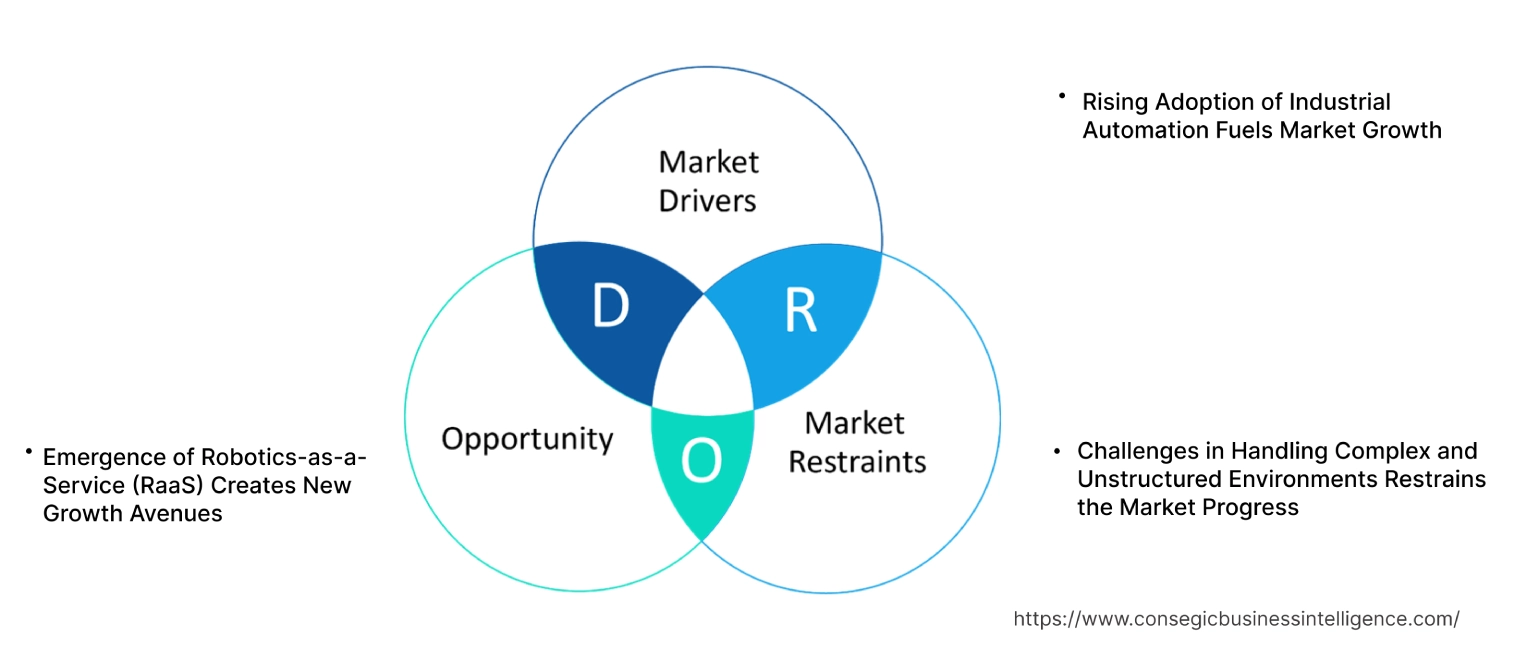
Rising Adoption of Industrial Automation Fuels Market Growth
Industries are rapidly adopting robotic systems to automate repetitive tasks, enhance operational efficiency, and minimize human involvement. Programmable robotic systems play a pivotal role by offering high flexibility and precision in tasks such as assembly, packaging, and quality inspection. Unlike traditional fixed automation systems, these robots are customized to adapt to changing production requirements, making them ideal for small-batch manufacturing and industries with dynamic workflows. Sectors such as automotive, electronics, and consumer goods are leveraging these systems to achieve faster production cycles, improved product quality, and reduced operational costs. Additionally, the integration of advanced sensors, AI, and machine learning enables robots to handle complex tasks with minimal errors, further boosting their adoption. As industrial automation trends continue to grow, the ability of programmable systems to offer scalability and customization is positioning them as essential tools for modern manufacturing environments, driving the programmable robots market growth.
Key Restraints:
Challenges in Handling Complex and Unstructured Environments Restrains the Market Progress
Programmable robots often face limitations when operating in dynamic and unstructured environments where tasks are not standardized. Unlike controlled settings, these environments present irregular variables, such as unpredictable object placement, uneven surfaces, or changing conditions, which hinder robot performance. For instance, in warehouses, construction sites, or agricultural fields, robots struggle to adapt without advanced perception systems or real-time adjustments. The lack of sophisticated AI or adaptive algorithms in some systems further exacerbates this issue, limiting their ability to function efficiently in such settings. Additionally, programming robots to handle complex, non-linear tasks demands significant time and technical expertise, increasing deployment costs. These constraints make programmable robotic systems less viable for industries requiring high versatility and adaptability, restraining their adoption in applications beyond structured manufacturing environments. Thus, the aforementioned factors limit the programmable robot market demand.
Future Opportunities :
Emergence of Robotics-as-a-Service (RaaS) Creates New Growth Avenues
The Robotics-as-a-Service (RaaS) model is transforming the adoption of robotic systems by offering flexible, subscription-based access rather than requiring significant upfront investment. This pay-as-you-go approach lowers financial barriers for small and medium-sized businesses, enabling them to leverage programmable robotic systems for tasks like manufacturing, warehousing, and logistics without heavy capital expenditures. RaaS providers also offer maintenance, software updates, and technical support, simplifying implementation for companies lacking in-house expertise. The scalability of this model allows businesses to adjust their robotic usage based on demand, making it ideal for dynamic production environments and industries with fluctuating workloads. The increasing adoption of RaaS aligns with trends in automation-as-a-service and cloud-based robotics, driving growth in industries previously hesitant to adopt robotic solutions. As this model expands, it accelerates the penetration of programmable robots into emerging sectors such as retail, agriculture, and healthcare, fostering innovation and operational efficiency. Thus, the above-mentioned factors create significant programmable robot market opportunities.
Programmable Robots Market Segmental Analysis :
By Component:
Based on components, the market is segmented into hardware and software.
The hardware segment accounted for the largest revenue of the total programmable robots market share in 2023.
- Hardware components, including sensors, actuators, controllers, and power systems, are critical for the operational efficiency of programmable robots.
- The segment benefits from technological advancements in components that enhance robot precision, speed, and reliability.
- Increased adoption of hardware solutions in industries like manufacturing and education supports the segment's strong position.
- As per segmental trend analysis, the rising focus on high-performance robotics with improved motion control and sensing capabilities further fuels this segment’s dominance, contributing to the programmable robots market expansion.
The software segment is expected to register the fastest CAGR during the forecast period.
- Software solutions enable robots to execute complex tasks with greater accuracy and adaptability, improving overall functionality.
- Integration of AI, machine learning, and IoT technologies is driving the development of advanced programming platforms for robots.
- Increasing demand for cloud-based and real-time software solutions enhances scalability and reduces programming complexity.
- As per the programmable robots market analysis, the segment's rapid growth is supported by the need for customizable solutions to address dynamic industrial and educational applications.
By End-User Industry:
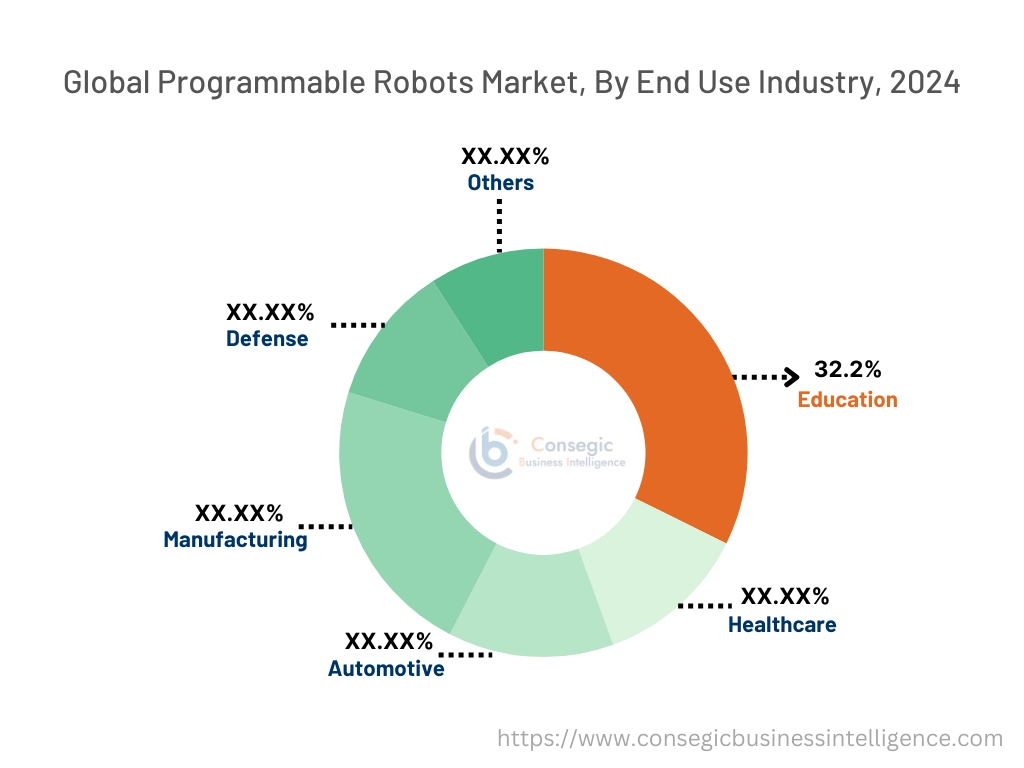
Based on end-user industry, the market is segmented into education, healthcare, automotive, manufacturing, defense, and others.
The education segment held the largest revenue of 32.2% of the total programmable robots market share in 2023.
- Programmable robots are widely adopted in STEM education to teach robotics, coding, and automation through hands-on experiences.
- Schools and universities use these robots to foster practical learning and problem-solving skills among students.
- The growth in the availability of affordable robotics kits and platforms has increased their adoption in educational institutions globally.
- As per the programmable robots market trends, government initiatives to promote technical education and equip students with future-ready skills have further strengthened this segment.
The manufacturing segment is expected to register the fastest CAGR during the forecast period.
- Programmable robots are used in industrial automation for tasks like material handling, assembly, and quality inspection, improving productivity.
- The segment benefits from the adoption of Industry 4.0 and smart factory initiatives, which prioritize automation for operational efficiency.
- Integration of robotics with advanced technologies like IoT and AI drives precision and flexibility in manufacturing processes.
- Thus, the analysis of segmental trends depicts that the rising labor costs and demand for high-output production are prompting manufacturers to invest in these robots to maintain competitiveness, fueling the programmable robots market demand.
Regional Analysis:
The regions covered are North America, Europe, Asia Pacific, the Middle East and Africa, and Latin America.
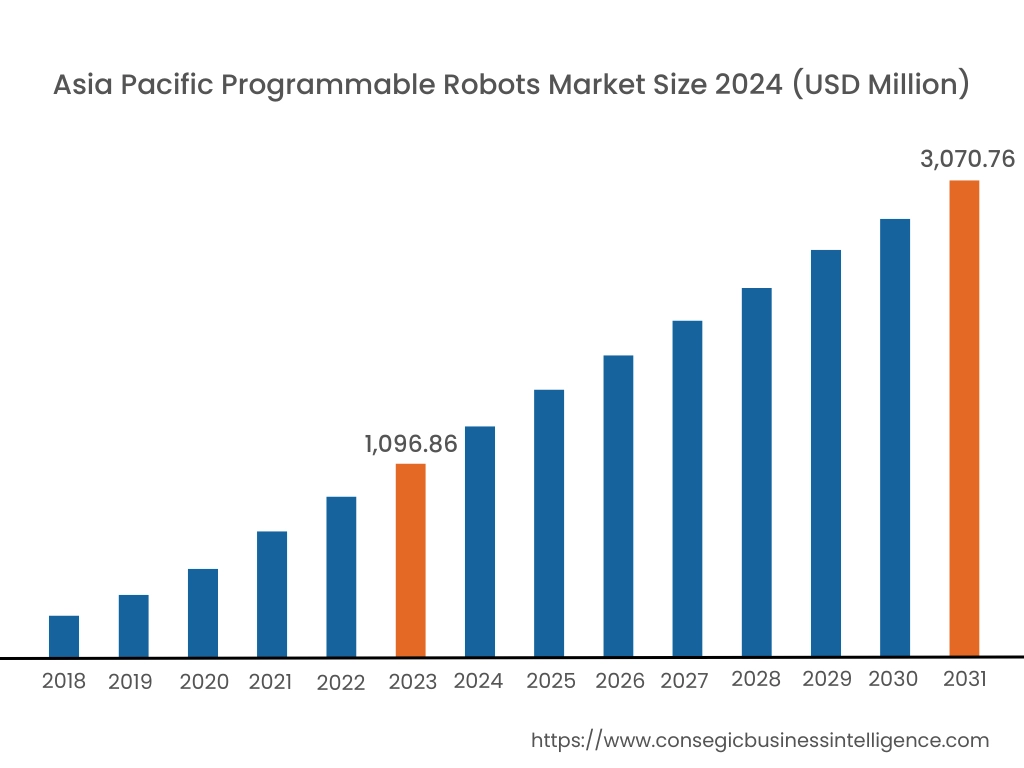
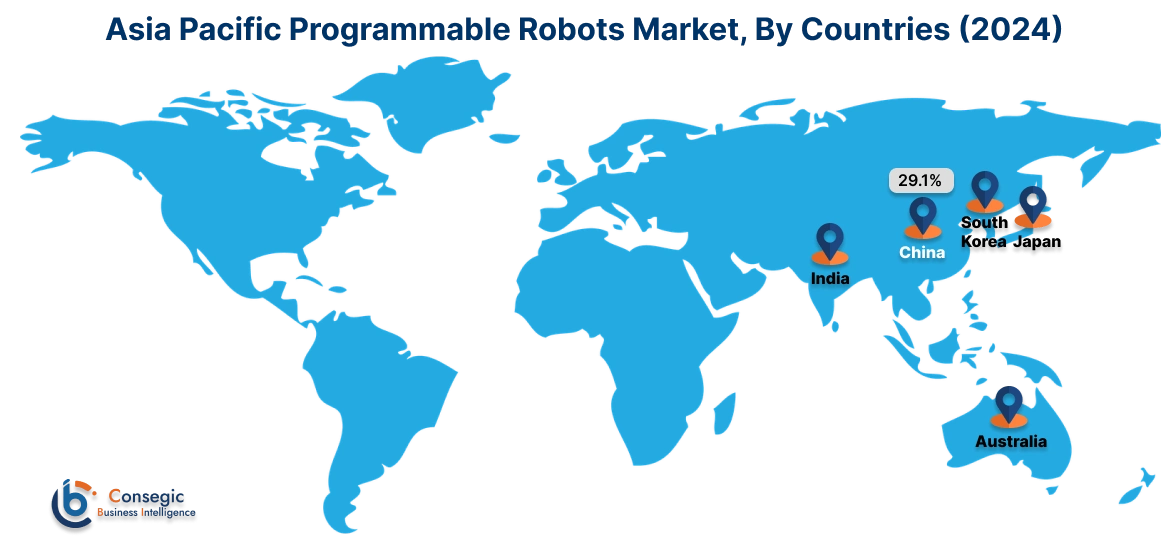
Asia Pacific region was valued at USD 1,096.86 Million in 2024. Moreover, it is projected to grow by USD 1,226.21 Million in 2025 and reach over USD 3,070.76 Million by 2032. Out of this, China accounted for the maximum revenue share of 29.1%. The Asia-Pacific region is experiencing rapid development in the programmable robots market, driven by industrialization and technological advancements in countries such as China, Japan, and South Korea. The expansion of the manufacturing sector and the rising demand for automation have intensified the need for these types of robots. Government initiatives promoting industrial efficiency further influence programmable robots market opportunities.
North America is estimated to reach over USD 3,268.42 Million by 2032 from a value of USD 1,235.40 Million in 2024 and is projected to grow by USD 1,374.57 Million in 2025. This region holds a substantial share of the programmable robots market, driven by the increasing adoption of robots for educational purposes and the integration of advanced technologies. The United States, in particular, has seen a rise in interactive learning courses incorporating these robots to enhance STEM education. A notable trend is the utilization of robots to address the shortage of computer specialists. The programmable robots market analysis indicates that the aging population is also leading to the introduction of these robots in the consumer sector.
Europe represents a significant share of the global programmable robots market, with countries like Germany, France, and the United Kingdom leading in adoption and innovation. As per the programmable robots market trends, the region's emphasis on advanced manufacturing and automation has propelled the utilization of robots in various industries. Analysis indicates a growing trend towards the deployment of robots in educational settings to promote STEM learning and address skill shortages in technology sectors.
The Middle East & Africa region shows a growing interest in advanced robotic solutions, particularly in the education and industrial sectors. Countries like the United Arab Emirates and South Africa are investing in modern technologies to enhance educational outcomes and production efficiency. Analysis suggests an increasing trend towards adopting these robots to meet international quality standards and promote technological literacy is fueling the programmable robots market expansion.
Latin America is an emerging market with Brazil and Mexico being key contributors. The region's growing focus on educational modernization and the automotive sector has spurred the adoption of advanced robotic solutions. Government policies aimed at enhancing technological capabilities influence programmable robots market growth.
Top Key Players and Market Share Insights:
The Programmable Robots market is highly competitive with major players providing products and services to the national and international markets. Key players are adopting several strategies in research and development (R&D), product innovation, and end-user launches to hold a strong position in the global Programmable Robots market. Key players in the Programmable Robots industry include -
- Furhat Robotics (Sweden)
- Sphero, Inc. (USA)
- Hatch Ltd. (Canada)
- VEX Robotics, Inc. (USA)
- Universal Robots (Denmark)
- The LEGO Group (Denmark)
- SoftBank Robotics Group (Japan)
- ABB (Switzerland)
- Robokits India (India)
- ROBOTICAL LTD. (UK)
Recent Industry Developments :
Product Launches:
- In June 2024, Sphero launched BOLT+™, the next evolution of its top educational robot. Designed for hands-on STEM and coding education, BOLT+ features a 128x128-pixel LCD screen for graphics and animations, new programming blocks, and 38 standards-aligned lessons. With wireless QI charging, improved battery life, and real-time sensor data display, BOLT+ enhances learning experiences across math, science, and language arts. Built for all programming levels, it empowers students to code creatively while supporting educators worldwide.
- In April 2023, SynSense, a leader in ultra-low-power sensory hardware, unveiled the world’s first neuromorphic programmable robot. Powered by SynSense's Speck™ chip, the robot enables human body recognition, visual perception, and mimicry, responding to gestures like waving or arm crossing. The low-power, privacy-protecting Speck™ solution allows real-time interaction without external devices, making it ideal for intelligent toys with scalable posture recognition capabilities.
Programmable Robots Market Report Insights :
| Report Attributes | Report Details |
| Study Timeline | 2019-2032 |
| Market Size in 2032 | USD 10,084.60 Million |
| CAGR (2025-2032) | 13.3% |
| By Component |
|
| By End-User Industry |
|
| By Region |
|
| Key Players |
|
| North America | U.S. Canada Mexico |
| Europe | U.K. Germany France Spain Italy Russia Benelux Rest of Europe |
| APAC | China South Korea Japan India Australia ASEAN Rest of Asia-Pacific |
| Middle East and Africa | GCC Turkey South Africa Rest of MEA |
| LATAM | Brazil Argentina Chile Rest of LATAM |
| Report Coverage |
|
Key Questions Answered in the Report
What is the size of the Programmable Robots Market? −
Programmable Robots Market size is estimated to reach over USD 10,084.60 Million by 2032 from a value of USD 3,724.36 Million in 2024 and is projected to grow by USD 4,151.85 Million in 2025, growing at a CAGR of 13.3% from 2025 to 2032.
What are the segments and subsegments covered in the Programmable Robots Market report? +
The market is segmented into components, end-user industries, and regions. Under components, the market is divided into hardware, which includes sensors, actuators, controllers, power systems, and software. In terms of end-user industries, the market covers education, healthcare, automotive, manufacturing, defense, and other sectors. The market is also segmented by region, which includes Asia-Pacific, Europe, North America, Latin America, and the Middle East & Africa.
Which segment is expected to grow the fastest in the Programmable Robots Market? +
The manufacturing segment is expected to register the fastest CAGR during the forecast period. This growth is driven by the adoption of programmable robots in industrial automation and smart manufacturing applications.
Who are the key players in the Programmable Robots Market? +
Key players in the Programmable Robots Market include Furhat Robotics (Sweden), Sphero, Inc. (USA), The LEGO Group (Denmark), SoftBank Robotics Group (Japan), ABB (Switzerland), Robokits India (India), ROBOTICAL LTD. (UK), Hatch Ltd. (Canada), VEX Robotics, Inc. (USA), and Universal Robots (Denmark).
Overview
Reputation & Certifications


Our Services
- Market Intelligence & Forecasting
- Custom Research Solutions
- Market Entry Strategy
- Competitive Intelligence
- Customer Insights
- Industry Innovation Analysis
- Investment Advisory